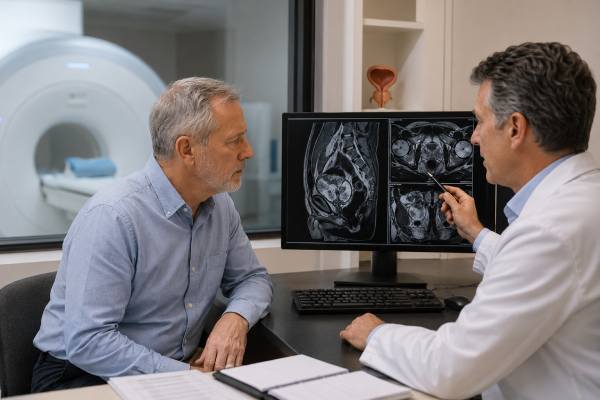
A prostate MRI is an imaging test that gives a detailed look at the prostate gland and the tissues around it. It is most often used when prostate cancer risk is unclear after a PSA blood test, digital rectal exam, previous biopsy, or ongoing monitoring. Unlike a PSA test, MRI does not diagnose cancer by itself. It helps show whether there is a suspicious area, where that area is, how large it looks, and whether a targeted biopsy may be needed.
For many men, the hardest part is understanding what the report means. Terms like PI-RADS, lesion, restricted diffusion, prostate volume, and extracapsular extension can sound more alarming than they are. A good MRI report should help your urologist decide whether to watch, repeat testing, biopsy a specific spot, or plan treatment if cancer has already been found.
Table of Contents
- What a Prostate MRI Shows
- When Doctors Order Prostate MRI
- How the Scan Is Done
- How to Read PI-RADS Results
- How MRI Results Affect Biopsy Decisions
- What MRI Can and Cannot Rule Out
- What Happens After the Report
- Questions to Ask Your Doctor
What a Prostate MRI Shows
A prostate MRI shows the size, shape, zones, and internal texture of the prostate. It also looks for areas that behave differently from normal prostate tissue. These areas may be called lesions, findings, nodules, or regions of interest.
The prostate has different zones. Many prostate cancers begin in the peripheral zone, which sits toward the back of the gland near the rectum. Benign prostate enlargement usually starts in the transition zone, which surrounds the urethra. MRI helps separate these areas better than a standard ultrasound.
A typical report may include:
- Prostate volume, often measured in milliliters or cubic centimeters
- PSA density, which compares PSA level with prostate size
- Suspicious lesions, with location and size
- PI-RADS score for each suspicious lesion
- Signs of benign enlargement, inflammation, bleeding, or scarring
- Whether a suspicious area appears limited to the prostate
- Whether there are concerning lymph nodes or nearby bone findings
MRI is different from a PSA test. PSA is a blood marker made by prostate tissue. It can rise because of cancer, but it can also rise from benign prostate enlargement, inflammation, infection, recent ejaculation, urinary retention, or prostate procedures. MRI gives an image-based view of the gland, which can help explain why a PSA is high or whether a biopsy should target a specific area.
MRI can also help measure prostate volume. This matters because a large benign prostate can make PSA look higher than expected. PSA density is calculated by dividing PSA by prostate volume. For example, a PSA of 6 in a very large prostate may be less concerning than a PSA of 6 in a small prostate, although the full risk picture still matters.
MRI does not replace a biopsy when tissue diagnosis is needed. Cancer is confirmed by looking at prostate tissue under a microscope. MRI helps decide whether a biopsy is needed and where the biopsy needles should go.
When Doctors Order Prostate MRI
MRI is usually considered when prostate cancer risk remains uncertain after initial testing. It is not normally the first test for every urinary symptom, and it is not a routine scan for all men.
Common reasons include:
- PSA is elevated, rising, or higher than expected for prostate size
- A digital rectal exam feels abnormal
- A previous biopsy was negative, but suspicion remains
- A man is considering an initial biopsy
- Prostate cancer has already been diagnosed and more detail is needed
- A man on active surveillance needs monitoring
- The doctor needs to plan a targeted biopsy, surgery, radiation, or focal treatment
A high PSA by itself does not always mean cancer. Men with an enlarged prostate, prostatitis, recent urinary retention, or recent prostate manipulation can have elevated PSA. When PSA is unexpected or keeps rising, doctors may repeat the test under cleaner conditions, check risk factors, use additional blood or urine markers, or order MRI. The next step depends on age, family history, race, prior biopsy results, prostate size, PSA pattern, and personal preferences. A more detailed discussion of PSA follow-up is covered in high PSA causes and next steps.
MRI can be especially useful before a repeat biopsy. If a man had a standard biopsy that found no cancer, but PSA keeps rising, MRI may show a lesion that was missed. Some lesions are in areas that are harder to sample with a standard biopsy pattern, such as the front part of the prostate.
MRI is also used after prostate cancer has already been found. In that setting, the scan may help estimate whether cancer looks confined to the prostate or whether it may be near the capsule, seminal vesicles, or nearby structures. This information can affect treatment planning, but MRI is only one part of staging. Doctors also use biopsy grade, PSA, exam findings, and sometimes other scans.
MRI is not usually ordered just because a man has urinary frequency, a weak stream, or nighttime urination. Those symptoms are more often related to benign prostate enlargement, bladder overactivity, medications, or infection. When the concern is whether symptoms point more toward BPH or cancer, a urologist may start with PSA, urine testing, exam, symptom scoring, bladder scan, or ultrasound. The difference is explained more clearly in BPH vs prostate cancer.
How the Scan Is Done
Most prostate MRIs are done while you lie on your back inside a tube-shaped scanner. The test usually takes about 20 to 45 minutes, depending on the protocol, scanner, and whether contrast is used. You need to stay still because movement can blur the images.
Many centers use multiparametric MRI, often shortened to mpMRI. “Multiparametric” means the scan uses several types of MRI images, not just one view. The main parts are:
- T2-weighted images, which show prostate anatomy in detail
- Diffusion-weighted images, which show how water moves through tissue
- ADC maps, which are processed images related to diffusion
- Dynamic contrast-enhanced images, which show how tissue takes up contrast dye over time
Some centers use biparametric MRI, which usually means T2-weighted and diffusion-weighted imaging without contrast. This can shorten the test and avoid contrast dye. Whether that is appropriate depends on the center’s protocol, the reason for the scan, image quality, and local expertise.
Contrast dye, when used, is usually gadolinium-based and given through an IV. It is not the same as iodine contrast used in many CT scans. Many people tolerate gadolinium well, but your care team may ask about kidney disease, previous contrast reactions, pregnancy, or implanted devices.
Before the scan, you may be asked to:
- Remove metal objects, watches, cards, and jewelry
- Tell the staff about pacemakers, implants, clips, or metal fragments
- Avoid heavy meals shortly before the test if your center recommends it
- Use a small enema if the imaging center requires it
- Tell the staff if you are claustrophobic
- Bring prior PSA results, biopsy reports, or earlier MRI images if requested
Some older prostate MRI protocols used an endorectal coil, which is a device placed in the rectum to improve image quality. Many modern scanners can produce good images with external coils, so an endorectal coil is less common in many centers. If your imaging center uses one, ask what to expect and whether it is necessary in your case.
The scan itself should not hurt. You may hear loud knocking sounds, so ear protection is usually provided. If you have trouble lying still, back pain, anxiety, or claustrophobia, tell the imaging team before the appointment. Some men need medication for anxiety, but that requires planning because you may need someone to drive you home.
How to Read PI-RADS Results
PI-RADS is a scoring system radiologists use to describe how suspicious a prostate MRI finding looks for clinically significant prostate cancer. Clinically significant usually means cancer that is more likely to need treatment or close monitoring, often Grade Group 2 or higher.
PI-RADS does not say for certain whether cancer is present. It estimates the chance that a suspicious area could be clinically significant cancer. The biopsy, not the MRI, confirms the diagnosis.
| PI-RADS score | Usual meaning | Common next step |
|---|---|---|
| PI-RADS 1 | Very low suspicion | Follow PSA and risk factors; biopsy often not needed right away unless risk is high |
| PI-RADS 2 | Low suspicion | Usually monitoring, repeat PSA, or other risk checks |
| PI-RADS 3 | Intermediate or uncertain suspicion | Decision depends on PSA density, family history, prior biopsy, and other risk factors |
| PI-RADS 4 | High suspicion | Targeted biopsy is commonly recommended |
| PI-RADS 5 | Very high suspicion | Targeted biopsy is usually recommended, often with systematic sampling |
A report may list more than one lesion. Each lesion can have its own PI-RADS score. The highest-scoring lesion often drives the next step, but location, size, PSA density, and previous biopsy history also matter.
PI-RADS 3 is the gray zone. Some PI-RADS 3 lesions turn out to be harmless enlargement or inflammation. Others contain cancer. Doctors often look at PSA density, lesion size, whether the lesion is in the peripheral or transition zone, and whether the PSA is rising. A man with PI-RADS 3, low PSA density, and no major risk factors may be monitored. A man with PI-RADS 3 plus high PSA density, strong family history, or prior abnormal biopsy may be advised to have a biopsy.
Other report terms can also matter:
- Lesion: an area that looks different from nearby tissue
- Restricted diffusion: a signal pattern that can be seen with cancer but also with some inflammation
- Prostate volume: gland size, used to help interpret PSA
- Extracapsular extension: concern that cancer may extend beyond the prostate capsule
- Seminal vesicle invasion: concern that cancer may involve the glands behind the prostate
- Lymphadenopathy: enlarged or suspicious lymph nodes
- Post-biopsy hemorrhage: blood products after biopsy, which can affect image quality
Benign findings are common. BPH nodules, prostatitis, scarring, calcifications, cysts, and prior biopsy changes can all appear on MRI. A good radiology report should separate clearly suspicious findings from common noncancer changes.
How MRI Results Affect Biopsy Decisions
MRI often changes biopsy planning. Instead of sampling the prostate in a standard pattern only, doctors can target the suspicious lesion seen on MRI. This may improve the chance of finding clinically significant cancer while reducing the detection of very small, low-risk cancers that may never cause harm.
There are several biopsy approaches:
- MRI-targeted biopsy: samples are aimed at the lesion seen on MRI
- Systematic biopsy: samples are taken from standard regions of the prostate
- Combined biopsy: both targeted and systematic samples are taken
- Transrectal biopsy: the needle passes through the rectal wall
- Transperineal biopsy: the needle passes through the skin between the scrotum and anus
Many urologists use combined biopsy when MRI shows a suspicious lesion, especially PI-RADS 4 or 5. The targeted samples focus on the visible lesion, while systematic samples check the rest of the gland. This matters because MRI can miss some cancers, and not every important tumor is clearly visible.
A prostate biopsy is usually considered when MRI shows a suspicious lesion or when risk remains high despite a negative MRI. Risk may remain high because of a fast-rising PSA, high PSA density, abnormal rectal exam, strong family history, inherited cancer mutations, or concerning prior biopsy findings.
A negative MRI may help some men avoid immediate biopsy. This is more likely when the PSA pattern is stable, PSA density is low, the rectal exam is normal, and there are no strong risk factors. Avoiding or delaying biopsy can reduce infection risk, bleeding, pain, anxiety, and overdiagnosis. It also means follow-up needs to be reliable.
MRI is not a shortcut around clinical judgment. A man with a very concerning PSA pattern may still need biopsy even if the MRI is PI-RADS 1 or 2. A man with a PI-RADS 3 lesion may not need biopsy right away if the rest of the risk picture is low. The result should be interpreted with the whole case, not as a single yes-or-no answer.
What MRI Can and Cannot Rule Out
A negative MRI lowers the chance of clinically significant prostate cancer, but it does not make the chance zero. Small tumors, lower-volume cancers, lesions hidden by inflammation, and image-quality problems can lead to missed findings. Reader experience also matters.
MRI is strongest when it is done with a good scanner, a high-quality prostate protocol, and radiologists who read prostate MRI regularly. Poor bowel preparation, motion during the scan, hip replacement artifacts, bleeding after a recent biopsy, or technical limits can make the report less reliable.
False positives also happen. Inflammation, recent infection, BPH nodules, scarring, or bleeding can look suspicious. This is one reason MRI cannot diagnose cancer by itself. A PI-RADS 4 lesion is concerning, but it is still possible for biopsy to show benign tissue, prostatitis, or atypical cells rather than cancer.
MRI also cannot answer every prostate question. It may not fully explain pelvic pain, painful ejaculation, chronic prostatitis symptoms, or urinary urgency. Those problems may need urine testing, STI testing, bladder evaluation, pelvic floor assessment, or other exams. When symptoms include pelvic pain, burning, ejaculation pain, or urinary discomfort, conditions such as chronic prostatitis may need a separate workup.
MRI is only one part of cancer staging. If biopsy shows higher-risk cancer, doctors may order additional imaging, such as PSMA PET, CT, bone scan, or other tests depending on the grade, PSA, and risk group. A prostate MRI looks closely at the prostate and nearby area, but it is not always enough to check the whole body.
A “normal” MRI also does not mean PSA should be ignored forever. Follow-up may include repeat PSA, PSA density review, free PSA, newer biomarkers, repeat MRI, or biopsy if risk changes. If PSA stays elevated, a discussion of free PSA versus total PSA may help clarify why additional testing is being considered.
What Happens After the Report
The next step depends on the MRI score, PSA pattern, prostate size, age, health status, prior biopsy results, and personal risk. The same PI-RADS score does not always lead to the same plan for every man.
For PI-RADS 1 or 2, many men are monitored with repeat PSA and clinical follow-up. If PSA density is low and risk factors are limited, a urologist may recommend watching rather than biopsy. If PSA keeps rising or the rectal exam is abnormal, further testing may still be needed.
For PI-RADS 3, the plan is more individualized. Doctors may consider PSA density, lesion size, family history, race, prior biopsy findings, and patient preference. Some men have a targeted biopsy. Others repeat PSA or MRI after a set interval. The goal is to avoid unnecessary biopsy without ignoring a meaningful risk.
For PI-RADS 4 or 5, biopsy is commonly recommended. The biopsy report, not the MRI, determines whether cancer is present and how aggressive it appears. If cancer is found, the pathology report usually includes Gleason score or Grade Group. Grade Group 1 is often considered low risk, while higher Grade Groups are more concerning.
If low-risk cancer is found, immediate treatment is not always needed. Some men choose active surveillance, which may include PSA monitoring, repeat MRI, repeat biopsy, and regular urology visits. If cancer appears more aggressive, treatment options may include surgery, radiation, hormone therapy, or combinations. Treatment planning is covered more fully in prostate cancer treatment options.
If the MRI was done for active surveillance, the doctor compares it with previous scans. A stable lesion may support continued monitoring. A growing lesion, higher PI-RADS score, rising PSA density, or new suspicious area may lead to repeat biopsy.
If the MRI suggests cancer may extend beyond the prostate, doctors may use the scan when discussing surgery margins, radiation fields, nerve-sparing decisions, or whether additional imaging is needed. These decisions depend heavily on biopsy grade and overall risk group.
Men sometimes feel stuck when the report says “equivocal,” “indeterminate,” or “clinical correlation recommended.” These phrases usually mean the radiologist cannot make the next decision from images alone. The urologist needs to match the MRI with PSA, exam findings, history, and risk factors.
Questions to Ask Your Doctor
The best MRI discussion is specific. A general statement like “your MRI is abnormal” is not enough to understand the risk or the next step.
Useful questions include:
- What is my highest PI-RADS score?
- How many suspicious lesions were found?
- Where is the lesion located?
- What is my prostate volume?
- What is my PSA density?
- Does the MRI explain my PSA level?
- Do you recommend biopsy now, repeat testing, or monitoring?
- If biopsy is needed, will it be targeted, systematic, or both?
- Do you recommend a transperineal or transrectal approach?
- If the MRI is negative, how often should PSA be repeated?
- What changes would make you recommend biopsy later?
- Does the scan show signs of BPH, prostatitis, or other benign findings?
- Was the image quality good enough to trust the result?
- Should my MRI be reviewed by a prostate MRI specialist?
- How does this result fit my age, family history, and overall health?
It is reasonable to ask for a copy of the MRI report. Many reports are written for doctors, not patients, so some wording may sound blunt or technical. Ask your urologist to point out the most important lines: PI-RADS score, lesion size, location, prostate volume, PSA density, and whether there are signs of spread.
If you are deciding whether to have prostate cancer screening in the first place, MRI usually comes later in the process. Screening starts with a discussion of age, risk factors, PSA testing, possible benefits, false alarms, and the chance of finding a low-risk cancer. That broader decision is covered in prostate cancer screening.
You should seek prompt medical care if you have inability to urinate, fever with urinary symptoms, severe pelvic pain, new bone pain with known prostate cancer, or blood in the urine with clots. These symptoms are not handled by waiting for a routine MRI follow-up.
References
- Early Detection of Prostate Cancer: AUA/SUO Guideline 2026 (Guideline)
- EAU-EANM-ESTRO-ESUR-ISUP-SIOG Guidelines on Prostate Cancer—2024 Update. Part I: Screening, Diagnosis, and Local Treatment with Curative Intent 2024 (Guideline)
- Early Detection of Prostate Cancer: AUA/SUO Guideline Part II 2023 (Guideline)
- Biparametric vs Multiparametric MRI for Prostate Cancer Diagnosis: The PRIME Diagnostic Clinical Trial 2025 (Clinical Trial)
- Prostate Imaging Reporting and Data System 2024 (Official Resource)
- MRI-Targeted or Standard Biopsy in Prostate Cancer Screening 2021 (RCT)
Disclaimer
This article is for education about prostate MRI, PSA follow-up, and prostate cancer evaluation. It should not replace care from a qualified clinician who can review your PSA history, exam findings, MRI images, biopsy history, medications, and personal risk factors. Contact a healthcare professional promptly for severe urinary symptoms, fever, new severe pain, or concerning bleeding.