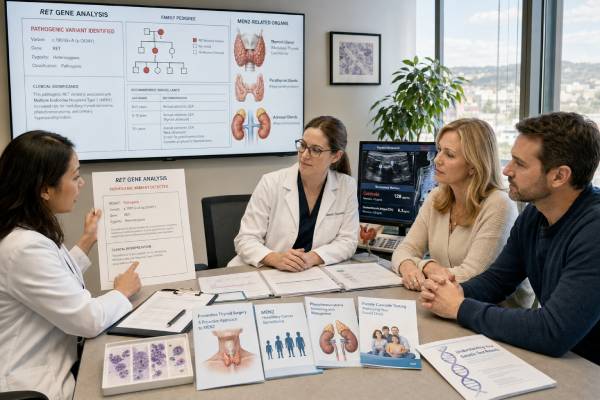
A germline RET genetic test looks for an inherited activating variant that causes multiple endocrine neoplasia type 2, or MEN2. MEN2 creates a high risk of medullary thyroid carcinoma and can also cause pheochromocytoma, primary hyperparathyroidism, and characteristic findings that vary by subtype. Because the age and aggressiveness of thyroid disease are strongly related to the specific RET codon, the result can guide the timing of thyroid surgery, biochemical screening, and testing of relatives.
Testing is usually performed on blood or saliva. It should be offered to people with medullary thyroid cancer, those with clinical features of MEN2, and relatives of a person with a known germline RET variant. A positive result does not mean every associated tumor is already present, but it does require a coordinated endocrine plan. Before any thyroid operation in a person who may have MEN2, clinicians must evaluate for pheochromocytoma because an unrecognized catecholamine-secreting tumor can cause a dangerous surgical crisis.
- A pathogenic germline RET variant confirms MEN2 or hereditary medullary thyroid cancer predisposition.
- Nearly every person with medullary thyroid carcinoma should be offered germline RET testing, even without a family history.
- The exact RET codon helps determine thyroid-cancer risk category and the timing of preventive or early thyroid surgery.
- Pheochromocytoma must be excluded before thyroid or parathyroid surgery in a RET carrier.
- Each child of a nonmosaic carrier has a 50% chance of inheriting the familial RET variant.
Table of Contents
- How RET Causes MEN2
- Who Needs Germline RET Testing
- How the Test Is Done
- Understanding RET Results
- Genotype Risk and Thyroid Surgery
- Screening for Other MEN2 Tumors
- Family Testing and Reproductive Options
- Limitations and Care Coordination
How RET Causes MEN2
RET encodes a receptor tyrosine kinase involved in cell growth, migration, and development. In MEN2, a germline gain-of-function variant keeps RET signaling more active than it should be. This is different from the loss-of-function mechanism seen in many tumor-suppressor syndromes. One altered copy is enough to create predisposition, so MEN2 follows an autosomal dominant inheritance pattern.
MEN2 is divided into overlapping clinical groups:
- MEN2A commonly includes medullary thyroid carcinoma, pheochromocytoma, and primary hyperparathyroidism. Some variants are also associated with cutaneous lichen amyloidosis or Hirschsprung disease.
- MEN2B is usually caused by a specific high-risk variant, most often p.Met918Thr. It is associated with very early and aggressive medullary thyroid carcinoma, pheochromocytoma, mucosal neuromas, intestinal ganglioneuromatosis, and a marfanoid body habitus. Hyperparathyroidism is not typical.
- Familial medullary thyroid carcinoma was historically used for families in which medullary thyroid cancer dominated without clear pheochromocytoma or hyperparathyroidism. Many experts now consider it within the MEN2A spectrum because additional features may appear with age or in other relatives.
Medullary thyroid carcinoma, or MTC, begins in thyroid C cells, which produce calcitonin. It is biologically different from papillary and follicular thyroid cancers. Radioactive iodine does not target C cells, so early surgery is especially important in hereditary disease.
RET alterations can also be somatic. A RET mutation found only in an MTC tumor can guide therapy but does not by itself diagnose MEN2. Conversely, RET fusions drive some papillary thyroid and lung cancers. A RET fusion test is therefore a separate molecular test with different implications.
Who Needs Germline RET Testing
Germline testing is recommended for people with medullary thyroid carcinoma because a meaningful minority have hereditary disease despite no obvious family history. A new variant may have arisen in the person, relatives may be young or undiagnosed, or the family may be small.
Testing is also appropriate for:
- A person with pheochromocytoma plus MTC, hyperparathyroidism, mucosal neuromas, or a family history suggestive of MEN2.
- A child with MEN2B features such as mucosal neuromas, feeding or intestinal problems related to ganglioneuromatosis, and marfanoid habitus.
- A person with C-cell hyperplasia or an unexplained strong family history of MTC.
- First-degree relatives of someone with a confirmed germline RET pathogenic variant.
- A fetus, embryo, child, or adult at risk for a known familial variant when the family chooses predictive testing.
- Selected people with Hirschsprung disease when the family history or RET variant pattern suggests overlap with MEN2A.
Testing should not wait for symptoms in an at-risk child. For the highest-risk variants, clinically important thyroid disease can begin in infancy. Families with MEN2B need urgent testing and management, often within the first year of life. Other variants permit a more individualized timetable based on calcitonin, ultrasound, age, and family history, but childhood testing is still essential.
A genetic counselor should document a three-generation family history of MTC, thyroid surgery, adrenal tumors, sudden episodes of severe hypertension, hyperparathyroidism, kidney stones, and unexplained early deaths. Pathology reports matter because relatives may describe any thyroid cancer as “medullary” when it was actually papillary or follicular.
How the Test Is Done
The test generally uses DNA from blood. Saliva or a buccal sample can be acceptable, but blood may be preferred when the laboratory wants to evaluate mosaicism or obtain a high-quality sample. No fasting is needed.
Modern testing usually sequences all clinically relevant coding exons of RET rather than checking only a few common codons. Deletion and duplication analysis may be included, although classic MEN2 is overwhelmingly caused by activating sequence variants rather than whole-exon deletions. A multigene endocrine tumor panel may be ordered when the presentation includes pheochromocytoma without a known diagnosis because several other genes can cause hereditary pheochromocytoma-paraganglioma syndromes.
There are three common testing situations:
- Diagnostic germline testing in a person with MTC or MEN2 features.
- Targeted familial testing for the exact variant already identified in a relative.
- Tumor testing with germline follow-up when an MTC specimen contains a RET variant that could be inherited.
A tumor-only report cannot reliably determine inheritance. The variant allele fraction may offer a clue, but tumor purity, copy-number changes, and loss of the normal allele can distort it. Confirmatory testing of blood or another normal tissue is needed.
Turnaround time is often two to six weeks. Targeted family testing may be faster. In an infant suspected of MEN2B, the ordering team should tell the laboratory that the result is urgent because it may affect immediate surgery.
Before testing, patients should understand possible outcomes, family implications, and insurance or privacy considerations. They should also know that a positive result may lead to screening even when they feel completely well.
Understanding RET Results
RET reports classify variants as pathogenic, likely pathogenic, uncertain, likely benign, or benign. The report should use standard gene and protein notation, identify the affected codon, and describe the associated MEN2 risk category when evidence supports it.
Pathogenic or likely pathogenic
This result confirms inherited RET-related tumor predisposition. In a person with MTC, it establishes hereditary disease. In an unaffected relative, it predicts a high enough risk to justify syndrome-specific management.
The result should trigger:
- Referral to an endocrinologist and thyroid surgeon familiar with MEN2.
- Calcitonin and carcinoembryonic antigen evaluation when age-appropriate.
- Thyroid ultrasound as part of the clinical assessment, recognizing that normal imaging does not eliminate microscopic MTC.
- Screening for pheochromocytoma before any planned surgery.
- Assessment for hyperparathyroidism according to the variant and age.
- Targeted testing for relatives.
“Likely pathogenic” is generally managed like “pathogenic.” It does not mean the cancer risk is merely possible; it means the evidence for disease causation is strong but not absolute.
Negative
A true negative for a known familial variant usually means the person did not inherit MEN2 and does not need RET-specific surveillance. Their care reverts to risks based on their own history.
A negative result in someone with apparently sporadic MTC means no germline RET variant was identified. The tumor may still have a somatic RET alteration, and the person still needs standard MTC treatment and follow-up. Rare technical limitations, mosaicism, or another genetic cause may be considered when clinical suspicion remains high.
Variant of uncertain significance
A VUS should not determine prophylactic thyroidectomy or predictive testing of healthy children by itself. Management should rely on calcitonin, pathology, clinical findings, and family history while the variant is investigated. Expert review may consider population frequency, functional studies, location in the RET protein, segregation, and prior observations in MEN2.
A VUS can be reclassified. Patients should keep the report and maintain contact with the genetics clinic. The broad principles described for a genetic variant test result are especially important when a surgical decision is being considered.
Mosaic result
A low-level variant can indicate mosaic MEN2, though this is uncommon. Risk depends on which tissues carry the alteration, and transmission risk may be below or near 50%. Confirmation with a second tissue and specialist laboratory review is appropriate.
MEN2A and MEN2B share medullary thyroid cancer risk but often look different. MEN2A commonly includes pheochromocytoma and primary hyperparathyroidism, with penetrance influenced by the RET codon. Some families have cutaneous lichen amyloidosis or Hirschsprung disease. MEN2B is usually associated with a particularly aggressive, very early medullary thyroid cancer risk, mucosal neuromas, thickened lips, intestinal ganglioneuromatosis, and a marfanoid body habitus. Many MEN2B cases arise de novo, so absence of family history is common.
These patterns help clinicians recognize an urgent case, but genetic testing remains decisive. A child with suspected MEN2B should not wait for every physical feature to appear before testing and specialty referral. Likewise, a person with apparently sporadic medullary thyroid cancer should receive germline RET evaluation because family history alone cannot reliably separate inherited from non-inherited disease.
Genotype Risk and Thyroid Surgery
The exact RET variant is unusually important because genotype correlates with the typical age and aggressiveness of MTC. Professional guidelines group variants into risk categories. The highest-risk category includes p.Met918Thr, the classic MEN2B variant. Some cysteine-codon variants, particularly codon 634, carry high risk and are also strongly associated with pheochromocytoma and hyperparathyroidism. Other variants often have later average onset, but individual variation remains substantial.
Risk categories guide rather than replace clinical judgment. The decision about thyroidectomy considers:
- The exact RET codon and evidence for that variant.
- The child’s age.
- Basal or stimulated calcitonin, interpreted with age-appropriate laboratory ranges.
- Thyroid ultrasound findings.
- Family history of the age and behavior of MTC.
- Availability of an experienced pediatric thyroid surgeon.
- The risks of permanent hypoparathyroidism and recurrent laryngeal nerve injury.
For MEN2B, thyroidectomy is generally recommended very early, often in infancy, because MTC can develop rapidly. For other variants, the operation may occur in early childhood or be timed using genotype, calcitonin, and close monitoring. Delaying surgery requires reliable follow-up; a normal ultrasound alone is not enough because microscopic C-cell disease may be invisible.
The term prophylactic thyroidectomy can be misleading. In some carriers, microscopic C-cell hyperplasia or MTC is already present when the thyroid is removed. The purpose is to operate before disease spreads, when surgery has the best chance to cure.
A high calcitonin level suggests a larger C-cell burden but can be affected by age, assay, kidney function, medications, and other conditions. Trends and the laboratory’s reference interval matter. Carcinoembryonic antigen is used mainly in established MTC rather than as a stand-alone screening test.
Neck lymph-node surgery is not automatic for every asymptomatic carrier. It depends on calcitonin, imaging, operative findings, and established MTC guidelines. Surgery at a high-volume center is important because the child will require lifelong thyroid hormone replacement and careful calcium monitoring afterward.
Before thyroidectomy or another major operation, clinicians must evaluate for pheochromocytoma. An unrecognized catecholamine-secreting tumor can trigger a dangerous hypertensive crisis during anesthesia or surgery. When pheochromocytoma and medullary thyroid cancer are both present, the adrenal condition is usually stabilized and treated first. Plasma free metanephrines or urinary fractionated metanephrines are commonly used, followed by imaging when biochemistry is abnormal.
Pregnancy also requires planning. A carrier who is pregnant or considering pregnancy should review pheochromocytoma screening, blood pressure, thyroid status, and prior surgery with endocrinology and maternal-fetal medicine. Symptoms such as episodic severe headache, palpitations, sweating, or marked hypertension need prompt assessment rather than being attributed automatically to pregnancy.
Screening for Other MEN2 Tumors
MEN2 management extends beyond the thyroid. Pheochromocytomas arise in the adrenal medulla and can release catecholamines, causing episodic headache, sweating, palpitations, tremor, anxiety, or sustained or paroxysmal hypertension. Some are silent.
Biochemical screening commonly uses plasma free metanephrines or urinary fractionated metanephrines. The starting age and interval depend on the RET variant category and family history. Abnormal results lead to imaging and endocrine evaluation. Screening must occur before thyroidectomy, parathyroid surgery, pregnancy planning, or other major procedures because anesthesia can provoke a life-threatening catecholamine crisis in an undiagnosed tumor.
Primary hyperparathyroidism is more common in MEN2A, especially with certain variants. Screening may include albumin-adjusted or ionized calcium and parathyroid hormone. Symptoms can include kidney stones, bone loss, abdominal complaints, fatigue, or no symptoms at all. Management is individualized because multigland disease and recurrence can occur.
MEN2B can involve mucosal neuromas of the lips, tongue, and eyelids, thickened corneal nerves, intestinal ganglioneuromatosis, constipation or diarrhea, feeding problems, and a marfanoid habitus. These findings may precede MTC and should prompt urgent genetic evaluation.
Some MEN2A families have cutaneous lichen amyloidosis, often an itchy patch over the upper back, or Hirschsprung disease. These findings do not replace biochemical surveillance but can help identify relatives who have not yet been tested.
After thyroidectomy for MTC or C-cell disease, follow-up uses calcitonin and carcinoembryonic antigen trends, neck imaging when indicated, and assessment for distant disease if markers remain elevated. A positive RET result does not change the need for standard cancer staging; it adds hereditary surveillance and family management.
For advanced RET-mutant MTC requiring systemic therapy, selective RET inhibitors may be options. Tumor response does not remove the inherited predisposition or the need to screen for pheochromocytoma and hyperparathyroidism.
Family Testing and Reproductive Options
MEN2 is autosomal dominant. Each child of a person with a constitutional pathogenic RET variant has a 50% chance of inheriting it. Men and women can transmit the variant equally. Severity can differ even among relatives with the same codon.
Once a variant is known, targeted testing is preferred over repeating a broad panel. The priority is often:
- Children, because management may be time-sensitive.
- Siblings and parents of the affected person.
- More distant relatives on the side of the family shown to carry the variant.
If neither parent carries the variant in blood, it may be de novo. This is common in MEN2B. Sibling risk is then low but not zero because parental gonadal mosaicism is possible. The affected person’s own future children remain at risk.
Testing of minors is appropriate because early intervention can prevent metastatic MTC. The process should include age-appropriate explanation and psychological support. A child who tests negative for the known familial variant can avoid repeated endocrine tests and surgery related to MEN2.
Reproductive options include natural conception, prenatal diagnosis through chorionic villus sampling or amniocentesis, and in vitro fertilization with preimplantation genetic testing for monogenic disease. Prenatal testing shows whether the fetus inherited the variant but cannot predict every feature or exact age of onset. Some families use the result to plan delivery near an expert center, while others use it in pregnancy decision-making.
A written family letter should include the exact RET variant and the urgency of testing children. Verbal messages such as “thyroid cancer runs in the family” are not specific enough to guide care.
After thyroid surgery, follow-up does not end with removal of the gland. Calcitonin and carcinoembryonic antigen are monitored to assess biochemical response and possible persistent or recurrent medullary thyroid cancer. Trends and doubling times can be more informative than one isolated value. Neck imaging or broader staging may be needed when markers remain detectable or rise. Lifelong thyroid hormone replacement is required after total thyroidectomy, with dosing adjusted for age, growth, pregnancy, and other health conditions.
A prophylactic operation performed before cancer develops can be curative, but the recommended age is variant specific. Family members should not copy the timing used for another relative without confirming that they carry the same pathogenic variant and reviewing current guidance.
Limitations and Care Coordination
Although RET testing is highly sensitive, no assay is perfect. Low-level mosaicism, rare regulatory variants, sample mix-ups, and incomplete older tests can produce unresolved cases. A person tested years ago only for a few “hotspot” codons may deserve full-gene testing if the phenotype is convincing.
Genotype-phenotype correlations are strong at a group level but cannot predict one person’s exact course. Relatives with the same variant can have different ages of MTC, different pheochromocytoma histories, and different calcium findings. Surveillance cannot be abandoned because older relatives appeared mildly affected.
Care works best when one team maintains a written schedule for:
- Thyroid surgery or postoperative MTC follow-up.
- Pheochromocytoma biochemical testing.
- Calcium and parathyroid assessment.
- Blood-pressure review.
- Pregnancy planning and preoperative clearance.
- Testing of relatives.
- Periodic reinterpretation of uncertain results.
Before any operation, the surgical and anesthesia teams should be told about the RET result. “Rule out pheochromocytoma first” is one of the most important safety principles in MEN2.
Patients should keep copies of the laboratory report, operative note, thyroid pathology, calcitonin and CEA trends, adrenal imaging, and family letter. These records allow future clinicians to distinguish germline MEN2 from a tumor-only RET alteration and to avoid repeating expensive testing.
A current medication list is also important because several drugs and supplements can affect blood pressure, heart rate, or biochemical testing. The endocrine team should provide preparation instructions before metanephrine sampling.
References
- Multiple Endocrine Neoplasia Type 2 2023 (Review)
- Multiple Endocrine Neoplasia Type 2 (MEN2) (PDQ®)–Health Professional Version 2025 (Official Review)
- Multiple endocrine neoplasia type 2: A review 2022 (Review)
- Revised American Thyroid Association Guidelines for the Management of Medullary Thyroid Carcinoma 2015 (Guideline)
- Genomic testing for RET in the clinic: UK and global perspective 2025 (Review)
- Efficacy and Safety of Selpercatinib in Patients With RET-Activated Thyroid Cancer: Long-Term Safety and Efficacy From LIBRETTO-001 2024 (Clinical Trial)
Disclaimer
This article is educational and does not replace evaluation by a clinical geneticist, endocrinologist, or experienced thyroid surgeon. The timing of testing, surgery, and surveillance depends on the exact RET variant, age, calcitonin results, family history, and current guidelines. A possible RET carrier must be evaluated for pheochromocytoma before thyroid, parathyroid, or other major surgery.