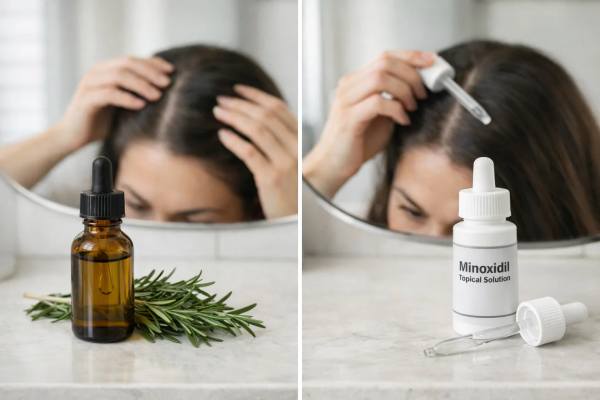
Rosemary oil and minoxidil are often discussed as if they belong in the same evidence tier. They do not. Both are used on the scalp, both are linked to hair-growth claims, and both can irritate sensitive skin, but one is a standardized drug with a long clinical track record and the other is a variable botanical ingredient with far less direct human research. That difference matters more than most comparisons admit.
If you are deciding between them, the real question is not simply which is “better.” It is which option has stronger proof for your type of hair loss, which one fits your tolerance for risk and routine, and which one you are likely to use consistently for months. Hair treatments fail in real life not only because they are weak, but because people expect results too fast, overlook scalp irritation, or choose a product that does not match the cause of their thinning.
Quick Facts
- Minoxidil has the stronger evidence base and the more predictable track record for androgenetic hair loss.
- Rosemary oil has limited but interesting evidence, with one small head-to-head trial suggesting benefit over six months.
- Neither option works quickly enough to judge in a few weeks, and both require consistent use to assess fairly.
- Scalp burning, worsening redness, swelling, or rash are reasons to stop and reassess rather than pushing through.
- If you try rosemary oil, use a diluted, patch-tested product and judge it over months, not days.
Table of Contents
- How Strong Is the Evidence
- What the Direct Comparison Actually Showed
- Results Timeline and What to Expect
- Irritation Risks and Scalp Reactions
- Which Option Fits Different Goals
- How to Use Them More Safely
How Strong Is the Evidence
The biggest mistake in the rosemary oil versus minoxidil conversation is treating them like two equally studied treatments that happen to come from different worlds. They are not. Minoxidil is a defined active drug with standardized concentrations, a long clinical history, and a large body of androgenetic alopecia research behind it. Rosemary oil is a broad botanical category. Formulas vary, concentrations vary, carriers vary, and the ingredient is often sold in multi-oil blends rather than as a tightly controlled medical product. That makes the comparison uneven before you even look at a single result.
For minoxidil, the evidence base is broad enough to support practical guidance. It has been studied in men and women, in different strengths, in foam and solution forms, and in both topical and oral versions. There are enough trials and reviews to speak with some confidence about timelines, common side effects, and the kind of density gains people may reasonably expect. That does not mean minoxidil is perfect. It means clinicians have seen the same patterns often enough to know where it fits.
Rosemary oil has a much thinner evidence base. The enthusiasm around it has grown far faster than the research. There is biologic plausibility behind the interest. Rosemary contains compounds linked to antioxidant, anti-inflammatory, and possibly antiandrogenic activity. It may also affect scalp microcirculation. Those features make it a plausible candidate for hair-loss research. But plausible is not the same as proven. Most of what people hear about rosemary oil comes from social media, beauty marketing, and repeated retellings of one direct comparison study rather than a deep pool of replicated clinical trials.
This difference in evidence quality leads to a practical conclusion: if you want the option with stronger proof, more predictable formulation, and clearer treatment pathways, minoxidil is ahead by a wide margin. If you want a more natural topical with some early supportive data but far more uncertainty, rosemary oil becomes the more speculative choice.
That uncertainty matters even more when the diagnosis is unclear. Pattern thinning is not the same as breakage, shedding after illness, traction damage, or scalp inflammation. A person who is not sure whether they have true hair loss or just more shedding needs a better frame first, which is why it often helps to review the difference between shedding and hair loss before expecting a topical product to answer the whole problem.
An honest summary is simple. Minoxidil is better established. Rosemary oil is promising but underproven. Anyone comparing the two should start there, not after the marketing has already blurred the line.
What the Direct Comparison Actually Showed
Most rosemary oil articles lean heavily on one direct human study, and it is worth understanding exactly what that study did and did not show. In the trial most often cited, 100 men with androgenetic alopecia were assigned to either rosemary oil or 2% minoxidil for six months. Hair counts were assessed at baseline, three months, and six months. The key finding was that both groups showed increased hair counts at six months, and there was no significant difference between the groups on that measure.
That result is interesting, but it needs context. First, the comparison was to 2% minoxidil, not 5% minoxidil. That matters because 5% is commonly viewed as the stronger topical option in many settings. A reader who hears “rosemary worked as well as minoxidil” may imagine it matched the most commonly recommended strength, but that is not what the trial actually tested.
Second, the study was small. One hundred participants is useful, but it is not enough to settle a treatment question on its own, especially when the field lacks multiple follow-up trials that reproduce the result. Third, the trial lasted six months. That is a fair early window for hair-growth assessment, but it is not long enough to answer the bigger question many people care about: which option holds up better over a year or longer.
There are also design limits to remember. Rosemary oil products are not standardized in the same way a drug formulation is. Even if one rosemary preparation performed reasonably in a single study, that does not mean every bottle sold online behaves the same way. This is one of the least appreciated problems in “natural remedy” comparisons. The headline reads as if rosemary oil is one thing. In reality, purity, dilution, oxidation state, added fragrance, and carrier oils can all change tolerability and possibly performance.
The study did include one detail that people notice: scalp itching was reported more often in the minoxidil group. That finding is meaningful, but it should not be overstated. It does not prove rosemary oil is broadly non-irritating. It only suggests that in that particular comparison, the minoxidil group had more itch complaints. Rosemary can still irritate, especially in concentrated or fragranced formulas.
So what should the study actually do for your decision-making? It should encourage nuance, not hype. It supports the idea that rosemary deserves interest and further research. It does not justify treating rosemary as a plug-and-play replacement for standard therapy, especially for clearly progressive androgenetic loss.
This is where many readers benefit from taking one step back and looking at the broader menu of male pattern baldness treatment options or parallel female pattern treatment strategies. Once you do that, the study looks less like a final verdict and more like one useful but limited piece of a much bigger treatment puzzle.
Results Timeline and What to Expect
Hair grows slowly enough that impatience ruins a lot of otherwise reasonable treatment trials. This is true for minoxidil, and it is just as true for rosemary oil. If you judge either option after two or three weeks, you are mostly judging scalp feel, not hair growth.
With topical minoxidil, many people need at least 3 to 4 months before they can begin to judge meaningful change, and a fuller assessment often takes 6 to 12 months. Early in treatment, some users notice extra shedding. That can be alarming, but it does not automatically mean the product is failing. In many cases, it reflects a shift in follicle cycling. The confusing part is that this “worse before better” phase happens just when people are already anxious about losing more hair. Understanding the minoxidil shedding phase can make the difference between staying consistent and quitting too early.
Rosemary oil follows a similar patience rule, though the evidence is much thinner. In the best-known direct comparison study, neither group showed a significant hair-count change at three months, while both groups improved at six months. That alone should reset expectations. If rosemary helps, it is not likely to behave like an overnight rescue. It is a slow-burn experiment, not a two-week scalp hack.
The timeline question is really two questions at once:
- How long before you might notice less shedding or better texture?
- How long before you can fairly judge visible density change?
The first can happen earlier, but it is less reliable because hair feel, shine, reduced breakage, and styling changes can all create the impression of improvement. The second is more important, and it generally takes months. That is why monthly photos under the same lighting are more useful than day-to-day mirror checks.
A fair expectation framework looks like this:
- First few weeks: scalp tolerance, application habits, and possible irritation become clear.
- Around 2 to 3 months: you may notice reduced shedding or no obvious benefit yet.
- Around 4 to 6 months: this is where early density changes become more believable.
- Around 6 to 12 months: the better window for deciding whether the treatment is truly helping.
Maintenance matters too. Minoxidil is not a permanent reset. If you stop, gains often fade over time. Rosemary oil is less well studied in this respect, but there is no strong reason to assume any benefit would be permanent after stopping. Hair-loss management is usually ongoing, especially when the cause is androgenetic alopecia.
The most grounded expectation is this: minoxidil has the clearer timeline because it has more data. Rosemary oil may help some users, but it deserves to be treated like a slower, less certain option whose success has to be judged cautiously and over a long enough window to matter.
Irritation Risks and Scalp Reactions
People often choose rosemary oil because they assume “natural” means gentler. That is not a safe assumption. Both rosemary oil and minoxidil can irritate the scalp, and they do so for different reasons.
With topical minoxidil, the most common complaints are itching, dryness, flaking, redness, and scaling. Sometimes the problem is the active drug itself. Sometimes it is the vehicle, especially ingredients such as propylene glycol found in some liquid formulas. This distinction matters because someone who reacts to one formulation may still tolerate another. For example, a foam can sometimes be easier to tolerate than a liquid. But not all irritation is simple dryness. Allergic contact dermatitis can occur, and when it does, pushing through is usually the wrong move.
Signs that a minoxidil reaction may be more than routine dryness include:
- persistent scalp redness rather than mild transient tingling
- worsening scale that looks eczematous
- burning that intensifies with each use
- swelling, especially near the forehead or eyes
- rash extending beyond the scalp
Rosemary oil has a different problem. Essential oils are concentrated aromatic compounds, and they can absolutely trigger irritation or allergy, especially when used undiluted, overused, or layered into already inflamed scalps. A bottle marketed as scalp oil may also contain mint, fragrance, botanical extracts, or preservatives that add to the irritation burden. In other words, the reaction may not come from rosemary alone, but rosemary does not get a free pass.
This is especially relevant in people who already have dandruff, eczema, seborrheic dermatitis, psoriasis, a damaged skin barrier, or a history of fragrance sensitivity. For them, rosemary oil can turn a “hair growth test” into a scalp-inflammation problem. If the scalp is already itchy or flaky, it helps to review common signs of scalp inflammation before assuming a stimulating oil is the answer.
There is also a practical difference in reaction patterns. Minoxidil irritation often appears as a medication-type dermatitis with itch, dryness, or scaling at application sites. Rosemary oil reactions may be more variable and can feel like stinging, burning, tingling, patchy rash, or delayed sensitivity after repeated exposure. The fact that it smells pleasant does not make it low risk.
A good rule is this: mild transient scalp awareness may be tolerable; steadily worsening irritation is not. If either product causes obvious rash, swelling, persistent burning, or worsening scalp symptoms, stop using it. Treatment only counts as helpful if the scalp can tolerate it well enough to continue. A growth product that creates ongoing inflammation is working against its own goal.
Which Option Fits Different Goals
The better choice depends less on ideology and more on what you are trying to solve. Some people want the option with the best clinical proof. Some want the gentlest possible starting point. Some want something over the counter. Others want to avoid a medication mindset entirely. The right answer shifts with the goal.
Minoxidil is usually the stronger choice when:
- you have clear androgenetic hair loss and want the best-supported topical treatment
- you care more about evidence strength than ingredient naturalness
- you want a treatment clinicians use routinely and know how to troubleshoot
- you are comfortable with a daily or near-daily application routine
- you are willing to wait several months and continue long term
Rosemary oil may be a reasonable option when:
- you prefer starting with a botanical rather than a drug
- your thinning is mild and you want a lower-evidence experiment before escalating
- you could not tolerate a specific minoxidil formulation and want a different type of topical
- your goal includes scalp care, massage, or gentler cosmetic support rather than a fully medical plan
- you understand that the evidence is limited and the outcome is less predictable
There is also a third category: people who should not frame this as rosemary versus minoxidil at all. If your hair loss is patchy, sudden, heavily inflammatory, scar-like, or accompanied by eyebrow loss, scalp pain, or major shedding after illness, the comparison may be the wrong one from the start. So is the idea that every thin-hair problem needs a stimulant. Sometimes the issue is not weak treatment. It is the wrong diagnosis.
This is especially important for women, since pattern thinning, diffuse shedding, nutritional issues, and hormone-related causes are often blended together in ways that make a simple product choice inadequate. When the picture is not clearly androgenetic, broader guides to common causes of hair loss in women can be more useful than forcing a product comparison too early.
Another practical distinction is personality fit. Minoxidil asks for routine discipline and some tolerance for a medication-style process. Rosemary oil often appeals to people who want a ritual rather than a prescription feeling. That is not trivial. Adherence shapes outcomes. A treatment with stronger evidence still fails if you hate using it and stop after six weeks.
The clearest decision rule is this: if you want the treatment with the strongest case for androgenetic alopecia, choose minoxidil. If you want to try a more natural, lower-evidence option and you understand the uncertainty, rosemary oil can be a cautious experiment. But rosemary is best framed as an alternative trial or adjunctive scalp-care strategy, not a proven equivalent to standard therapy.
How to Use Them More Safely
The safest way to use either treatment is to reduce avoidable irritation, apply consistently, and stop pretending that more is always better. Overapplication is one of the most common mistakes with both minoxidil and rosemary oil.
If you are using minoxidil, apply it to the scalp rather than the hair shaft, and let it dry before layering other styling products. More product does not necessarily mean more benefit. It usually just means more residue and a greater chance of scalp irritation or unwanted facial hair from transfer. If one formula makes your scalp miserable, the answer may be a different formulation rather than abandoning the ingredient entirely. That is one reason people compare foam versus solution for a sensitive scalp before giving up.
If you are trying rosemary oil, safety starts with formulation. Pure essential oil should not be used straight on the scalp. It should be diluted in a carrier oil or used in a properly formulated scalp product. Patch testing matters more than people think. Apply a small amount to a limited area first and watch for delayed itching, redness, burning, or rash over the next day or two. If your scalp already has dandruff, eczema, open scratching, or recent irritation from another product, postpone the test.
A simple safety framework looks like this:
- Start only one new scalp treatment at a time.
- Patch test first, especially with essential oils.
- Use the smallest effective amount rather than saturating the scalp.
- Give the product time, but do not push through obvious dermatitis.
- Reassess if there is no meaningful benefit after a fair trial window.
Be careful with do-it-yourself mixing. Adding essential oil to multiple hair products at once makes it impossible to know which ingredient caused a reaction. It also increases the chance that the scalp is exposed to more fragrance compounds than it can tolerate. The more “natural” your routine becomes, the more chaotic the exposure pattern can get.
There is also a point where self-treatment stops being useful. If your scalp becomes increasingly itchy, your hair loss is accelerating, or you are layering treatment over an unclear diagnosis, it is time to step back. A guide on when to see a dermatologist for hair loss is often more valuable at that stage than buying a stronger oil or switching formulas again.
The safest comparison conclusion is not dramatic. Minoxidil is usually the more evidence-based first choice. Rosemary oil can be explored more cautiously, ideally as a diluted, patch-tested option rather than a miracle substitute. In both cases, the goal is not just growth. It is sustained use on a scalp that stays calm enough to support it.
References
- Rosemary oil vs minoxidil 2% for the treatment of androgenetic alopecia: a randomized comparative trial 2015 (RCT)
- Treatment of Androgenetic Alopecia: Current Guidance and Unmet Needs 2023 (Review)
- An Overview of Commonly Used Natural Alternatives for the Treatment of Androgenetic Alopecia, with Special Emphasis on Rosemary Oil 2024 (Review)
- Contact Dermatitis Caused by Topical Minoxidil: Allergy or Just Irritation 2025 (Systematic Review)
- Rosmarinus officinalis L. as cause of contact dermatitis 2014 (Review)
Disclaimer
This article is for educational purposes only and is not a diagnosis or substitute for medical care. Hair thinning, shedding, and scalp irritation can have many causes, including androgenetic alopecia, telogen effluvium, inflammatory scalp disease, nutritional deficiency, hormonal shifts, and allergic reactions. Rosemary oil and minoxidil are not appropriate for every scalp or every type of hair loss. If you have sudden shedding, scalp pain, swelling, significant redness, patchy loss, or worsening symptoms despite treatment, seek advice from a qualified clinician.
If this article helped you, please share it on Facebook, X, or another platform where it may help someone else make a clearer, safer decision.