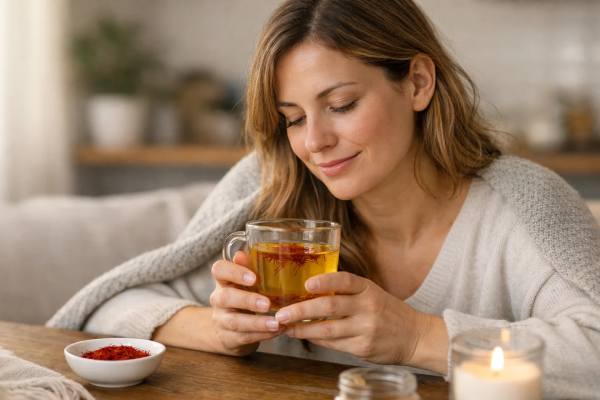
PMS is often described as a few difficult days before a period, but for many people it is far more disruptive than that. Irritability can sharpen quickly, motivation can drop, sleep may feel less restorative, and physical symptoms such as cramps, breast tenderness, or bloating can make the emotional side harder to manage. That is why interest in saffron has grown. Unlike many “hormone balance” trends, saffron has actually been studied for premenstrual symptoms and mood.
The appeal is understandable: it is familiar as a culinary spice, yet it may also influence neurotransmitters involved in mood and stress response. Still, “natural” does not automatically mean effective, interchangeable with standard care, or safe for everyone. The dose used in clinical studies is more specific than most people realize, and the people most likely to benefit are not the same as the people who should avoid it.
A useful saffron plan starts with three questions: what symptoms are you trying to improve, how strong is the evidence, and is it a good fit for your health history?
Core Points
- Saffron may modestly improve PMS and PMDD-related mood symptoms, and it may also help some people with menstrual pain.
- The best-studied dosing pattern is 30 mg per day, usually split into 15 mg twice daily, using a standardized supplement rather than culinary saffron in food.
- Evidence is promising but still limited by small trials, short follow-up, and a narrow range of study populations.
- Pregnancy, breastfeeding, severe depression, bipolar disorder, and medication use are all reasons to ask a clinician before trying it.
- A practical way to use it is to trial one quality-controlled product for two menstrual cycles while tracking mood, sleep, cramps, and side effects.
Table of Contents
- What Studies Suggest
- How Saffron May Work
- Dosage Timing and Form
- Side Effects and Red Flags
- Who Should Avoid It
- Where It Fits in PMS Care
What Studies Suggest
The evidence for saffron in PMS is encouraging, but it is still best described as promising rather than definitive. Clinical trials and newer reviews suggest that saffron may reduce overall premenstrual symptom burden, especially mood-related symptoms such as irritability, tension, low mood, emotional sensitivity, and feeling overwhelmed in the late luteal phase. Some research also suggests a benefit for menstrual pain, which matters because physical discomfort and low mood often amplify each other.
That said, the size of the evidence base matters. Most studies are relatively small, short, and drawn from limited populations. That means the signal is interesting, but it is not as broad or as settled as the evidence behind first-line treatments such as selective serotonin reuptake inhibitors, cognitive behavioral therapy, or certain hormonal options for people with more severe symptoms. In other words, saffron may be useful, but it is not a replacement for standard care when symptoms are severe, disabling, or clearly consistent with premenstrual dysphoric disorder.
A helpful distinction is that PMS and PMDD are not the same. PMS can include bothersome physical and emotional symptoms that show up predictably before a period and ease once bleeding starts. PMDD is the more severe end of that spectrum, with prominent mood symptoms and meaningful disruption in work, relationships, or day-to-day functioning. Saffron has been studied in both, but the decision to use it should be different if symptoms are affecting safety, employment, or mental health stability. If you are unsure where you fall, it helps to compare your pattern with the differences between PMS and PMDD instead of treating all premenstrual symptoms as one category.
Another important point is that saffron seems most relevant for cyclical symptoms. If low mood, anxiety, or irritability are present all month, a “PMS supplement” may be the wrong frame altogether. In that situation, the menstrual cycle may be worsening a broader issue rather than causing the whole problem.
The best way to read the evidence is with both openness and restraint. Saffron is not just internet hype; it has clinical data behind it. But it is also not a magic flower that fixes every monthly symptom. The people most likely to notice benefit are those with mild to moderate cyclical mood symptoms, some associated physical symptoms, and a willingness to track whether it is actually helping over one to two cycles rather than assuming it must work because it is natural.
How Saffron May Work
Saffron’s possible benefits in PMS and mood are usually explained through a mix of brain signaling, inflammation, and pain pathways. None of these mechanisms has been fully mapped out in humans, but together they make the research findings easier to understand.
The first theory involves neurotransmitters. PMS and PMDD are not caused by “low serotonin” in a simple way, but serotonin signaling clearly matters in premenstrual mood symptoms. That is part of why SSRIs can work quickly for PMDD, even when taken only during the luteal phase in some people. Saffron’s active compounds, especially crocin and safranal, are thought to influence serotonin and other monoamine pathways involved in mood, emotional regulation, and stress response. That does not make saffron an herbal SSRI, but it may help explain why mood symptoms are where the supplement looks most promising.
The second theory is anti-inflammatory and antioxidant activity. Premenstrual symptoms are not purely inflammatory, but many people experience headaches, body aches, pelvic pain, brain fog, and fatigue that may worsen when inflammatory signaling and oxidative stress are higher. Saffron’s bioactive compounds have shown antioxidant and anti-inflammatory effects in several lines of research, which may contribute to why some users report not only better mood but also less overall physical misery.
The third theory is pain modulation. Menstrual cramps and pelvic discomfort are heavily shaped by prostaglandins, uterine contractility, and nervous system sensitivity. Saffron has been studied for dysmenorrhea as well as PMS, and it may have mild antispasmodic and pain-modulating effects that help some people feel less physically burdened during the worst days of the cycle.
What matters in practice is that saffron may help because PMS is not one thing. It is a cluster of symptoms that can include mood shifts, sleep changes, pain, food cravings, lower stress tolerance, and physical discomfort. A supplement that touches more than one pathway can feel more useful than one aimed at a single symptom.
Still, mechanism is not the same as proof. Proposed pathways help explain why saffron is worth studying, but they do not guarantee benefit in every person. They also do not mean more is better. Mood-active supplements often have a narrow zone where “enough to test” is different from “so much it becomes risky or pointless.”
There is also an important hormone context. PMS is driven by sensitivity to normal hormonal shifts, not by a simple estrogen deficiency or progesterone deficiency in most people. So saffron should be thought of less as a hormone fixer and more as a symptom-modulating supplement that may make the late luteal phase more tolerable.
Dosage Timing and Form
This is where many supplement articles get vague, but saffron works best as a conversation about studied dosing, not kitchen folklore. The most commonly studied amount for PMS and mood symptoms is 30 mg per day, usually divided into 15 mg twice daily. That pattern appears in the classic PMS trial and in later PMDD research. The time frame is also specific: benefits were generally assessed over one to two menstrual cycles, not after a single capsule or one difficult week.
There are two main ways people use saffron in practice:
- Daily across the cycle, especially when symptoms begin well before bleeding starts or mood support is the main goal.
- Luteal-phase use only, often starting about 10 to 14 days before the expected period, when symptoms are clearly cyclical and concentrated in that window.
Neither approach is perfect for everyone. A person with broad mood and sleep deterioration across most of the second half of the cycle may prefer daily dosing. Someone whose symptoms are tightly confined to the final 7 to 10 days may prefer targeted luteal-phase use. The practical question is not which approach sounds cleaner, but which one matches the timing of your symptoms.
Form matters too. Culinary saffron threads in rice or tea are not interchangeable with a standardized supplement used in a trial. The amount is less precise, the active compound content varies, and everyday cooking doses are usually far below what has been studied for mood or PMS. If someone wants to meaningfully test saffron as a supplement, they need a product with a stated milligram dose, clear standardization when available, and preferably third-party quality testing.
A sensible self-test usually looks like this:
- choose one product only
- use the studied dose rather than improvising
- track symptoms for at least two cycles
- stop if side effects appear or if there is no meaningful change
- avoid stacking it immediately with several other new supplements
This last point matters because many people start saffron together with magnesium, vitamin B6, ginger, or an herbal blend and then cannot tell what is helping. If you are already exploring other options for cycle-related symptoms, it is better to introduce saffron separately. That is especially true if you are comparing it with other popular approaches such as vitamin B6 for PMS, which has a different evidence base and different safety considerations.
A good rule is to judge saffron by function, not hope. Did irritability ease? Did low mood lift faster? Did cramps or sleep improve enough to matter? If the answer is no after one to two clear cycles at an evidence-based dose, the trial has given you useful information.
Side Effects and Red Flags
Short-term saffron use at studied doses appears to be generally well tolerated for many adults, but “well tolerated” does not mean side-effect free. The most commonly reported issues are mild and can include nausea, headache, dizziness, dry mouth, appetite changes, stomach upset, and fatigue. Some people also describe the opposite of fatigue and feel a little overstimulated, restless, or wired. That is one reason it helps to start when you can actually observe how you respond rather than taking it for the first time during an especially stressful week.
The biggest mistake with saffron is assuming that because it is a spice, the dose barely matters. In trials, the daily amount is controlled. At higher intake, side effects are more likely, and very large doses are not something to experiment with casually. This is especially relevant for concentrated supplements, mixed hormone blends, and products that do not clearly state what part of the plant or extract standardization is being used.
There are also red flags that should stop the “maybe I just need a supplement” line of thinking. These include:
- suicidal thoughts or hopelessness
- panic symptoms that feel unsafe or disabling
- mood symptoms that continue outside the premenstrual window
- new severe headaches or neurological symptoms
- very heavy bleeding, fainting, or symptoms of anemia
- pelvic pain that is worsening or not confined to the usual pattern
- major sleep disruption that is spiraling month after month
Those situations call for evaluation, not more supplement experimentation.
Another practical point is that side effects are sometimes mistaken for proof the supplement is “working.” Feeling sedated, emotionally flat, or slightly nauseated is not evidence of benefit. The goal is better functioning with acceptable tolerability, not simply feeling something. That is also why a symptom log is so useful. Without one, people tend to remember the hardest day of the month and judge the whole experiment by that.
It is wise to stop saffron and reassess if you notice a clear worsening in agitation, palpitations, headaches, unusual bleeding, rash, or meaningful digestive distress. It is also smart to pause before surgery or in any situation where your clinician wants a clean list of all supplements and medications.
If you already take more than one supplement for hormonal or mood symptoms, the bigger safety question is often not saffron alone but the overall stack. Combining multiple “natural” products can turn a simple trial into a messy experiment. That is where the broader principles behind safer supplement use become much more important than the promise of any single ingredient.
Who Should Avoid It
Saffron is not the right fit for everyone, and some of the most important “avoid it” decisions have less to do with saffron itself than with the situation it is being used in.
Pregnancy is the clearest example. Culinary amounts used in food are one thing, but supplement-level dosing is another. Because of limited pregnancy safety data and longstanding concern about uterine effects at higher exposure, saffron supplements are generally not a good self-treatment choice during pregnancy. If someone might be pregnant, is trying to conceive, or is in the two-week wait, that should be part of the decision before starting. Breastfeeding is another gray area where evidence is too limited to assume safety at supplemental doses.
People with severe depression, recent self-harm thoughts, or rapidly worsening mood should also avoid self-managing with saffron alone. The problem there is not that saffron is uniquely dangerous; it is that a monthly mood problem can cross into a more serious mental health condition, and delaying proper care can be risky. The same caution applies to people with bipolar disorder or a history of hypomania or mania. Any mood-active supplement deserves clinician input in that setting.
Medication use matters too. If you take antidepressants, anti-anxiety medication, mood stabilizers, sedatives, or other centrally acting drugs, it is sensible to ask a clinician or pharmacist before adding saffron. Interaction data are not robust enough to assume no issue. The same kind of caution applies if you take blood thinners or have a bleeding disorder, since supplement interactions are often under-studied rather than fully reassuring.
You should also be cautious if you have:
- a known saffron or plant-product allergy
- frequent dizziness or low blood pressure
- a history of unusual supplement sensitivity
- planned surgery
- significant liver or kidney disease unless a clinician clears it
There is also a timing issue that gets overlooked: new-onset “PMS” after age 40, after childbirth, after stopping hormonal contraception, or in the middle of major sleep disruption deserves a broader lens. What looks like PMS may actually be perimenopause, thyroid disease, iron deficiency, depression, medication effects, or another gynecologic problem.
The bottom line is that saffron is best for people whose symptoms are clearly cyclical, not medically urgent, and not already entangled with pregnancy, high-risk medication use, or unstable mental health. If that does not describe your situation, skipping saffron is not being overly cautious. It is choosing the right level of care for the problem in front of you.
Where It Fits in PMS Care
The best role for saffron is usually as one piece of a structured PMS plan, not as the entire plan. It makes the most sense for mild to moderate cyclical mood symptoms, especially when someone wants to try a nonprescription option and has a clear sense of what they hope will improve. It makes less sense when symptoms are severe enough to suggest PMDD, when daily mood symptoms are present all month, or when the person has not yet tracked whether symptoms are actually tied to the cycle.
A strong PMS plan usually starts with pattern recognition. If you do not know when symptoms begin, peak, and ease, it is hard to judge whether any intervention works. A daily log for at least two cycles is often more valuable than another supplement. Once the pattern is clear, the treatment choice becomes more precise.
For people with mainly mood symptoms, saffron may sit alongside other low-risk supports such as sleep protection, regular meals, reduced alcohol in the late luteal phase, exercise, and therapy strategies for irritability or overwhelm. For people whose main complaint is pain, another tool may deserve priority. Someone with strong cramps, for example, may benefit more from approaches aimed directly at pain and prostaglandins, including options like ginger for period cramps or standard anti-inflammatory medication when appropriate.
It also helps to be honest about treatment goals. Are you trying to reduce sadness, soften irritability, sleep better, feel less emotionally reactive, or cut down on cramps? Saffron may not help every symptom equally. Expecting one supplement to fix cravings, insomnia, anxiety, pelvic pain, breast tenderness, and work-related burnout all at once is a setup for disappointment.
For more severe PMS or PMDD, saffron should be viewed as a possible complement rather than a substitute for evidence-based care. That may include SSRIs, luteal-phase medication strategies, combined hormonal contraception, therapy, or evaluation for overlapping conditions such as anxiety disorders, migraine, endometriosis, thyroid disease, or anemia.
A practical framework is this:
- use saffron when symptoms are cyclical, moderate, and carefully tracked
- choose a studied dose and a time-limited trial
- stop if no clear benefit shows up
- escalate care if function, safety, or mental health are slipping
This is where saffron can be genuinely useful: not as a miracle, not as a placebo in spice form, but as a targeted option for selected people with selected symptoms. The most effective PMS care is rarely about finding the one perfect supplement. It is about matching the right tool to the actual pattern.
References
- Effect of saffron on premenstrual syndrome and dysmenorrhea: a systematic review and meta-analysis 2026 (Systematic Review)
- Effect of saffron on depression, anxiety and mood disorder: a GRADE assessed systematic review and meta-analysis of 34 randomized controlled trials 2026 (Systematic Review)
- Management of Premenstrual Disorders: ACOG Clinical Practice Guideline No. 7 2023 (Guideline)
- Therapeutic effects of saffron (Crocus sativus L) on female reproductive system disorders: A systematic review 2024 (Systematic Review)
- Saffron for the Management of Premenstrual Dysphoric Disorder: A Randomized Controlled Trial 2020 (RCT)
Disclaimer
This article is for educational purposes only and is not a substitute for medical advice, diagnosis, or treatment. PMS and PMDD can overlap with depression, anxiety disorders, thyroid conditions, anemia, endometriosis, medication effects, and perimenopausal hormone changes. Saffron may be helpful for some people, but it is not appropriate for everyone, especially during pregnancy, with certain medications, or when mood symptoms are severe or unsafe. Seek urgent care for suicidal thoughts, severe mood changes, fainting, or unusually heavy bleeding.
If this article clarified where saffron may and may not fit, please share it on Facebook, X, or your preferred platform so someone else can make a more informed decision.