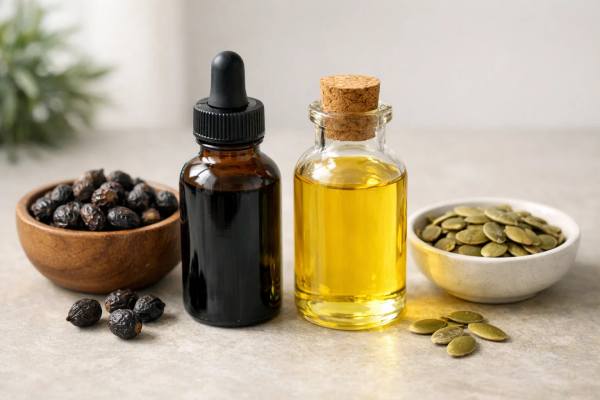
Two bottles on the supplement shelf often get grouped together for thinning hair: saw palmetto and pumpkin seed oil. Both are marketed as gentler, more “natural” ways to support hair growth, especially when the concern is androgenetic alopecia, the common pattern-driven thinning linked to dihydrotestosterone, or DHT. That overlap makes them easy to confuse. Yet they are not the same product, they do not have the same depth of evidence, and their dosing and safety questions are not identical.
What matters most is not the label claim, but the quality of the human data. Hair supplements often sound more certain than the science behind them. With these two, the evidence is promising in places, thin in others, and highly dependent on the exact formulation used in a study.
This guide compares saw palmetto and pumpkin seed oil in practical terms: what each may do, what the studies actually suggest, how doses are usually discussed, and which interactions deserve a careful review before you try either one.
Fast Facts
- Both supplements are mainly studied for androgenetic alopecia, not for patchy, scarring, or sudden diffuse shedding.
- Saw palmetto has slightly broader human hair data, but the studies are still small and product standardization varies.
- Pumpkin seed oil has a clearer oral hair trial dose, but the number of controlled studies is lower.
- If you try either one, use a single standardized product consistently for several months rather than mixing multiple “hair growth” supplements at once.
Table of Contents
- Why These Two Supplements Are Compared So Often
- What the Saw Palmetto Data Actually Show
- What the Pumpkin Seed Oil Data Show
- Which One Has the Better Case for Hair
- Dosing, Side Effects, and Interaction Questions
- How to Decide Whether Either One Is Worth Trying
Why These Two Supplements Are Compared So Often
Saw palmetto and pumpkin seed oil keep showing up in hair conversations for one main reason: both are framed as possible natural DHT modulators. In androgenetic alopecia, DHT contributes to follicle miniaturization in people who are genetically susceptible. Over time, hairs become finer, shorter, and less visible. Because prescription treatments such as finasteride also target androgen pathways, any supplement that appears to influence 5-alpha-reductase or DHT quickly attracts attention.
That is where the similarity begins, but it is not where it ends. Saw palmetto is usually discussed as an extract from the berries of Serenoa repens, rich in fatty acids and phytosterols. Pumpkin seed oil is derived from Cucurbita pepo seeds and is commonly promoted for its phytosterols, fatty acids, and broader anti-inflammatory profile. Both are sold in oral capsules, but their real-world marketplace is messy. Some products are single-ingredient formulas, while others are bundled with biotin, zinc, marine collagen, or plant blends. That makes it hard to know whether you are buying the studied ingredient or a marketing version of it.
Another reason they are compared is that they appeal to the same audience: people who want a middle path between “do nothing” and “take a prescription drug.” That can include men with early pattern hair loss, women with diffuse crown thinning, and people who are wary of the adverse-effect discussions around finasteride or who simply want to start with something less aggressive. If you are looking at the broader landscape of male pattern treatment options, these two supplements are usually positioned as adjuncts rather than as first-line replacements for established medical therapy.
Still, it is important to name what they are not. They are not proven treatments for every type of hair loss. The evidence around both ingredients centers on androgenetic alopecia, not alopecia areata, scarring alopecias, infection-related loss, or classic telogen effluvium from stress, illness, or rapid weight loss. If the shedding is sudden, patchy, painful, or associated with scalp inflammation, the match is already weak.
There is also a practical difference between a mechanistic idea and a clinically meaningful result. A supplement may influence an enzyme in a lab setting and still fail to deliver a noticeable cosmetic benefit on the scalp. Hair biology is slow, complex, and highly variable. That is why the useful question is not “Can this affect DHT in theory?” but “Did people using a defined product actually grow or keep more hair in a controlled study?”
Once you frame the comparison that way, the conversation becomes much clearer. Saw palmetto and pumpkin seed oil may both belong in the same family of “natural antiandrogen” discussion, but the human trial picture, dose clarity, and safety uncertainty are not perfectly matched.
What the Saw Palmetto Data Actually Show
Saw palmetto has the slightly broader hair-loss literature of the two, but “broader” should not be confused with “robust.” The studies are still small, the formulations vary, and some earlier reports mixed saw palmetto with vitamins or other botanicals, which makes cause-and-effect harder to judge. Even so, it has enough human data to justify cautious interest.
The central idea is that saw palmetto may reduce androgen signaling by inhibiting 5-alpha-reductase, the enzyme that converts testosterone to DHT. In hair terms, that could slow follicle miniaturization in people with androgen-sensitive pattern loss. The more recent clinical data are helpful because they used a more clearly defined extract rather than a vague proprietary blend.
One of the more useful modern trials evaluated a standardized saw palmetto oil in adults with mild-to-moderate androgenetic alopecia. In that study, oral and topical forms were each compared with placebo over 16 weeks. The oral arm used a 400 mg capsule once daily, containing 100 mg of standardized saw palmetto extract, while the topical arm used about 5 mL of a 20 percent lotion once daily. The oral and topical groups both improved measures of hair fall and hair density, and the oral group also showed a reduction in serum DHT. That is encouraging, but it is still a single modest-sized trial, not the kind of repeated multi-center evidence that settles a debate.
Earlier reviews of complementary and non-prescription treatments generally place saw palmetto in the “possibly helpful, still underpowered” category. That is a fair description. The signal is real enough that it keeps surviving into newer reviews, but the evidence base is not deep enough to claim a predictable response rate for routine clinical use.
A few practical points matter here. First, saw palmetto looks most relevant for androgenetic alopecia, not for every cause of thinning. Second, the exact extract matters. A standardized oil with declared fatty acid or phytosterol content is not interchangeable with a generic capsule that simply says “saw palmetto” on the front. Third, the route matters. Oral and topical use may not produce the same effect size, the same adverse effects, or the same adherence challenges.
This is especially important for women. Saw palmetto is sometimes discussed in female pattern thinning, but the overall data remain much thinner than the marketing around it. That does not mean it is useless. It means the confidence interval is wide, and decisions should be more individualized, particularly when the differential diagnosis for thinning in women is broad. If the cause of thinning is unclear, a review of common causes of hair loss in women often helps explain why a DHT-focused supplement may or may not fit the picture.
Bottom line: saw palmetto has enough evidence to be considered a plausible adjunct for pattern hair loss, especially if someone wants a nonprescription option, but it does not yet have the kind of consistent, standardized data that would put it on equal footing with established medical therapy.
What the Pumpkin Seed Oil Data Show
Pumpkin seed oil has a smaller human hair literature than saw palmetto, but one feature works in its favor: the oral trial signal is relatively easy to describe. The most often cited study enrolled men with mild-to-moderate androgenetic alopecia and used 400 mg of pumpkin seed oil daily for 24 weeks. Compared with placebo, the treatment group showed a meaningful increase in hair count, while adverse effects were not different between groups. For a supplement study, that is a useful piece of evidence because the dose, population, and time frame are clear.
There is also a small randomized comparative trial in women with female pattern hair loss that evaluated topical pumpkin seed oil against minoxidil 5 percent foam over three months. The pumpkin seed oil group improved on dermoscopic measures, which supports the idea that pumpkin seed oil is not only an oral supplement story. Still, this trial should be read carefully. It was small, it used a specific product approach, and it does not prove that topical pumpkin seed oil is equivalent to minoxidil or ready to replace it.
Mechanistically, pumpkin seed oil is usually discussed in terms of phytosterols, especially beta-sitosterol, along with fatty acids that may influence 5-alpha-reductase activity and local inflammatory signaling. That makes it conceptually similar to saw palmetto, but not identical. Pumpkin seed oil also has a “food-derived” advantage in how many people perceive it. It often feels more familiar, less hormone-active, and easier to tolerate psychologically than an herbal extract associated with prostate supplements. That perception may improve willingness to try it, though it should not be mistaken for proof of superior safety or efficacy.
The biggest limitation is the thinness of the dataset. Pumpkin seed oil has a memorable oral trial, a small topical female study, and supportive placement in newer review papers. What it does not have is a deep library of repeated, independent trials across multiple populations and standardized formulations. That means the evidence is promising but fragile. One positive 24-week oral study is useful; it is not a guarantee that every pumpkin seed oil capsule on the market will perform the same way.
Another nuance is that “pumpkin seed oil” can refer to different real-world products. A culinary oil, a softgel supplement, and a topical hair serum are not interchangeable. The label may not tell you the phytosterol content, extraction method, or whether the product resembles the study material at all. That gap between trial product and retail product is one of the biggest hidden problems in hair supplementation.
For women, the topic often comes up in the setting of diffuse crown thinning or widening part lines. If that pattern is the concern, it helps to compare the look and progression of female pattern thinning before deciding whether a DHT-focused botanical makes sense. Pumpkin seed oil may be worth considering as an adjunct, but the smartest reading of the evidence is still modest: encouraging, not definitive.
Which One Has the Better Case for Hair
If the question is simply “Which has the stronger hair evidence right now?” saw palmetto probably has a small edge in breadth, while pumpkin seed oil has an edge in dose clarity for oral use. That may sound like a split decision, and in a way it is.
Saw palmetto has appeared in more hair-focused reviews and has human data in both oral and topical forms, including a newer placebo-controlled trial using a standardized extract. That gives it a slightly richer clinical footprint. The trade-off is that the literature is harder to interpret cleanly because older studies often used mixed formulas or nonuniform preparations. When the active ingredient is surrounded by other vitamins and botanicals, it becomes difficult to know how much credit saw palmetto deserves by itself.
Pumpkin seed oil has fewer trials, but the main oral study is straightforward: 400 mg daily for 24 weeks in men with androgenetic alopecia. That clarity is useful for readers who want a supplement with at least one recognizable oral regimen. The downside is that the overall evidence base is thinner, especially if you want repeated confirmation across sexes, formulations, and study centers.
There is also an important question no one should pretend has been answered: there are no strong head-to-head trials directly comparing oral saw palmetto with oral pumpkin seed oil for hair growth. Without that, any “winner” is really a judgment based on study architecture, not on a true comparison trial. The most honest conclusion is that both have preliminary evidence, saw palmetto is a bit more studied, and neither has yet built a case strong enough to displace evidence-based standards.
How might that play out in real decisions?
- If someone wants the more widely discussed botanical for androgen-related hair loss, saw palmetto is usually the first of the two to consider.
- If someone wants the simpler oral regimen with a clear hair-study dose, pumpkin seed oil has an appealing 400 mg per day data point.
- If someone is especially concerned about hormone-active supplements, pumpkin seed oil may feel like the lower-friction option, though that is more about comfort and perception than definitive proof of superiority.
- If someone wants an option that can also be considered topically, both have topical literature, but the products used in studies are not standardized enough to treat store-bought serums as equivalent.
A helpful way to frame both is as adjuncts, not anchors. They may be reasonable add-ons for early or mild androgenetic alopecia, or for people who decline prescription therapy. They are weaker candidates when the thinning is fast, advanced, or diagnostically unclear. In those settings, it is more useful to understand how the main evidence-based options compare than to spend months hoping a supplement will behave like a drug.
So which one “wins”? In a strict evidence hierarchy, neither wins decisively. Saw palmetto is a little better established. Pumpkin seed oil is a little easier to dose from the best-known oral trial. The right choice depends less on hype and more on how much uncertainty you are willing to accept.
Dosing, Side Effects, and Interaction Questions
Dosing is where supplement marketing often sounds precise while the science remains uneven. With both saw palmetto and pumpkin seed oil, the most honest answer is that hair-study dosing exists, but it is not standardized across the marketplace.
For saw palmetto, published hair studies have used different preparations. The cleaner recent trial used one 400 mg capsule daily that contained 100 mg of a standardized saw palmetto extract, and a topical arm used about 5 mL of a 20 percent lotion once daily. That does not mean every 400 mg saw palmetto capsule on a store shelf is equivalent. The extract type, fatty acid content, and degree of standardization can all vary. A capsule may weigh the same while delivering very different active chemistry.
For pumpkin seed oil, the clearest oral hair regimen is 400 mg daily for 24 weeks in men with androgenetic alopecia. The topical female-pattern trial is harder to translate into routine use because the trial details are more product-specific and because topical pumpkin seed oil products on the retail market are not standardized in a consistent way. In practical terms, oral pumpkin seed oil has the clearer dose anchor, while topical pumpkin seed oil remains less portable from paper to shelf.
Side effects for both supplements appear mostly mild in hair studies, but that does not make them trivial. Saw palmetto has been associated with digestive upset, headache, dizziness, and occasional topical irritation. In some studies of scalp use, participants reported mild burning, itching, cold sensation, acne-like changes, or unpleasant odor. Pumpkin seed oil appears generally well tolerated in the hair literature, with fewer clearly described adverse effects, but mild abdominal discomfort, itching, and topical tolerability issues can occur.
The interaction discussion is where nuance matters most. Saw palmetto raises more questions than pumpkin seed oil because it is often framed as having hormone-active and possible antiplatelet effects. The problem is not that every interaction is firmly proven in hair studies; it is that the evidence is incomplete enough to justify caution. In practice, many clinicians review saw palmetto carefully in people who are pregnant, trying to conceive, breastfeeding, preparing for surgery, taking anticoagulants or antiplatelet drugs, or using hormone-sensitive therapies. Pumpkin seed oil has fewer well-known interaction concerns in the hair literature, but fewer known interactions is not the same as no interactions. Food-derived oils can still cause problems in concentrated supplement form, especially when product quality is inconsistent or when someone has a seed allergy history.
One of the most overlooked risks is stacking. A person may take a “hair blend” that already contains saw palmetto, then add separate pumpkin seed oil, zinc, biotin, collagen, and another anti-DHT formula. That creates a cloudy picture fast. If side effects appear, or if nothing happens, it becomes impossible to tell what was useful and what was noise. This is one reason supplement red flags matter so much in hair care.
The safest practical rule is simple: choose one standardized product, know the exact ingredient and dose, review your medications first, and do not assume that “natural” means interaction-free.
How to Decide Whether Either One Is Worth Trying
The best candidates for saw palmetto or pumpkin seed oil are not people with every kind of shedding. They are people with likely androgenetic alopecia, mild-to-moderate thinning, and a realistic understanding of what supplements can and cannot do. That means slower expectations, smaller effect sizes, and more uncertainty than with established medical therapy.
A sensible decision process usually looks like this:
- Confirm that the pattern fits androgenetic alopecia rather than sudden shedding, patchy loss, scalp inflammation, or breakage.
- Decide whether you want an adjunct to standard treatment or an alternative because you are not ready for prescription therapy.
- Pick one ingredient rather than layering multiple new supplements at the same time.
- Use a product with a clear standardized label, not a vague “hair complex.”
- Reassess after a meaningful trial period rather than switching every few weeks.
For saw palmetto, the strongest use case is the person who wants the more studied of the two botanicals and accepts that its interaction profile needs a more careful medication review. For pumpkin seed oil, the strongest use case is the person who wants the simpler oral trial dose and is comfortable with the fact that there are fewer studies overall. Neither is an ideal first move for unexplained shedding or advanced loss that is already progressing quickly.
It also helps to be honest about goals. Some people expect a supplement to regrow a visibly thinner hairline or restore dense coverage at the crown. That is not the most realistic bar. The better early targets are reduced shedding, slower progression, modest density support, or improvement when used alongside standard care. In other words, think support, not rescue.
There are also clear situations where a supplement-first strategy is a weak fit. If you have sudden hair fall, bald patches, scalp pain, heavy scaling, postpartum shedding, recent illness, weight-loss-related shedding, or possible thyroid or iron issues, a DHT-focused botanical may not address the real problem. Likewise, if the thinning is already advanced, waiting months on a low-certainty supplement can cost valuable time. In those cases, learning when a dermatologist should evaluate hair loss is more useful than picking the most appealing supplement label.
The most balanced takeaway is this: saw palmetto and pumpkin seed oil are reasonable topics to explore, but only within their lane. Their lane is early or moderate pattern hair loss, careful expectations, and informed use. Saw palmetto has the slightly fuller evidence story. Pumpkin seed oil has the cleaner oral dose story. Neither should be sold as a proven replacement for therapies with a stronger clinical track record.
If you choose one, make the decision slowly and use the same standard you would use for any other treatment: match it to the right diagnosis, respect the safety questions, and judge it by real results rather than by how natural it sounds.
References
- Do Non-Prescription Products Help in Managing Androgenic Alopecia? 2025 (Review)
- Emerging and traditional 5-α reductase inhibitors and androgen receptor antagonists for male androgenetic alopecia 2024 (Review)
- Oral and Topical Administration of a Standardized Saw Palmetto Oil Reduces Hair Fall and Improves the Hair Growth in Androgenetic Alopecia Subjects – A 16-Week Randomized, Placebo-Controlled Study 2023 (RCT)
- Pumpkin seed oil vs. minoxidil 5% topical foam for the treatment of female pattern hair loss: A randomized comparative trial 2021 (RCT)
- Effect of pumpkin seed oil on hair growth in men with androgenetic alopecia: a randomized, double-blind, placebo-controlled trial 2014 (RCT)
Disclaimer
This article is for educational purposes only and is not medical advice. Hair thinning can have many causes, and saw palmetto or pumpkin seed oil may be inappropriate if the diagnosis is unclear. Because supplements vary in purity, strength, and ingredient accuracy, and because medication and hormone-related interactions may matter in some people, speak with a qualified clinician before starting either product. Seek prompt medical evaluation for sudden shedding, patchy loss, scalp pain, marked inflammation, or thinning accompanied by menstrual changes, fatigue, weight loss, or other systemic symptoms.
If this article helped you, please share it on Facebook, X, or your preferred platform.