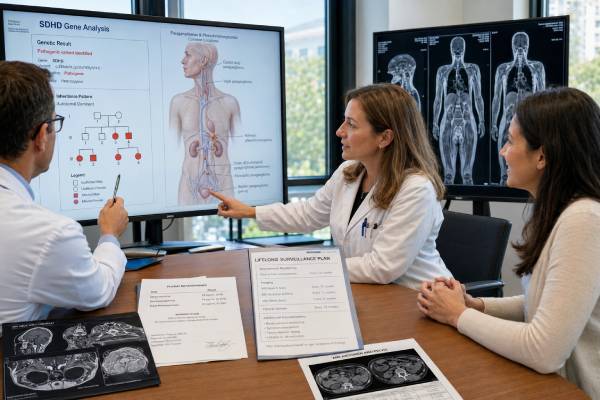
An SDHD genetic test looks for an inherited pathogenic variant that predisposes to paragangliomas and pheochromocytomas. SDHD-associated disease often involves multiple head and neck paragangliomas, although adrenal, chest, abdominal, and pelvic tumors also occur. The gene has an important parent-of-origin effect: tumor risk is much higher when the pathogenic variant is inherited from the father. People who inherit it from the mother can still pass it to their children, and rare disease after maternal transmission has been reported.
Testing usually uses blood or saliva and includes sequencing plus deletion-duplication analysis. A positive result guides biochemical screening, MRI surveillance, assessment before anesthesia or pregnancy, and targeted testing for relatives. It does not prove a tumor is present or predict how many tumors will develop. A negative result is most reassuring when it excludes the exact familial variant. A variant of uncertain significance should not be treated as a confirmed hereditary diagnosis. Interpretation should include the tumor location, hormone production, pathology, family history, and which parent transmitted the variant.
- A pathogenic SDHD result confirms inherited PPGL susceptibility, with risk strongly influenced by the transmitting parent.
- Paternally inherited SDHD variants commonly predispose to head and neck paragangliomas and multiple tumors.
- Normal metanephrine results do not rule out nonsecretory head and neck paragangliomas.
- Maternally inherited carriers can transmit the variant and need specialist counseling about uncertain, usually lower personal risk.
- A VUS should not be used alone for predictive testing, preventive treatment, or a lifelong surveillance diagnosis.
Table of Contents
- How SDHD Affects Cells
- Who May Need SDHD Testing
- How Testing Is Done
- Understanding SDHD Results
- The Parent-of-Origin Effect
- Tumor Patterns and Symptoms
- Surveillance and Treatment Planning
- Family Testing and Next Steps
How SDHD Affects Cells
SDHD encodes a small membrane-anchoring subunit of succinate dehydrogenase, or mitochondrial complex II. This enzyme connects two major energy pathways: the citric acid cycle and the electron transport chain. When the complex loses function, succinate accumulates and blocks enzymes involved in oxygen sensing and gene regulation. The cell develops a pseudohypoxic state and widespread epigenetic changes that can favor tumor growth.
A carrier is usually born with one altered SDHD copy and one working copy. A tumor can arise when the remaining working copy is lost or silenced in a susceptible paraganglial cell. This helps explain why risk is incomplete and why different relatives with the same variant can have very different numbers and locations of tumors.
SDHD is one of several SDHx genes associated with hereditary paraganglioma-pheochromocytoma syndrome. SDHD has a particularly strong association with parasympathetic paragangliomas of the head and neck and with multifocal disease. Some carriers develop several tumors over time or tumors on both sides of the neck. Adrenal pheochromocytoma and sympathetic paraganglioma outside the head and neck are also possible.
A paraganglioma arises from paraganglial tissue outside the adrenal gland. A pheochromocytoma arises within the adrenal medulla. Head and neck paragangliomas are often nonsecretory and present because of their location. Sympathetic tumors in the chest, abdomen, or pelvis are more likely to release catecholamines and cause blood-pressure or cardiac symptoms.
SDHD-related tumors can show loss of SDHB protein on immunohistochemistry because disruption of one subunit destabilizes the entire SDH complex. This staining pattern is a clue, not a gene-specific answer. Germline testing or combined tumor and germline analysis is needed to determine whether SDHD is responsible.
A positive germline finding is different from a tumor-only alteration. If tumor genomic testing identifies an SDHD variant, a normal-tissue sample is required to determine whether it is inherited. Family counseling should not begin from a tumor report alone.
Who May Need SDHD Testing
Most people diagnosed with pheochromocytoma or paraganglioma should be offered genetic evaluation because hereditary causes are common and can affect treatment, follow-up, and relatives. A multigene panel is usually more appropriate than SDHD-only testing in the first affected family member. Targeted SDHD testing is preferred when the family’s exact pathogenic variant is already documented.
Clinical findings that make SDHD especially relevant include:
- More than one head and neck paraganglioma.
- Bilateral carotid body tumors or a combination of carotid, vagal, jugular, or tympanic tumors.
- A paraganglioma diagnosed at a young age.
- A family history of paraganglioma or pheochromocytoma, especially through the father’s side.
- A person whose father carries a known SDHD pathogenic variant.
- Loss of SDHB staining in a paraganglioma with retained SDHA staining.
- A head and neck tumor plus an adrenal or abdominal PPGL.
- A relative with a known SDHD result who needs predictive testing.
Family history must be taken broadly. A relative may have been told they had a carotid body tumor, glomus jugulare tumor, ear-base tumor, vagal tumor, adrenal tumor, or highly vascular neck mass. Older records may not use the word paraganglioma. Hearing loss, cranial-nerve injury after skull-base surgery, or repeated neck operations can also reveal an unrecognized family pattern.
A negative family history does not exclude SDHD. The variant may be de novo, transmitted through a mother with low apparent risk, or carried by relatives who never underwent imaging. Small families, early deaths, adoption, and incomplete medical information can hide the pattern.
Tumor immunohistochemistry can help select genetic testing. Loss of SDHB staining suggests SDH deficiency but can result from pathogenic variants in SDHB, SDHC, SDHD, or related mechanisms. A broad hereditary cancer gene panel designed for PPGL is often the clearest next step.
Healthy relatives may seek testing because surveillance can start before symptoms. Testing a child is considered when the result will change medical care during childhood or adolescence. The family should discuss timing with a genetics and pediatric endocrine team rather than use a direct-to-consumer result.
How Testing Is Done
Germline SDHD testing generally uses blood or saliva. Blood provides high-quality DNA and may be preferred when a low-level finding needs confirmation. No fasting is required, and ordinary medications do not alter the DNA sequence.
A clinically complete test should assess both sequence variants and copy-number changes. Depending on the presentation, the laboratory may use:
- A targeted familial-variant test for a known SDHD change.
- Single-gene analysis with sequencing and deletion-duplication testing.
- A PPGL multigene panel that includes SDHD and other validated susceptibility genes.
- Tumor testing to look for loss of the normal allele, SDH-deficient molecular features, or another cause.
- Additional tissue testing when mosaicism or a blood-specific artifact is suspected.
Panel testing is common because RET, VHL, NF1, SDHB, SDHC, SDHA, MAX, TMEM127, FH, and other genes can produce overlapping tumors. The report should state which genes and variant types were analyzed. A large gene count is not automatically better; the panel should include genes with a well-established relationship to the phenotype and validated methods.
Results often take two to six weeks. Targeted testing can be faster. The laboratory may need more time for deletion confirmation, RNA analysis of a suspected splice variant, or family studies.
Pretest counseling should cover the parent-of-origin effect. The same positive result has different immediate surveillance implications depending on whether it came from the father or mother. Whenever possible, testing both parents clarifies the transmitting side. If a parent is unavailable, pedigree information and testing of other relatives may help, but uncertainty can remain.
Tumor tissue can add evidence. SDHB and SDHA immunostains must be interpreted with internal controls. Loss of SDHB staining with preserved SDHA is compatible with SDHD deficiency but not specific. Tumor sequencing may demonstrate loss of the remaining normal chromosome region, supporting a two-hit mechanism.
When a report shows a low variant allele fraction, the laboratory should consider mosaicism, technical artifact, sample contamination, or a blood-cell clone. A second blood draw or another tissue may be required. The percentage in blood cannot by itself predict which organs are at risk.
Understanding SDHD Results
Variant classifications generally include pathogenic, likely pathogenic, uncertain significance, likely benign, and benign. The category reflects evidence that the DNA change affects gene function. It does not state whether the person has a tumor today.
Pathogenic or likely pathogenic
A positive constitutional result confirms SDHD-related PPGL susceptibility. The next steps include identifying the parent of origin, performing a baseline clinical and imaging assessment when indicated, and offering focused testing to relatives.
Likely pathogenic variants are usually managed like pathogenic variants. The complete laboratory report should be retained because relatives need the exact DNA notation. A broad statement such as “SDHD positive” is not sufficient for accurate family testing.
A positive result cannot predict how many tumors will occur, whether they will secrete hormones, or whether they will need treatment. Some carriers remain asymptomatic; others develop multifocal head and neck disease. The result is a risk marker, not a tumor scan.
Negative
A negative targeted result in a relative means the known family variant was not inherited. That person generally does not require SDHD-specific surveillance, although any separate personal medical issue still needs care.
A negative panel in an affected person is less definitive. The tumor may have another hereditary cause, an undetected variant, mosaicism, or a somatic mechanism. The tumor’s own follow-up does not end because germline testing was negative.
If testing occurred years ago, confirm that deletion-duplication analysis and a full PPGL panel were included. Updating a limited test can be reasonable when the phenotype remains convincing.
Variant of uncertain significance
A VUS means evidence is insufficient. It should not trigger predictive testing of healthy relatives as though it were pathogenic, and it should not be the sole reason for surgery or lifelong screening. The person’s known tumors and family history guide care while the classification remains unresolved.
A VUS may be reclassified as more cases, functional studies, tumor data, and population evidence become available. Families should avoid trying to infer causality only from whether one relative with the variant has a neck mass. Formal segregation analysis requires enough informative relatives and laboratory interpretation.
The broader rules for a variant of uncertain significance apply: do not use uncertainty as a positive result, keep the report, and maintain a route for recontact.
Benign or likely benign
These variants are not considered the cause of hereditary PPGL and usually do not appear in the main clinical result section. They do not justify syndrome-specific surveillance.
The Parent-of-Origin Effect
SDHD has a well-recognized parent-of-origin effect. Clinical disease develops predominantly when the pathogenic variant is inherited from the father. This pattern is related to genomic imprinting and loss of maternal chromosome 11 material during tumor development, although the biology is more complex than a simple on-off switch.
A paternally inherited carrier has the clearest indication for standard SDHD surveillance. The father may or may not have developed tumors himself, because penetrance remains incomplete. All of the carrier’s children have a 50% chance of inheriting the variant.
A maternally inherited carrier usually has much lower observed tumor risk, but the risk is not proven to be zero. Rare tumors after maternal transmission have been reported, and international guidance is not entirely uniform about surveillance intensity. The result should be reviewed by a specialist who can consider family history, symptoms, evolving evidence, and local recommendations.
Transmission across generations can change the clinical pattern. A woman who inherited an SDHD variant from her mother may have low personal expression, but if she passes it to a son or daughter, that child has inherited it from the mother and also generally has lower expression. If a male carrier passes the variant to his child, the child receives it paternally and may have substantially higher tumor risk.
This can create apparently “skipped” generations. A family may see disease in a grandfather and grandchildren but little disease in the intervening female carrier. The variant did not disappear; its expression changed with the transmitting parent.
Parent-of-origin information should be recorded in the medical chart and family letter. It affects surveillance counseling but not the basic 50% chance of transmission. It also does not mean a maternally inherited result can be ignored, because the carrier’s descendants may receive it through a father in a future generation.
When the transmitting parent is unknown, clinicians may recommend a cautious plan until family testing clarifies the lineage. If both parents test negative in blood, the variant may be de novo; in that case, the affected person is the first carrier in the family, and future children inherit it from that person according to their sex as the transmitting parent.
Tumor Patterns and Symptoms
SDHD is strongly associated with head and neck paragangliomas, often at more than one site. Common locations include the carotid body, vagal paraganglia, jugular bulb, and middle ear. Tumors can be bilateral or develop metachronously, meaning a second tumor appears years after the first.
Head and neck symptoms can include:
- A slowly enlarging, usually painless neck mass.
- Pulsatile tinnitus or a rhythmic sound in one ear.
- Hearing loss, ear fullness, or dizziness.
- Hoarseness, swallowing difficulty, aspiration, or tongue weakness.
- Facial, shoulder, or other cranial-nerve deficits.
- Headache or pain from a large skull-base lesion.
These tumors are often nonsecretory, so blood pressure and metanephrine tests can be normal. Symptoms arise from pressure on nearby nerves, the ear, airway, and blood vessels. A normal biochemical screen must never be used to exclude head and neck disease in a carrier.
SDHD carriers can also develop adrenal pheochromocytomas and sympathetic paragangliomas in the thorax, abdomen, or pelvis. These may secrete catecholamines and cause episodic headache, sweating, palpitations, tremor, pallor, anxiety-like spells, or sustained or fluctuating hypertension. Some are found by screening before symptoms begin.
Severe catecholamine effects can cause arrhythmia, heart failure, stroke, or shock. Chest pain, fainting, severe headache with marked hypertension, new weakness, or breathing difficulty requires urgent care. A suspected secretory tumor must be assessed before elective anesthesia or surgery.
The average metastatic risk for SDHD-associated PPGL is generally lower than for SDHB-associated disease, but metastasis can occur. No pathology report can guarantee benign behavior. Tumor size, location, growth, biochemical phenotype, and long-term imaging help define risk.
Other SDH-related tumors, including gastrointestinal stromal tumor and renal tumors, have been reported less commonly. Their precise SDHD-specific risks are uncertain. Abdominal imaging used for PPGL surveillance may detect some of these lesions, while symptoms such as gastrointestinal bleeding, unexplained anemia, blood in the urine, or persistent flank pain require direct evaluation.
Surveillance and Treatment Planning
Surveillance aims to detect silent tumors, identify catecholamine secretion before a crisis, and preserve nerve function by finding head and neck lesions at a manageable size. Current protocols generally combine regular clinical review, biochemical testing, and MRI from the skull base to the pelvis.
A baseline evaluation for a carrier at meaningful risk commonly includes:
- Personal and family tumor history, including the parent of origin.
- Blood pressure and symptom review.
- Plasma free metanephrines or 24-hour urinary fractionated metanephrines.
- MRI of the head and neck, thorax, abdomen, and pelvis.
- Functional imaging when a lesion is suspected, multifocal disease is known, or staging is required.
After a normal baseline, many expert approaches use annual clinical assessment, periodic biochemical testing, and MRI approximately every two to three years. Exact starting ages and intervals vary. A family’s earliest tumor, the carrier’s parent of origin, prior tumors, and local guideline can modify the schedule.
MRI is preferred for repeated surveillance because it avoids cumulative radiation. CT may be better for selected anatomy, acute situations, or surgical planning. Functional imaging can map multifocal or metastatic disease and help determine whether radionuclide-based therapy is relevant.
Metanephrine collection conditions matter. Stress, illness, strenuous exercise, posture, caffeine, nicotine, and some medicines can produce mild false-positive elevations. Borderline findings may be repeated under controlled conditions. Strong or persistent elevations prompt localization studies.
Treatment of head and neck paraganglioma is individualized. Observation with serial MRI may be suitable for a small, slow-growing, asymptomatic tumor. Surgery can provide local control but may injure cranial nerves, particularly with large skull-base or vagal tumors. Radiation can control selected tumors while avoiding an operation, but it has its own long-term effects. Age, tumor growth, symptoms, multiplicity, hearing, existing nerve function, secretion, and patient preference all matter.
Multifocal SDHD disease requires planning across all tumors rather than treating each lesion in isolation. Operating on both sides of the neck can create cumulative nerve and vascular risks. A multidisciplinary skull-base team can prioritize the lesion most likely to threaten function while observing others.
Secretory tumors require endocrine preparation before surgery. Alpha-adrenergic blockade, hydration, salt intake, and anesthetic planning may be used according to the specialist’s protocol. Removing a catecholamine-producing tumor without preparation can be dangerous.
Follow-up continues after treatment because new primary tumors, recurrence, or metastases can appear later. Postoperative biochemistry, imaging, and functional assessment are tailored to the original tumor and treatment.
Family Testing and Next Steps
SDHD is inherited in an autosomal dominant manner: each child of a carrier has a 50% chance of receiving the variant. The parent-of-origin effect changes the probability of tumor expression, not the probability of inheriting the DNA change.
After a positive result, testing the parents is unusually informative. It establishes whether the variant was inherited paternally, inherited maternally, or arose de novo. Siblings, children, and more distant relatives can then receive targeted testing and counseling appropriate to their branch of the family.
A relative who tests negative for the exact familial variant generally does not need SDHD-specific surveillance. A positive relative needs counseling that includes both their own transmitting parent and how their sex will affect risk in children who inherit the variant.
Testing minors may be offered when surveillance would begin before adulthood. The discussion should be age appropriate and emphasize that testing finds susceptibility, not a current tumor. A pediatric team can reduce unnecessary fear while ensuring that screening is not delayed.
Reproductive options include natural conception, prenatal diagnosis, and in vitro fertilization with preimplantation genetic testing for monogenic disease. Prenatal tests can show whether the fetus inherited the variant but cannot predict whether tumors will develop. Parent-of-origin should be part of the reproductive counseling because it influences expected expression in the child.
Useful next steps after a pathogenic result are:
- Obtain the complete laboratory report and confirm constitutional status.
- Test parents or other informative relatives to establish parent of origin.
- Meet with a hereditary PPGL specialist for a baseline assessment.
- Create a written schedule for symptoms, metanephrines, and MRI.
- Notify surgical, anesthesia, and obstetric teams before procedures or pregnancy.
- Offer focused testing to relatives with a clear family letter.
- Keep imaging, biochemical, pathology, and genetic records together.
- Revisit surveillance guidance as evidence about maternal transmission evolves.
Genetics, endocrinology, radiology, otolaryngology or skull-base surgery, nuclear medicine, oncology, anesthesia, and primary care may all participate. One team should coordinate the overall plan so that repeated tests are purposeful and no anatomic region is overlooked.
References
- Hereditary Paraganglioma-Pheochromocytoma Syndromes 2023 (Review)
- International consensus on initial screening and follow-up of asymptomatic SDHx mutation carriers 2021 (Consensus Statement)
- Clinical consensus guideline on the management of phaeochromocytoma and paraganglioma in patients harbouring germline SDHD pathogenic variants 2023 (Guideline)
- Pheochromocytoma: an updated scoping review from clinical presentation to treatment 2024 (Review)
- Management and follow-up strategies for patients with head and neck paraganglioma 2024 (Review)
- Overview of recent guidelines and consensus statements on initial screening and management of phaeochromocytoma and paraganglioma in SDHx pathogenic variant carriers and patients 2025 (Review)
Disclaimer
SDHD results require specialist interpretation because parent of origin, variant classification, and personal history change surveillance advice. This information is educational and does not replace individualized care or urgent evaluation of severe blood-pressure, cardiac, breathing, or neurologic symptoms.