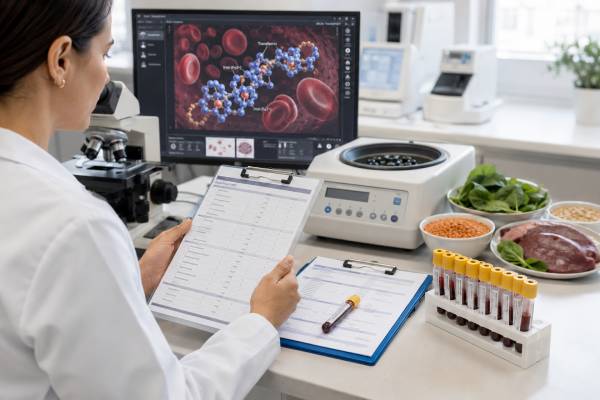
A serum iron test measures the amount of iron circulating in the liquid part of your blood. Most of that iron is attached to transferrin, the main protein that carries iron to the bone marrow, liver, muscles, and other tissues. The result can help show whether too little iron is available, too much iron is circulating, or whether a broader iron panel needs closer review.
Serum iron is useful, but it is also one of the more changeable iron markers. Levels can shift with time of day, recent meals, iron supplements, inflammation, menstrual timing, pregnancy, liver disease, and some medicines. For that reason, a serum iron result is usually interpreted with ferritin, transferrin saturation, total iron-binding capacity, and a complete blood count rather than judged by itself.
- A common adult serum iron range is about 59–158 mcg/dL for males and 37–145 mcg/dL for females, but your lab’s range should guide interpretation.
- Low serum iron can occur with iron deficiency, inflammation, chronic blood loss, pregnancy, poor intake, or poor absorption.
- High serum iron can occur with iron overload, hemochromatosis, liver injury, hemolysis, iron poisoning, or recent iron intake.
- Morning testing and fasting may be recommended because serum iron can vary after meals and across the day.
- Ferritin and transferrin saturation often matter more than serum iron alone when assessing iron stores and iron overload risk.
- Urgent care is needed for possible iron poisoning, especially after accidental or intentional overdose of iron tablets.
Table of Contents
- What Serum Iron Measures
- Serum Iron Normal Range
- How to Prepare for the Test
- What Low Serum Iron Can Mean
- What High Serum Iron Can Mean
- Serum Iron vs Other Iron Tests
- Patterns That Help Interpret Results
- Follow-Up and When to Seek Care
What Serum Iron Measures
Serum iron measures iron that is circulating in the blood at the time the sample is drawn. It does not measure all the iron in your body. Most body iron is inside red blood cells as part of hemoglobin, some is stored as ferritin in the liver and bone marrow, and a smaller amount is being transported through the bloodstream.
That distinction matters. A person can have a normal serum iron level but low iron stores, especially early in iron deficiency. Another person can have low serum iron because inflammation is keeping iron locked away in storage, even when total body iron is not truly low. This is one reason serum iron is rarely the only test used to judge iron status.
Serum iron is often ordered as part of an iron panel. A typical iron panel may include:
- Serum iron
- Ferritin
- Total iron-binding capacity, or TIBC
- Transferrin or transferrin saturation
- Sometimes unsaturated iron-binding capacity, or UIBC
The test is commonly used when someone has symptoms or blood count changes that suggest anemia, iron deficiency, iron overload, chronic inflammation, liver disease, or a problem with iron absorption.
Why serum iron changes so easily
Serum iron is a “snapshot” marker. It can rise or fall over hours, while ferritin and hemoglobin usually change more slowly. Serum iron may be affected by:
- Recent iron supplements or multivitamins with iron
- A recent iron-rich meal
- Time of day, with levels often higher earlier in the day
- Menstrual blood loss
- Pregnancy
- Infection or inflammation
- Liver disease
- Hemolysis, meaning red blood cells breaking down
- Recent blood transfusion
- Certain medicines, including estrogen therapy and some antibiotics
Because of this variability, a mildly low or mildly high result is usually interpreted in context rather than treated as a diagnosis by itself.
Serum Iron Normal Range
Serum iron reference ranges vary by laboratory, sex, age, testing method, and units. A common adult reference range is:
| Group | Common reference range | SI unit equivalent |
|---|---|---|
| Adult males | About 59–158 mcg/dL | About 10.6–28.3 micromol/L |
| Adult females | About 37–145 mcg/dL | About 6.6–25.9 micromol/L |
| Children | Often about 50–120 mcg/dL | Often about 9–21 micromol/L |
| Newborns | Often about 100–250 mcg/dL | Often about 18–45 micromol/L |
These ranges are examples, not universal cutoffs. Your result should be compared with the reference interval printed on your own report. A value just outside the listed range may be less important than a repeated abnormal pattern, a very abnormal result, symptoms, or changes in ferritin, transferrin saturation, hemoglobin, MCV, and liver enzymes.
Serum iron is usually reported in mcg/dL in the United States and micromol/L in many other countries. To convert approximately from mcg/dL to micromol/L, multiply by 0.179. To convert from micromol/L to mcg/dL, multiply by 5.59.
Normal does not always mean iron status is normal
A normal serum iron result can be reassuring, but it does not always rule out early iron deficiency or iron overload. Ferritin may fall before serum iron becomes low in iron deficiency. Transferrin saturation may rise before ferritin becomes very high in some iron overload patterns.
For example, someone with heavy menstrual bleeding may have normal serum iron on one morning blood draw but low ferritin, low energy, restless legs, or a rising red cell distribution width. That pattern may still point toward iron depletion. In that situation, a ferritin blood test is often more informative than serum iron alone.
How to Prepare for the Test
Many clinicians prefer serum iron testing in the morning, often after fasting. Preparation depends on the reason for testing and your clinician’s instructions, but common steps include:
- Ask whether to fast. Some offices recommend no food for about 8–12 hours before an iron panel, especially when serum iron and transferrin saturation are being checked.
- Ask about iron supplements. Do not stop prescribed iron unless your clinician tells you to, but make sure the ordering clinician knows if you take iron tablets, prenatal vitamins, multivitamins, or recent IV iron.
- List medicines and hormones. Birth control pills, estrogen therapy, testosterone, some antibiotics, cholesterol medicines, blood pressure medicines, and other drugs may affect interpretation.
- Avoid comparing tests drawn under different conditions. A fasting morning sample and a nonfasting afternoon sample may not be directly comparable.
- Tell the clinician about recent illness. Infection, inflammation, surgery, or flare-ups of inflammatory disease can change iron markers.
The blood draw itself is simple. A health professional takes blood from a vein, usually in the arm. Mild bruising, soreness, or brief lightheadedness can happen, but serious problems are uncommon.
Why timing matters
Serum iron can be higher in the morning and can rise after recent iron intake. This does not make the test unreliable, but it does mean the collection conditions matter. If a result is unexpected, repeating the iron panel under standardized conditions may be more useful than reacting to a single value.
A practical example: taking an iron tablet the morning of the test may temporarily raise serum iron and transferrin saturation. That result may not reflect your usual iron status. On the other hand, testing during a viral illness may show low serum iron because the body temporarily limits circulating iron as part of the inflammatory response.
What Low Serum Iron Can Mean
Low serum iron means less iron than expected is circulating in the blood at the time of testing. It can occur because the body truly lacks iron, because iron is being held in storage during inflammation, or because iron demand has increased.
Common causes include:
- Iron deficiency from blood loss
- Heavy menstrual bleeding
- Gastrointestinal bleeding, such as from ulcers, polyps, cancer, inflammatory bowel disease, or frequent use of certain pain relievers
- Pregnancy or recent childbirth
- Low dietary iron intake
- Poor absorption from celiac disease, bariatric surgery, inflammatory bowel disease, or low stomach acid in some settings
- Chronic inflammation, chronic kidney disease, heart failure, or infection
- Anemia of chronic disease, also called anemia of inflammation
A low result is easier to understand when ferritin, TIBC, transferrin saturation, and the CBC are reviewed at the same time. The related article on low serum iron focuses more specifically on causes and next steps when this marker is below range.
Low serum iron with iron deficiency
In straightforward iron deficiency, the usual pattern is:
- Low ferritin
- Low serum iron
- High TIBC or high transferrin
- Low transferrin saturation
- Sometimes low hemoglobin, low MCV, low MCH, or high RDW
Early iron deficiency may show low ferritin before anemia appears. Later, hemoglobin can fall and red blood cells may become smaller and paler. That is why clinicians often compare iron studies with a complete blood count.
Iron deficiency is not a final diagnosis by itself. The cause matters. In children, pregnancy, frequent blood donation, or heavy periods, the cause may be fairly clear. In adult men and postmenopausal women, unexplained iron deficiency often needs evaluation for gastrointestinal blood loss unless another cause is obvious.
Low serum iron with inflammation
Inflammation can lower serum iron even when total body iron stores are normal or high. The body increases hepcidin, a hormone that reduces iron absorption and keeps iron stored inside cells. This can produce a pattern sometimes called functional iron deficiency or iron-restricted erythropoiesis.
In this pattern:
- Serum iron is low
- Transferrin saturation is often low
- TIBC or transferrin may be low or normal
- Ferritin may be normal or high because ferritin rises with inflammation
- CRP or other inflammatory markers may be elevated
This is why a normal or high ferritin does not always exclude iron-restricted blood production in chronic inflammatory conditions. The pattern is different from simple iron deficiency, where ferritin is usually low and TIBC is often high.
What High Serum Iron Can Mean
High serum iron means more circulating iron than expected was present when the sample was drawn. A single high value can be caused by recent iron intake, but persistent elevation deserves a closer look, especially when transferrin saturation is also high.
Possible causes include:
- Recent iron tablets, multivitamins with iron, or iron-rich intake before testing
- Iron overload
- Hereditary hemochromatosis
- Repeated blood transfusions
- Some liver diseases, including hepatitis or liver cell injury
- Hemolytic anemia, where red blood cells break down too quickly
- Ineffective red blood cell production in some bone marrow disorders
- Iron poisoning or overdose
- Lab artifact from hemolysis in the sample
The related article on high serum iron gives a more focused review of elevated results and common follow-up testing.
High serum iron and transferrin saturation
Serum iron is often interpreted with transferrin saturation, also called TSAT. TSAT estimates how much of transferrin’s iron-carrying capacity is filled. It is usually calculated from serum iron and TIBC.
A typical adult TSAT range is roughly 20%–50% for males and 15%–45% for females, though labs vary. A persistently high TSAT, especially above about 45%–50%, can raise concern for iron overload or hemochromatosis. The transferrin saturation normal range is often more useful than serum iron alone when the question is iron overload.
Hereditary hemochromatosis is one important cause of iron overload. It is a genetic condition in which the body absorbs too much iron over time. Untreated iron overload can affect the liver, pancreas, heart, joints, endocrine glands, and skin. The diagnosis is not made from serum iron alone; clinicians usually consider TSAT, ferritin, liver tests, family history, symptoms, and sometimes genetic testing.
Iron poisoning is different from a mildly high result
Iron poisoning is an emergency and is usually related to a significant overdose of iron-containing tablets, especially in children. Symptoms can include vomiting, abdominal pain, diarrhea, blood in vomit or stool, drowsiness, shock, or worsening illness after an initial period of improvement.
A mildly high serum iron on routine bloodwork is not the same as acute poisoning. Still, any possible overdose should be handled urgently through emergency services or poison control rather than waiting for routine lab follow-up.
Serum Iron vs Other Iron Tests
Serum iron is one part of iron testing. It becomes much more useful when paired with markers that show iron storage, transport capacity, and red blood cell production.
| Test | What it reflects | How it is commonly used |
|---|---|---|
| Serum iron | Iron circulating in blood at that moment | Helps calculate TSAT and identify low or high circulating iron |
| Ferritin | Iron stores, but also rises with inflammation | Often the most useful first marker for low iron stores |
| TIBC | Blood’s iron-binding capacity, mostly related to transferrin | Often high in iron deficiency and low/normal in inflammation |
| Transferrin saturation | Percentage of iron-binding sites filled | Useful for iron deficiency and iron overload patterns |
| CBC | Hemoglobin, red cell size, red cell variation, and other blood cells | Shows whether iron changes are affecting red blood cell production |
Ferritin and serum iron answer different questions. Serum iron asks, “How much iron is circulating right now?” Ferritin asks, “How much iron appears to be stored?” That difference is why ferritin vs serum iron can be confusing when one marker is normal and the other is not.
TIBC also adds important context. If serum iron is low and TIBC is high, iron deficiency becomes more likely. If serum iron is low and TIBC is low or normal, inflammation or chronic disease becomes more likely. A dedicated TIBC normal range review can help explain that marker in more detail.
Serum iron and ferritin can disagree
Disagreement between serum iron and ferritin is common. Here are a few examples:
- Low serum iron with normal ferritin: may occur with inflammation, recent illness, chronic disease, or early/partial iron deficiency.
- Normal serum iron with low ferritin: may occur in early iron depletion before circulating iron falls.
- High ferritin with normal or low serum iron: may occur with inflammation, liver disease, metabolic syndrome, alcohol-related liver stress, chronic infection, or malignancy.
- High serum iron with normal ferritin: may occur after recent iron intake, early iron overload patterns, hemolysis, or sample issues.
The pattern matters more than any one number. Repeating the test under controlled conditions and adding CRP, liver enzymes, or additional iron markers may clarify the picture.
Patterns That Help Interpret Results
Iron markers are pattern-based tests. A clinician usually looks at how serum iron, ferritin, TIBC, TSAT, hemoglobin, MCV, RDW, symptoms, and medical history fit together.
| Possible pattern | Serum iron | Ferritin | TIBC/transferrin | TSAT |
|---|---|---|---|---|
| Iron deficiency | Low | Low | Often high | Low |
| Inflammation-related iron restriction | Low | Normal or high | Low or normal | Low or low-normal |
| Possible iron overload | High or high-normal | Often high, but may vary early | Low or normal | High |
| Recent iron intake | Temporarily high | Usually unchanged short term | Usually unchanged short term | Temporarily high |
| Pregnancy or estrogen effect | Variable | May be low if iron demand exceeds intake | Often high | May be low |
These patterns are not perfect diagnostic rules. They are starting points. Real cases can be mixed. For example, someone with inflammatory bowel disease may have both blood loss and inflammation. A person with fatty liver disease may have high ferritin from liver inflammation but also low transferrin saturation. A frequent blood donor may have low ferritin before hemoglobin drops.
How CBC results change the interpretation
A CBC shows whether iron availability is affecting red blood cell production. In iron deficiency anemia, hemoglobin may be low, MCV may be low, MCH may be low, and RDW may rise. The pattern may be clearer when hemoglobin and ferritin are interpreted together, especially if symptoms include fatigue, shortness of breath on exertion, dizziness, palpitations, restless legs, brittle nails, hair shedding, or pica.
If hemoglobin is low but serum iron is normal, iron deficiency is still possible, but other causes of anemia also need consideration. B12 deficiency, folate deficiency, kidney disease, chronic inflammation, thalassemia trait, hemolysis, and bone marrow disorders can all affect anemia patterns. This is why iron tests are often interpreted with blood cell indices rather than in isolation.
When repeat testing helps
Repeat testing may help when:
- The sample was drawn after taking iron
- The result does not match symptoms
- Serum iron is abnormal but ferritin and TSAT do not fit
- The person was sick at the time of testing
- The abnormality is mild and unexpected
- Treatment was started and response needs monitoring
For iron deficiency treatment, clinicians often monitor hemoglobin response first, then ferritin or other iron markers later. Ferritin can take longer to recover than hemoglobin because rebuilding iron stores takes time.
Follow-Up and When to Seek Care
Follow-up depends on the full pattern, not serum iron alone. A mildly abnormal serum iron result may only need repeat testing or a complete iron panel. A clearly abnormal pattern, anemia, symptoms, pregnancy, chronic disease, or signs of iron overload may need more specific evaluation.
Reasonable follow-up questions include:
- Was the blood draw fasting and done in the morning?
- Was iron taken within the previous 24–48 hours?
- Are ferritin, TIBC, and TSAT also abnormal?
- Is hemoglobin low, and are red blood cells small or pale?
- Is there heavy menstrual bleeding, recent childbirth, frequent blood donation, or known bleeding?
- Are there digestive symptoms, dark stools, unexplained weight loss, or a history of ulcers, celiac disease, inflammatory bowel disease, or bariatric surgery?
- Are liver enzymes abnormal?
- Is there a family history of hemochromatosis or unexplained liver disease?
When to contact a clinician soon
Contact a healthcare professional for timely follow-up if serum iron is abnormal and you also have:
- Low hemoglobin or suspected anemia
- Shortness of breath, chest discomfort, fainting, or rapid heartbeat
- Black or bloody stools
- Heavy menstrual bleeding
- Unexplained weight loss
- Persistent abdominal pain
- Pregnancy
- Known kidney disease, inflammatory bowel disease, heart failure, liver disease, or cancer
- High transferrin saturation or high ferritin
- A first-degree relative with hereditary hemochromatosis
Seek urgent help for possible iron overdose, severe weakness, fainting, chest pain, severe shortness of breath, vomiting blood, black tarry stools, or symptoms of shock.
What not to do with an abnormal result
Do not start high-dose iron just because serum iron is low. Iron can help when deficiency is present, but it can be harmful or unnecessary if the pattern is due to inflammation, infection, liver disease, thalassemia, or iron overload. Also avoid stopping prescribed iron or other medicines without medical advice.
A safer approach is to confirm the pattern. For suspected deficiency, that often means checking ferritin, TSAT, TIBC, CBC, and the cause of iron loss. For suspected overload, that often means repeating fasting iron studies, checking ferritin and liver enzymes, reviewing supplements and transfusion history, and considering hemochromatosis testing when appropriate.
References
- Serum iron test: MedlinePlus Medical Encyclopedia 2026 (Official Page)
- Iron Tests: MedlinePlus Medical Test 2026 (Official Page)
- Gastrointestinal evaluation of iron deficiency anemia 2020 (Guideline)
- HFE-Related Hemochromatosis 2024 (Review)
- About Hereditary Hemochromatosis 2026 (Official Page)
- WHO guideline on use of ferritin concentrations to assess iron status in individuals and populations 2020 (Guideline)
Disclaimer
Serum iron results should be interpreted with your own lab’s reference range, your symptoms, your medical history, and related tests such as ferritin, transferrin saturation, TIBC, and CBC. This article is for general education and cannot diagnose iron deficiency, anemia, iron overload, or poisoning. Seek urgent medical care or poison control guidance for possible iron overdose or severe symptoms.