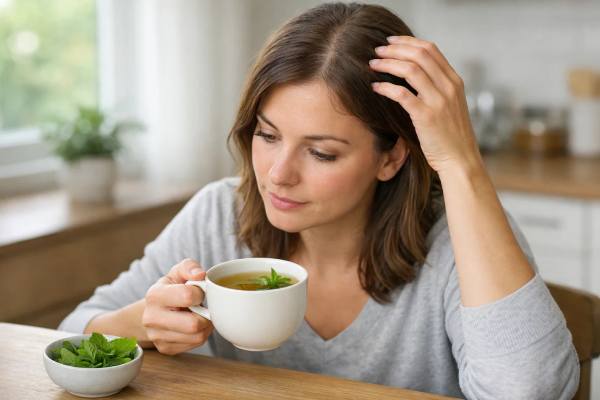
PCOS hair changes can feel especially frustrating because they often move in two directions at once. You may notice more facial hair, more body hair, or acne while also seeing thinner scalp hair, a wider part, or reduced volume at the crown. That mismatch is one reason spearmint tea has attracted so much attention. It is often described as a gentle, natural way to lower androgens and calm the hormone signals that drive unwanted hair growth.
But the leap from “may affect hormones” to “will regrow scalp hair” is much larger than most headlines admit. The human studies on spearmint tea are small, short, and focused more on hormone markers and hirsutism than on scalp-density outcomes. That does not make the idea useless. It simply means the best way to use spearmint tea is as a realistic support, not as a stand-alone solution.
For PCOS-related hair concerns, the smartest question is not whether spearmint tea is promising. It is what it can plausibly do, what it cannot, and how to use it safely.
Quick Facts
- Spearmint tea may modestly improve androgen-related symptoms in some people with PCOS, but direct scalp-hair evidence is limited.
- The best human data suggest hormone shifts over days to weeks, while visible scalp-hair change usually takes months.
- The strongest practical benefit is as a low-intensity adjunct, not a replacement for diagnosis or evidence-based treatment.
- Product quality, strength, and consistency can vary, so “natural” does not automatically mean standardized.
- A realistic trial is usually closer to the small study pattern of two cups daily than to escalating doses or concentrated stacks.
Table of Contents
- How PCOS Changes Hair Patterns
- What Spearmint Tea May Change Hormonally
- Can It Actually Help PCOS Scalp Hair?
- How to Try It Without Overdoing It
- Safety, Side Effects, and Who Should Be Cautious
- When Tea Is Not Enough for Hair Loss
How PCOS Changes Hair Patterns
To understand why spearmint tea gets so much attention, it helps to understand the hair pattern many people with PCOS are trying to change. PCOS often involves hyperandrogenism, which means higher androgen activity than the body would ideally have. That androgen activity can show up in ways that feel contradictory: more terminal hair on the face, chin, chest, or abdomen, but less density on the scalp.
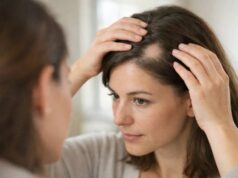
This is not a contradiction inside the follicle. It is a site-specific response. Hair follicles do not all react to hormones in the same way. On the face and body, androgen exposure can stimulate thicker, darker hair. On the scalp, especially at the frontal or crown region, androgen-sensitive follicles may gradually miniaturize. The result can look like slower growth, a wider part, reduced ponytail volume, or a more visible scalp under bright light.
That is why PCOS hair concerns rarely fit into one neat category. Some people have clear female pattern thinning. Others have chronic shedding layered on top of androgen sensitivity. Others mainly notice texture changes and less density around the part. A broader guide to common causes of hair thinning in women can help show where PCOS fits, but the short version is that hormones are only one piece of the story. Insulin resistance, inflammation, sleep disruption, iron status, calorie restriction, and stress can all intensify the picture.
This matters because many readers hear the phrase “anti-androgen” and assume that any androgen-lowering habit should fix scalp hair. Not necessarily. Scalp loss tied to PCOS can overlap with classic female pattern hair loss, and that process is often slow, cumulative, and harder to reverse than mild unwanted facial hair. Even if a habit nudges hormone levels in a favorable direction, it may not be strong enough to shift scalp density in a visible way on its own.
There is also a timing issue. Body-hair and scalp-hair changes do not move at the same speed. Unwanted facial hair reflects follicles that have already been driven toward a coarser pattern. Scalp follicles, meanwhile, operate on a much longer cycle of shedding, resting, and regrowth. That means a strategy can affect hormone markers before it affects what you see in the mirror.
So when people ask whether spearmint tea helps “PCOS hair,” they are often asking about two separate goals: reducing androgen-driven unwanted hair and improving scalp thinning. Those goals overlap, but they are not identical. Any honest article on spearmint has to keep that distinction front and center.
What Spearmint Tea May Change Hormonally
The strongest reason spearmint tea is discussed in PCOS is its possible anti-androgen effect. In small human studies, spearmint tea taken twice daily was associated with reductions in free testosterone over a short period. One early trial in hirsute women used a five-day protocol during the follicular phase. A later randomized trial in women with PCOS used spearmint tea twice a day for 30 days and found reductions in free and total testosterone along with changes in LH and FSH.
That sounds impressive at first glance, and it is the basis for many online hormone claims. But there are three important reality checks.
First, the trials were small. Small trials can be useful for generating interest, but they are not strong enough to settle clinical questions on their own. A hormone shift seen in a small group over a short time does not automatically translate into reliable, repeatable hair improvement for a wider population.
Second, the endpoint was not scalp-hair regrowth. The 30-day randomized study looked at hormone levels, subjective improvement in hirsutism, and Ferriman-Gallwey scoring. Participants reported feeling better about their hair symptoms, but objective hirsutism scores did not significantly improve over that short period. That is an important distinction. A self-perceived improvement can matter, especially when unwanted hair affects quality of life, but it is not the same as a measured change in follicle behavior.
Third, not every hormone claim about spearmint is supported. The evidence suggests a possible effect on androgen-related markers, especially free testosterone, but that is not the same as proof that spearmint blocks DHT in a clinically meaningful way, reverses follicle miniaturization, or works like prescription anti-androgens. Those stronger claims go well beyond what the available human data can support.
A broader review of herbal tea trials in PCOS adds another layer of caution. When researchers pooled several tea studies, they found some encouraging effects in areas like weight, body mass index, fasting glucose, and follicle-stimulating hormone. But the pooled effect on total testosterone was not significant overall. That does not disprove spearmint. It simply reminds us that evidence becomes less dramatic when you move from a single promising trial to a broader clinical view.
The clearest, most accurate summary is this: spearmint tea may modestly shift some hormone markers linked to hyperandrogenism, and that is biologically relevant for PCOS. But the evidence does not show that it reliably produces the level of hormonal change needed to regrow scalp hair in a predictable way. That gap between “possible endocrine effect” and “visible hair result” is where most overselling happens.
Can It Actually Help PCOS Scalp Hair?
This is the question most readers care about, and it deserves a direct answer. Spearmint tea might help PCOS-related scalp hair indirectly, but the direct evidence is weak. There are no strong scalp-hair trials showing that it increases density, reverses a widened part, or reliably thickens miniaturized follicles. Most of the enthusiasm comes from hormone findings and from studies on hirsutism, not from measured scalp outcomes.
That does not mean the idea is unreasonable. It means the benefit, if it happens, is likely to be modest and indirect. If your scalp thinning is being pushed by androgen excess, then even a small reduction in androgen activity could, in theory, make the follicle environment somewhat less hostile. But “less hostile” is not the same as “restored.” Hair follicles already affected by androgen sensitivity often need more than a gentle herbal intervention to produce visible regrowth.
A helpful way to frame the evidence is to separate three possible outcomes.
- Hormone marker change: This is the part with the best support. Small trials suggest spearmint can shift some androgen-related labs.
- Body-hair symptom change: This has limited but somewhat plausible support, especially over a longer time horizon than a four-week trial.
- Scalp-hair regrowth: This remains the weakest claim, because it has not been directly demonstrated in strong human studies.
Hair-cycle timing is a big reason for that. The follicle does not respond on a social-media schedule. A visible change in scalp density usually takes months, not weeks, because follicles need time to move through shedding, resting, and new growth phases. A brief refresher on the normal hair-growth cycle helps explain why a 30-day study can show hormone movement without proving cosmetic scalp improvement.
There is also the question of baseline severity. Someone with mild androgen-related shedding, good iron status, stable nutrition, and early thinning may notice that hair fall feels less active over time. Someone with established female pattern hair loss, insulin resistance, a very high androgen burden, or multiple drivers of shedding may notice nothing at all. The same cup of tea can feel meaningful in one context and irrelevant in another.
The most honest clinical framing is that spearmint tea belongs in the “adjunct” category. It may be worth trying for some readers who want a low-intensity, low-cost routine and whose goals are modest. It is not a dependable stand-alone intervention for scalp regrowth. The farther your hair concern has progressed, the less sensible it is to rely on tea alone.
If you choose to try it, the best expectation is not “this will regrow my hair.” The better expectation is “this may be one supportive habit inside a broader PCOS and hair plan.”
How to Try It Without Overdoing It
If you want to test spearmint tea, the goal should be consistency rather than intensity. The most commonly cited human study pattern is two cups daily, not heavy intake, concentrated extracts, or multiple mint products layered together. That matters because once a remedy becomes trendy, people often drift from a studied routine into a self-designed stack that no trial actually tested.
A sensible trial usually follows a few rules.
First, keep the intervention simple. Use plain spearmint tea, not a mixed “hormone balance” blend with ten herbs, added biotin, iodine, or other ingredients that make the result impossible to interpret. If your hair changes after six weeks, you want to know what you actually changed.
Second, give the trial enough time. A few days may be enough to shift a lab marker, but it is not enough to judge scalp hair. A fair cosmetic trial is usually measured in months. Many readers do better by taking standardized scalp photos every 8 to 12 weeks in the same lighting and with the same part placement. Daily mirror checks are almost guaranteed to create frustration.
Third, do not let tea distract from the rest of the foundation. PCOS-related hair health is strongly influenced by energy balance, protein intake, sleep, insulin resistance, and iron status. A warm herbal routine can be helpful, but it does not cancel out crash dieting, chronically low protein intake, or untreated metabolic strain. That is why readers often get farther when they pair any complementary habit with a broader nutrition and medical strategy.
Fourth, avoid “dose escalation thinking.” There is no good evidence that more cups mean better scalp results. Once people start thinking in that direction, they often move from tea to concentrated powders, extracts, or multi-herb supplements. That is where the risk-benefit balance gets worse.
A practical self-check can help:
- Are you using one simple tea product rather than a complex blend?
- Are you judging progress over 8 to 12 weeks, not 8 to 12 days?
- Are you tracking scalp changes separately from facial-hair changes?
- Are you also addressing sleep, protein, and the broader PCOS picture?
- Are you resisting the urge to add three more “hair” products at the same time?
That last point matters more than it seems. Complementary routines often fail not because they are useless, but because they are buried inside supplement overload. If your plan is getting crowded, a review of common supplement warning signs is often more helpful than adding a new product.
Spearmint tea is most useful when it stays ordinary: one simple habit, one clear reason for using it, and a realistic timeline for judging whether it belongs in your routine.
Safety, Side Effects, and Who Should Be Cautious
Spearmint tea is often described as harmless because it is familiar and food-like. That is partly true, but it can also create a false sense of certainty. The clinical studies that make spearmint look promising were short and small. Short studies are useful for early signals, but they are not strong proof of long-term safety for daily use over many months, especially in people managing a complex hormonal condition.
The first safety point is simple: tea is not automatically standardized. Complementary products can vary in dose, quality, consistency, and what they are combined with. That matters because readers often move from plain tea bags to loose-leaf products, extracts, capsules, or blends marketed for hormones. Those products are not interchangeable. Once the form changes, the actual exposure may change too.
The second point is that “natural anti-androgen” is still a biologically active idea. That is exactly why readers are interested in spearmint in the first place. If you are trying to conceive, are pregnant, are breastfeeding, or are using prescription treatment for PCOS or hair loss, it makes sense to discuss routine use with a clinician rather than assuming a tea-based product is too mild to matter. The same caution applies if you have a complicated medication list or a history of significant liver, kidney, or endocrine problems.
The third point is practical tolerance. Some people simply do not tolerate strong daily herbal regimens well, even when the product is not dangerous in a formal sense. A habit can be technically low risk and still be a poor fit if it causes stomach discomfort, becomes difficult to maintain, or crowds out more important parts of care.
A sensible safety filter looks like this:
- Use plain spearmint tea rather than concentrated formulas unless you have a clear reason not to.
- Avoid mixing several hormone-targeted supplements at once.
- Be extra cautious during fertility treatment, pregnancy, or breastfeeding.
- Reassess the plan if new symptoms appear after starting it.
- Stop treating “more natural” as the same thing as “better studied.”
There is also a subtler safety issue: delay. A very gentle remedy can become unsafe in practice if it keeps someone from addressing a more serious cause of hair loss. That is especially relevant when thinning is rapid, patchy, accompanied by menstrual changes, or severe enough to affect mental well-being. The risk is not the tea itself. The risk is losing time while assuming the tea should have fixed it by now.
For most healthy adults, moderate spearmint tea use appears reasonable. But reasonable is not the same as proven, and supportive is not the same as sufficient. Safety improves when the tea stays simple, the expectations stay modest, and the rest of the medical picture is not ignored.
When Tea Is Not Enough for Hair Loss
Tea is not enough when the hair problem is bigger than the claim. That sounds obvious, but it is often the turning point. Many readers keep asking whether spearmint “works” when the real question is whether they are treating the right problem at all.
PCOS-related thinning can overlap with female pattern hair loss, chronic telogen effluvium, iron deficiency, thyroid disease, medication effects, rapid weight loss, or severe psychological stress. If you are missing one of those drivers, a gentle hormone-support habit may not do very much. That is why persistent hair loss deserves a clearer workup than “I have PCOS, so it must be hormones.”
Clues that you need more than tea include:
- Shedding that is heavy, sudden, or ongoing for several months
- Progressive widening of the part or crown visibility
- Patchy loss, eyebrow loss, scalp pain, or marked itching
- Irregular or absent periods with worsening acne or hirsutism
- Signs of anemia, restrictive eating, or recent major weight change
- Significant distress, avoidance, or loss of confidence because of the hair change
In those situations, the next step is usually a targeted medical evaluation, not a stronger tea routine. That often includes reviewing ferritin, thyroid status, androgen patterns, prolactin when indicated, and the overall PCOS phenotype. A practical overview of common blood tests used in hair-loss workups can help you understand what clinicians are looking for and why.
This is also where expectations about treatment matter. Evidence-based care for PCOS-related hair thinning may include lifestyle treatment, insulin-resistance management, prescription anti-androgens, topical or oral minoxidil, or other tailored options depending on age, pregnancy plans, and the pattern of hair loss. Spearmint tea may still have a place inside that plan, but it should not delay it.
One of the most useful mindset shifts is to stop asking whether spearmint tea is “enough” in the abstract. Ask instead: enough for what? Enough to feel proactive? Possibly. Enough to support a broader routine? Sometimes. Enough to reverse established scalp thinning in every person with PCOS? No.
That is not a failure of spearmint tea. It is a reminder that hair loss is rarely one-dimensional. The more clearly you define the type of hair problem you have, the easier it becomes to decide whether tea belongs in the plan, or whether it is time to move from supportive care to more targeted treatment.
References
- Recommendations From the 2023 International Evidence-based Guideline for the Assessment and Management of Polycystic Ovary Syndrome 2023 (Guideline)
- Association of Herbal Tea and Follicle-Stimulating Hormone, Anthropometric Parameters, and Fasting Blood Glucose Levels Among Polycystic Ovary Syndrome Women: A Systematic Review and Meta-Analysis of Clinical Trials 2024 (Systematic Review)
- Bi-directional association between female pattern hair loss and polycystic ovary syndrome: A systematic review and meta-analysis 2025 (Systematic Review)
- Spearmint herbal tea has significant anti-androgen effects in polycystic ovarian syndrome. A randomized controlled trial 2010 (RCT)
- Effect of spearmint (Mentha spicata Labiatae) teas on androgen levels in women with hirsutism 2007 (Clinical Trial)
Disclaimer
This article is for educational purposes only and is not personal medical advice. PCOS-related hair changes can overlap with other causes of hair loss, including female pattern hair loss, iron deficiency, thyroid disease, medication effects, recent illness, and nutritional stress. Spearmint tea may be a reasonable complementary option for some adults, but it is not a substitute for diagnosis, lab evaluation when indicated, or evidence-based treatment. If your thinning is rapid, patchy, worsening, or causing significant distress, seek medical guidance rather than relying on tea alone.
If this article was useful, please share it on Facebook, X, or another platform your audience trusts.