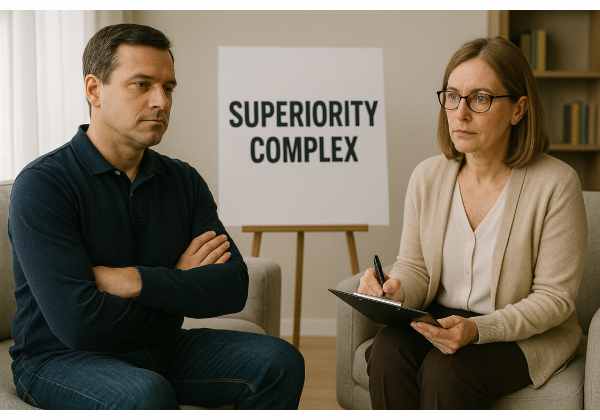
A superiority complex is a pattern of thinking and behavior in which a person acts as though they are better, more capable, more important, or more deserving than other people. The term is often used casually, but in mental health it is best understood as a descriptive concept rather than a formal diagnosis.
A person with this pattern may seem arrogant, dismissive, entitled, competitive, or unable to tolerate criticism. Underneath, the behavior may reflect fragile self-worth, deep insecurity, shame, fear of being ordinary, or a long-standing need to feel protected from feelings of inferiority. In some people, superiority-like behavior is mild and situation-specific. In others, it becomes rigid enough to damage relationships, work, judgment, and emotional stability.
Table of Contents
- What superiority complex means
- Symptoms and signs
- Superiority complex vs confidence and narcissism
- Causes and developmental factors
- Risk factors and related patterns
- Effects on relationships, work, and self-image
- Complications and urgent warning signs
- Diagnostic context and clinical evaluation
What superiority complex means
A superiority complex means more than simple confidence or pride. It describes an exaggerated sense of personal importance that often protects the person from feeling inadequate, vulnerable, dependent, embarrassed, or emotionally exposed.
The concept is strongly associated with Alfred Adler’s individual psychology. In that framework, feelings of inferiority are a normal part of human development: people notice limitations, compare themselves with others, and try to become more capable. That healthy striving can support growth. A superiority complex is different because the person does not simply aim to improve; they inflate their self-image, devalue others, or deny ordinary limits in order to feel secure.
This distinction matters because the outward behavior can be misleading. A person may appear intensely self-assured while being highly reactive to criticism. They may insist they are exceptional while feeling threatened by anyone who seems more skilled, admired, attractive, wealthy, educated, or socially accepted. They may talk as if they do not care what others think, yet organize much of their behavior around status, dominance, recognition, or avoiding humiliation.
A superiority complex is not a diagnosis in the way major depressive disorder, bipolar disorder, or narcissistic personality disorder are diagnoses. It is a psychological description. Clinicians may consider it alongside broader questions about personality functioning, self-esteem regulation, emotional defenses, attachment history, trauma, mood symptoms, substance use, and interpersonal impairment. When the pattern is pervasive, rigid, and harmful, it may overlap with diagnosable conditions or personality traits that warrant a more formal assessment.
In everyday life, a superiority complex can appear in different degrees. A person might show it only in one setting, such as work, academics, parenting, sports, politics, religion, social status, appearance, or money. Another person may show a broader pattern across many areas of life. The more fixed, automatic, and damaging the pattern becomes, the more clinically important it is.
A useful way to understand the pattern is this: the person’s self-worth depends on staying above others. Equality may feel unsafe. Feedback may feel like humiliation. Other people’s success may feel like a personal threat. Admitting uncertainty may feel unbearable. Because of this, the person may try to manage discomfort by dominating conversations, dismissing other perspectives, exaggerating accomplishments, or framing ordinary disagreement as proof that others are stupid, jealous, weak, or inferior.
Symptoms and signs
The most recognizable signs of a superiority complex are exaggerated self-importance, contempt toward others, and difficulty tolerating criticism. The pattern usually becomes clearer through repeated behavior, not one isolated arrogant comment.
Common signs can include:
- Speaking as though ordinary rules, expectations, or limits should not apply to them
- Exaggerating achievements, intelligence, attractiveness, moral purity, status, talent, or influence
- Correcting, interrupting, or lecturing others in a condescending way
- Treating disagreement as ignorance, jealousy, disloyalty, or disrespect
- Needing to win, dominate, or be seen as the most competent person in the room
- Dismissing other people’s feelings, needs, or expertise
- Name-dropping, status-signaling, or overemphasizing elite affiliations
- Becoming defensive, contemptuous, withdrawn, or angry when criticized
- Blaming others for failures while taking excessive credit for success
- Mocking people who seem less educated, less wealthy, less attractive, less productive, or less powerful
- Comparing constantly, even in casual situations
- Avoiding situations where they might appear average, inexperienced, or wrong
Some signs are more subtle. A person may not openly brag, but may communicate superiority through tone, facial expression, sarcasm, selective attention, or “helpful” advice that carries contempt. They may appear calm and refined while quietly making others feel small. They may present themselves as uniquely rational, uniquely ethical, uniquely misunderstood, or uniquely burdened by the incompetence of everyone around them.
The emotional signs are also important. People with superiority-like patterns may show intense sensitivity to perceived slights. Minor feedback can lead to shame, rage, contempt, cold withdrawal, or a need to retaliate verbally. They may replay criticisms for days, insist they were “disrespected,” or reinterpret neutral comments as attacks on their worth.
Not every person with these traits is loud or openly grandiose. Some present as quietly superior, morally elevated, intellectually untouchable, or chronically unimpressed. Others use vulnerability in a self-elevating way, implying that no one has suffered, understood, sacrificed, or developed insight as deeply as they have. The common thread is not the specific style; it is the need to maintain a position above others.
A superiority complex can also coexist with insecurity. The person may secretly fear being exposed as inadequate, ordinary, replaceable, unattractive, unintelligent, or unloved. This inner vulnerability may never be stated directly. Instead, it may appear as criticism of others, perfectionism, envy, competitiveness, contempt, or refusal to acknowledge mistakes.
Superiority complex vs confidence and narcissism
A superiority complex is not the same as healthy confidence, and it is not automatically the same as narcissistic personality disorder. The differences depend on flexibility, empathy, impairment, motivation, and how the person responds when their self-image is challenged.
Healthy confidence is usually reality-based. A confident person can recognize strengths without needing to degrade others. They can accept feedback, admit mistakes, learn from people with different skills, and tolerate not being exceptional in every area. Their self-respect does not require someone else to be inferior.
A superiority complex is more defensive. The person may need to feel above others to remain emotionally steady. Their confidence may collapse or turn hostile when challenged. They may confuse vulnerability with weakness and equality with loss of status.
Narcissistic personality disorder is a formal psychiatric diagnosis involving a persistent pattern of grandiosity, need for admiration, lack of empathy, and impairment across contexts. A superiority complex may resemble narcissistic traits, but the terms should not be used interchangeably. Some people show superiority-like defenses without meeting criteria for a personality disorder. Others may have narcissistic traits as part of a broader clinical picture. A careful personality disorder assessment looks at long-term patterns, impairment, self-functioning, interpersonal functioning, and differential diagnosis rather than relying on labels.
| Pattern | Typical self-view | Response to feedback | Impact on others |
|---|---|---|---|
| Healthy confidence | Realistic awareness of strengths and limits | Can consider feedback without major threat to identity | Usually respectful, collaborative, and flexible |
| Superiority complex | Inflated or defensive sense of being above others | May react with contempt, defensiveness, shame, or anger | Can make others feel dismissed, judged, or controlled |
| Narcissistic personality disorder | Pervasive grandiosity, need for admiration, and fragile self-esteem | Often highly sensitive to criticism, failure, or perceived humiliation | May cause significant relationship, occupational, or social impairment |
It is also important not to confuse superiority with temporary pride, ambition, leadership, assertiveness, or high achievement. A surgeon, executive, athlete, artist, parent, teacher, or student can be highly skilled and direct without having a superiority complex. The concern increases when status, dominance, entitlement, and devaluation become the person’s main way of relating to others.
Other conditions can also produce behavior that looks superficially superior. During mania or hypomania, for example, a person may show inflated self-esteem, excessive confidence, pressured speech, risky decisions, and reduced need for sleep. That pattern belongs in a different diagnostic context, and clinicians may consider bipolar symptom screening when grandiosity appears with major changes in energy, sleep, impulsivity, or mood.
Delusions of grandeur are different as well. A person with a delusion may hold fixed false beliefs about having extraordinary powers, identity, mission, wealth, fame, or divine status despite clear evidence to the contrary. That requires a different level of concern and may be evaluated within a psychosis evaluation when hallucinations, disorganized thinking, paranoia, or loss of reality testing are present.
Causes and developmental factors
A superiority complex can develop when a person learns to protect self-worth by feeling above others. No single cause explains every case, and the pattern usually reflects a mix of temperament, family environment, social learning, emotional injury, and reinforcement over time.
One common pathway involves deep feelings of inferiority. A child, teen, or adult who repeatedly feels inadequate may compensate by imagining themselves as exceptional. If the person cannot tolerate shame, helplessness, dependence, or ordinary limitations, superiority can become a psychological shield. Instead of thinking, “I feel small right now,” the person may think, “Everyone else is beneath me.”
Early family dynamics can contribute. Some people grow up with harsh criticism, humiliation, emotional neglect, bullying, comparison with siblings, or pressure to perform. Others grow up with unrealistic praise, overindulgence, or the message that they are special in a way that places them above ordinary accountability. These environments are different, but both can interfere with stable self-worth.
Developmental experiences that may contribute include:
- Being valued mainly for achievement, appearance, intelligence, status, or obedience
- Frequent criticism, shaming, teasing, or comparison
- Conditional approval that depends on being impressive or successful
- Family modeling of contempt, elitism, dominance, or emotional coldness
- Overpraise that does not match effort, empathy, or realistic ability
- Social rejection, bullying, exclusion, or chronic humiliation
- Trauma that leaves the person feeling powerless and determined never to feel powerless again
- Cultural or peer environments that reward status, image, aggression, or domination
Trauma and adversity do not automatically lead to superiority-like behavior. Many people respond to adversity with empathy, caution, anxiety, withdrawal, perfectionism, depression, or people-pleasing instead. Still, for some, superiority becomes a way to stay emotionally armored. A broader discussion of how early experiences can shape adult relationships appears in childhood trauma and adult relationship patterns.
Temperament may also matter. Some people are naturally more sensitive to shame, competition, rejection, or social rank. Others may have high dominance, low agreeableness, high reward-seeking, or intense emotional reactivity. These traits do not determine destiny, but they can influence how a person responds to insecurity and social comparison.
Social reinforcement can make the pattern stronger. If arrogance gets rewarded with promotions, attention, fear, compliance, romantic interest, online status, or peer approval, the person may learn that superiority works. Over time, the behavior can become less conscious and more automatic. The person may not experience themselves as defensive; they may simply believe their own elevated self-story.
Risk factors and related patterns
Risk factors for a superiority complex include unstable self-esteem, chronic comparison, shame sensitivity, status-focused environments, and repeated reinforcement of entitled or contemptuous behavior. The pattern is more likely to become problematic when it is rigid, persistent, and used across many relationships.
A person may be at higher risk when they have a long history of feeling inadequate but cannot safely acknowledge it. This can happen in families, schools, workplaces, sports, religious communities, social media spaces, or peer groups where worth is measured narrowly. If being ordinary feels unacceptable, superiority may become a way to avoid emotional collapse.
Relevant risk factors can include:
- Fragile self-esteem that depends heavily on external validation
- Strong fear of humiliation, failure, rejection, or being “found out”
- Perfectionistic standards tied to identity rather than values
- Envy of others’ success, attractiveness, relationships, or recognition
- Frequent social comparison, especially in competitive environments
- Early experiences of being admired for status but not known emotionally
- Limited practice with apology, accountability, compromise, or mutuality
- Family or cultural messages that rank people by wealth, education, beauty, power, or prestige
- Repeated success in environments where intimidation or arrogance is rewarded
- Co-occurring depression, anxiety, trauma symptoms, substance misuse, or personality-related difficulties
Superiority-like behavior can overlap with several broader psychological patterns. It may appear with narcissistic traits, antisocial traits, histrionic traits, obsessive perfectionism, shame-based defensiveness, insecure attachment, or certain trauma responses. It may also appear during specific mood states, intoxication, withdrawal, or high-stress periods.
This does not mean every arrogant person has a mental health condition. Personality is shaped by context, and some people behave condescendingly because they learned poor interpersonal habits, lack feedback, hold rigid beliefs, or occupy social positions where others rarely challenge them. The clinical question is whether the pattern is enduring, inflexible, harmful, and connected to impairment.
A related issue is insight. Some people know they act superior but feel unable to stop. Others see the problem only as other people’s jealousy, weakness, incompetence, or oversensitivity. Low insight can increase risk because the person may not recognize how often they create conflict or emotional distance. In formal assessment, clinicians often look at whether a person can reflect on their role in repeated problems, not just whether they can describe other people’s faults.
Effects on relationships, work, and self-image
A superiority complex can damage relationships by replacing mutual respect with ranking, control, criticism, or emotional one-upmanship. Even when the person is talented or successful, the interpersonal cost can be high.
In close relationships, the pattern may make emotional intimacy difficult. Partners, friends, children, or relatives may feel judged, corrected, dismissed, or used as an audience. The person with superiority-like behavior may expect admiration but offer little curiosity in return. They may struggle to apologize without adding blame, minimize others’ hurt, or frame ordinary needs as weakness.
Common relationship effects include:
- Frequent arguments about respect, tone, fairness, or accountability
- Others feeling they must “walk on eggshells” around criticism
- Emotional distance because vulnerability is treated as weakness
- Power struggles over who is right, competent, or in control
- Difficulty repairing conflict after hurtful comments
- One-sided conversations focused on the person’s achievements, views, or grievances
- Envy or resentment when others receive attention
- Loss of trust when apologies are absent, strategic, or incomplete
In work or school settings, a superiority complex can create a different set of problems. The person may be skilled, ambitious, and persuasive, but also difficult to collaborate with. They may dismiss colleagues, resist supervision, take credit, blame teams for setbacks, or ignore input from people they consider lower status. When they are in leadership roles, their behavior can shape the emotional climate around them.
The effects are not always obvious at first. Some people with superiority-like patterns perform well in competitive environments where confidence, decisiveness, and self-promotion are rewarded. Problems may emerge later when teamwork, humility, mentoring, ethical judgment, or long-term trust become more important than image.
Internally, superiority can be exhausting. Maintaining an elevated self-image takes effort. The person may constantly monitor status, scan for disrespect, compare themselves with others, and avoid situations that could reveal uncertainty. They may feel brief relief when admired but quickly return to insecurity, irritation, or the need for another win.
Self-image may become narrow and unstable. Instead of feeling valuable as a whole person, the person may feel valuable only when superior. This can make aging, failure, illness, rejection, unemployment, criticism, or loss of status especially destabilizing. When the “above others” position is threatened, the person may experience shame, rage, emptiness, anxiety, depression, or desperate attempts to restore the old self-image.
Complications and urgent warning signs
The main complications of a superiority complex involve relationship breakdown, impaired judgment, emotional volatility, social isolation, and worsening mental health symptoms. The risk is higher when the person cannot tolerate criticism, refuses accountability, or reacts aggressively to perceived humiliation.
Possible complications include:
- Chronic conflict with partners, relatives, coworkers, or peers
- Repeated job, school, or leadership problems despite ability
- Social isolation after others withdraw from contempt or criticism
- Escalating envy, resentment, or preoccupation with status
- Risky decisions made to prove superiority or avoid appearing weak
- Verbal aggression, intimidation, bullying, or coercive behavior
- Depression or anxiety after failure, rejection, public criticism, or loss of admiration
- Substance misuse used to manage shame, anger, loneliness, or pressure
- Legal, academic, or workplace consequences from entitlement or exploitation
- Worsening of co-occurring personality, mood, trauma, or psychotic symptoms
A superiority complex may also interfere with accurate self-perception. If a person cannot admit mistakes, they may repeat them. If they cannot recognize others’ expertise, they may reject useful information. If they believe rules do not apply to them, they may cross boundaries that harm others or create serious consequences.
Urgent professional evaluation may be needed when superiority-like behavior appears with severe mood changes, threats, violence, stalking, coercive control, paranoia, hallucinations, delusional beliefs, suicidal thoughts, self-harm, inability to sleep for days, reckless behavior, or substance-related danger. In those situations, the concern is no longer just arrogance or interpersonal difficulty; it may involve immediate safety or loss of reality testing. Guidance on red-flag situations is discussed more fully in ER-level mental health warning signs.
Another serious complication is harm to people around the person. Superiority-driven behavior can become emotionally abusive when it includes humiliation, intimidation, isolation, threats, financial control, gaslighting, or repeated degradation. Not every superiority complex leads to abuse, and not every harmful relationship involves a superiority complex, but contempt and entitlement are important warning signs when they become persistent.
It is also possible for the person with superiority-like traits to suffer significantly. They may feel lonely, misunderstood, constantly attacked, or unable to relax. They may lose relationships and opportunities without understanding why. They may experience painful shame after failures but cover it quickly with blame or disdain. This mixture of outward arrogance and inner distress is one reason careful assessment is more useful than casual labeling.
Diagnostic context and clinical evaluation
A superiority complex is not diagnosed by a single test, and it is not a stand-alone disorder in major diagnostic manuals. In clinical settings, the focus is usually on the person’s long-term patterns, level of impairment, emotional functioning, relationship history, and whether another mental health condition better explains the behavior.
A clinician may explore questions such as:
- How long has the superiority-like behavior been present?
- Does it occur across many settings or only in one role or relationship?
- Does the person show empathy, accountability, and flexibility at times?
- How do they respond to criticism, failure, embarrassment, or rejection?
- Are there signs of mood episodes, psychosis, trauma symptoms, substance use, or cognitive changes?
- Is the pattern causing distress, relationship breakdown, work impairment, legal problems, or safety concerns?
- Do other people describe a consistent pattern that the person does not recognize?
- Are there cultural, occupational, developmental, or family factors that affect how the behavior is interpreted?
This is where the difference between screening and diagnosis matters. A questionnaire can highlight traits, but it cannot fully determine the meaning of a person’s behavior. A diagnosis, when relevant, depends on clinical judgment, history, context, impairment, and differential diagnosis. The distinction is explained in screening versus diagnosis in mental health.
A mental health evaluation may include conversation about current symptoms, developmental history, relationship patterns, family history, school or work functioning, trauma exposure, substance use, medical issues, and risk. In some cases, collateral information from a partner, family member, or previous clinician can be useful, especially when insight is limited or accounts differ sharply. A general description of this process appears in what happens during a mental health evaluation.
Clinical evaluation also considers what the behavior is not. Persistent arrogance is different from a manic episode. Entitlement is different from a fixed delusion. Social awkwardness is different from contempt. Cultural confidence is different from impaired empathy. Defensive pride after humiliation is different from a pervasive personality pattern. These distinctions reduce the risk of mislabeling someone and help identify when symptoms point to a broader condition.
Different professionals may be involved depending on the question. Psychiatrists, psychologists, clinical social workers, counselors, and neuropsychologists have different roles in assessment and diagnosis. The differences are outlined in who diagnoses what in mental health.
The most useful takeaway is that “superiority complex” should be used carefully. It can describe a real and damaging pattern, but it should not be used as a casual insult or a substitute for evaluation. The more the pattern causes harm, impairment, safety concerns, or confusion about possible mood, psychotic, trauma-related, or personality-related symptoms, the more important it is to look beyond the label and examine the full clinical picture.
References
- Adlerian Therapy 2024 (Clinical Review)
- Narcissistic Personality Disorder 2024 (Clinical Review)
- Evidence-Based Assessment of Personality Disorder 2024 (Review)
- The ICD-11 classification of personality disorders 2022 (Review)
- What Is Narcissistic Personality Disorder? 2024 (Professional Organization)
- Narcissistic Personality Disorder (NPD) 2026 (Clinical Reference)
Disclaimer
This article is for general educational purposes only and is not a substitute for professional medical advice, diagnosis, or treatment. Superiority-like behavior can have many causes, and only a qualified mental health professional can evaluate whether it reflects a broader mental health condition or safety concern.
Thank you for taking the time to read this sensitive topic; sharing it with someone who may find it useful can help support more thoughtful conversations about mental health and relationships.