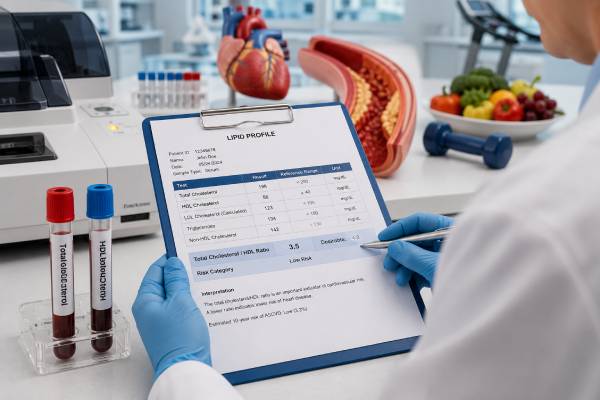
The total cholesterol/HDL ratio test compares all cholesterol in the blood with HDL cholesterol, the lipoprotein often linked with cholesterol removal from arteries. The result can give a quick sense of cholesterol balance: a lower ratio usually reflects a healthier mix of lower atherogenic cholesterol and higher HDL, while a higher ratio often points to more plaque-forming cholesterol, low HDL, or both. This ratio is usually calculated from a standard lipid panel rather than ordered as a separate blood test. It can be useful for screening and risk estimation, but it should not be read alone. LDL cholesterol, non-HDL cholesterol, triglycerides, blood pressure, diabetes status, smoking, age, family history, and previous cardiovascular disease all change how much a ratio means for one person. A high ratio is not an emergency by itself, but it is a reason to look more closely at cardiovascular risk and the habits, conditions, or medications that may be affecting lipid levels.
- The total cholesterol/HDL ratio is calculated by dividing total cholesterol by HDL cholesterol; a result of 200 mg/dL ÷ 50 mg/dL equals 4.0.
- A ratio below 3.5 is often considered favorable, around 3.5–4.9 is commonly acceptable or average, and 5.0 or higher suggests higher cardiovascular risk.
- A high ratio usually means total cholesterol is too high, HDL is too low, or both; LDL, VLDL, remnant cholesterol, and triglyceride-rich particles may be contributing.
- Fasting is often not needed for the ratio itself, but some clinicians request an 8–12 hour fast when triglycerides are high or when a fasting lipid panel is needed.
- Follow-up is most important when the ratio is high together with high LDL, high non-HDL cholesterol, diabetes, smoking, high blood pressure, kidney disease, or a family history of early heart disease.
Table of Contents
- What the Total Cholesterol/HDL Ratio Measures
- Normal Range and Result Meaning
- How to Calculate the Ratio
- Why a High Ratio Raises Heart Risk
- Causes of a High Total Cholesterol/HDL Ratio
- Testing Preparation and Result Accuracy
- What to Do After a High Ratio
- How the Ratio Fits With Other Cholesterol and Risk Markers
What the Total Cholesterol/HDL Ratio Measures
The total cholesterol/HDL ratio measures the relationship between all cholesterol in your blood and the portion carried by HDL particles. It is written as a number, such as 3.2, 4.5, or 6.1. A lower number usually means a larger share of your cholesterol is carried in HDL relative to the total amount.
Total cholesterol includes cholesterol carried by several lipoproteins. LDL cholesterol is the main plaque-forming cholesterol measured on a standard lipid panel. VLDL and remnant particles also contribute to atherosclerosis, especially when triglycerides are high. HDL cholesterol is different because HDL particles are involved in reverse cholesterol transport, a process that helps move cholesterol away from tissues and toward the liver.
That is why the ratio can sometimes tell a clearer story than total cholesterol alone. A total cholesterol of 210 mg/dL may look mildly high, but its meaning changes depending on HDL. If HDL is 70 mg/dL, the ratio is 3.0, which looks favorable. If HDL is 35 mg/dL, the ratio is 6.0, which suggests a much less favorable cholesterol pattern.
The ratio is not a direct measurement of plaque, artery narrowing, or future heart attack risk. It is a screening and risk-estimation number. It works best when read with the full lipid panel, personal risk factors, and clinical history.
Normal Range and Result Meaning
A lower total cholesterol/HDL ratio is generally better. Many clinicians consider a ratio below 3.5 favorable, while a ratio of 5.0 or higher usually points to increased cardiovascular risk. Some labs use slightly different cutoffs, and risk calculators may treat the ratio as one part of a broader risk score rather than as a stand-alone “normal” or “abnormal” result.
| Ratio result | Common interpretation | What it may suggest |
|---|---|---|
| Below 3.5 | Favorable | Often reflects lower total cholesterol, higher HDL, or both |
| 3.5–4.9 | Acceptable to average for many adults | Risk depends strongly on LDL, non-HDL cholesterol, blood pressure, diabetes, smoking, and age |
| 5.0–5.9 | High | Often reflects low HDL, high LDL/non-HDL cholesterol, high triglycerides, or metabolic risk |
| 6.0 or higher | Very high | Needs closer cardiovascular risk review and usually follow-up lipid management |
These ranges are useful for orientation, but they are not treatment targets in the same way LDL cholesterol or non-HDL cholesterol targets may be used. A person with known coronary artery disease can have a ratio that looks decent while still needing aggressive LDL lowering. Another person with a high ratio may mainly have low HDL, but medication decisions may still depend more on LDL cholesterol, non-HDL cholesterol, ApoB, and total cardiovascular risk.
Adult lipid values that often support a healthier ratio include total cholesterol below 200 mg/dL, LDL cholesterol below 100 mg/dL for many lower-risk adults, non-HDL cholesterol below 130 mg/dL, triglycerides below 150 mg/dL, and HDL cholesterol at least 40 mg/dL in men or 50 mg/dL in women. HDL around 60 mg/dL or higher is often considered favorable, although very high HDL is not always protective.
A ratio can also look high when total cholesterol is only mildly elevated if HDL is low. For example, a total cholesterol of 190 mg/dL with HDL of 32 mg/dL gives a ratio of 5.9. The total cholesterol may not appear alarming, but the ratio shows an unfavorable balance.
How to Calculate the Ratio
The calculation is simple: divide total cholesterol by HDL cholesterol. The ratio has no unit because both numbers use the same unit.
Formula: total cholesterol ÷ HDL cholesterol = total cholesterol/HDL ratio
For example:
- Total cholesterol 180 mg/dL and HDL 60 mg/dL: 180 ÷ 60 = 3.0
- Total cholesterol 220 mg/dL and HDL 55 mg/dL: 220 ÷ 55 = 4.0
- Total cholesterol 240 mg/dL and HDL 40 mg/dL: 240 ÷ 40 = 6.0
- Total cholesterol 200 mg/dL and HDL 35 mg/dL: 200 ÷ 35 = 5.7
The same calculation works with mmol/L. A total cholesterol of 5.2 mmol/L and HDL of 1.3 mmol/L gives a ratio of 4.0. Do not mix units; both numbers must be in mg/dL or both must be in mmol/L.
Most lab reports calculate the ratio automatically. If it is not listed, you can calculate it from the total cholesterol and HDL values on your lipid panel. If either number looks unusual, repeat testing may be needed before making major decisions.
This ratio is closely related to, but different from, the LDL/HDL ratio. The LDL/HDL ratio compares LDL directly with HDL, while the total cholesterol/HDL ratio includes LDL, HDL, VLDL, and other cholesterol-containing particles. That broader numerator is one reason the total cholesterol/HDL ratio can rise when triglyceride-rich particles are high.
Why a High Ratio Raises Heart Risk
A high total cholesterol/HDL ratio usually means the blood contains too much cholesterol carried in atherogenic particles compared with HDL. Atherogenic particles are lipoproteins that can enter artery walls and contribute to plaque buildup. Over time, plaque can narrow arteries, inflame the vessel wall, and increase the chance of heart attack, stroke, or peripheral artery disease.
LDL particles are the best-known contributors to plaque. VLDL remnants and other triglyceride-rich remnants can also be harmful because they carry cholesterol into artery walls. HDL is usually associated with lower risk because it participates in cholesterol transport and reflects several favorable metabolic patterns, including better insulin sensitivity and lower triglycerides in many people.
The ratio becomes high through three main patterns:
- High total cholesterol with normal HDL: This often points to high LDL, high non-HDL cholesterol, or inherited cholesterol elevation.
- Normal or mildly high total cholesterol with low HDL: This pattern is common with insulin resistance, abdominal weight gain, smoking, physical inactivity, and high triglycerides.
- High total cholesterol with low HDL: This is often the most concerning pattern because both sides of the ratio move in the wrong direction.
A high ratio does not show exactly which particles are high. That is why the full lipid panel matters. If total cholesterol is high, the next step is to look at LDL, non-HDL cholesterol, triglycerides, and sometimes ApoB. ApoB can be especially helpful because it estimates the number of atherogenic particles rather than the amount of cholesterol inside them.
The ratio also does not include important non-lipid risks. A ratio of 4.2 may carry different meaning in a 28-year-old nonsmoker with normal blood pressure than in a 62-year-old smoker with diabetes and high blood pressure. Cardiovascular risk comes from the combination of lipid exposure, blood pressure, glucose metabolism, inflammation, genetics, age, sex, kidney function, and lifestyle.
Causes of a High Total Cholesterol/HDL Ratio
A high ratio usually comes from high total cholesterol, low HDL, or both. The cause may be lifestyle-related, genetic, metabolic, hormonal, medication-related, or a mix of several factors.
Common lifestyle and metabolic causes
Diet patterns high in saturated fat, trans fat, processed meats, butter, cream, fried foods, and many ultra-processed snacks can raise LDL and total cholesterol. Diets high in refined carbohydrates, sugary drinks, and excess alcohol can raise triglycerides and often lower HDL, especially in people with insulin resistance.
Physical inactivity can lower HDL and worsen triglycerides, blood pressure, body weight, and insulin sensitivity. Smoking tends to lower HDL and damage the artery wall, making cholesterol-related risk more dangerous. Poor sleep, untreated sleep apnea, and chronic stress may also worsen metabolic health, even when they are not the only cause of abnormal cholesterol.
Insulin resistance is one of the most common patterns behind a high ratio. It often appears with high triglycerides, low HDL, abdominal weight gain, fatty liver, prediabetes, or type 2 diabetes. A person with this pattern may also have a high triglyceride/HDL ratio, which can point toward metabolic risk even before glucose reaches the diabetes range.
Medical and genetic causes
Some people inherit cholesterol patterns that raise total cholesterol from childhood or young adulthood. Familial hypercholesterolemia can cause very high LDL cholesterol, sometimes 190 mg/dL or higher in adults, and can sharply increase early heart disease risk. Family history is especially important when a parent, sibling, or child had a heart attack, stroke, stent, or bypass surgery at a young age.
Other medical causes include hypothyroidism, kidney disease, nephrotic syndrome, cholestatic liver disease, menopause-related lipid changes, pregnancy, and some inflammatory conditions. Diabetes, fatty liver disease, and metabolic syndrome often drive high triglycerides, low HDL, and higher non-HDL cholesterol. When these conditions are present, the ratio may improve only when the underlying condition is addressed.
Medication and hormone effects
Some medications can worsen cholesterol or triglyceride patterns in certain people. Examples include some older beta blockers, thiazide diuretics at higher doses, oral corticosteroids, certain antipsychotics, some HIV medicines, isotretinoin, anabolic steroids, and some hormone therapies. The effect varies by drug, dose, duration, and personal risk.
Do not stop a prescribed medicine because of a cholesterol result without medical advice. The safer approach is to ask whether the medication could be contributing, whether an alternative exists, and whether lipid treatment or lifestyle changes are more appropriate.
Testing Preparation and Result Accuracy
The total cholesterol/HDL ratio is calculated from a blood sample, usually as part of a lipid panel. Many lipid panels can be done non-fasting, especially for routine screening. Fasting may still be requested when triglycerides are very high, when a previous result was unexpected, when a clinician needs a fasting baseline, or when the lab or local protocol requires it.
If fasting is requested, the usual fasting window is 8–12 hours. Water is allowed unless your clinician gives different instructions. Continue prescribed medicines unless you are specifically told otherwise.
Several factors can temporarily shift lipid results:
- A recent major illness, infection, surgery, or inflammatory flare
- Heavy alcohol intake in the days before the test
- A large dietary change shortly before testing
- Pregnancy or the months after delivery
- Major weight loss or weight gain
- Recent starting, stopping, or changing of medications
- Poorly controlled diabetes or thyroid disease
- Lab variation or sample handling error
A single abnormal ratio should be interpreted calmly. If the result is surprising, repeating the lipid panel can help confirm whether the number is persistent. A repeat test is also common after lifestyle changes or cholesterol-lowering therapy, often after enough time has passed for levels to stabilize.
Home cholesterol tests and finger-stick screening tests can be useful for awareness, but medical decisions usually rely on a laboratory lipid panel. If a screening result is high, confirm it with a standard blood test that reports total cholesterol, HDL, LDL, triglycerides, and preferably non-HDL cholesterol.
What to Do After a High Ratio
A high ratio is a signal to review the full cardiovascular picture. The first step is to identify which part of the ratio is driving the result: high total cholesterol, low HDL, or both. Then compare the ratio with LDL cholesterol, non-HDL cholesterol, triglycerides, blood pressure, glucose or A1c, smoking status, family history, kidney function, weight pattern, and any known artery disease.
For many people, the most effective changes are not aimed at “raising HDL” alone. Trials have not shown that simply raising HDL with medication reliably lowers cardiovascular events. Better results come from lowering LDL and non-HDL cholesterol, improving triglycerides when elevated, treating blood pressure and diabetes, stopping smoking, and building sustainable eating and activity patterns.
A heart-supportive plan often includes:
- Replacing butter, lard, fatty meats, and high-fat dairy with olive oil, nuts, seeds, avocado, fish, and other unsaturated fat sources
- Eating more soluble fiber from oats, barley, beans, lentils, psyllium, apples, and vegetables
- Choosing minimally processed carbohydrates instead of sugary drinks, white bread, pastries, and refined snacks
- Eating fish or other omega-3-rich foods regularly when appropriate
- Limiting alcohol, especially if triglycerides are high
- Doing at least 150 minutes per week of moderate aerobic activity, plus resistance training when possible
- Stopping smoking and avoiding nicotine exposure
- Losing 5–10% of body weight when excess abdominal weight is contributing to insulin resistance
Medication may be appropriate when LDL cholesterol is high, cardiovascular risk is elevated, diabetes is present, familial hypercholesterolemia is suspected, or there is already known atherosclerotic cardiovascular disease. Statins are commonly used because they lower LDL and reduce cardiovascular events. Ezetimibe, PCSK9 inhibitors, bempedoic acid, inclisiran, and other therapies may be considered in selected situations.
Seek urgent care for symptoms of a heart attack or stroke, not for the ratio number itself. Chest pressure, shortness of breath, pain spreading to the arm or jaw, sudden weakness on one side, trouble speaking, sudden vision loss, or severe unexplained dizziness needs emergency evaluation.
How the Ratio Fits With Other Cholesterol and Risk Markers
The total cholesterol/HDL ratio is useful, but it is only one lens. Modern lipid care often places more weight on LDL cholesterol, non-HDL cholesterol, ApoB, triglycerides, and overall risk calculation.
LDL cholesterol remains a major treatment focus because lowering LDL lowers cardiovascular events. Many adults start by comparing their LDL result with standard ranges, but people with diabetes, previous heart attack or stroke, very high risk, or familial hypercholesterolemia often need lower LDL levels than average-risk adults. A person can learn more about LDL interpretation through LDL cholesterol targets when reviewing a lipid panel.
Non-HDL cholesterol is total cholesterol minus HDL cholesterol. It includes LDL, VLDL, IDL, remnants, and other atherogenic cholesterol. It is especially useful when triglycerides are elevated because it captures cholesterol in triglyceride-rich particles. In many routine situations, non-HDL cholesterol gives a clearer picture of atherogenic cholesterol burden than total cholesterol alone.
ApoB measures the main protein found on atherogenic particles. One ApoB molecule generally corresponds to one atherogenic particle, so ApoB can reveal high particle number even when LDL cholesterol does not look severe. This is common in insulin resistance, high triglycerides, and some mixed lipid disorders.
Lipoprotein(a), or Lp(a), is a mostly inherited risk marker. A high Lp(a) level can raise cardiovascular risk even when the total cholesterol/HDL ratio is not high. Many people only need it checked once because the level is largely genetic. It is especially worth discussing when there is premature heart disease in the family or unexplained cardiovascular disease despite ordinary cholesterol numbers.
The total cholesterol/HDL ratio can still be helpful because it is simple, familiar, and included in some cardiovascular risk tools. It also gives patients a quick way to see whether the cholesterol pattern is improving. If total cholesterol drops from 240 to 190 mg/dL while HDL stays at 50 mg/dL, the ratio improves from 4.8 to 3.8. If HDL rises and triglycerides fall through exercise, weight loss, or improved insulin sensitivity, the ratio may improve further.
The safest interpretation is balanced: a favorable ratio is reassuring, but it does not erase high LDL, high ApoB, high Lp(a), diabetes, smoking, or high blood pressure. A high ratio is concerning, but it becomes much more useful when it leads to a clear review of the full lipid panel and modifiable risk factors.
References
- Cholesterol ratio or non-HDL cholesterol: Which is most important? 2024 (Expert Answer)
- Cholesterol Levels: What You Need to Know 2025 (Official Resource)
- Testing for Cholesterol 2024 (Official Guidance)
- What Your Cholesterol Levels Mean 2026 (Official Resource)
- 2021 ESC Guidelines on cardiovascular disease prevention in clinical practice 2021 (Guideline)
- 2022 ACC ECDP on Role of Nonstatin Therapies for LDL-C Lowering 2022 (Guideline Summary)
Disclaimer
The total cholesterol/HDL ratio can help estimate cholesterol-related risk, but it cannot diagnose heart disease or determine treatment by itself. Results should be interpreted with a clinician who can review the full lipid panel, medical history, medications, family history, and overall cardiovascular risk. Seek emergency care for symptoms of heart attack or stroke, even if recent cholesterol results seemed normal.