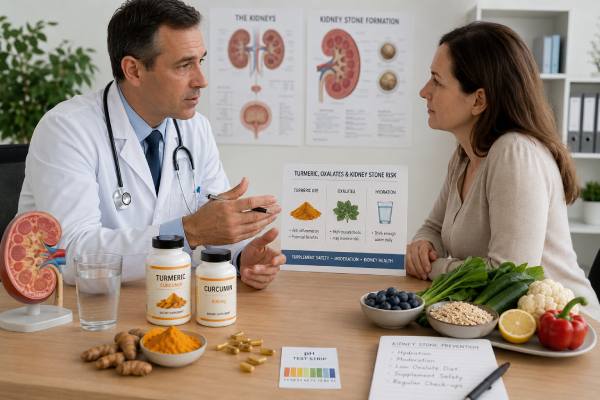
Turmeric is a useful spice, but it deserves a closer look if you form calcium oxalate kidney stones. The issue is not the bright yellow color, the curry flavor, or the fact that turmeric comes from a plant. The issue is oxalate, a natural compound that binds with calcium and forms the most common type of kidney stone.
A pinch of turmeric in food is very different from using turmeric powder by the teaspoon, taking concentrated curcumin capsules, or drinking daily “wellness shots” made with large amounts of spice. The dose, the form, your stone history, your urine test results, and whether you take it with a meal all change the risk.
This guide explains when turmeric is usually reasonable as a food seasoning, when supplements become a problem, how oxalates fit into stone risk, and what to do if you want the flavor without raising your chances of another stone.
Table of Contents
- Quick answer: is turmeric bad for kidney stones?
- Why oxalates in turmeric matter
- Food turmeric vs turmeric supplements
- Who should be most careful with turmeric?
- How to use turmeric more safely if you get stones
- What matters more than turmeric for stone prevention
- Testing, supplement labels, and practical decisions
- Bottom line
Quick answer: is turmeric bad for kidney stones?
Turmeric is not automatically “bad” for everyone with kidney stones. Small culinary amounts are usually not the main problem. The concern rises when turmeric is used like a supplement instead of a seasoning.
The clearest practical distinction is this: a light sprinkle in a pot of soup, rice, lentils, eggs, or curry is a food choice. One or more teaspoons of turmeric powder every day, turmeric capsules, concentrated curcumin formulas, and turmeric drinks taken for a health effect are supplement-style use. That second pattern adds a larger and more regular oxalate load.
Most kidney stones are calcium-based, and calcium oxalate stones are especially common. If your stone was calcium oxalate, or your 24-hour urine test showed high urine oxalate, turmeric deserves more attention than it does for someone with a different stone type and normal urine oxalate. A general guide to calcium oxalate stones helps explain why diet changes focus on both oxalate and calcium rather than oxalate alone.
A practical answer looks like this:
| Turmeric use | Typical concern level | Why it matters |
|---|---|---|
| Small amount used in cooking | Low for most people | The total oxalate dose is usually modest, especially when eaten with a meal that contains calcium. |
| Daily golden milk or tea with large spoonfuls | Moderate to high | The portion is larger, repeated, and often taken apart from a balanced meal. |
| Turmeric powder taken by the teaspoon as a home remedy | High for calcium oxalate stone formers | Ground turmeric is concentrated enough to add a meaningful oxalate load. |
| Curcumin or turmeric capsules | Varies, but caution is sensible | Labels differ widely, and enhanced-absorption products add supplement safety questions beyond oxalate. |
The safest rule for stone-prone readers is simple: use turmeric as a spice, not as a daily high-dose treatment, unless your clinician or dietitian has reviewed your stone type, urine oxalate level, kidney function, medications, and supplement label.
Why oxalates in turmeric matter
Oxalate is a natural substance found in many plant foods. Your body also makes some oxalate on its own. Once oxalate reaches the urine, it binds with calcium. If the urine is concentrated or the balance of stone inhibitors is low, calcium oxalate crystals form and grow into stones.
That does not mean every high-oxalate food must disappear from the diet. Many high-oxalate foods are nutritious. The goal is to reduce the biggest, most frequent oxalate loads and pair oxalate-containing foods with enough calcium at meals. Calcium in the gut binds oxalate before it reaches the urine. This is why stone prevention advice usually favors normal dietary calcium rather than a very low-calcium diet.
Turmeric stands out because it is a dried spice. Drying removes water and concentrates plant compounds. A teaspoon does not look like much on a spoon, but it represents a dense amount of plant material. Turmeric has also been measured as relatively high in total oxalate, with a large soluble portion. Soluble oxalate is the form that is more available for absorption.
This is why turmeric behaves differently from many casual seasonings. A pinch used for color in scrambled eggs is minor. A heaping teaspoon stirred into a drink every morning is a repeated oxalate dose. If that drink is taken without calcium-containing food, more of the oxalate is available for absorption.
Why “natural” does not mean stone-safe
Turmeric’s health reputation often comes from curcumin, a group of compounds studied for anti-inflammatory effects. That reputation leads people to take turmeric in amounts far beyond normal cooking. The kidney stone issue comes from the whole product, not from the marketing language around it.
A common mistake is comparing turmeric to ordinary food seasoning rather than to other concentrated plant powders. Someone might avoid spinach because they know it is high in oxalate, then add large spoonfuls of turmeric to smoothies, tea, or capsules without counting it. For a calcium oxalate stone former, that tradeoff makes little sense.
Another mistake is focusing only on the ingredient name. “Turmeric,” “curcumin,” “turmeric extract,” “Curcuma longa,” and “curcuminoids” are related terms, but they do not always mean the same oxalate exposure. Ground turmeric powder contains the whole dried spice. A purified curcumin extract contains concentrated active compounds and less whole spice material, but labels do not always make the oxalate content clear. Some products combine turmeric powder, extract, black pepper extract, ginger, greens powders, vitamin C, or other ingredients that matter for stone risk.
Food turmeric vs turmeric supplements
Food use is usually occasional, smaller, and eaten with other ingredients. Supplement use is usually daily, larger, and taken for a promised effect. That difference matters more than the word “turmeric” itself.
In cooking, turmeric often appears as ¼ to ½ teaspoon spread across several servings. A pot of lentil soup, chicken curry, rice, roasted cauliflower, or chickpea stew might contain enough turmeric to give color and flavor, but each serving gets only part of the total amount. The meal also often includes yogurt, milk, cheese, tofu set with calcium, or other calcium-containing foods that help bind oxalate in the gut.
Supplement-style use looks different. A capsule might be taken once or twice daily. A homemade drink might contain a full teaspoon in one serving. A “wellness shot” might combine turmeric with black pepper for absorption. A smoothie might include turmeric plus spinach, almond butter, cacao, beet powder, or other high-oxalate ingredients. Each choice looks small alone, but the daily pattern adds up.
The best comparison is not turmeric versus no turmeric. It is normal food seasoning versus concentrated routine dosing.
Ground turmeric powder
Ground turmeric is the form most directly tied to oxalate load because it is the whole dried spice. If you use it in cooking, measure it for a week. Many people discover that their actual intake is either tiny or much larger than they thought.
A small kitchen habit helps: use a measuring spoon instead of shaking freely from the jar when making a daily drink or repeated recipe. A rounded spoonful becomes a different dose from a level ¼ teaspoon. For someone trying to reduce urinary oxalate, that difference is meaningful.
Curcumin capsules and extracts
Curcumin capsules are not automatically safer or riskier than ground turmeric from a stone standpoint because formulas vary. Some are mostly curcuminoid extract. Others include turmeric root powder. Some add piperine, also called black pepper extract, to increase absorption. Some use liposomal, phytosome, or other enhanced-absorption systems.
For kidney stone prevention, the label questions are practical:
- Does it list turmeric root powder, turmeric extract, curcuminoids, or a blend?
- How many milligrams are in the daily serving?
- Does it include black pepper extract or piperine?
- Does it include vitamin C, greens powder, beetroot, cacao, or other oxalate-relevant ingredients?
- Is it third-party tested for quality?
Curcumin supplements also raise non-stone safety issues. High-dose or enhanced-absorption turmeric products have been linked with digestive side effects and rare liver injury reports. They also deserve extra caution in people who take blood thinners, have gallbladder disease, are scheduled for surgery, are pregnant, or take several medications.
Turmeric drinks, shots, and smoothies
Turmeric drinks often create the biggest hidden exposure because they feel like food but are used like supplements. A latte made occasionally with a small amount of turmeric is different from a daily drink with a full teaspoon of powder.
The risk rises further when the drink stacks several stone-relevant ingredients. A smoothie with turmeric, spinach, almond milk, almond butter, chia seeds, cacao, and high-dose vitamin C powder brings several oxalate or stone-risk issues together. Someone trying to lower urine oxalate does better with a simpler drink: water, milk or calcium-fortified milk alternative, a small amount of turmeric for flavor, and no extra high-oxalate powders.
Who should be most careful with turmeric?
The people who need the most caution are not everyone who enjoys curry. They are people whose stone pattern or medical history makes extra oxalate more risky.
Be especially careful with turmeric supplements or large daily turmeric drinks if you have had a calcium oxalate stone, repeated kidney stones, high urine oxalate on a 24-hour urine test, low urine volume, low urine citrate, chronic diarrhea, inflammatory bowel disease, bariatric surgery, fat malabsorption, or reduced kidney function. In these situations, extra absorbed oxalate has a clearer path to becoming a problem.
Chronic diarrhea and malabsorption deserve special attention. When fat is not absorbed well, calcium in the gut binds fat instead of oxalate. More free oxalate is then absorbed and sent to the kidneys. This is one reason people with bowel disease, certain surgeries, pancreatic problems, or long-term diarrhea often need more specific stone guidance than “drink more water.”
People with chronic kidney disease should avoid experimenting with high-dose supplements without medical guidance. Reduced kidney function changes the margin of safety for many products, especially when supplements affect electrolytes, fluid balance, bleeding risk, liver function, or medication levels. A broader explanation of CKD diet basics is useful because kidney nutrition advice changes when filtration is reduced.
Stone formers with high urine oxalate
If your 24-hour urine test shows high oxalate, turmeric belongs on your review list along with spinach, almonds, cashews, rhubarb, beets, bran, cacao, chocolate, and high-oxalate powders. The point is not to panic over one spice. The point is to find the repeat exposures that keep urine oxalate high.
A person who uses turmeric once a week in dinner probably has bigger targets elsewhere. A person who takes turmeric capsules, drinks turmeric tea every morning, and uses almond-heavy smoothies has a clearer reason to cut back.
People taking vitamin C or other supplements
High-dose vitamin C increases oxalate production in the body. Combining high-dose vitamin C with turmeric powder or turmeric supplements is a poor choice for calcium oxalate stone formers unless a clinician has a specific reason for it. The same caution applies to supplement stacks that include collagen powders, greens powders, beetroot powder, cacao, or “detox” blends. If your supplement routine is long, simplify it before fine-tuning minor foods. A guide to vitamin C and kidney stones explains why dose matters.
How to use turmeric more safely if you get stones
You do not always need to remove turmeric completely. A better approach is to control portion, frequency, form, and meal pairing.
Use turmeric mainly in cooked food, not as a standalone daily powder. Keep the amount modest: enough to flavor the recipe, not enough to act like a supplement. For many home recipes, ¼ to ½ teaspoon across multiple servings gives plenty of color. If a recipe calls for 1 to 2 tablespoons, treat it as a high-turmeric recipe and consider reducing the amount if you form calcium oxalate stones.
Eat turmeric-containing foods with a meal that includes calcium. This does not require a calcium pill for everyone. Yogurt with a meal, milk, kefir, calcium-set tofu, canned salmon with bones, cheese in a reasonable portion, or a calcium-fortified plant milk all help bind oxalate in the gut. This is the same practical strategy used for other oxalate-containing foods. The key is timing: calcium works best when it is in the gut at the same time as the oxalate. For a deeper explanation, see calcium with meals for oxalates.
Drink enough fluid throughout the day so urine stays diluted. Turmeric does not form a stone by itself. Stones form when urine chemistry favors crystal growth. Concentrated urine makes that easier. A person who uses a little turmeric in food and drinks enough fluid has a different risk profile from someone who takes turmeric powder daily and stays mildly dehydrated.
Limit turmeric capsules unless there is a clear reason to take them. “Inflammation support” is too vague to justify a daily supplement in a stone former with high urine oxalate. If you use a supplement because a clinician recommended it for a specific condition, bring the actual bottle to your appointment and ask whether it fits your stone prevention plan.
A simple turmeric checklist for stone-prone people
Use this quick check before making turmeric a daily habit:
- Have I had a calcium oxalate stone?
- Has a 24-hour urine test shown high oxalate?
- Am I taking turmeric by capsule, spoonful, shot, or smoothie rather than as seasoning?
- Am I also using high-dose vitamin C, greens powders, almond-heavy foods, cacao, or spinach smoothies?
- Do I have chronic diarrhea, bowel disease, bariatric surgery, or reduced kidney function?
- Am I taking blood thinners, diabetes medicines, or several prescriptions?
If several answers are yes, turmeric supplements are not a casual choice. Review them with a clinician or kidney-stone dietitian.
What matters more than turmeric for stone prevention
Turmeric is one piece of a larger stone-prevention plan. Removing turmeric while keeping low fluid intake, high sodium meals, frequent cola, very high animal protein intake, and low dietary calcium will not solve the main problem.
The most important prevention target is urine dilution. Many guidelines aim for enough fluid to produce about 2.5 liters of urine per day in adults who are advised to increase fluids. That usually means drinking steadily, not chugging water once at night. Pale yellow urine through much of the day is a useful rough sign, though supplements and vitamins change urine color.
Sodium is another major lever. High salt intake increases calcium in the urine. That extra urinary calcium has more chance to bind with oxalate or phosphate. Restaurant meals, deli meats, packaged soups, instant noodles, salty snacks, frozen meals, sauces, and fast food often contribute more sodium than the salt shaker. A person who lowers sodium often improves stone risk without needing an extreme diet. The connection between high sodium and kidney stones is direct enough that it belongs near the top of most prevention plans.
Normal dietary calcium is also protective for many calcium oxalate stone formers. This surprises people because the stone contains calcium. The key is location. Calcium in the gut binds oxalate and reduces absorption. Calcium in the urine contributes to stones when urine is concentrated or other risk factors are present. Cutting calcium too low often backfires.
Animal protein portions matter too. Large amounts of meat, poultry, fish, and protein supplements increase acid load, lower urine citrate, and raise stone risk in susceptible people. This does not mean everyone needs a vegetarian diet. It means portions should be reasonable, spread across meals, and balanced with fruits, vegetables, and calcium-containing foods.
Citrate is another protector. Citrate binds calcium in urine and makes stones less likely to form. Lemon and lime juice add citrate for some people, while prescription potassium citrate is used when urine citrate is low or urine pH needs medical adjustment. Food approaches and medication approaches are not interchangeable, so testing matters.
Oxalate control should be targeted, not extreme
A low-oxalate diet works best when it focuses on the highest-impact foods and habits. Trying to remove every trace of oxalate makes the diet stressful and often less healthy. Many people do better by cutting the biggest sources: spinach smoothies, almond flour baked goods, large nut portions, rhubarb, beet greens, bran-heavy cereals, cacao-heavy powders, and high-oxalate supplement blends.
Turmeric fits into that same logic. Occasional food use is rarely the first target. Daily spoonfuls, capsules, or drinks deserve attention. A practical low-oxalate diet should leave room for balanced meals, not turn eating into a long list of forbidden foods.
Testing, supplement labels, and practical decisions
The best way to know whether turmeric matters for you is to look at your actual stone risk profile. A stone analysis tells you what the stone was made of. A 24-hour urine test shows urine volume, calcium, oxalate, citrate, uric acid, sodium, pH, and other factors. Without those details, people often focus on the wrong target.
Ask about a 24-hour urine test if you have recurrent stones, a calcium oxalate stone, stones at a young age, a strong family history, one kidney, chronic kidney disease, bowel disease, bariatric surgery, or stones despite making basic diet changes. The test is also useful when you want to know whether a change worked. You can compare results before and after adjusting fluids, sodium, calcium timing, oxalate sources, or supplements. A practical guide to the 24-hour urine test for kidney stones explains what the collection measures and why preparation matters.
Supplement labels need careful reading. Do not rely on front-label claims such as “joint support,” “inflammation balance,” “extra strength,” or “clean ingredients.” Turn the bottle over and look at the serving size, milligrams per serving, ingredient form, and added absorption enhancers.
Piperine, the active compound in black pepper extract, is common in curcumin products because it increases absorption. That is the selling point, but stronger absorption also means a stronger supplement exposure. For someone taking multiple medications or dealing with liver, gallbladder, bleeding, or kidney concerns, this is not a minor detail.
Also check whether the product includes vitamin C. Some immune or antioxidant blends combine turmeric with vitamin C, citrus bioflavonoids, greens, or fruit powders. That might sound harmless, but high-dose vitamin C is relevant to oxalate production. A product can be marketed for general wellness while still being a poor fit for someone who forms calcium oxalate stones.
What to bring to your appointment
Bring the actual supplement bottle or a clear photo of the Supplement Facts panel. Also bring a simple list of how often you use turmeric in food and drinks. A useful note looks like this:
- “Turmeric capsule, 1,000 mg daily, includes black pepper extract.”
- “Golden milk, 1 teaspoon turmeric powder, 5 mornings per week.”
- “Curry or lentils with ½ teaspoon turmeric in the whole recipe, once weekly.”
- “Smoothie with turmeric, spinach, almond butter, and vitamin C powder.”
This level of detail helps your clinician or dietitian separate low-risk food use from a real oxalate pattern.
Bottom line
Turmeric is best treated as a spice if you are prone to calcium oxalate kidney stones. Use small amounts in meals, avoid large daily spoonfuls, be cautious with capsules, and do not combine turmeric-heavy routines with other high-oxalate supplement habits.
The highest-risk pattern is not the occasional curry. It is the daily wellness routine: turmeric powder in drinks, turmeric capsules with black pepper extract, spinach or almond smoothies, high-dose vitamin C, low fluid intake, and no attention to calcium timing. That pattern creates repeated oxalate exposure and often hides behind the word “natural.”
If you have never had a stone and use turmeric only in cooking, there is usually no reason to fear it. If you have calcium oxalate stones, high urine oxalate, recurrent stones, chronic diarrhea, bowel disease, bariatric surgery, chronic kidney disease, or a long supplement list, treat turmeric supplements as something to review rather than something to start casually.
A good stone-prevention plan is bigger than one spice. Keep urine diluted, reduce sodium, eat normal calcium with meals, moderate animal protein, target the largest oxalate sources, and use testing to guide decisions. Turmeric then becomes a manageable detail, not a mystery or a panic button.
References
- Effect of cinnamon and turmeric on urinary oxalate excretion, plasma lipids, and plasma glucose in healthy subjects 2008 (Clinical Study)
- Oxalate nephropathy and chronic turmeric supplementation 2024 (Case Report)
- Oxalate nephropathy: a review 2021 (Review)
- Prevention of Recurrent Kidney Stones: A CARI Guidelines Summary 2026 (Guideline Summary)
- Prevention of Recurrent Nephrolithiasis in Adults and Children: A Systematic Review 2026 (Systematic Review)
- EAU Guidelines on Urolithiasis 2025 (Guideline)
Disclaimer
This article is for education and does not diagnose the cause of kidney stones or replace care from a qualified clinician. If you have recurrent stones, chronic kidney disease, bowel disease, bariatric surgery, high urine oxalate, or use turmeric supplements with medications, review your plan with a urologist, nephrologist, physician, or kidney-stone dietitian. Seek urgent care for fever with stone pain, uncontrolled vomiting, severe one-sided pain, inability to urinate, or signs of infection.