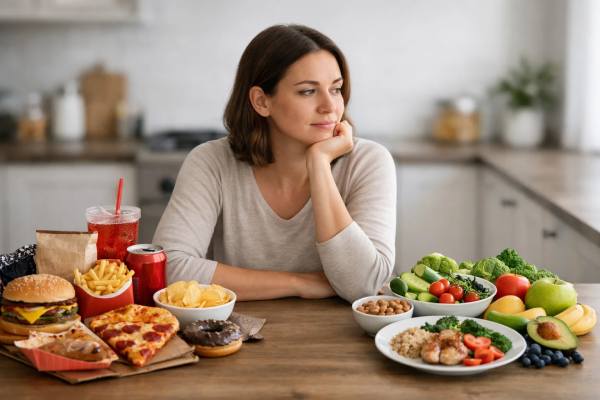
For many people, “eat less processed food” sounds sensible but vague. It becomes more relevant when the conversation turns to hormone health, because ultra-processed foods do not just affect calories on paper. They can influence how quickly you digest a meal, how hard your pancreas has to work, how full you feel afterward, and how often you end up chasing another snack an hour later. Over time, that pattern can shape insulin levels, appetite regulation, body fat distribution, and metabolic risk in ways that feel hormonal even before lab work changes.
That does not mean every packaged food is harmful or that one protein bar will derail your endocrine health. It means degree of processing matters, especially when meals are built mostly from foods designed to be convenient, hyper-palatable, and easy to overeat. The goal is not fear. It is clarity. This article explains what ultra-processed foods are, how they can affect insulin and appetite signals, what the strongest evidence actually shows, and which practical swaps tend to make the biggest difference.
Brief Summary
- Ultra-processed foods can make insulin and blood sugar control harder by combining refined carbohydrates, low fiber, and easy-to-overeat textures.
- They often weaken fullness by increasing eating speed, energy density, and reward value rather than by changing one single hormone in isolation.
- The strongest evidence links higher intake to weight gain, type 2 diabetes risk, and worse cardiometabolic patterns, not to every hormone claim made online.
- Start by replacing the most repeated daily items first, such as sugary breakfast foods, sweet drinks, and packaged snacks, rather than trying to eliminate everything at once.
Table of Contents
- What Counts as Ultra-Processed
- How They Affect Insulin
- Why Appetite Signals Get Louder
- What the Evidence Really Shows
- What to Swap First
- How to Make It Sustainable
What Counts as Ultra-Processed
Before talking about hormone health, it helps to define the term. Ultra-processed foods are not simply foods that have been cooked, frozen, canned, or packaged. Most food is processed in some way. Washing spinach, grinding oats, pasteurizing milk, freezing berries, or canning beans all count as processing. None of that automatically makes a food a problem. Ultra-processed foods are different because they are industrial formulations built largely from refined ingredients, extracted components, additives, flavor systems, emulsifiers, colorings, sweeteners, and textures designed for convenience, shelf life, and easy consumption.
Common examples include sugary breakfast cereals, packaged pastries, candy, soda, energy drinks, many chips and crackers, instant noodles, some frozen meals, sweetened yogurts with long ingredient lists, flavored coffee drinks, processed meats, and many snack bars marketed as health foods. These products are often fast to eat, highly palatable, and easy to consume in large amounts without feeling physically full in the same way you would after a meal built from minimally processed foods.
What matters for hormones is not that these foods are “toxic” in a cartoonish sense. It is that they are often structured in ways the body handles differently. A meal made from intact grains, beans, eggs, fruit, vegetables, nuts, or plain dairy usually asks more of digestion. It slows you down. It delivers more fiber, protein, water, and chewing. An ultra-processed meal often does the opposite. It concentrates energy while reducing friction.
This is also where a lot of confusion starts. Not every packaged food is ultra-processed. Plain Greek yogurt, canned lentils, frozen vegetables, tofu, canned tuna, roasted nuts, and whole-grain bread may all be processed but still useful and metabolically reasonable. A practical way to think about the difference is to ask two questions:
- Does this still look like food I could recognize in a kitchen?
- Is this mainly built from refined starches, sugars, oils, additives, and flavor systems designed to make me keep eating?
The point is not to become perfect at classification. The point is to notice patterns. If a large share of your daily intake comes from foods that are soft, sweet, salty, crunchy, rapid to eat, and low in fiber and protein, the endocrine consequences are more likely to add up.
This is one reason people with repeated blood sugar spikes, afternoon crashes, and constant snacking often benefit from looking at food structure, not just calories. Ultra-processed foods change how the body experiences a meal, and that is where hormone health starts to become relevant. The issue is less “packaged versus homemade” and more “easy-to-overconsume industrial formula versus food that still behaves like food.”
How They Affect Insulin
Insulin is one of the clearest hormone systems affected by a diet high in ultra-processed foods. Not because every ultra-processed food causes an immediate dramatic blood sugar crisis, but because many of these foods create the conditions that make insulin work harder over and over again. They are often rich in refined carbohydrates, low in fiber, low in intact protein, and easy to consume quickly. That combination can produce larger and faster glucose excursions than a meal with more structural resistance built in.
Think about the difference between eating an apple with nuts and eating apple-flavored cereal or a sweet snack bar. On paper, both might contain carbohydrates. In the body, the experience is very different. Whole or minimally processed foods usually arrive with fiber, water, slower eating, and more chewing. Many ultra-processed foods arrive as finely milled starch, added sugar, liquid carbohydrate, or soft textures that digest rapidly and require a stronger insulin response to manage the incoming glucose load.
This does not mean all carbohydrates are bad or that insulin itself is the enemy. Insulin is doing its job. The problem is repetition. If breakfast is sweet cereal, lunch is a packaged sandwich and chips, the afternoon is an energy drink and granola bar, and dinner is a frozen meal followed by dessert, the body spends much of the day reacting rather than coasting. Over time, that pattern may contribute to insulin resistance, higher fasting insulin, more hunger, and easier fat gain, especially when sleep, activity, and stress are already suboptimal.
Liquid calories are especially relevant here. Sweet coffee drinks, soda, juice-like beverages, energy drinks, and even some smoothie products can deliver a lot of quickly absorbed carbohydrate without much satiety. These are some of the least forgiving ultra-processed choices for insulin control because they are easy to consume, weak at producing fullness, and often stacked on top of meals rather than replacing them.
There is also a secondary effect. When a meal is low in fiber and protein and high in refined carbohydrate, the later crash can drive the next craving. People often describe this as poor willpower, but it is often just unstable fuel management. You eat something easy, blood sugar rises fast, insulin rises to manage it, and a few hours later you feel tired, snacky, or mentally preoccupied with food again. This is one reason a more fiber-forward eating pattern can make appetite feel calmer even before weight changes.
The strongest practical lesson is that insulin strain is shaped by food pattern more than by one villain ingredient. A packaged item that contains protein and fiber and fits into a balanced meal is not the same as building your whole day around fast starch, sweet drinks, and low-satiety snacks. Ultra-processed foods become hormonally disruptive when they dominate the rhythm of eating. At that point, insulin is not just responding to one treat. It is responding to a repeated environment of easy glucose, low friction, and poor satiety.
Why Appetite Signals Get Louder
People often assume ultra-processed foods affect appetite because they somehow “break leptin” or “spike ghrelin.” The reality is more interesting and more practical. Appetite signals do involve hormones such as ghrelin, GLP-1, PYY, insulin, leptin, and others, but the everyday effect of ultra-processed foods seems to come less from one single hormonal switch and more from the way these foods change the eating experience itself.
Many ultra-processed foods are soft, crunchy, fast to chew, and easy to swallow quickly. They often pack a lot of calories into a small volume and are engineered to be highly rewarding. That matters because the speed and density of eating influence how soon fullness catches up. If you can eat a large number of calories before stretch, chewing, and gut-based satiety signals have time to build, it becomes much easier to overshoot your needs without noticing in the moment.
This is why people can polish off a bag of chips, sweet cereal, crackers, or ice cream in a way that feels almost frictionless, while a meal of potatoes, eggs, beans, yogurt, fruit, or vegetables tends to slow things down. The second kind of meal creates more physical and sensory stopping points. The first often does not. Appetite hormones are still involved, but they are responding to a food environment that favors rapid intake and weak mechanical satiety.
Another factor is reward. Ultra-processed foods often combine refined starch, fat, sugar, salt, and flavorings in ways that make them more compelling than their minimally processed counterparts. This does not mean your body is broken if you crave them. It means these foods are doing exactly what they were designed to do: keep you interested. When reward is high and satiety is delayed, appetite can feel louder than it otherwise would.
This is also why appetite can remain elevated even when a person is technically eating enough calories. The calories may be arriving in a form that does not create much staying power. Meals low in protein and fiber often disappear from memory quickly. A person may eat a large muffin and sweet coffee at 8 a.m. and still feel hungry by 10:30. That is not a character flaw. It is a predictable response to a low-satiety breakfast.
Some readers also worry that all hunger means something is wrong hormonally. Usually it does not. Hunger is normal. The issue is when the food pattern turns ordinary hunger into chronic noise. A helpful reset is to anchor meals with protein, intact carbohydrates, and volume. Even simple choices such as a more substantial protein-rich breakfast can change the rest of the day’s appetite dramatically.
The most useful takeaway here is that appetite is not managed by discipline alone. It is strongly shaped by food texture, energy density, chewing, fiber, protein, and the speed at which a meal disappears. Ultra-processed foods often make those signals harder to interpret. When people say, “These foods make me hungrier,” that experience is often physiologically real.
What the Evidence Really Shows
The strongest evidence on ultra-processed foods is not that they uniquely destroy every hormone in the body. It is that higher intake is consistently linked to worse metabolic outcomes, and controlled feeding trials show that people tend to eat more and gain more weight when ultra-processed foods dominate the diet. That matters for hormone health because weight gain, visceral fat, insulin resistance, and chronic overeating are themselves major endocrine stressors.
The clearest evidence is strongest in three areas. First, experimental trials show that ultra-processed diets can lead to higher calorie intake and weight gain even when meals are designed to look nutritionally similar on paper. Second, observational and review-level evidence links higher intake to greater risk of obesity, type 2 diabetes, and other cardiometabolic problems. Third, newer trials suggest that reducing the degree of processing, even while following standard healthy eating guidance, can improve weight and some cardiometabolic markers further.
That said, nuance matters. The literature does not support every sweeping social-media claim. Evidence is stronger for insulin burden, weight gain, diabetes risk, and altered satiety than it is for direct causal effects on thyroid hormone, estrogen, testosterone, or cortisol in otherwise healthy adults. Those systems may still be affected indirectly through weight gain, inflammation, sleep disruption, gut changes, or body fat distribution, but that is different from proving that one packaged snack causes a direct endocrine collapse.
This distinction protects readers from two common mistakes. One is dismissing ultra-processed food concerns entirely because some claims are exaggerated. The other is believing that every endocrine problem comes from food processing alone. Good science usually lives in the middle. Higher ultra-processed food intake does appear metabolically disadvantageous, but the body’s response is shaped by the whole pattern: sleep, movement, stress, genetics, meal composition, and how much minimally processed food is still present.
There is also a related but separate issue: packaging and food-contact chemicals. Some ultra-processed foods may come with higher exposure to substances from packaging, inks, or industrial handling, but that is not the same question as the food’s effect on insulin and appetite. It is better understood as an overlapping concern, and readers who want that angle in more detail may find food packaging exposures helpful to review separately.
So what should readers take from the evidence? The most defensible message is this:
- Ultra-processed foods are not harmless just because they fit calorie targets.
- Their effects seem to go beyond nutrients on a label.
- The biggest metabolic concerns are insulin demand, overeating, body fat gain, and diabetes risk.
- Direct hormone claims outside those pathways should be stated more carefully.
That balance is important. It lets you take the issue seriously without turning every packaged food into a villain. The goal is not ideology. It is better metabolic patterning, and the evidence is strong enough to support that aim.
What to Swap First
The fastest way to improve hormone-related eating patterns is not to purge your kitchen. It is to identify the ultra-processed foods you repeat most often and replace those first. Repeated exposures matter more than occasional ones. The breakfast you eat five times a week, the drink you buy every afternoon, and the snack you open every night usually shape insulin and appetite far more than the birthday cake you had on Saturday.
Start with the biggest leverage points.
1. Breakfast
Many people begin the day with ultra-processed foods that are easy but not very filling: sugary cereal, toaster pastries, sweet yogurt, flavored coffee drinks, or a pastry grabbed on the way out the door. Better swaps include:
- Oats with fruit and nuts
- Eggs and toast
- Plain Greek yogurt with berries
- Cottage cheese and fruit
- Leftovers with protein instead of a sweet breakfast
2. Drinks
Sweet beverages often add insulin demand without much fullness. Useful swaps include:
- Sparkling water instead of soda
- Coffee with less sweetener instead of dessert-style coffee drinks
- Unsweetened tea instead of bottled sweet tea
- Whole fruit instead of juice-like drinks
3. Snacks
Packaged snack bars, crackers, chips, and candy often create a fast rise and a fast return of hunger. Better options usually include protein, fiber, or both:
- Fruit with nuts
- Cheese and fruit
- Hummus with carrots
- Yogurt
- Roasted chickpeas
- A sandwich half instead of a snack pile
4. Convenience meals
Frozen pizza, instant noodles, and heavily processed ready meals can be useful in emergencies, but they often underdeliver on satiety. Better swaps do not have to be elaborate:
- Rotisserie chicken with bagged salad
- Pre-cooked rice with beans and avocado
- Frozen vegetables with eggs
- Soup plus a side of protein
- A quick plate built around leftovers
Meal order can help too. Eating protein and fiber earlier in a meal often blunts the “still hungry after eating” problem. That is why some people do well with protein before carbs rather than starting with bread, chips, or dessert.
The key is to swap by function, not by moral labels. Ask what job the ultra-processed food is doing. Is it fast breakfast, sweet reward, portable snack, or comfort dinner? Once you know the job, the replacement becomes easier. A real swap solves the same problem with better satiety. A fake swap simply adds guilt. The most effective replacements are the ones you will actually repeat, especially on ordinary weekdays when convenience matters more than nutrition theory.
How to Make It Sustainable
The biggest mistake people make with ultra-processed foods is turning the topic into a purity project. That usually backfires. Most adults do not need a perfectly minimally processed diet to improve insulin control, appetite stability, and metabolic health. They need a more favorable ratio. If most meals are built from foods with better satiety and slower digestion, occasional ultra-processed foods become much less important.
A sustainable strategy starts with addition before subtraction. Add more protein, more intact carbohydrate, more produce, and more fiber-rich staples. Add a better breakfast. Add one reliable afternoon snack that keeps you from raiding the pantry at 5 p.m. Add a few quick dinners that do not depend on takeout. When these pieces are in place, the ultra-processed foods often shrink naturally because they are not doing as much structural work in the day.
This is especially important for people who live in the real world of time pressure, limited cooking energy, family preferences, and tight budgets. The goal is not to make every meal from scratch. It is to become more selective about which convenience foods stay. A bagged salad, canned beans, frozen vegetables, plain yogurt, pre-cooked grains, rotisserie chicken, or whole-grain wraps can all support hormone-friendly eating even though they are not farm-to-table ideals.
A few habits make the shift easier:
- Keep one easy protein ready at all times
- Build breakfast around satiety, not speed alone
- Shop for ingredients that can become two meals
- Pair convenience foods with fiber and protein instead of eating them alone
- Use “upgrade” thinking instead of all-or-nothing rules
For example, frozen nuggets plus a side salad and fruit is usually better than nuggets alone. Instant soup plus beans or chicken is better than soup and crackers. Sweet cereal can become more stable when paired with plain yogurt and seeds, though a less processed breakfast is usually better still. The question becomes, “How can I make this meal less insulin-demanding and more filling?”
Some people benefit from objective feedback, especially if appetite, cravings, or fatigue are confusing. A basic review of metabolic risk markers or broader metabolic syndrome patterns can help clarify how strongly food choices may already be affecting the body.
The most durable mindset is not “never eat ultra-processed foods again.” It is “make them less central.” When they stop being the backbone of breakfast, snacks, and drinks, insulin usually has an easier day, fullness becomes more trustworthy, and cravings feel less like a constant negotiation. That is the version of hormone-friendly eating most people can actually maintain, and maintenance matters more than intensity.
References
- Ultra-processed food consumption and metabolic disease risk: an umbrella review of systematic reviews with meta-analyses of observational studies 2024 (Umbrella Review)
- Ultra-Processed Foods and Human Health: A Systematic Review and Meta-Analysis of Prospective Cohort Studies 2023 (Systematic Review)
- Ultra-processed foods cause weight gain and increased energy intake associated with reduced chewing frequency: A randomized, open-label, crossover study 2024 (RCT)
- Ultraprocessed or minimally processed diets following healthy dietary guidelines on weight and cardiometabolic health: a randomized, crossover trial 2025 (RCT)
- Ultra-processed food consumption and risk of diabetes: results from a population-based prospective cohort 2024 (Prospective Cohort Study)
Disclaimer
This article is for educational purposes only and is not medical advice, diagnosis, or treatment. Ultra-processed foods can affect insulin, appetite, and long-term metabolic risk, but no single food category explains every hormone symptom. If you have diabetes, an eating disorder, unexplained fatigue, major weight change, thyroid disease, or significant digestive symptoms, get individualized medical guidance rather than relying on general nutrition advice alone.
If this article helped you, consider sharing it on Facebook, X, or your preferred platform so others can better understand how ultra-processed foods may affect insulin, appetite, and metabolic health.