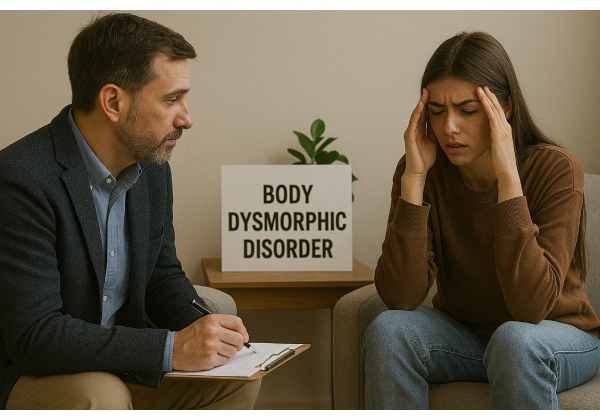
Body dysmorphic disorder is more than ordinary concern about appearance. It is a psychiatric condition in which a person becomes intensely preoccupied with one or more perceived flaws in how they look, even when the feature is not visible to others or appears minor. The distress can feel overwhelming, private, and hard to explain, which is one reason the condition is often hidden for years.
The central problem is not vanity. People with body dysmorphic disorder may spend hours checking, comparing, hiding, seeking reassurance, or avoiding situations because the perceived flaw feels urgent and threatening. The condition can affect school, work, relationships, medical decisions, and safety, especially when shame, depression, self-harm thoughts, or repeated cosmetic procedures become part of the picture.
Table of Contents
- What Body Dysmorphic Disorder Means
- Core Symptoms and Common Preoccupations
- Signs Other People May Notice
- Causes and Contributing Mechanisms
- Risk Factors and Who Is Affected
- Diagnosis and Related Conditions
- Effects on Daily Life
- Complications and Urgent Warning Signs
What Body Dysmorphic Disorder Means
Body dysmorphic disorder, often shortened to BDD, involves persistent distress about perceived defects or flaws in physical appearance. The concern is usually not explained by how the feature objectively appears to other people, but the distress is real and can be severe.
BDD is classified among obsessive-compulsive and related disorders. That classification matters because the condition usually includes both intrusive appearance preoccupations and repetitive behaviors or mental rituals. A person may feel driven to check mirrors, compare their appearance with others, ask for reassurance, groom repeatedly, conceal a feature, take photos from different angles, or mentally review how they looked in a past interaction.
The word “perceived” should not be misunderstood as dismissive. The person’s distress is not fake, exaggerated for attention, or simply low confidence. In BDD, the mind gives a perceived flaw an extreme level of threat, importance, and emotional weight. The person may intellectually know that others do not see the problem in the same way, or they may be completely convinced the flaw is obvious and unacceptable.
Insight varies widely. Some people recognize that their beliefs about their appearance may not be accurate. Others believe the flaw is probably real. In more severe cases, the belief can become fixed or delusional, meaning the person is certain that the defect exists and that other people notice or judge it. This poor insight can make the condition harder to identify because the person may seek dermatologic, dental, cosmetic, or surgical solutions rather than mental health evaluation.
BDD can involve any body area. Common concerns include skin, hair, nose, face shape, eyes, teeth, jaw, lips, body size, breasts, stomach, legs, genitals, or signs of aging. Some people focus on one feature for years; others shift between features or worry about several at once.
A key distinction is impairment. Many people dislike something about their appearance from time to time. BDD is different because the preoccupation is repetitive, difficult to control, distressing, and disruptive. It may consume hours each day and shape major decisions, such as whether to leave home, attend school, go to work, date, take photos, use video calls, or pursue cosmetic procedures.
Because BDD is often accompanied by shame, people may describe only depression, anxiety, isolation, or avoidance at first. A careful mental health evaluation may be needed to uncover the appearance-focused thoughts and behaviors driving those symptoms.
Core Symptoms and Common Preoccupations
The core symptoms of body dysmorphic disorder are appearance preoccupation, repetitive behaviors, distress, and impairment. The symptoms usually form a cycle: the person notices or imagines a flaw, feels intense anxiety or shame, performs a behavior to check or reduce distress, then becomes pulled back into the concern again.
Appearance thoughts in BDD are intrusive and hard to dismiss. A person may repeatedly think, “My skin looks disgusting,” “My nose ruins my face,” “My hairline is abnormal,” “My body looks deformed,” or “Everyone can see what is wrong with me.” These thoughts may feel urgent, even when other people do not notice the feature or view it as minor.
Common repetitive behaviors include:
- mirror checking, sometimes for long periods or many times a day
- avoiding mirrors completely because seeing the feature feels unbearable
- comparing appearance with friends, strangers, celebrities, or images online
- repeated grooming, shaving, hair styling, makeup use, or skin care rituals
- changing clothes many times to hide or correct the perceived flaw
- camouflaging with hats, masks, makeup, hair, posture, clothing, or lighting
- taking, deleting, retaking, or analyzing photos and videos
- reassurance seeking from family, friends, clinicians, or online communities
- skin picking, hair removal, or other attempts to “fix” a perceived defect
- excessive exercise or body checking, especially when muscle size or body shape is the concern
Mental rituals can be just as impairing as visible behaviors. A person may mentally compare themselves with others, replay social interactions, scan memories of how they looked, or spend long periods trying to decide whether a feature looked worse today than yesterday. These rituals can be exhausting even when no one else sees them.
Some people with BDD have muscle dysmorphia, a specifier in which the main concern is that the body is too small, insufficiently muscular, or not lean enough. This can occur in any gender, though it is often discussed in boys and men. Muscle dysmorphia may involve excessive checking, rigid exercise, distress about missed workouts, avoidance of situations where the body is visible, or concern that others view the body as weak or inadequate.
BDD can overlap with patterns seen in intrusive thoughts, but the content is specifically appearance-focused. The thoughts are not simply preferences or goals. They tend to feel repetitive, sticky, and emotionally charged, and they often trigger behaviors that briefly reduce distress but keep the cycle active.
The emotional symptoms can be intense. Shame, disgust, anxiety, embarrassment, sadness, anger, and hopelessness are common. Many people believe they would be able to live normally “if only” the perceived flaw were fixed. That belief can lead to repeated attempts to change the body, but the underlying preoccupation often remains or shifts to another feature.
Signs Other People May Notice
BDD is often hidden, but people close to the person may notice avoidance, reassurance seeking, appearance rituals, or repeated distress that seems out of proportion to the visible concern. These signs can be confusing because the person may not clearly explain what they are experiencing.
A family member, partner, friend, teacher, or clinician may notice that the person frequently asks how they look, whether a feature is noticeable, whether a photo should be posted, or whether others were staring. Reassurance may help briefly, but the relief usually fades, leading to more questions. This can resemble the reassurance loops seen in health anxiety, although the feared problem in BDD centers on appearance.
Avoidance is another common sign. A person may avoid bright light, mirrors, cameras, video calls, dating, swimming, gyms, classrooms, parties, workplaces, or medical appointments. They may cancel plans at the last minute because their appearance feels unacceptable that day. Some people avoid leaving home altogether during severe episodes.
Other visible signs may include:
- spending unusually long periods grooming or getting ready
- repeatedly changing outfits or asking others to evaluate clothing
- covering parts of the face or body with hair, hats, makeup, masks, or specific clothing
- avoiding eye contact or positioning the body to hide a feature
- becoming distressed after looking in a mirror, photo, or phone camera
- seeking frequent dermatology, dental, hair, cosmetic, or surgical consultations
- feeling devastated by small changes in skin, hair, weight, shape, or facial appearance
- showing skin lesions, irritation, or hair loss from picking, plucking, or repeated procedures
In adolescents, BDD may look like school refusal, falling grades, social withdrawal, anger when appearance is discussed, repeated bathroom trips, avoidance of sports or photos, or intense distress about acne, hair, body shape, or facial features. Because adolescence is also a period of normal body awareness, the difference lies in severity, time spent, distress, repetitive behaviors, and impairment.
BDD can also be missed in people who appear polished, fashionable, athletic, or highly groomed. Looking put together does not rule out the disorder. In some cases, the polished appearance is the result of hours of distress-driven checking, grooming, camouflaging, or preparation.
Loved ones may feel tempted to argue that the person looks fine. While the impulse is understandable, repeated debates about whether the flaw is real often do not resolve the distress. The more important warning sign is not whether others can see the feature, but whether the concern is consuming time, causing suffering, driving compulsive behaviors, or limiting life.
Causes and Contributing Mechanisms
There is no single cause of body dysmorphic disorder. Current evidence points to a combination of genetic vulnerability, brain-based processing differences, temperament, learning history, social experiences, and cultural pressures around appearance.
BDD tends to run partly in families, suggesting that inherited vulnerability can play a role. This does not mean a person is destined to develop the condition. Genes may influence traits such as anxiety sensitivity, obsessive thinking, perfectionism, threat perception, or emotional reactivity, while life experiences shape how those vulnerabilities are expressed.
Brain and cognitive research suggests that some people with BDD may process visual information in a detail-focused way. Instead of seeing the face or body as a whole, attention may lock onto small details, asymmetries, skin texture, hairline changes, or perceived imperfections. This detail-focused processing can make a minor feature feel large, central, and impossible to ignore.
Attention bias is also important. Once the appearance concern becomes threatening, the mind may scan for confirmation. Mirrors, photos, reflections, lighting, and other people’s facial expressions become evidence to interpret. Neutral social cues may be misread as judgment, staring, disgust, or ridicule. This can feed ideas of reference, where a person believes others are noticing, talking about, or reacting to the perceived flaw.
Temperament may add to risk. People who are highly self-critical, perfectionistic, socially anxious, sensitive to rejection, or prone to rumination may be more vulnerable. These traits do not cause BDD by themselves, but they can make appearance concerns more emotionally sticky.
Adverse experiences can also contribute. Bullying, teasing, criticism about appearance, childhood neglect, abuse, peer rejection, or repeated humiliation may shape how a person monitors and evaluates their body. Appearance-related teasing can be especially powerful when it occurs during puberty, a time when the body is changing and social comparison is intense.
Cultural and digital environments may intensify vulnerability. Filters, edited images, cosmetic procedure content, appearance-based social rewards, and constant comparison can reinforce the idea that small physical details determine worth or safety. Social media does not cause BDD in every user, but for vulnerable people, frequent comparison and image checking can worsen preoccupation. Concerns about social media and body image are especially relevant when online comparison becomes repetitive, distressing, or tied to avoidance.
BDD is best understood as a condition in which appearance becomes the focus of a broader threat system. The perceived flaw feels like the reason for shame, rejection, or danger, even when the deeper pattern involves obsessive attention, distorted salience, emotional distress, and compulsive attempts to feel certain or acceptable.
Risk Factors and Who Is Affected
Body dysmorphic disorder can affect people of any gender, age, background, or body type. It often begins in adolescence, but many adults do not receive recognition until years later.
Community estimates commonly place BDD in the low single digits of the population, with higher rates in some clinical settings. It is seen more often among people seeking dermatologic, cosmetic, dental, orthodontic, or plastic surgery services than in the general population. This makes sense because many people with BDD first interpret their distress as a physical appearance problem rather than a psychiatric condition.
Important risk factors include:
- adolescence or young adulthood, when appearance and peer evaluation often become more intense
- family history of BDD, obsessive-compulsive disorder, anxiety disorders, or related conditions
- high perfectionism, shame proneness, or fear of negative evaluation
- bullying, appearance teasing, rejection, neglect, abuse, or trauma
- repeated social comparison, especially around photos, filters, fitness, or cosmetic ideals
- co-occurring anxiety, depression, OCD, eating disorders, or substance use problems
- frequent cosmetic, dermatologic, or body-focused procedures that do not relieve distress
- occupations, sports, or social environments with intense appearance scrutiny
BDD affects all genders, though the focus of concern may differ. Women may more often report concerns about skin, body fat, breasts, hips, legs, or facial features. Men may more often report concerns about hair thinning, muscularity, body build, genitals, or facial structure. These patterns are not rules; any person can become preoccupied with any feature.
Children can have appearance preoccupations, but full BDD is more commonly recognized in teenagers and adults. In youth, warning signs include repeated appearance checking, school avoidance, distress over photos, excessive grooming, refusal to attend social events, or intense upset over perceived flaws that others do not see in the same way.
BDD may be especially difficult to identify in people who also have depression or anxiety. The person may say they are depressed because they are ugly, anxious because people are judging them, or isolated because their appearance makes social life impossible. Without careful questioning, the appearance preoccupation can remain hidden beneath broader mood or anxiety symptoms.
It is also important not to confuse BDD with normal grooming, style interest, fitness goals, or cosmetic preferences. The risk signal is not caring about appearance. The risk signal is being trapped by appearance concerns that are time-consuming, distressing, repetitive, and impairing.
Diagnosis and Related Conditions
BDD is diagnosed through clinical assessment, not by a blood test, brain scan, mirror check, or cosmetic evaluation. The key diagnostic question is whether appearance preoccupation and related behaviors cause significant distress or impairment and are not better explained by another condition.
A clinician typically asks about the specific appearance concern, how much time it takes, what behaviors follow, how strongly the person believes the concern, and how it affects daily life. Because many people feel ashamed, direct but sensitive questions are often necessary. Screening questionnaires may help identify possible BDD, but diagnosis requires clinical judgment.
BDD must be distinguished from several related conditions:
| Concern or condition | Main focus | How it differs from BDD |
|---|---|---|
| Normal appearance concern | Dislike of a feature or temporary self-consciousness | Usually does not consume hours, drive compulsive rituals, or seriously impair life |
| Eating disorder | Weight, shape, fatness, food, or eating behaviors | BDD can involve body shape, but eating disorders center on eating, weight, and body fat concerns |
| Obsessive-compulsive disorder | Obsessions and compulsions across many themes | BDD thoughts and rituals specifically focus on perceived appearance flaws |
| Social anxiety disorder | Fear of embarrassment, scrutiny, or negative evaluation | BDD avoidance is usually driven by the belief that a specific appearance flaw will be noticed or judged |
| Excoriation disorder | Recurrent skin picking | In BDD, skin picking is usually performed to fix or improve a perceived appearance defect |
| Gender dysphoria | Distress related to incongruence between experienced gender and sex characteristics | BDD is not the same as gender incongruence and should not be used to dismiss gender-related distress |
BDD and eating disorders can occur together, which makes assessment more complex. If a person’s main concern is body fat, weight, food restriction, bingeing, purging, or compensatory exercise, an eating disorder assessment may be relevant. If the central concern is a perceived defect such as skin, nose shape, hair, facial symmetry, muscularity, or a specific body part, BDD may be more likely.
OCD is another close comparison. Both OCD and BDD can involve intrusive thoughts, distress, checking, reassurance seeking, avoidance, and rituals. The difference is the theme. In OCD, fears may involve contamination, harm, symmetry, morality, taboo thoughts, or uncertainty. In BDD, the obsessional focus is physical appearance. An OCD screening may help when symptoms overlap or when both conditions may be present.
Insight should also be assessed. Some people with BDD know their concern may be exaggerated; others are convinced the defect is real. Poor insight does not rule out BDD. In fact, it is common and clinically important because it can increase distress, conflict, avoidance, and pursuit of procedures.
Effects on Daily Life
BDD can affect nearly every part of daily life because appearance concerns become tied to safety, worth, acceptance, and control. The condition often narrows life around checking, hiding, avoiding, and trying to feel certain.
Social functioning is commonly affected. A person may avoid parties, dating, school, work meetings, gyms, beaches, bright rooms, restaurants, or any situation where they feel visible. They may sit in specific places, avoid certain angles, keep hair over part of the face, wear heavy makeup, or refuse photos. These behaviors may look like preference from the outside, but internally they may be driven by intense fear of being seen.
Work and school can suffer. Time spent checking, grooming, researching procedures, comparing images, or recovering from distress can make concentration difficult. Some people arrive late because getting ready takes hours. Others miss important events because their appearance feels unacceptable. Performance may decline even when the person is capable and motivated.
Relationships can become strained. Reassurance seeking may frustrate partners or family members, while avoidance may be misread as disinterest. The person with BDD may feel misunderstood, ashamed, or angry when others do not see the flaw. Loved ones may feel helpless because compliments and reassurance do not last.
BDD can also influence medical and cosmetic decisions. A person may seek repeated dermatology visits, dental changes, hair treatments, injectables, cosmetic surgery, or other procedures. Even when a procedure is technically successful, the distress may persist, shift to another feature, or become focused on the outcome. Some people become trapped in a cycle of seeking correction without lasting relief.
Daily routines may become rigid. Lighting, mirrors, clothing, makeup, exercise, camera settings, or routes outside the home can feel nonnegotiable. A small change, such as unexpected bright sunlight or an unflattering photo, may trigger hours of distress. This rigidity can make ordinary life feel unpredictable and unsafe.
BDD also affects self-concept. Over time, the person may define themselves by the perceived flaw and underestimate their abilities, relationships, humor, values, intelligence, kindness, or strengths. The appearance concern can become the explanation for every rejection, awkward moment, or disappointment, even when many other explanations are possible.
The burden is often invisible. Someone may appear functional while privately spending much of the day monitoring their appearance. Another person may seem withdrawn or irritable, when the underlying issue is shame and fear. Recognizing the condition as a psychiatric disorder helps shift attention from “fixing” a body part to understanding the pattern of preoccupation, distress, and impairment.
Complications and Urgent Warning Signs
BDD can lead to serious complications, including depression, social isolation, repeated procedures, substance misuse, self-injury, and suicidal thoughts or behavior. Any signs of immediate danger require urgent professional evaluation.
Depression is one of the most common complications. A person may feel hopeless because the perceived flaw seems permanent or because attempts to correct it have not relieved distress. Shame can deepen isolation, and isolation can make the appearance concern feel even more central. Some people stop pursuing friendships, education, work, or dating because they believe their appearance makes a normal life impossible.
Anxiety can also become severe. Panic symptoms, social anxiety, avoidance, and constant scanning for judgment may develop. The person may feel unsafe in public or convinced that others are staring, laughing, or commenting. When these beliefs become fixed, the distress may look delusional, even though it remains part of the BDD picture for some people.
Physical complications can occur from repetitive behaviors. Skin picking may cause wounds, scarring, infection, or discoloration. Excessive grooming may irritate skin or damage hair. Extreme exercise, rigid dieting, supplement misuse, or unregulated appearance-enhancing substances may create additional risks, especially in muscle dysmorphia.
Cosmetic and medical complications are also important. People with BDD may pursue repeated procedures, sometimes from multiple providers, and may remain distressed or dissatisfied afterward. In severe cases, a person may attempt unsafe self-directed changes to the body. Repeated procedures can create financial strain, medical harm, family conflict, and worsening preoccupation.
Substance use may develop when a person uses alcohol, sedatives, stimulants, steroids, or other substances to manage shame, social fear, body image distress, or appearance goals. This can add another layer of risk and make the condition harder to recognize.
Urgent evaluation is especially important if a person:
- talks about wanting to die, disappear, or not wake up
- has thoughts of self-harm or suicide
- has a plan, intent, or access to means for self-harm
- is injuring themselves or making unsafe attempts to change their body
- is unable to leave home, eat, sleep, attend school, work, or function because of appearance distress
- shows severe depression, agitation, hopelessness, paranoia-like conviction, or escalating impulsive behavior
- is a child or teenager with rapidly worsening avoidance, self-harm, or suicidal statements
A suicide risk screening may be necessary when BDD is accompanied by self-harm thoughts, prior attempts, severe depression, or hopelessness. In an immediate crisis, emergency services or local crisis resources are appropriate.
BDD should be taken seriously even when the appearance concern seems minor to others. The severity of the condition is measured by distress, impairment, compulsive behavior, poor insight, and safety risk—not by whether the perceived flaw is visible.
References
- Body dysmorphic disorder 2024 (Review)
- Body Dysmorphic Disorder 2024 (Clinical Review)
- Body Dysmorphic Disorder: Clinical Overview and Relationship to Obsessive-Compulsive Disorder 2021 (Review)
- Epidemiology of Body Dysmorphic Disorder and Appearance Preoccupation in Youth: Prevalence, Comorbidity and Psychosocial Impairment 2025 (Epidemiologic Study)
- Intentional Self-Harm and Death by Suicide in Body Dysmorphic Disorder: A Nationwide Cohort Study 2024 (Cohort Study)
- Obsessive-compulsive disorder and body dysmorphic disorder: treatment 2005 (Guideline, reviewed 2024)
Disclaimer
This content is for general educational purposes only and is not a substitute for professional medical advice, diagnosis, or treatment. Body dysmorphic disorder can involve severe distress and safety risks, so symptoms that affect daily functioning or include self-harm thoughts should be evaluated by a qualified health professional.
Thank you for taking the time to read this sensitive topic; sharing it may help someone recognize distress they have been struggling to name.