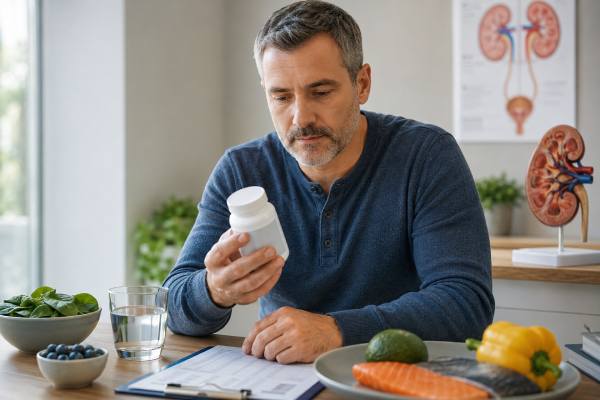
Vitamin B6 is sometimes discussed in kidney stone prevention because it plays a role in how the body handles oxalate. Oxalate is one of the key ingredients in calcium oxalate stones, the most common kidney stone type. The idea is simple: if vitamin B6 helps the body make less oxalate, it might lower stone risk in the right person.
The important phrase is “in the right person.” Vitamin B6 is not a general kidney stone cure, and taking large doses without testing is a common mistake. It is most relevant when urine testing shows high oxalate, when a clinician suspects a problem with oxalate metabolism, or when a rare condition called primary hyperoxaluria is part of the picture. For someone whose main stone risks are low urine volume, high sodium intake, low citrate, or high urine calcium, B6 is usually not the main fix.
Safe dosing also matters. Vitamin B6 is water-soluble, but that does not make high-dose supplements harmless. Long-term excess intake causes nerve symptoms such as tingling, burning, numbness, and trouble with balance. The safest approach is to match the dose to the reason for using it, confirm the need with urine testing, and avoid stacking B6 from multiple supplements.
Table of Contents
- How B6 Connects to Oxalate Stones
- Who Is Most Likely to Benefit
- Who Should Not Expect Much Benefit
- Safe Dose Ranges and When Higher Doses Are Used
- How to Use B6 Without Missing Bigger Stone Risks
- Side Effects, Warning Signs, and Supplement Labels
- Practical Next Steps Before Starting
How B6 Connects to Oxalate Stones
Vitamin B6 helps the body run enzyme reactions that handle amino acids and related compounds. In stone prevention, the key point is its role in glyoxylate metabolism. Glyoxylate is a small molecule that the body can route toward safer products or toward oxalate. The active form of vitamin B6, called pyridoxal 5’-phosphate, helps an enzyme move glyoxylate toward glycine instead of oxalate.
When that pathway works poorly, more oxalate ends up in urine. Oxalate then combines with calcium, especially when urine is concentrated. The result is a higher chance of calcium oxalate crystal formation. Those crystals start small, but they grow when urine stays crowded with calcium, oxalate, and other stone-forming substances.
This is why B6 comes up in discussions of calcium oxalate stones. It targets oxalate production inside the body, not oxalate absorption from food. That distinction matters because many stone formers have several risks at the same time. A person might have high urine oxalate, low urine volume, high urine sodium, and low citrate. B6 would only address one part of that pattern.
Oxalate in urine comes from two broad places. Some comes from foods such as spinach, almonds, beets, rhubarb, wheat bran, and certain teas. Some comes from normal metabolism inside the liver. Vitamin B6 is tied more closely to the second source. If the main problem is heavy intake of very high-oxalate foods, poor calcium timing with meals, or intestinal oxalate absorption after bowel surgery, B6 alone is not enough.
The best way to know whether oxalate is truly high is a 24-hour urine test for stones. A standard urinalysis does not give the same information. The 24-hour test measures how much oxalate, calcium, citrate, sodium, uric acid, and fluid volume pass into urine over a full day. That pattern shows whether B6 is worth considering or whether another prevention step deserves priority.
Urine oxalate results vary by lab, but many reports flag values above roughly 40–45 mg per day as high. Much higher levels, especially repeated results above about 75 mg per day, raise concern for severe hyperoxaluria and sometimes primary hyperoxaluria. A single abnormal result should be interpreted with diet, collection accuracy, kidney function, medications, and medical history in mind.
Who Is Most Likely to Benefit
The strongest case for vitamin B6 is not “I had a stone.” It is “I form calcium oxalate stones and testing shows high urine oxalate, especially if my doctor thinks my body is overproducing oxalate.” That group is much narrower, but it is the group where B6 makes the most biological sense.
People with primary hyperoxaluria type 1
Primary hyperoxaluria is a rare inherited condition that causes the liver to overproduce oxalate. Type 1 is the form most closely tied to vitamin B6 response. In some people with primary hyperoxaluria type 1, vitamin B6 improves the function or handling of the affected enzyme enough to lower urine oxalate. The response depends heavily on the person’s genetic variant, so this is not a trial-and-error supplement decision.
This situation belongs with a nephrologist, urologist, genetic specialist, or rare kidney disease center. Treatment often includes high fluid intake, urine alkalinization or citrate therapy, careful monitoring, genetic testing, and in selected cases newer RNA-based medicines. B6 is one part of a broader plan, not the whole plan.
A good response is measured by urine oxalate, not by how the person feels. Kidney stones, crystals, and kidney damage develop silently between painful episodes. Someone with primary hyperoxaluria needs follow-up testing even when symptoms settle.
People with repeated calcium oxalate stones and high urine oxalate
Some stone formers have high urine oxalate without a known rare genetic disorder. This is often called idiopathic hyperoxaluria, meaning the cause is not fully clear. In this group, clinicians sometimes use B6 along with diet changes, especially when urine oxalate stays high after the obvious steps are corrected.
The practical starting point is not a large dose. It is a prevention plan that looks at oxalate intake, calcium timing, sodium, fluid, citrate, and bowel health. B6 is more reasonable when urine oxalate remains high despite a serious attempt at those basics.
A person in this group might have a pattern like this: calcium oxalate stones on stone analysis, urine oxalate repeatedly above the lab range, no extreme spinach or almond habit, reasonable dietary calcium, and no obvious bowel disease causing oxalate absorption. That is the kind of profile where a clinician might discuss a monitored B6 trial.
People with low B6 intake or higher deficiency risk
True vitamin B6 deficiency is not the typical reason adults form kidney stones, but low B6 status changes the discussion. People with limited diets, heavy alcohol use, malabsorption conditions, inflammatory bowel disease, celiac disease, certain antiseizure medicines, and advanced kidney disease have a higher chance of low B6 levels.
Correcting a deficiency is different from taking high-dose B6 for stones. Deficiency replacement usually aims to restore normal status. It does not require chronic megadoses. If low intake is the issue, food choices and modest supplementation are safer than jumping to 100 mg tablets.
Good food sources include chickpeas, salmon, tuna, poultry, potatoes, bananas, and fortified cereals. These foods do not create the nerve-toxicity risk seen with excessive supplement use. The exception is when another diet restriction applies, such as potassium limits in advanced chronic kidney disease. In that case, food choices should be individualized.
Who Should Not Expect Much Benefit
Vitamin B6 is often overused because it sounds simple and low-risk. The people least likely to benefit are those who have not confirmed their stone type or urine risk pattern. Without that information, the supplement is a guess.
If a stone has never been analyzed, the first step is to identify the type. Calcium oxalate, uric acid, struvite, cystine, and calcium phosphate stones have different prevention plans. B6 is mainly discussed for oxalate-related stones. It does not dissolve an existing stone, and it does not treat infection stones, cystine stones, or uric acid stones.
B6 is also unlikely to solve stone risk when urine oxalate is normal. A person with normal oxalate but very low urine volume needs better fluid timing. Someone with high urine sodium and high urine calcium usually gets more benefit from lowering salt. Someone with low citrate often needs more citrate-focused treatment, sometimes including potassium citrate for stones under medical care.
A common mistake is using B6 as a substitute for dietary calcium with meals. Calcium in food binds oxalate inside the gut, so less oxalate gets absorbed. This is why many calcium oxalate stone formers are told not to avoid calcium completely. The useful move is usually normal calcium intake with meals, not a very low-calcium diet. A low-calcium diet leaves more oxalate unbound in the intestine and can increase oxalate absorption.
Another mismatch is taking B6 while continuing daily high-oxalate habits. Spinach smoothies, large almond flour portions, heavy nut snacking, beet powders, and high-dose turmeric supplements can keep urine oxalate high. A B6 capsule does not cancel out those inputs. Readers who need a food-focused plan should start with a practical low-oxalate diet rather than cutting foods randomly.
B6 also should not be used to delay care after severe stone symptoms. Fever, chills, vomiting that prevents fluids, one kidney, pregnancy, severe uncontrolled pain, or trouble passing urine needs urgent medical advice. Prevention supplements are for long-term risk reduction, not for managing an active emergency.
Safe Dose Ranges and When Higher Doses Are Used
The safest B6 dose is the lowest dose that matches the goal and shows a measurable benefit. For kidney stone prevention, that usually means checking the urine oxalate response after starting, instead of taking the supplement indefinitely and hoping it works.
For general nutrition, adults need only small amounts of vitamin B6. The recommended intake is roughly 1.3 mg per day for most adults up to age 50, with slightly higher needs in older adults and during pregnancy or breastfeeding. Food and ordinary multivitamins often cover that range.
Therapeutic stone discussions use higher amounts, but higher does not mean better. For idiopathic high urine oxalate, clinicians often think in the range of about 10–50 mg per day at first. Some older stone protocols used 50–100 mg per day and increased in selected patients, but long-term high doses deserve caution because nerve toxicity is the main safety concern.
Primary hyperoxaluria type 1 is different. Specialists use weight-based dosing, often starting around 5 mg per kg per day and adjusting based on urine oxalate response. Some patients need higher specialist-supervised doses. This should not be copied by someone with ordinary calcium oxalate stones, because the risk-benefit calculation is completely different.
| Situation | Typical dose approach | Practical safety note |
|---|---|---|
| General nutrition | About 1.3–1.7 mg per day for most adults, usually from food | Best handled through diet or a standard multivitamin if needed |
| Self-directed supplement use | Stay close to low-dose products, often 2–10 mg per day | Avoid stacking B6 from multiple products |
| High urine oxalate with recurrent calcium oxalate stones | Often discussed around 10–50 mg per day under clinician guidance | Recheck 24-hour urine to confirm benefit |
| Persistent idiopathic hyperoxaluria | Some protocols use 50–100 mg per day, with selected higher dosing | Use only with monitoring and a clear stop point if oxalate does not improve |
| Primary hyperoxaluria type 1 | Specialist-supervised weight-based dosing | Requires genetic and urine monitoring; not a DIY dose plan |
The dose limit is complicated because different authorities set different upper limits. In the United States, the adult tolerable upper intake level has traditionally been 100 mg per day. European safety reviews use a much lower adult upper limit of 12 mg per day. That gap reflects different interpretations of neuropathy risk, uncertainty around long-term exposure, and a more cautious European approach.
For a practical reader, the takeaway is clear: daily 50 mg and 100 mg B6 tablets are not casual wellness doses. They are therapeutic doses. A person using them for stone prevention should have a reason, a plan, and follow-up testing.
The form on the label also matters. Most supplements list vitamin B6 as pyridoxine hydrochloride. Others use pyridoxal 5’-phosphate, often called P-5-P or PLP. For stone prevention, the bigger safety issue is total B6 dose, not marketing claims about the form. A “coenzyme” label does not make a high dose automatically safe.
How to Use B6 Without Missing Bigger Stone Risks
B6 works best as one decision inside a complete stone prevention plan. The plan should start with the biggest risks on the urine report, because the largest abnormality often gives the largest prevention payoff.
Fluid usually comes first. Concentrated urine raises the chance that calcium and oxalate will meet and crystallize. Many stone prevention plans aim for enough fluids to produce at least 2 to 2.5 liters of urine per day, unless a medical condition requires fluid restriction. This usually means drinking steadily from morning through evening, not forcing a huge amount at once.
Calcium timing is another major lever. Many people hear “calcium oxalate” and assume calcium is the enemy. In food, calcium often protects against oxalate absorption when eaten with meals. Yogurt with lunch, milk with dinner, calcium-set tofu, or another calcium source taken alongside oxalate-containing foods binds some oxalate in the gut. The more targeted strategy is calcium with meals for oxalates, not calcium avoidance.
Sodium deserves close attention because salt drives more calcium into urine. Restaurant meals, deli meats, canned soups, salty snacks, frozen meals, sauces, pickles, and fast food can push sodium high even when the food does not taste extremely salty. Lowering sodium often lowers urine calcium, which reduces the chance that oxalate will find calcium to bind.
Citrate is another major factor. Citrate helps hold calcium in solution and makes crystal formation less favorable. Low citrate is common in people who eat very little fruit and vegetables, follow very high animal-protein diets, or have certain metabolic patterns. Lemon and lime drinks help some people, while others need prescription citrate. B6 does not replace citrate treatment when the urine report shows low citrate.
Animal protein also affects the urine environment. Large portions of meat, poultry, fish, and protein powders increase acid load and sometimes lower citrate. This does not mean every stone former needs to become vegetarian. It means portions matter. A practical target is often a palm-sized serving at meals rather than double portions, plus more plant foods that fit the person’s kidney and potassium needs.
Supplement review is part of the same plan. High-dose vitamin C is especially relevant because the body converts some vitamin C into oxalate. A stone former taking 1,000 mg vitamin C daily for “immune support” might be raising oxalate while taking B6 to lower it. That mismatch is worth correcting. Anyone using vitamin C regularly should understand the stone-specific concern with high-dose vitamin C and kidney stones.
B6 earns its place when it improves a measured problem. If urine oxalate drops meaningfully after a monitored trial, the supplement has done something useful. If the urine result barely changes, continuing the same dose for years adds risk without a clear benefit.
Side Effects, Warning Signs, and Supplement Labels
The main safety issue with too much vitamin B6 is nerve irritation or nerve damage, usually called peripheral neuropathy. Early symptoms include tingling, burning, pins-and-needles feelings, numbness, or unusual sensitivity in the feet or hands. Some people notice clumsiness, balance problems, or a strange feeling while walking. These symptoms deserve prompt attention, especially if the person takes B6, a B-complex, a multivitamin, magnesium products, energy drinks, or workout supplements.
Neuropathy risk is tied to dose and duration, but the exact threshold is not the same for everyone. Reports exist at lower supplement doses than older safety limits suggested, which is why caution has increased. The risk becomes more concerning when someone takes several products that each contain B6.
Label stacking is easy to miss. A person might take:
- a multivitamin with 5 mg of B6;
- a B-complex with 50 mg;
- a magnesium product with another 10–25 mg;
- an energy drink or fortified powder with added B vitamins.
That person might think they take one B6 supplement, when the real daily total is far higher. The label might list “vitamin B6,” “pyridoxine hydrochloride,” “pyridoxal 5’-phosphate,” “P-5-P,” or “PLP.” Count all of them.
High-dose B6 is especially risky when people keep taking it after symptoms start. Nerve symptoms often improve after stopping excess B6, but recovery is not always immediate. Some people worsen briefly before improving, and prolonged exposure raises the chance of lasting symptoms.
Certain people should be more cautious from the start. Anyone with existing neuropathy, diabetes-related nerve symptoms, balance problems, heavy alcohol use, advanced kidney disease, or several daily supplements should not add high-dose B6 without medical advice. People taking medications that affect B6 status, including some antiseizure drugs, need individualized guidance rather than a generic dose.
B6 is not the only supplement used in stone prevention, and it is not always the best first choice. Citrate, magnesium, calcium timing, and diet changes each fit different urine patterns. A careful comparison of kidney stone supplements helps prevent the common habit of taking several “stone support” products with overlapping ingredients.
Stop-and-check rules are useful. Stop B6 and contact a clinician if tingling, burning, numbness, balance changes, or unexplained nerve pain starts after using a supplement. Also stop and reassess if the dose is 50 mg or higher and no one has checked urine oxalate after starting. A supplement that is not being measured is not a treatment plan.
Practical Next Steps Before Starting
The best next step depends on what information is already available. Someone with a lab-confirmed calcium oxalate stone and high urine oxalate is in a different position from someone who had one painful stone years ago and never got stone analysis.
First, get the stone type whenever possible. If a stone passes, strain the urine and save the stone for analysis. Imaging shows size and location, but it does not always prove composition. Prevention becomes much more precise once the material is known.
Second, ask for a 24-hour urine test if stones are recurrent, bilateral, early-onset, severe, or linked with a family history. This test also makes sense after a first stone in people who strongly want prevention guidance. The result should be reviewed as a pattern, not as one isolated number.
Third, fix the big universal risks while waiting. Drink enough to keep urine pale most of the day, unless a clinician has restricted fluids. Eat normal calcium with meals. Reduce sodium from packaged and restaurant foods. Avoid daily large portions of the highest-oxalate foods. Skip high-dose vitamin C unless there is a specific medical reason.
Fourth, choose a B6 dose based on the reason. If the goal is basic nutrition, use food or a low-dose supplement. If the goal is to lower high urine oxalate, discuss a monitored dose with a clinician and plan a repeat 24-hour urine test. If primary hyperoxaluria is suspected, ask for specialist evaluation rather than self-treating.
Fifth, decide in advance what counts as success. A reasonable trial should have a baseline urine oxalate, a dose, a timeline, and a repeat test. If oxalate improves and no side effects appear, the clinician can decide whether to continue. If oxalate does not improve, the plan should shift toward other causes and treatments.
Use this simple checklist before taking B6 for oxalate stones:
- The stone type is known or strongly suspected to be calcium oxalate.
- A 24-hour urine test shows high oxalate or there is a specialist concern for primary hyperoxaluria.
- Dietary calcium is not being restricted unnecessarily.
- High-oxalate foods and high-dose vitamin C have been reviewed.
- The total B6 dose from all supplements has been counted.
- A repeat urine test is planned to confirm whether B6 is helping.
- Nerve symptoms are understood as a reason to stop and seek advice.
Vitamin B6 has a real place in oxalate stone prevention, but it is not a broad stone remedy. It is most useful when the problem is truly oxalate overproduction or persistent high urine oxalate. The safest plan is measured, specific, and boring in the best way: identify the stone, test the urine, use the lowest reasonable dose, recheck the result, and stop if there is no clear benefit.
References
- Clinical practice recommendations for primary hyperoxaluria: an expert consensus statement from ERKNet and OxalEurope 2023 (Consensus Statement)
- UPDATE – Canadian Urological Association guideline: Evaluation and medical management of kidney stones 2022 (Guideline)
- Kidney Stone Pathophysiology, Evaluation and Management: Core Curriculum 2023 2023 (Review)
- Vitamin B6 – Health Professional Fact Sheet 2023 (Fact Sheet)
- Scientific opinion on the tolerable upper intake level for vitamin B6 2023 (Scientific Opinion)
- Pyridoxine and dietary counseling for the management of idiopathic hyperoxaluria in stone-forming patients 2011 (Clinical Study)
Disclaimer
This article is for education about vitamin B6 and oxalate-related kidney stone prevention. It is not a diagnosis or a personal supplement plan. Recurrent stones, high urine oxalate, suspected primary hyperoxaluria, kidney disease, pregnancy, neuropathy symptoms, or use of high-dose supplements should be discussed with a qualified clinician. Seek urgent care for fever with stone pain, uncontrolled vomiting, severe pain, pregnancy with stone symptoms, one functioning kidney, or trouble passing urine.