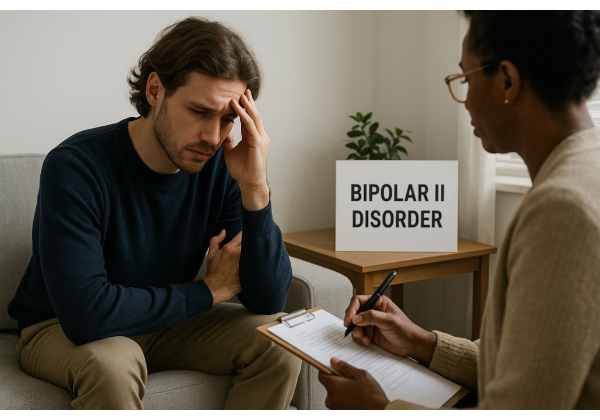
Bipolar II disorder is a mood disorder marked by episodes of depression and hypomania, a state of increased energy or mood change that is noticeable but not as severe as mania. It is often misunderstood because the depressive episodes may be more obvious, more distressing, and more likely to lead someone to ask for help, while hypomania can feel productive, sociable, or simply “better than usual” at first.
The condition is not simply mild bipolar disorder. Bipolar II can disrupt relationships, work, school, judgment, sleep, self-image, and physical health. It also carries meaningful risks, especially when depression is severe, mixed symptoms are present, substance use is involved, or suicidal thoughts appear. Understanding the pattern of symptoms is important because bipolar II disorder can look like major depression, anxiety, ADHD, trauma-related symptoms, personality patterns, or ordinary mood swings unless the full mood history is examined carefully.
Table of Contents
- What Bipolar II Disorder Means
- Hypomania and Depression Symptoms
- Signs That May Be Missed
- Causes and Brain-Body Factors
- Risk Factors and Triggers
- Diagnostic Context and Lookalikes
- Effects on Life and Functioning
- Complications and Urgent Warning Signs
What Bipolar II Disorder Means
Bipolar II disorder involves at least one major depressive episode and at least one hypomanic episode, without any history of a full manic episode. This distinction matters because mania changes the diagnosis to bipolar I disorder, while bipolar II is defined by hypomania plus depression.
A major depressive episode is more than feeling sad or discouraged. It usually involves a clear change from a person’s usual functioning, lasting at least two weeks, with symptoms such as low mood, loss of interest, fatigue, sleep changes, appetite changes, poor concentration, slowed or agitated movement, guilt or worthlessness, and thoughts of death or suicide. In bipolar II disorder, depressive episodes are often the part of the illness that causes the most distress and impairment.
Hypomania is a distinct period of elevated, expansive, or irritable mood with increased activity or energy. It is noticeable to others and different from the person’s baseline, but it does not cause the level of severe impairment, psychosis, or hospitalization that defines mania. A person in hypomania may sleep far less than usual yet feel energized, talk more, take on many projects, spend impulsively, feel unusually confident, become more social or sexually driven, or act in ways that are out of character.
The “II” in bipolar II does not mean second-best, less serious, or less real. Some people with bipolar II have long periods of stable mood between episodes, but others experience frequent depression, recurring hypomania, mixed symptoms, anxiety, substance use problems, or marked impairment. A person may also have many more depressive days than hypomanic days, which is one reason the condition is sometimes mistaken for recurring major depression.
Bipolar II disorder is episodic, meaning symptoms tend to occur in periods rather than being constant personality traits. This is one of the most important clues. Someone may seem like their usual self for weeks, months, or longer, then enter a period of depression or hypomania that changes sleep, energy, thinking, mood, behavior, and judgment. The timing and pattern of these changes are often as important as the symptoms themselves.
It can also vary in presentation. Some people have hypomanic episodes that feel pleasant and productive. Others experience hypomania mainly as irritability, agitation, impatience, racing thoughts, or feeling “wired but not happy.” Some have mixed features, where depressive mood and high-energy symptoms overlap. This can feel like despair combined with restlessness, impulsivity, insomnia, or inner pressure, and it can carry elevated risk.
Hypomania and Depression Symptoms
The core symptoms of bipolar II disorder fall into two main episode types: hypomania and depression. Recognizing both sides of the pattern is essential because depression alone does not reveal the bipolar II diagnosis.
| Episode type | Common symptoms | What makes it clinically important |
|---|---|---|
| Hypomania | Less sleep, increased energy, racing thoughts, more talking, impulsive choices, increased confidence, irritability, distractibility, more activity | The change is noticeable and different from baseline, but it does not reach the severity of mania |
| Depression | Low mood, loss of pleasure, fatigue, sleep or appetite changes, guilt, poor concentration, slowed movement, suicidal thoughts | Symptoms last long enough and are severe enough to impair daily life |
| Mixed features | Depressed mood with agitation, racing thoughts, insomnia, impulsivity, or intense inner tension | The combination can be confusing and may increase risk, especially when distress and activation occur together |
During hypomania, a person may feel unusually capable, attractive, creative, persuasive, or driven. They might start several projects, make quick plans, send many messages, speak more rapidly, or feel unusually certain about ideas. Some people notice an increased desire for stimulation: more social contact, more spending, more travel, more sexual activity, more risk-taking, or more arguments.
The reduced need for sleep is especially important. This is not the same as insomnia, where a person wants to sleep but cannot and feels tired the next day. In hypomania, someone may sleep three or four hours and still feel energized. That said, not every person has every symptom, and hypomania can be subtle, especially when it appears as irritability rather than euphoria.
Depressive episodes in bipolar II disorder can look very similar to major depressive disorder. The person may feel slowed down, empty, hopeless, heavy, ashamed, or unable to enjoy anything. Concentration can become poor, routine decisions may feel difficult, and ordinary tasks can seem overwhelming. Sleep may increase or decrease. Appetite and weight may change. Some people become socially withdrawn, miss work or school, or struggle to maintain basic routines.
Because depression is often more painful than hypomania, people may remember and report the depressive episodes more clearly. Hypomania may be forgotten, minimized, or described as a time when they were “finally doing well.” This is why a careful mood history often includes questions about periods of unusually high energy, decreased sleep, impulsive choices, increased talkativeness, and feedback from other people.
A person who wants to understand how clinicians screen for bipolar symptoms may find a separate explanation of bipolar disorder screening useful, especially because screening tools can raise questions but cannot confirm the diagnosis by themselves.
Signs That May Be Missed
Bipolar II disorder is often missed when hypomania is brief, enjoyable, or interpreted as a normal personality shift. The condition may be especially hard to recognize when the person seeks help only during depression.
One commonly missed sign is a repeating pattern of “crashes” after high-energy periods. A person may have several days of unusually intense productivity, social activity, spending, confidence, or little sleep, followed by exhaustion, regret, depression, or withdrawal. The high-energy phase may not seem like a problem at the time, but the pattern becomes clearer when viewed across months or years.
Another clue is a mismatch between sleep and energy. Many people lose sleep during stress, but in hypomania the person may not feel tired in the expected way. They may stay up late planning, messaging, cleaning, working, exercising, shopping, or researching ideas, then wake up early feeling driven rather than depleted. Others may describe them as unusually intense, fast, impatient, funny, charming, argumentative, or “not quite themselves.”
Bipolar II disorder can also show up through consequences rather than obvious mood descriptions. Examples include:
- sudden debt, risky purchases, or business ideas that felt urgent at the time
- conflicts caused by bluntness, irritability, or unusually rapid speech
- impulsive travel, sexual choices, or commitments
- starting many projects without finishing them
- feeling unusually brilliant or destined for something, then later feeling embarrassed
- periods of intense sociability followed by isolation
- recurrent depression that does not seem fully explained by circumstances
Some signs are easy to confuse with temperament. A naturally energetic person may talk quickly, enjoy novelty, or need less sleep than others. Bipolar II disorder is different because symptoms represent a change from baseline and occur in episodes. The question is not simply “Is this person intense?” but “Are there distinct periods when mood, energy, sleep, activity, and judgment shift together?”
Irritability is another overlooked presentation. Hypomania is often imagined as happiness or euphoria, but some people mainly become agitated, restless, reactive, or easily angered. They may feel that other people are too slow, too negative, or in the way. This can be mistaken for anxiety, anger problems, stress, burnout, or relationship conflict unless the full symptom pattern is considered.
Family or partner observations may help identify signs the person does not notice. Loved ones may recall that the person slept very little, talked rapidly, made unusual decisions, seemed unusually confident, or became more impulsive. This does not mean outside observers are always right, but bipolar II diagnosis often depends on reconstructing patterns that are hard to see from one mood state alone.
Causes and Brain-Body Factors
Bipolar II disorder does not have one single cause. Current evidence points to a complex mix of genetic vulnerability, brain and body regulation, sleep-wake rhythms, stress exposure, development, and environmental factors.
Genetics play a major role in bipolar disorders. Having a close biological relative with bipolar disorder increases risk, although it does not mean a person will definitely develop the condition. Many genes appear to contribute small amounts of risk rather than one gene acting as a simple on-off switch. Genetic research also suggests overlap between bipolar disorder and other psychiatric conditions, which helps explain why mood, anxiety, psychosis-spectrum, ADHD-like, and substance-related symptoms can sometimes cluster in families.
Brain systems involved in mood regulation, reward, motivation, sleep, circadian rhythm, and impulse control are also relevant. Bipolar II disorder is not caused by a personal weakness or a simple attitude problem. The shifts in energy, sleep, mood, and judgment reflect changes in systems that regulate arousal and emotional state. Researchers continue to study inflammation, mitochondrial function, stress hormones, neurotransmitter signaling, and circadian rhythm disruption, but no single blood test or brain scan can currently diagnose bipolar II disorder.
Sleep and circadian rhythm are especially important because hypomania often involves a reduced need for sleep, and mood episodes may be linked with disrupted daily rhythms. Some people are more sensitive to sleep loss, night shifts, jet lag, irregular schedules, or major changes in routine. These factors do not “cause” bipolar II by themselves, but they may interact with an underlying vulnerability.
Stressful or traumatic experiences can also influence onset, severity, and course. Childhood adversity, major losses, interpersonal conflict, childbirth, substance use, and intense life changes have all been studied in relation to bipolar disorder. These experiences should be understood as risk-related factors, not as proof that someone’s symptoms are purely psychological or that the person caused the condition.
Medical and substance-related factors can complicate the picture. Thyroid disease, neurological conditions, sleep disorders, stimulant use, alcohol or drug use, and some medications can produce mood or energy changes that resemble bipolar symptoms. That is one reason diagnostic evaluation often includes a broader review of medical history, substances, sleep, and timing of symptoms. For related context, the distinction between psychiatric symptoms and medical contributors is also relevant in medical conditions that mimic anxiety and depression.
A useful way to think about causes is vulnerability plus context. A person may inherit or develop a higher sensitivity in mood-regulating systems. Then sleep disruption, stress, substances, hormonal changes, or other life events may influence when symptoms appear, how intense they become, and how often episodes recur.
Risk Factors and Triggers
Risk factors raise the likelihood of bipolar II disorder or more complicated mood episodes, but they do not determine a person’s future on their own. Triggers are factors that may precede or worsen an episode in someone who is already vulnerable.
Important risk factors include family history of bipolar disorder, recurrent depression beginning in adolescence or early adulthood, episodes of depression with periods of unusually increased energy, and mood symptoms that fluctuate in clear episodes. A history of hypomanic symptoms after sleep loss, antidepressant exposure, stimulant use, or substance use may also prompt a closer bipolar assessment, though the details matter.
Age of onset is often in late adolescence or early adulthood, but bipolar II disorder can be recognized later, especially if earlier hypomanic episodes were mild or not reported. Some people spend years with a diagnosis of depression before hypomanic history becomes clear. This delay can happen because depression is more likely to feel like a problem, while hypomania may feel useful, exciting, or ego-syntonic, meaning it fits the person’s self-perception at the time.
Common episode triggers or amplifiers may include:
- major sleep loss or irregular sleep-wake schedules
- high stress, loss, conflict, or major life transitions
- alcohol or drug use
- stimulant exposure or other activating substances
- childbirth or major hormonal transitions
- intense goal pursuit with reduced rest
- seasonal changes in light exposure for some people
- coexisting anxiety, trauma symptoms, or substance use disorders
Triggers are not always obvious. A depressive episode may appear after a clear stressor, or it may seem to come “out of nowhere.” Hypomania may follow a positive event, such as a new relationship, a promotion, a creative breakthrough, or a period of intense opportunity. Positive stress can still activate sleep loss, stimulation, and goal-directed behavior.
Bipolar II disorder also commonly overlaps with other mental health conditions. Anxiety disorders, substance use disorders, ADHD, trauma-related symptoms, and some personality disorder patterns may coexist or resemble parts of the bipolar picture. This overlap does not make the symptoms less real. It means the timing, duration, triggers, and episode pattern need careful attention.
People with recurrent depression and periods of increased energy sometimes complete questionnaires such as the MDQ. A detailed explanation of the Mood Disorder Questionnaire can help clarify what a screen is designed to flag, but a positive screen is not the same thing as a confirmed diagnosis.
Diagnostic Context and Lookalikes
Bipolar II disorder is diagnosed through clinical evaluation of mood episodes over time, not through a single lab test, scan, or questionnaire. The central diagnostic question is whether the person has had both major depression and hypomania, with no history of mania and no better explanation for the symptoms.
A clinical evaluation usually looks at the person’s current symptoms, past mood episodes, sleep patterns, family history, medical conditions, substance use, medications, safety risks, and functional changes. The evaluator may ask about periods when the person needed much less sleep, felt unusually energized, spoke more, took risks, became more irritable, or behaved in ways others noticed. When appropriate, information from family members, partners, or prior records may help establish the timeline.
Bipolar II disorder is often confused with major depressive disorder because depressive episodes may dominate the clinical picture. The depressive symptoms themselves can look the same. What changes the diagnosis is the history of hypomania. Without asking about past high-energy or irritable episodes, bipolar II may remain hidden behind recurrent depression.
It can also resemble ADHD. Both can involve distractibility, impulsivity, restlessness, talkativeness, and difficulty finishing tasks. The difference is often timing. ADHD symptoms are usually long-standing and present across many situations from childhood onward, while bipolar II symptoms tend to occur in distinct mood episodes. Some people have both, which can make assessment more complex. A separate discussion of bipolar disorder vs ADHD can be useful when the symptom overlap is unclear.
Borderline personality disorder can also overlap with bipolar II disorder. Both may involve intense emotions, impulsivity, relationship conflict, and self-harm risk. Bipolar II episodes usually last days to weeks or longer and include changes in sleep, energy, and activity. Borderline personality patterns are often more closely tied to interpersonal triggers, fear of abandonment, identity disturbance, and rapid emotional shifts. Still, the two conditions can coexist, and a careful evaluation avoids reducing either condition to a stereotype.
Other possible lookalikes include anxiety disorders, PTSD, substance-induced mood symptoms, cyclothymic disorder, thyroid disease, sleep disorders, and medication effects. Psychosis is particularly important diagnostically. If hallucinations or delusions occur during an elevated mood episode, that points away from hypomania and toward mania or another condition requiring urgent assessment.
Screening tools can help organize symptoms, but they are not diagnostic by themselves. A positive result may mean further evaluation is warranted; a negative result does not always rule out bipolar II disorder if the history strongly suggests it. For broader context, screening vs diagnosis in mental health explains why a questionnaire result and a formal diagnosis are not the same thing.
Effects on Life and Functioning
Bipolar II disorder can affect daily life even when episodes are not dramatic from the outside. The main burden often comes from recurring depression, unstable energy, impaired concentration, disrupted sleep, and the consequences of decisions made during hypomania.
At work or school, depressive episodes may reduce focus, speed, attendance, motivation, and confidence. A person may miss deadlines, avoid communication, or feel unable to start tasks. During hypomania, the same person may take on too much, work long hours, speak impulsively in meetings, make unrealistic commitments, or shift plans rapidly. This uneven pattern can be confusing for coworkers, teachers, and the person themselves.
Relationships may be affected by both depression and hypomania. During depression, withdrawal, low libido, irritability, hopelessness, or emotional numbness may create distance. During hypomania, increased intensity, impatience, impulsive spending, risk-taking, flirtation, or argumentativeness may strain trust. Loved ones may struggle to understand why the person seems so different across episodes.
Finances and judgment can also be affected. Hypomania may bring confidence that feels convincing in the moment: a purchase seems necessary, a business idea seems certain, a move seems urgent, or a relationship decision feels obvious. Later, the person may feel regret, embarrassment, debt, or confusion about why the decision felt so compelling.
Cognitive effects can occur across mood states. During depression, thinking may feel slow and effortful. During hypomania, thoughts may race so quickly that focus becomes fragmented. Some people notice memory problems, distractibility, word-finding difficulty, or trouble organizing tasks, especially during and after episodes. These symptoms can be mistaken for laziness or lack of discipline, even when they reflect mood-state changes.
Physical health can also be involved. Bipolar disorders are associated with higher rates of some medical comorbidities, including cardiovascular and metabolic problems, and with shortened life expectancy at the population level. These risks are influenced by many factors, including stress, sleep disruption, substance use, access to healthcare, medication effects in treated populations, and social determinants of health. The presence of bipolar II disorder does not mean a specific complication will happen, but it does make the condition more than a mood-label alone.
The social effects can be significant. People may feel misunderstood because others only see one side of the illness: the withdrawn depressed period, the charismatic high-energy period, or the aftermath of impulsive decisions. Stigma can make people hide symptoms, delay evaluation, or explain episodes as personal failures rather than recognizable mood changes.
Complications and Urgent Warning Signs
The most serious complications of bipolar II disorder include suicide risk, substance misuse, unsafe impulsive behavior, severe functional decline, and worsening mood instability. These risks are especially important during depression, mixed states, and periods of agitation or reduced sleep.
Suicidal thoughts can occur during depressive episodes, mixed states, or after painful consequences of hypomanic behavior. Warning signs may include talking about death, feeling trapped, giving away possessions, searching for methods, sudden calm after severe distress, increased substance use, reckless behavior, or saying others would be better off without them. Any active suicidal intent, plan, or inability to stay safe calls for urgent professional evaluation.
Mixed symptoms deserve careful attention. A person who feels depressed but also energized, sleepless, agitated, impulsive, or full of racing thoughts may be at higher risk than someone who is depressed and slowed down. The combination of distress and activation can make harmful action more likely.
Other urgent warning signs include:
- not sleeping for several nights while becoming increasingly energized, agitated, or disinhibited
- hallucinations, delusions, paranoia, or severe confusion
- threats of harm to self or others
- dangerous driving, spending, sexual behavior, or substance use
- severe inability to function, eat, drink, or care for basic needs
- sudden extreme behavior that is very different from the person’s baseline
- intense mood symptoms after childbirth or during a major medical change
Bipolar II disorder can also be complicated by alcohol or drug use. Substances may temporarily seem to change mood, sleep, or confidence, but they can blur diagnosis, worsen impulsivity, increase depression, and raise safety risk. Stimulants, sedatives, cannabis, alcohol, and other substances can all complicate the episode pattern in different ways.
Another complication is misdiagnosis or incomplete diagnosis. If only depression is recognized, the underlying bipolar pattern may be missed. If only impulsivity or conflict is recognized, hypomania and depression may be overlooked. If ADHD, trauma, anxiety, or personality symptoms are present, the evaluator may need to sort out whether symptoms are episodic, chronic, triggered, substance-related, or part of more than one condition.
A person concerned about immediate danger can benefit from knowing when symptoms call for emergency-level evaluation. A separate resource on ER-level mental health warning signs may be helpful when safety, psychosis, severe confusion, or inability to function is part of the picture.
Bipolar II disorder is best understood as a pattern over time: depression, hypomania, possible mixed features, periods of return to baseline, and real-world consequences. Seeing the whole pattern makes the condition easier to distinguish from ordinary mood changes and from other conditions that can resemble it.
References
- Bipolar II disorder: a state-of-the-art review 2025 (Review)
- Bipolar disorder: assessment and management 2025 (Guideline)
- Bipolar disorder 2025 (Fact Sheet)
- Risk of suicidal behavior in patients with major depression and bipolar disorder – A systematic review and meta-analysis of registry-based studies 2024 (Systematic Review)
- Life expectancy and years of potential life lost in bipolar disorder: systematic review and meta-analysis 2022 (Systematic Review)
- Study Illuminates the Genetic Architecture of Bipolar Disorder 2025 (Research Highlight)
Disclaimer
This content is for general educational purposes only and is not a substitute for professional medical advice, diagnosis, or treatment. Bipolar II disorder and related safety concerns should be evaluated by a qualified mental health professional, especially when suicidal thoughts, psychosis, severe depression, or risky behavior is present.
Thank you for taking the time to read about this sensitive topic; sharing this article may help someone recognize when mood symptoms deserve careful professional attention.