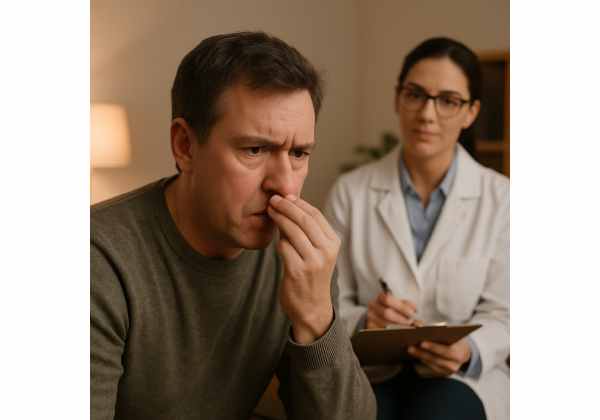
A smell that no one else can detect can be unsettling, especially when it is strong, unpleasant, or keeps returning. Olfactory hallucinations are real sensory experiences: the person smells something even though there is no matching odor source in the environment. The experience may last seconds, minutes, hours, or longer, and it can arise from the nose and smell pathways, the brain, medications or substances, neurological conditions, or mental health conditions.
The medical term often used for this experience is phantosmia, also called a phantom smell. It is different from simply having a sensitive nose, being reminded of a smell, or misidentifying a real odor. Because smell is closely tied to taste, memory, emotion, safety, and appetite, persistent olfactory hallucinations can affect daily life even when the underlying cause is not dangerous.
What matters most about phantom smells
- Olfactory hallucinations mean smelling an odor when no external odor source is present.
- Many people describe smoke, burning, chemicals, rotten food, garbage, mold, or a metallic smell, though pleasant smells can also occur.
- They are often confused with parosmia, sinus odors, taste problems, environmental smells, or anxiety about body odor.
- Causes can include post-viral smell changes, sinus disease, migraine, head injury, seizures, neurological disease, medication effects, substance exposure, or psychosis-related conditions.
- New, severe, persistent, or neurologically unusual symptoms deserve professional evaluation, especially when they occur with confusion, seizures, severe headache, weakness, or other hallucinations.
Table of Contents
- What Olfactory Hallucinations Mean
- Symptoms and Common Smell Patterns
- Conditions Commonly Confused With Phantom Smells
- Causes of Olfactory Hallucinations
- Mental Health and Neurological Context
- Risk Factors for Phantosmia
- Complications and Daily Life Impact
- Diagnostic Context and Urgent Warning Signs
What Olfactory Hallucinations Mean
Olfactory hallucinations are smell perceptions that occur without an identifiable odor source. The person is not “imagining it” in the casual sense; the brain is registering a smell experience, but the signal does not match the outside environment.
The most common clinical term is phantosmia. It belongs to a broader group of smell disorders called qualitative olfactory disorders, which affect the quality or character of smell rather than only the strength of smell. This is why a person may have a normal ability to detect some odors yet still experience a phantom smell at other times.
A key feature is the absence of a matching external trigger. For example, smelling smoke when no smoke, fire, overheated appliance, or tobacco source is present may be phantosmia. Smelling smoke because someone is burning leaves nearby is not. In real life, the distinction can take time to sort out because odors move through vents, clothing, drains, walls, cars, workplaces, and neighboring spaces.
Olfactory hallucinations can be:
- Unilateral, seeming to come from one nostril or one side.
- Bilateral, seeming to involve both nostrils or the whole smell field.
- Intermittent, appearing in episodes.
- Persistent, present much of the time.
- Simple or hard to name, such as “chemical” or “burnt.”
- Specific and recognizable, such as cigarette smoke, gasoline, spoiled food, or perfume.
Phantosmia can occur on its own, but it can also appear alongside other smell changes. Some people have reduced smell after a viral illness and later develop phantom odors. Others have distorted smell, where real odors smell wrong. Because smell and taste are closely connected, people may describe food as tasting smoky, rotten, metallic, or chemical even when the primary problem is smell perception.
The word “hallucination” can sound alarming because it is often associated with psychosis. In this topic, it simply means a perception without an external stimulus. Olfactory hallucinations can occur in psychiatric conditions, but they can also occur in sinus disease, post-viral smell dysfunction, migraine, seizures, head injury, neurodegenerative disorders, medication effects, and idiopathic cases where no clear cause is found.
This broad range of possible causes is why context matters. A brief phantom smell during a migraine pattern is different from a new phantom smell with confusion, seizure-like episodes, or other hallucinations. A persistent burnt odor after a respiratory infection is different from a smell belief tied to a fixed fear that one’s body is emitting an odor. The symptom is the starting point, not the diagnosis.
Symptoms and Common Smell Patterns
The core symptom is smelling something that is not actually present. The smell may be faint, intense, familiar, strange, pleasant, disgusting, or impossible to identify.
Many people describe unpleasant odors. Common descriptions include:
- Smoke or cigarette smoke
- Burning rubber, burnt toast, or electrical burning
- Rotten food, garbage, sewage, or decay
- Chemicals, petrol, cleaning products, or paint
- Mold, dampness, or stale air
- Metal, blood-like, or bitter smells
- Perfume, flowers, food, or other pleasant odors in less common cases
The smell may seem to come and go without a clear pattern. Some people notice it more at night, during quiet moments, after waking, during stress, with fatigue, during illness, or in certain rooms. These patterns do not prove a cause, but they can help distinguish a true phantom smell from a hidden environmental odor.
Duration is also important. A phantom smell that lasts a few seconds may raise different possibilities than one that lasts most of the day. In seizure-related auras, smell experiences are often brief and stereotyped, meaning the same smell returns in a similar way. In post-viral smell dysfunction, episodes may be more variable and may occur with reduced smell or distorted smell. In migraine, unusual smell experiences may appear before or during an attack, sometimes along with light sensitivity, nausea, headache, or other sensory symptoms.
Olfactory hallucinations can also affect taste. Much of what people call flavor comes from smell molecules reaching the olfactory system through the back of the nose while eating. A phantom smoky or rotten smell can make coffee, meat, eggs, vegetables, or other foods seem unpleasant even when the food is fresh. Some people lose interest in eating because meals feel contaminated by the phantom odor.
Symptoms that may occur alongside olfactory hallucinations include:
- Reduced ability to smell familiar odors
- Distorted smell when real odors are present
- Nasal congestion, facial pressure, or postnasal drip
- Headache, light sensitivity, or nausea
- Brief déjà vu, rising stomach sensation, staring spells, or altered awareness
- Memory changes, tremor, slowed movement, or dream-enactment symptoms
- Anxiety, low mood, suspiciousness, or other hallucinations
- Recent medication changes, substance exposure, or withdrawal symptoms
The emotional response can be intense. A person may repeatedly check appliances, throw away food, open windows, ask others to smell the room, or feel embarrassed if they worry the odor is coming from them. These reactions are understandable, especially when the smell is smoke, decay, or chemicals. Still, repeated checking does not always settle the uncertainty, and the persistence of the symptom can become distressing in its own right.
Conditions Commonly Confused With Phantom Smells
Olfactory hallucinations are not the same as every unusual smell experience. Sorting out related conditions helps prevent unnecessary fear and helps clinicians ask the right questions.
| Term or condition | What it means | How it differs from olfactory hallucination |
|---|---|---|
| Phantosmia | A smell is perceived when no odor source is present. | This is the usual medical term for an olfactory hallucination. |
| Parosmia | A real smell is present, but it smells distorted or wrong. | The trigger exists, but the brain interprets it inaccurately. |
| Anosmia or hyposmia | Smell is absent or reduced. | The issue is reduced smell strength, though it can coexist with phantosmia. |
| Hyperosmia | Smells feel unusually intense or overpowering. | The odor source is real, but sensitivity is heightened. |
| Sinus or dental odor | An odor may come from infection, inflammation, drainage, dental disease, or trapped material. | There may be an internal odor source rather than a hallucination. |
| Olfactory reference concerns | A person is preoccupied with the belief that they emit a bad smell. | The main issue is fear of body odor, not necessarily smelling an odor with no source. |
| Dysgeusia | Taste is distorted, bitter, metallic, or unpleasant. | The complaint may be taste-based, smell-based, or both. |
Parosmia is especially easy to confuse with phantosmia. In parosmia, coffee may smell like sewage, onions may smell like chemicals, or soap may smell rotten. The odor is real, but the perception is distorted. In phantosmia, the smell appears even when there is no coffee, onion, soap, or other source.
Hidden environmental odors also matter. Smoke, gas, mold, sewer gases, old food, damp carpets, faulty appliances, and workplace chemicals can be intermittent. A smell that appears only in one building, near a vent, in a car, or after using a certain appliance should be taken seriously as a possible real exposure until the environment is reasonably checked.
Internal odor sources can also mimic phantom smells. Chronic sinus inflammation, nasal polyps, postnasal drip, tonsil stones, reflux, dental infections, and dry mouth can create unpleasant odor or taste sensations. These may be noticed more by the affected person than by others, especially if the odor source is inside the nose or mouth.
The distinction is not always obvious from a single description. Clinicians often ask whether the smell disappears when the nostrils are blocked, whether it is linked to real odors, whether nasal symptoms are present, whether the same episode repeats in a stereotyped way, and whether there are neurological or psychiatric symptoms. These details help narrow the possibilities without assuming the cause too early.
Causes of Olfactory Hallucinations
Olfactory hallucinations have many possible causes, and some cases remain unexplained even after evaluation. The main causes can be grouped into nasal and sinus conditions, post-infectious smell changes, neurological conditions, medication or substance effects, and psychiatric conditions.
Nasal and sinus causes are common considerations because the olfactory receptors sit high in the nasal cavity. Inflammation, infection, chronic rhinosinusitis, nasal polyps, allergies, and structural blockage may alter how odor signals reach the smell system. A person may notice congestion, facial pressure, reduced smell, thick drainage, or symptoms that fluctuate with allergies or infections.
Post-viral smell dysfunction is another important context. Respiratory viruses can injure or disrupt smell pathways. Some people first lose smell, then later develop distorted or phantom smells as the system recovers or misfires. COVID-19 increased public awareness of this pattern, but other viral infections can also be involved.
Head trauma can affect smell through injury to the nose, olfactory nerve fibers, skull base, or brain regions involved in smell processing. The symptom may appear after a concussion, facial injury, or more severe traumatic brain injury. If smell changes occur after head trauma, the broader clinical picture matters, including headache, dizziness, confusion, memory problems, and other neurological symptoms.
Migraine can include unusual sensory experiences. Visual aura is best known, but some people report smell sensitivity or phantom odors before or during migraine attacks. A migraine-related smell experience may occur with nausea, light sensitivity, sound sensitivity, throbbing pain, or a personal history of similar attacks.
Seizures, especially those involving temporal lobe networks, can sometimes include a smell aura. These episodes are often brief, repetitive, and similar each time. They may occur with déjà vu, fear, a rising sensation in the stomach, lip smacking, staring, confusion, or a gap in awareness. When this pattern is suspected, clinicians may consider tests such as an EEG test as part of the diagnostic workup.
Brain and neurological conditions are less common but important. Olfactory hallucinations have been reported with Parkinson’s disease, Alzheimer’s disease and related dementias, brain tumors, stroke, and other disorders affecting smell pathways or brain networks. A brain MRI may be considered when the history suggests a structural, neurological, or unexplained cause, especially when symptoms are new, progressive, one-sided, or accompanied by other neurological signs.
Medications, toxins, and substances can also contribute. Medication changes, withdrawal states, recreational substances, heavy alcohol use, exposure to solvents or chemicals, and some neurological or psychiatric medications may be relevant depending on timing. This does not mean a medication is automatically the cause, but the timeline often provides an important clue.
Mental Health and Neurological Context
Olfactory hallucinations can occur in mental health conditions, but they should not be automatically interpreted as psychosis. The meaning depends on whether the smell occurs alone, with mood symptoms, with other hallucinations, with delusions, with substance use, or with neurological signs.
In psychiatric settings, hallucinations are most often discussed in relation to hearing voices or seeing things. Smell hallucinations are less common, but they may appear in schizophrenia spectrum disorders, mood disorders with psychotic features, severe depression, bipolar disorder, trauma-related states, substance-related conditions, or delirium. The smell may be neutral, frightening, disgusting, or tied to a belief about poisoning, contamination, danger, or personal body odor.
The surrounding mental state is crucial. A person who occasionally smells smoke after a viral illness but knows others cannot smell it has a different presentation from someone who is convinced neighbors are pumping chemicals into the home despite repeated evidence to the contrary. Clinicians look at insight, reality testing, mood, sleep, anxiety, cognition, substance exposure, and whether there are auditory, visual, tactile, or other sensory hallucinations.
When olfactory hallucinations occur with delusions, disorganized thinking, unusual behavior, or major functional decline, a structured psychosis evaluation may be relevant. In a first episode of possible psychosis, clinicians usually look broadly for medical, neurological, medication-related, and substance-related explanations rather than assuming a primary psychiatric disorder from the start.
Neurological context is equally important. Smell pathways connect to brain regions involved in memory, emotion, and threat detection, including limbic and temporal lobe networks. This overlap helps explain why phantom smells can feel vivid, emotionally charged, and hard to dismiss. It also explains why the same symptom can appear in migraine, seizures, neurodegenerative disorders, and some psychiatric conditions.
Delirium deserves special caution. If a person has sudden confusion, fluctuating attention, agitation, sleep-wake disruption, fever, infection, dehydration, medication toxicity, or recent hospitalization, hallucinations of any sensory type may reflect an acute medical problem. Sudden mental status changes are different from long-standing intermittent phantom smells and should be evaluated promptly.
Cognitive change is another context where smell symptoms may be relevant but not diagnostic by themselves. Reduced smell is more widely discussed in Parkinson’s disease and some dementias than phantosmia is. Still, phantom smells reported with memory decline, movement symptoms, visual hallucinations, REM sleep behavior symptoms, or personality change may require a broader neurological assessment.
The most balanced interpretation is this: olfactory hallucinations are a symptom with many possible explanations. They can be benign, distressing, medically meaningful, psychiatric, neurological, or mixed. The pattern and accompanying signs determine how seriously and how urgently they should be investigated.
Risk Factors for Phantosmia
Risk factors are not the same as causes. They increase the chance of phantom smells or make certain explanations more likely, but they do not prove why the symptom is happening in an individual person.
Common risk factors and associated contexts include:
- Recent upper respiratory infection, especially when smell was reduced or distorted afterward.
- COVID-19 or other post-viral smell changes, particularly when phantosmia appears after anosmia, hyposmia, or parosmia.
- Chronic rhinosinusitis, allergies, nasal polyps, or recurring nasal inflammation, especially with congestion or drainage.
- Head injury, including concussion, facial trauma, or skull base injury.
- Migraine history, particularly if phantom smells occur around headache episodes or other aura-like symptoms.
- Possible seizure symptoms, such as brief stereotyped episodes, altered awareness, déjà vu, or unexplained spells.
- Neurological disorders, including Parkinson’s disease, dementia syndromes, stroke history, or brain lesions.
- Medication changes or substance exposure, including prescribed medicines, recreational substances, withdrawal states, toxins, or solvents.
- High stress, anxiety symptoms, poor sleep, or recent severe life events, which may influence perception, attention, and distress even when they are not the sole cause.
- Psychiatric history, especially when phantom smells occur with other hallucinations, fixed false beliefs, mania, severe depression, or major functional change.
Age can affect the interpretation. Smell disorders become more common with aging, and older adults are more likely to have multiple possible contributors, including medications, sinus disease, neurodegenerative disorders, and medical illness. In younger adults, migraine, post-viral change, substance exposure, anxiety, and seizure-related patterns may be more prominent considerations, though none is exclusive to one age group.
Sex differences have been reported in some population research, with olfactory hallucinations reported more often by women in certain samples. This does not mean the symptom is “female” or hormonal by default. It means demographic patterns may exist, while individual evaluation still depends on the symptom pattern and accompanying signs.
Risk is also shaped by timing. A phantom smell that begins within days of a new medication, chemical exposure, viral illness, head injury, or first seizure-like event has a different meaning from one that has occurred occasionally for years without change. A symptom that is stable, rare, and isolated is usually interpreted differently from one that is worsening, spreading to other sensory experiences, or occurring with cognitive or behavioral changes.
Because many risk factors overlap, clinicians often build a timeline. They may ask when the smell began, what changed in the weeks before it started, whether it is improving or worsening, and what symptoms happen before, during, and after each episode. This timeline can be more useful than a single list of possible causes.
Complications and Daily Life Impact
Olfactory hallucinations can affect quality of life even when they are not caused by a dangerous condition. Smell is tied to eating, safety, comfort, memory, social confidence, and emotional regulation, so a persistent phantom odor can become more than a minor annoyance.
Food and appetite are common areas of impact. A smoky, rotten, metallic, or chemical smell can make meals seem spoiled or unsafe. Some people avoid certain foods, eat less, lose enjoyment in cooking, or worry that food is contaminated. Others develop nausea when the phantom odor is strong. When smell distortion and phantom smells occur together, the effect on diet can be more disruptive.
Safety concerns are also understandable. Smelling smoke, gas, chemicals, or burning wires naturally prompts people to check the stove, appliances, heaters, outlets, cars, and living spaces. This can be protective at first because real hazards must be ruled out. Over time, repeated false alarms may create exhaustion, uncertainty, or conflict with family members who cannot smell anything.
Sleep can be affected when the smell appears at night or in bed. A person may wake up repeatedly, check the home, open windows, or struggle to fall asleep because the odor feels threatening. Poor sleep can then increase stress, headache vulnerability, anxiety, and attention to bodily sensations, creating a cycle that makes the symptom feel more intrusive.
Social effects may appear when the person worries that others think the smell is coming from them. This can lead to embarrassment, repeated washing, excessive use of fragrance, avoidance of shared spaces, or reluctance to invite people home. If the main concern becomes a fixed belief about emitting a bad odor despite reassurance, clinicians may consider a different diagnostic pathway than phantosmia alone.
Mental health impact varies. Some people are mildly puzzled; others feel frightened, disgusted, or preoccupied. A phantom smell can become linked to health anxiety, contamination fears, trauma reminders, or fear of neurological disease. It can also worsen distress in people who already have depression, anxiety, obsessive checking, or psychosis-related symptoms.
Complications are more concerning when olfactory hallucinations occur with impaired judgment or loss of reality testing. For example, a person who believes the smell proves they are being poisoned may stop eating, confront others, leave home suddenly, or take unsafe actions. A person with confusion or delirium may misinterpret smells as danger and become agitated. In these situations, the main concern is not the smell itself but the broader change in thinking, behavior, or safety.
The daily impact should be taken seriously without assuming the worst cause. Even when phantosmia is idiopathic or post-viral, it can still be distressing, disruptive, and worthy of evaluation when persistent.
Diagnostic Context and Urgent Warning Signs
Evaluation focuses on confirming that the symptom is truly a phantom smell and then looking for clues to nasal, neurological, medication-related, substance-related, cognitive, or psychiatric causes. The workup varies because olfactory hallucinations do not have a single diagnostic test.
A clinician may begin with practical questions:
- What does the smell resemble?
- When did it start?
- Is it constant or episodic?
- Does it affect one nostril or both?
- Does it occur with real odors or without any trigger?
- Are there nasal, dental, reflux, or sinus symptoms?
- Was there a recent infection, COVID-19, head injury, migraine change, or medication change?
- Are there seizure-like spells, confusion, weakness, severe headache, or memory changes?
- Are there other hallucinations, paranoia, severe mood symptoms, or substance use concerns?
Physical examination may include the nose, mouth, throat, cranial nerves, and general neurological signs. Depending on the pattern, clinicians may consider smell testing, nasal endoscopy, sinus imaging, neurological assessment, medication review, cognitive screening, psychiatric assessment, toxicology testing, EEG, CT, or MRI. If substances, medication toxicity, or exposure are part of the concern, toxicology screening may be one part of a broader assessment.
Urgency depends on the full picture. A long-standing intermittent phantom smell with no other symptoms is usually different from a new smell hallucination with neurological or psychiatric warning signs.
| Pattern | Why it matters |
|---|---|
| Sudden weakness, facial droop, trouble speaking, vision loss, severe dizziness, or new confusion | These can suggest a stroke or other acute neurological problem. |
| New seizure, loss of awareness, repeated staring spells, or brief stereotyped smell episodes with confusion | Smell auras can occur with seizures, especially temporal lobe seizures. |
| Worst headache, sudden severe headache, fever with stiff neck, or recent significant head injury | These symptoms raise concern for urgent neurological or infectious causes. |
| New hallucinations in several senses, paranoia, disorganized thinking, mania, or severe depression | The smell symptom may be part of a broader psychiatric or medical syndrome. |
| Suicidal thoughts, thoughts of harming others, command hallucinations, or unsafe behavior | Immediate safety assessment is important regardless of the specific smell symptom. |
| Progressive memory loss, movement changes, repeated falls, or major personality change | A broader neurological or cognitive evaluation may be needed. |
When symptoms suggest immediate danger, emergency evaluation may be appropriate; a guide to ER-level mental health or neurological symptoms can help clarify the kinds of warning signs that should not wait.
For possible first-episode psychosis, the assessment is broader than a symptom checklist. Clinicians often evaluate medical conditions, substances, sleep deprivation, mood episodes, trauma, neurological symptoms, and functional change. A first-episode psychosis evaluation may include several types of assessment because hallucinations can have medical, psychiatric, or substance-related causes.
A careful evaluation does not mean the clinician expects a serious diagnosis. It means the symptom has enough possible explanations that context matters. Many cases are benign or related to smell-system disruption, but new or changing olfactory hallucinations deserve attention when they are persistent, distressing, unexplained, or accompanied by other concerning signs.
References
- Phantosmia 2025 (Review)
- Position paper on olfactory dysfunction: 2023 2023 (Position Statement)
- Parosmia and Phantosmia: Managing Quality Disorders 2023 (Review)
- Olfactory Dysfunction in Mental Illness 2023 (Review)
- Olfactory hallucinations in a population-based sample 2021 (Population Study)
- Phantosmia in Parkinson’s Disease: A Systematic Review of the Phenomenology of Olfactory Hallucinations 2024 (Systematic Review)
Disclaimer
This article is for general educational purposes only and is not a substitute for professional medical advice, diagnosis, or treatment. New, persistent, worsening, or safety-related olfactory hallucinations should be discussed with a qualified healthcare professional, especially when they occur with neurological changes, severe mood symptoms, confusion, or other hallucinations.
Thank you for taking the time to read this sensitive topic; sharing it may help someone else understand phantom smells with less fear and more clarity.