An EEG is a noninvasive test that records patterns of electrical activity from the brain. It is most often used when a clinician needs information about seizures, seizure-like episodes, episodes of altered awareness, unexplained spells, or certain forms of brain dysfunction that may not show up clearly on a scan.
The test does not read thoughts, measure intelligence, or diagnose most mental health conditions by itself. Its value is more specific: it can show whether the brain’s electrical rhythms are normal for the person’s age and state of alertness, whether there are patterns that suggest a tendency toward seizures, and whether more detailed testing is needed.
Table of Contents
- What an EEG Measures
- When an EEG Is Ordered
- Types of EEG Tests
- How to Prepare for an EEG
- What Happens During the Test
- What EEG Results Mean
- EEG vs Other Brain Tests
- Risks, Limitations, and Urgent Symptoms
What an EEG Measures
An EEG measures electrical activity produced by groups of brain cells, especially activity from the outer surface of the brain. Small electrodes placed on the scalp detect tiny voltage changes, which are amplified and displayed as wave patterns.
The result is often described as “brain waves,” but that phrase can be misleading. The EEG does not show thoughts, memories, personality, or emotions. It shows patterns of electrical rhythm, timing, symmetry, and abnormal discharges that may help a clinician understand how the brain is functioning during the recording.
A routine EEG usually evaluates several features:
- Background rhythm: the overall pattern of brain activity when a person is awake, drowsy, or asleep
- Symmetry: whether activity looks similar on both sides of the brain
- Speed and organization: whether the wave patterns are appropriate for age and alertness
- Epileptiform discharges: spikes or sharp waves that may suggest an increased likelihood of seizures
- Slowing: slower-than-expected activity that can reflect diffuse brain dysfunction or a more localized problem
- Responses to activation procedures: changes during hyperventilation, flashing lights, sleep, or drowsiness
EEG is especially useful because it captures brain activity in real time. A brain MRI may show structure, such as a tumor, scar, stroke, or malformation. EEG shows electrical function. This is why a person can have a normal MRI and still need an EEG, or have an abnormal MRI and still need EEG information to understand whether symptoms are seizure-related.
EEG findings are also strongly influenced by age, alertness, medications, recent sleep, and the exact timing of symptoms. A normal EEG during a short recording does not prove that seizures are absent. Many people with epilepsy have normal EEGs between seizures, especially if the abnormal activity is intermittent or deep in the brain. Likewise, an abnormal EEG pattern may increase suspicion for epilepsy but usually needs to be interpreted alongside the person’s symptoms and medical history.
EEG is a test of electrical patterns, not a stand-alone diagnosis. Its most useful role is to add objective information to a larger clinical picture.
When an EEG Is Ordered
Doctors usually order an EEG when symptoms suggest a possible seizure, seizure tendency, or episodic change in brain function. It may also be used in hospitals to evaluate confusion, coma, encephalopathy, or possible nonconvulsive seizures.
Common reasons for ordering an EEG include:
- A first seizure or suspected seizure
- Repeated staring spells, blackouts, or episodes of lost awareness
- Jerking movements, unusual sensory episodes, or unexplained spells
- Possible absence seizures in children
- Confusion that comes and goes without a clear cause
- A known epilepsy diagnosis that needs classification or follow-up
- Medication changes in someone with seizures
- Episodes that may be seizures or may be fainting, migraine, panic attacks, movement disorders, or psychogenic nonepileptic seizures
- Unexplained changes in consciousness in intensive care
- Suspected encephalitis, encephalopathy, or other diffuse brain dysfunction
In children, EEG may be ordered for repeated staring spells, sudden pauses in activity, unexplained falls, developmental regression with possible seizures, or unusual movements during sleep or wakefulness. In adults, it is often ordered after a first seizure-like event, unexplained loss of consciousness, suspected focal seizures, or new episodes of confusion.
EEG is not usually the first test for everyday forgetfulness, mild brain fog, anxiety, depression, or attention problems unless there are spell-like symptoms or features that raise concern for seizures. For cognitive symptoms, doctors often start with history, examination, medication review, lab testing, cognitive screening, and sometimes brain imaging. If symptoms involve memory loss or confusion, the workup may include other tools described in memory loss evaluation or brain fog testing.
An EEG may be ordered urgently in a hospital when a person remains confused after a convulsive seizure, has unexplained reduced consciousness, or may be having seizures without obvious shaking. These are situations where electrical seizures can be missed without EEG monitoring.
Types of EEG Tests
Different EEG tests are used for different clinical questions. A short routine EEG may be enough for some people, while others need sleep recording, home monitoring, or inpatient video EEG.
| Test type | Typical purpose | What to expect |
|---|---|---|
| Routine EEG | Initial evaluation for suspected seizures or abnormal brain rhythms | Usually recorded while awake, often with drowsiness if it happens naturally |
| Sleep or sleep-deprived EEG | Improves the chance of capturing abnormalities that appear during drowsiness or sleep | You may be asked to sleep less the night before so you can fall asleep during the test |
| Ambulatory EEG | Records brain activity over a longer period outside the hospital | You wear portable equipment at home, sometimes for one or more days |
| Video EEG monitoring | Compares EEG activity with visible events or spells | EEG is recorded along with video so clinicians can match symptoms to brain activity |
| Continuous EEG | Hospital monitoring for critically ill patients or suspected nonconvulsive seizures | Recording continues for many hours or longer while the care team monitors patterns |
A routine EEG is commonly the starting point. It may include periods of eye opening and closing, deep breathing, flashing lights, and quiet rest. If the routine EEG is normal but suspicion remains, the clinician may order a longer recording or a sleep-focused EEG.
A sleep-deprived EEG may be used because some epileptiform patterns are more likely to appear when a person is drowsy or asleep. Sleep deprivation can also make seizures more likely in susceptible people, so the instruction should be followed only as directed by the ordering clinician.
A video EEG is often helpful when the main question is whether a person’s real-life episodes are epileptic seizures, nonepileptic events, fainting, sleep-related behaviors, or another type of spell. Matching the video behavior to the EEG pattern can be much more informative than EEG alone.
Quantitative EEG, often called qEEG, uses computer analysis to compare EEG patterns with databases or generate maps. It can be useful in some research and specialized clinical contexts, but it is not the same as a standard diagnostic EEG interpretation. Claims that qEEG can reliably diagnose many psychiatric or developmental conditions should be treated cautiously; qEEG brain mapping has important limitations.
How to Prepare for an EEG
Preparation is usually simple, but the details matter because hair products, sleep, caffeine, and medication instructions can affect the recording. Always follow the instructions from the EEG lab or ordering clinician, because preparation can vary by test type.
For many routine EEGs, typical preparation includes:
- Wash your hair the night before or the morning of the test.
- Avoid oils, gels, sprays, heavy conditioners, or styling products.
- Bring a list of prescription medicines, over-the-counter medicines, and supplements.
- Eat normally unless you were told not to.
- Ask before changing any seizure medicine, sedative, stimulant, or sleep medicine.
- Avoid caffeine if your lab specifically instructs you to.
- Plan for messy hair afterward because electrode paste or adhesive may remain.
Do not stop anti-seizure medication, sedatives, antidepressants, stimulants, or other prescribed medications unless the clinician specifically tells you to. Stopping certain medicines suddenly can be unsafe and may trigger symptoms, withdrawal effects, or seizures.
For a sleep-deprived EEG, the lab may ask you to sleep less than usual the night before. The goal is to make drowsiness and sleep more likely during the recording. Because sleep deprivation can impair driving and may increase seizure risk in people who are vulnerable, it is often wise to arrange transportation if you have been told to stay awake most of the night.
For children, preparation may include bringing a favorite blanket, bottle, snack, toy, or tablet for comfort. Some labs schedule young children around nap time. Parents may be asked to help keep a child awake beforehand, then help them settle during the test.
Tell the EEG team before the test if you have a skin condition, scalp sensitivity, recent head surgery, implanted devices, pregnancy, severe anxiety about procedures, or a history of seizures triggered by flashing lights or sleep loss. EEG is generally safe, but the team can adjust the approach and monitor you more closely if needed.
What Happens During the Test
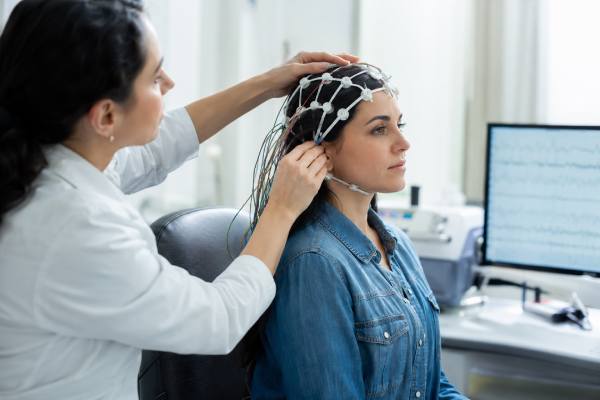
During a standard EEG, a technologist places electrodes on the scalp, records brain activity, and may ask you to do a few simple tasks. The test is usually painless, though the setup can feel tedious because accurate electrode placement takes time.
The typical process is straightforward:
- You sit in a chair or lie on an exam bed.
- The technologist measures your head and marks electrode positions.
- Small electrodes are attached with paste, gel, adhesive, or an electrode cap.
- The electrodes connect to recording equipment.
- You rest quietly while the EEG records brain activity.
- You may be asked to open and close your eyes, breathe deeply, look at flashing lights, relax, or try to sleep.
- The electrodes are removed, and you can usually return to normal activities unless told otherwise.
The electrodes only record electrical signals produced naturally by the brain. They do not send electricity into the brain and do not cause shocks. Some people feel mild scalp irritation from the paste or adhesive, but significant discomfort is uncommon.
Activation procedures are often part of the test. Hyperventilation means breathing deeply and steadily for a few minutes. It can bring out certain EEG patterns, especially in some absence seizure disorders, but it may cause temporary lightheadedness, tingling, or discomfort. Photic stimulation uses flashing lights at different speeds to look for light-sensitive EEG responses. If you have known photosensitive seizures, the team should already be aware, but it is still worth mentioning.
A routine EEG may take about an hour including setup, though the actual recording may be shorter. Longer EEGs, ambulatory EEGs, and inpatient video EEG monitoring can last many hours or days. In longer studies, the goal is often to record a typical event so the clinician can see whether symptoms match seizure activity.
After the test, a neurologist or clinical neurophysiologist reviews the recording. The technologist may not be able to interpret the results during the appointment, because formal reading requires detailed review and clinical context.
What EEG Results Mean
EEG results describe patterns, not a complete diagnosis by themselves. The most important question is whether the findings match the person’s symptoms, exam, history, and other test results.
A report may describe the EEG as normal, abnormal, or abnormal in a specific way. Common result categories include:
- Normal EEG: no concerning abnormal patterns were seen during the recording
- Epileptiform activity: spikes, sharp waves, or spike-and-wave patterns that can support a seizure diagnosis
- Focal slowing: slower activity in one region, which may suggest localized brain dysfunction
- Generalized slowing: widespread slowing that can occur with encephalopathy, medication effects, metabolic problems, infection, or other diffuse brain stress
- Seizure captured: an actual electrical seizure occurred during the test
- Nonspecific abnormality: a change is present but does not point to one clear diagnosis
A normal EEG can be reassuring, but it does not always rule out epilepsy. Seizure-related activity may not occur during the recording, may arise from deeper brain regions that scalp electrodes detect poorly, or may require sleep, repeated testing, or longer monitoring to capture.
An abnormal EEG also does not automatically prove epilepsy. Some abnormalities can be nonspecific, medication-related, age-related, or seen in people without clinical seizures. This is why clinicians avoid diagnosing epilepsy based only on an EEG report without a compatible history.
The most useful EEG result is one that answers the clinical question. For example, if a person has repeated spells and a typical spell is captured on video EEG without seizure activity, that finding may point away from epileptic seizures and toward another diagnosis. If a child with staring episodes has a typical absence seizure pattern during hyperventilation, EEG may strongly support the diagnosis. If an ICU patient is unresponsive and continuous EEG shows nonconvulsive seizures, the result may directly guide urgent treatment.
Ask the clinician to explain what the result means in plain language: whether it changes the diagnosis, whether it changes treatment, and whether more testing is needed.
EEG vs Other Brain Tests
EEG answers different questions than MRI, CT, PET, cognitive testing, or a sleep study. It is best understood as a functional electrical test, not a scan of brain structure.
| Test | What it mainly shows | When it may be preferred |
|---|---|---|
| EEG | Real-time electrical brain activity | Suspected seizures, seizure classification, altered awareness, encephalopathy |
| Brain MRI | Detailed brain structure | Tumor, stroke, scar, malformation, inflammation, unexplained neurological symptoms |
| Brain CT | Fast structural imaging | Emergency evaluation for bleeding, trauma, acute stroke concerns, sudden severe symptoms |
| PET or SPECT | Patterns of metabolism or blood flow | Selected dementia, epilepsy surgery, or specialized neurological workups |
| Polysomnography | Sleep stages, breathing, oxygen levels, movement, heart rhythm, and brain waves during sleep | Sleep apnea, narcolepsy, parasomnias, periodic limb movements, complex sleep symptoms |
| Cognitive testing | Memory, attention, language, processing speed, and problem-solving performance | Memory loss, dementia concerns, brain injury, ADHD, learning problems, functional changes |
A brain MRI can show structural causes that EEG cannot, such as a tumor, old injury, stroke, or developmental difference. An EEG can show abnormal electrical patterns that MRI cannot. The tests often complement each other, especially after a first seizure or when focal neurological symptoms are present.
A CT scan is faster than MRI and is often used in emergency settings, but it is less detailed for many non-emergency brain questions. When clinicians are deciding between imaging options, the choice depends on symptoms, timing, safety, and what diagnosis is most concerning. A broader comparison of MRI vs CT for brain symptoms may help explain why one test may be chosen over the other.
A sleep study is different from a routine EEG, even though it includes brain-wave recording. Polysomnography measures sleep stages along with breathing, oxygen level, heart rhythm, eye movements, muscle activity, body position, and limb movements. It is usually the more appropriate test when the main concern is sleep apnea, narcolepsy, unusual behaviors during sleep, or severe daytime sleepiness.
EEG is also different from cognitive or neuropsychological testing. Cognitive tests measure performance on tasks. EEG measures electrical activity. If the main concern is memory, attention, or thinking ability, EEG is usually only one possible piece of a broader workup, not the central test.
Risks, Limitations, and Urgent Symptoms
EEG is generally safe and noninvasive, but it has important limitations. The main risks are minor skin irritation, temporary discomfort from preparation, and rarely, triggering a seizure in someone who is already seizure-prone.
The electrodes record activity; they do not deliver electricity into the brain. Most people can return to usual activities after a routine EEG. Exceptions may apply if you were sleep deprived, had a seizure, received sedating medication, or were given specific driving or safety instructions.
The main limitations are diagnostic:
- A short EEG may miss intermittent seizure activity.
- Scalp EEG may not detect some deep or small seizure sources.
- Movement, muscle tension, blinking, sweat, and poor electrode contact can create artifacts.
- Some abnormal patterns are nonspecific.
- EEG interpretation depends on age, medications, sleep state, and clinical history.
- Results can be overinterpreted if they are not matched to symptoms.
Because of these limitations, follow-up may include repeat EEG, sleep-deprived EEG, ambulatory EEG, video EEG, brain imaging, blood tests, heart rhythm testing, sleep testing, or referral to an epilepsy specialist. The next step depends on the symptom pattern and the level of concern.
Some symptoms should not wait for an outpatient EEG appointment. Seek urgent medical evaluation for a first seizure, a seizure lasting about five minutes or longer, repeated seizures without full recovery between them, seizure with serious injury, seizure in pregnancy, seizure in water, new weakness or trouble speaking, severe headache with neurological symptoms, persistent confusion, high fever with stiff neck, or a person who does not wake or return to baseline as expected. For broader safety guidance, see when to go to the ER for neurological symptoms.
After an EEG, it is reasonable to ask the clinician three practical questions: What did the test show? Does it change the diagnosis or treatment plan? What should be done if another event happens? Clear answers to those questions usually matter more than the label “normal” or “abnormal” alone.
References
- Routine and sleep EEG: minimum recording standards of the International Federation of Clinical Neurophysiology and the International League Against Epilepsy 2023 (Guideline)
- Minimum standards for inpatient long-term video-EEG monitoring: A clinical practice guideline of the international league against epilepsy and international federation of clinical neurophysiology 2022 (Guideline)
- Electroencephalogram 2022 (Review)
- EEG (electroencephalogram) 2024 (Patient Procedure Review)
- Polysomnography (sleep study) 2025 (Patient Procedure Review)
- Electroencephalogram (EEG) 2024 (Patient Procedure Review)
Disclaimer
This information is for general educational purposes only and is not a substitute for professional medical advice, diagnosis, or treatment. EEG testing and seizure-related symptoms should be evaluated by a qualified healthcare professional who can interpret results in the context of the person’s full medical history.
Share this article on Facebook, X, or your preferred platform to help others understand what an EEG can and cannot show.