qEEG brain mapping can look impressive: colored maps, frequency bands, numerical scores, and reports that seem to translate brain activity into clear explanations for attention, mood, sleep, memory, or behavior. That presentation can make the test feel more definitive than it usually is.
Quantitative EEG is a real method of analyzing electrical brain activity, and it has meaningful uses in some clinical and research settings. But it is not a stand-alone diagnostic test for depression, anxiety, ADHD, autism, concussion, dementia, or most other brain and mental health conditions. Its value depends heavily on why it is being done, how the EEG is recorded, how artifacts are handled, which database or algorithm is used, and whether the results are interpreted by someone trained in clinical EEG.
Table of Contents
- What qEEG Brain Mapping Measures
- How qEEG Is Performed and Analyzed
- What qEEG Can Really Show
- Claims About qEEG and the Evidence
- How qEEG Compares With Other Tests
- Limitations, Risks, and Red Flags
- When qEEG May Be Worth Discussing
- Questions to Ask Before Testing
What qEEG Brain Mapping Measures
qEEG, short for quantitative electroencephalography, is a computer-assisted analysis of EEG data. It starts with the same basic signal used in a standard EEG test: tiny voltage changes recorded from electrodes placed on the scalp.
A regular EEG is usually interpreted visually by a trained clinician, who looks at the raw waveforms for features such as seizures, epileptiform discharges, slowing, sleep patterns, and other abnormalities. qEEG takes the recorded EEG signal and applies mathematical processing to measure features such as:
- Power in frequency bands, including delta, theta, alpha, beta, and sometimes gamma
- Ratios between frequency bands, such as theta-to-beta ratio
- Differences between brain regions, often shown as asymmetry
- Measures of synchronization or connectivity, sometimes called coherence
- Trends over time during prolonged EEG monitoring
- Comparisons with age-matched reference databases
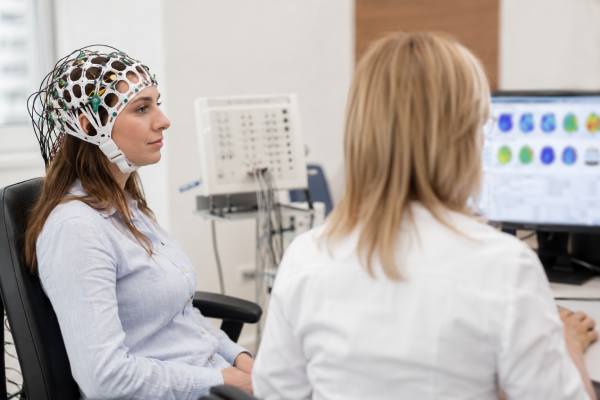
The “brain map” is usually a visual display of these measurements. A color-coded map may show where certain frequencies are higher or lower than expected, or where two regions appear more or less synchronized. The colors do not show thoughts, emotions, personality traits, intelligence, trauma memories, or a diagnosis. They show a processed representation of electrical activity recorded at the scalp.
That distinction matters. EEG is excellent at capturing timing because it measures brain electrical activity in milliseconds. It is much less precise at showing exactly where deep brain activity comes from. The signal also reflects a mixture of brain activity, muscle tension, eye movement, drowsiness, medication effects, technical noise, and the person’s state during the recording.
A qEEG result is therefore not a direct picture of the brain in the way many people imagine. It is an analysis of a surface electrical signal. Used carefully, that analysis may add information. Used carelessly, it can turn noise, normal variation, or nonspecific findings into an overly confident explanation.
How qEEG Is Performed and Analyzed
A qEEG session usually involves recording EEG from multiple scalp electrodes, then processing the data with specialized software. The recording may be done with eyes open, eyes closed, during rest, during a task, or across a longer clinical EEG study.
A typical process includes several steps:
- Electrodes are placed on the scalp, often using the standard 10–20 system or a higher-density setup.
- The EEG is recorded while the person sits or lies still.
- The technician or clinician monitors for movement, eye blinks, muscle tension, sleepiness, poor electrode contact, and other artifacts.
- The raw EEG is reviewed and cleaned so that non-brain signals do not distort the analysis.
- Software calculates frequency, power, asymmetry, coherence, or other measures.
- Results may be displayed as graphs, tables, trend panels, or topographic maps.
- A clinician interprets the findings in the context of symptoms, exam findings, medications, sleep, history, and other test results.
The artifact step is one of the most important parts. Jaw clenching can increase high-frequency activity. Eye movements can look like slow waves near the front of the head. Drowsiness can increase theta activity. Poor electrode contact can create abnormal-looking patterns. If these problems are not recognized, a map may appear abnormal even when the abnormality is not coming from the brain.
The comparison database also matters. Many qEEG systems compare a person’s results with a “normative” group. That can be useful only if the reference group is appropriate for the person’s age, recording conditions, and clinical context. A result that falls outside a database range does not automatically mean disease. Healthy people can fall outside statistical norms, and people with real symptoms can have normal-looking qEEG results.
This is why qEEG interpretation should not be separated from the raw EEG. A polished report can obscure the quality of the underlying recording. A responsible interpretation asks not only “What does the map show?” but also “Was the signal clean, was the person alert, were medications relevant, and does this finding match the clinical picture?”
What qEEG Can Really Show
qEEG can show patterns in electrical brain activity, but those patterns are usually nonspecific. They may support a broader clinical impression, guide closer review of a long EEG recording, or raise questions for further evaluation, but they rarely answer a diagnosis by themselves.
In clinical neurology, quantitative displays can be especially useful when EEG is recorded for many hours or days. In intensive care and neurological emergency settings, qEEG trends can help clinicians scan long recordings for possible seizures, changes in background activity, medication effects, or evolving brain dysfunction. Even there, qEEG is generally used alongside the raw EEG rather than as a replacement for expert interpretation.
In epilepsy care, qEEG-style trend displays may help identify periods that need closer review, especially during prolonged or video EEG monitoring. The diagnosis still depends on the clinical event, EEG pattern, history, and specialist interpretation.
In cognitive disorders, EEG and qEEG may show generalized slowing or altered rhythms in some forms of dementia or encephalopathy. Those findings can support a workup, but they do not replace clinical evaluation, cognitive testing, lab work, medication review, MRI, PET, or other tools used when doctors evaluate memory loss. A person concerned about cognition usually needs a broader assessment, not only a brain map; the role of neuropsychological testing for memory loss is often more directly tied to everyday thinking skills.
In mental health, qEEG research has found group-level differences in some conditions. For example, some studies have reported average differences in activity patterns among groups with ADHD, depression, anxiety, autism, PTSD, or substance use disorders. But group-level differences are not the same as a reliable diagnostic test for one individual. Many patterns overlap across conditions, and the same qEEG feature may be influenced by sleep, medication, age, alertness, substance use, head injury, pain, or another medical condition.
A useful way to think about qEEG is this: it may show that brain electrical activity looks different in a measurable way, but it usually cannot tell you exactly why. The “why” still comes from the full clinical workup.
Claims About qEEG and the Evidence
The strongest concern with qEEG is not that the technology is fake. It is that commercial claims often outrun the evidence. qEEG can be scientifically interesting and clinically useful in selected settings while still being overmarketed as a diagnostic shortcut.
Some clinics advertise qEEG brain mapping as a way to identify the “root cause” of depression, anxiety, ADHD, autism, trauma, brain fog, insomnia, addiction, or learning problems. That framing is too strong. These conditions are diagnosed through clinical criteria, history, functional impairment, symptom patterns, developmental history, medical review, and sometimes structured rating scales or cognitive testing.
For ADHD, the theta-to-beta ratio has received particular attention. Some people with ADHD may show higher theta activity or altered theta/beta patterns, but this is not consistent enough to confirm or rule out ADHD in routine practice. ADHD can also be confused with sleep deprivation, anxiety, trauma, learning disorders, depression, substance use, and medical causes of poor concentration. A careful adult ADHD evaluation, or a child-focused diagnostic workup, looks at symptoms across settings and over time rather than relying on an EEG ratio.
For depression and anxiety, qEEG findings may appear in research, but there is no single electrical signature that diagnoses either condition. Mood and anxiety symptoms can be affected by thyroid disease, anemia, sleep apnea, medication effects, substance use, chronic stress, trauma, pain, and many other factors. A qEEG map cannot sort through those possibilities on its own.
For autism, qEEG research explores brain connectivity and developmental patterns, but autism diagnosis remains behavioral and developmental. It requires a detailed history and direct assessment of social communication, restricted or repetitive behaviors, sensory features, functioning, and developmental course.
For concussion and mild traumatic brain injury, qEEG has been studied for decades, but it remains controversial as a diagnostic tool. A normal qEEG does not rule out concussion, and an abnormal qEEG does not prove that a concussion occurred. After head injury, the clinical history, neurological exam, symptom course, and targeted testing are more important. When symptoms persist, concussion testing may include symptom scales, balance testing, vestibular assessment, cognitive screening, and sometimes imaging when red flags are present.
| Claim | More accurate interpretation |
|---|---|
| “It can diagnose ADHD.” | qEEG may show patterns studied in ADHD, but it should not replace a clinical ADHD evaluation. |
| “It shows the cause of depression or anxiety.” | It may show nonspecific activity patterns, but symptoms still require medical and mental health assessment. |
| “It proves a concussion happened.” | Current evidence does not support qEEG as a stand-alone diagnostic test for mild traumatic brain injury. |
| “It creates a personalized treatment plan.” | It may inform hypotheses, but treatment decisions should be based on diagnosis, evidence, symptoms, risks, preferences, and clinical response. |
| “The colors show damaged brain areas.” | Color maps show processed electrical measurements, not a direct image of structural brain damage. |
How qEEG Compares With Other Tests
qEEG is easiest to understand when compared with the tests people often confuse it with. It is not an MRI, not a PET scan, not neuropsychological testing, and not a psychiatric diagnosis.
A standard EEG records brain electrical activity and is especially useful for seizures, epilepsy syndromes, encephalopathy, sleep-related changes, and certain altered mental status evaluations. qEEG analyzes EEG data numerically, often to summarize or quantify features that may be harder to see in raw tracings alone.
MRI shows brain structure. It can detect tumors, strokes, bleeding, inflammation, certain developmental differences, and other structural findings. It does not directly diagnose most mental health conditions. For readers trying to understand imaging limits, the difference between symptoms and scan findings is central to questions such as whether MRI can diagnose mental illness.
PET and SPECT scans measure aspects of metabolism, blood flow, or specific molecular targets, depending on the scan type. They may be useful in selected dementia, epilepsy, cancer, or other neurological workups. They are not interchangeable with qEEG.
Neuropsychological testing measures thinking skills through structured tasks. It can assess attention, processing speed, memory, language, executive function, visuospatial skills, and effort patterns. Unlike qEEG, it directly measures performance on cognitive tasks and can connect results to daily functioning, school needs, work demands, or rehabilitation planning.
Mental health screening tools and diagnostic interviews measure symptoms, duration, impairment, safety, and clinical criteria. They are not brain maps, but they often provide more relevant information for diagnosing depression, anxiety, bipolar disorder, PTSD, OCD, ADHD, and related conditions.
| Test | What it mainly measures | What it is best suited for |
|---|---|---|
| Standard EEG | Raw electrical brain activity over time | Seizures, epilepsy evaluation, encephalopathy, altered awareness |
| qEEG | Computer-analyzed EEG features | Adjunctive analysis, long EEG trend review, selected research and clinical questions |
| MRI | Brain structure | Stroke, tumor, bleeding, inflammation, structural causes of symptoms |
| PET or SPECT | Metabolism, blood flow, or molecular targets | Selected dementia, epilepsy, oncology, and specialty neurological workups |
| Neuropsychological testing | Cognitive performance and functional patterns | Memory loss, ADHD questions, brain injury, learning problems, dementia workups |
Limitations, Risks, and Red Flags
The main risk of qEEG is not physical harm from the recording itself. EEG is noninvasive and generally low risk. The bigger risk is misinterpretation: treating a colorful report as a diagnosis, overlooking more urgent conditions, or spending significant money on testing that does not change care.
Several limitations are especially important:
- qEEG findings are often nonspecific.
- Results can be affected by drowsiness, sleep deprivation, medications, caffeine, alcohol, cannabis, anxiety, pain, and movement.
- Normative databases vary, and “outside the norm” does not always mean clinically abnormal.
- Different software systems may produce different outputs from similar data.
- A brain map may look precise even when the underlying signal quality is poor.
- A qEEG report may not distinguish between overlapping conditions that cause similar symptoms.
Be cautious if a clinic promises that qEEG can definitively diagnose multiple psychiatric conditions, identify the exact cause of symptoms, replace a medical or psychological evaluation, or guarantee a treatment plan. Be especially cautious if the test is bundled with expensive treatment packages before a clear diagnosis has been made.
qEEG should also never delay urgent care. Seek emergency evaluation for new weakness or numbness on one side of the body, facial drooping, sudden severe headache, new seizure, fainting with injury, severe confusion, rapidly worsening mental status, head injury with repeated vomiting or worsening symptoms, suicidal intent, psychosis with unsafe behavior, or symptoms of mania with dangerous impulsivity. A brain map is not the right first step for those situations. For severe or sudden symptoms, guidance on when to go to the ER for neurological or mental health symptoms is more relevant than elective testing.
A safer approach is to ask what decision the qEEG will change. If the answer is vague, or if the result will be used mainly to validate a treatment already being sold, the test may not be worth doing.
When qEEG May Be Worth Discussing
qEEG may be worth discussing when it is ordered for a specific clinical question and interpreted by a qualified clinician as part of a broader evaluation. It is most defensible when the result can meaningfully guide next steps rather than simply produce a descriptive report.
Possible situations include prolonged EEG review, epilepsy monitoring, ICU or neurological emergency settings, research participation, selected cognitive disorder evaluations, or specialist-directed cases where standard EEG findings need quantitative support. In these settings, qEEG is usually not being used as a consumer-style “personality scan.” It is being used as an adjunct to clinical EEG interpretation.
qEEG may also be discussed in the context of neurofeedback. Neurofeedback aims to train self-regulation of certain brain activity patterns, often using EEG feedback. Some patients report benefit, and the field continues to be studied. But evidence varies by condition, protocol, outcome measure, and study quality. For ADHD, recent evidence does not support neurofeedback as a stand-alone treatment for most people. It may be considered only with realistic expectations, appropriate diagnosis, and attention to cost, time burden, and alternative evidence-based care.
For brain fog, fatigue, poor concentration, or memory complaints, qEEG is rarely the first test to consider. Common contributors include sleep apnea, insomnia, medications, depression, anxiety, thyroid disease, low B12, iron deficiency, blood sugar problems, substance use, long COVID, migraine, and stress. A basic medical and cognitive workup often provides more actionable information than qEEG. When symptoms are cognitive, a structured approach to brain fog testing may help identify more likely starting points.
For mental health symptoms, qEEG should not replace a diagnostic interview, safety assessment, medical review, or evidence-based treatment plan. It may be reasonable to ask a psychiatrist, neurologist, neuropsychologist, or clinical neurophysiologist whether qEEG would add anything in your particular case. Often, the answer will be no. Sometimes, in a specialist context, it may add a small piece to the larger picture.
Questions to Ask Before Testing
Before paying for qEEG brain mapping, ask practical questions that separate careful clinical use from overpromising. A reputable clinician should be able to answer clearly without pressuring you.
Useful questions include:
- What specific clinical question is this qEEG meant to answer?
- Will a licensed clinician trained in EEG review the raw EEG, or only the computer report?
- What artifacts will be checked and removed before analysis?
- What normative database or algorithm is being used, and is it appropriate for my age and situation?
- How will medications, sleep, caffeine, substance use, anxiety, or fatigue affect the result?
- What diagnoses can this test not make?
- How would the result change my treatment plan?
- Are there standard evaluations I should complete first?
- Is the test covered by insurance, and what is the full out-of-pocket cost?
- Will I receive a balanced written interpretation, including limitations?
The most important question is whether the result will change care in a medically sensible way. If qEEG is being used to decide where to look in a long EEG recording, support a specialist’s interpretation, or contribute to a research protocol, that is different from using it to diagnose a mental health condition from a color map.
It is also reasonable to seek a second opinion if the report lists many serious-sounding abnormalities that do not match your history, exam, or symptoms. Some qEEG reports use technical language that can make ordinary variation sound alarming. If results are unexpected or distressing, ask a neurologist, clinical neurophysiologist, psychiatrist, or neuropsychologist to help interpret them in context.
qEEG is best understood as a tool, not a verdict. It can quantify features of brain electrical activity, and in selected settings it can support clinical decision-making. But the most reliable answers still come from matching test data with the person in front of the clinician: their symptoms, history, exam, risks, functioning, and response to care.
References
- Assessment of Digital EEG, Quantitative EEG, and EEG Brain Mapping 1997 (Position Statement)
- Practice Advisory: The Utility of EEG Theta/Beta Power Ratio in ADHD Diagnosis 2016, reaffirmed 2025 (Guideline)
- Practice Guideline: Use of Quantitative EEG for the Diagnosis of Mild Traumatic Brain Injury: Report of the Guideline Committee of the American Clinical Neurophysiology Society 2021 (Guideline)
- Utility of Quantitative EEG in Neurological Emergencies and ICU Clinical Practice 2024 (Review)
- Neurofeedback for Attention-Deficit/Hyperactivity Disorder: A Systematic Review and Meta-Analysis 2025 (Systematic Review and Meta-Analysis)
- Quantitative EEG for early differential diagnosis of dementia with Lewy bodies 2023 (Original Research)
Disclaimer
This article is for general educational purposes only and is not a substitute for professional medical advice, diagnosis, or treatment. qEEG results should be interpreted by qualified clinicians in the context of symptoms, medical history, examination findings, and appropriate standard testing.
Please share this article on Facebook, X, or your preferred platform to help others understand what qEEG brain mapping can and cannot show.