A concussion is usually diagnosed from the story of the injury, the symptoms that follow, and a focused neurological exam—not from a single definitive scan or lab result. That can feel frustrating when symptoms are real but imaging is normal, or when a person seems “fine” at first and feels worse hours later.
Testing for mild traumatic brain injury is best understood as a layered process. Clinicians look for urgent danger signs, document symptoms, check thinking, balance, vision, eye movements, coordination, and neck function, and decide whether imaging or follow-up testing is needed. In sports, school, workplace, military, and emergency settings, the exact tools may differ, but the goal is the same: identify possible concussion, rule out more serious injury, guide recovery, and prevent a risky return to activity too soon.
Table of Contents
- What Concussion Testing Can Show
- First Assessment After a Head Injury
- Common Clinical Tests for Concussion
- SCAT6, ImPACT, and Sports Testing
- Imaging, Blood Tests, and Other Medical Tests
- Testing Persistent Post-Concussion Symptoms
- How Results Guide Next Steps
- When to Get Urgent Medical Care
What Concussion Testing Can Show
Concussion testing can help identify patterns of brain, balance, vision, and symptom changes after a head or body impact. It usually cannot prove or disprove a concussion with one result.
A concussion is a form of mild traumatic brain injury caused by a force that disrupts normal brain function. The force may come from a direct hit to the head, a fall, a collision, a blast exposure, or a blow to the body that rapidly moves the head and neck. Loss of consciousness can occur, but many concussions happen without being “knocked out.”
Clinicians diagnose concussion by combining several pieces of information:
- What happened during the injury
- Immediate signs, such as confusion, dazed appearance, poor balance, or memory gaps
- Symptoms that appear right away or over the next hours to days
- Neurological exam findings
- Cognitive, balance, vestibular, visual, or coordination test results
- Risk factors that raise concern for bleeding, skull fracture, seizure, neck injury, or prolonged recovery
A key point is that a normal test does not always rule out concussion. Symptoms can evolve, adrenaline can mask early problems, and some impairments are subtle or only appear with exertion, screen use, reading, busy environments, or school and work demands.
Concussion testing also has different purposes depending on timing. Immediately after an injury, the priority is safety: remove the person from play or risk, check for emergency signs, and decide whether urgent medical evaluation is needed. In the first few days, testing helps document symptoms and guide return to school, work, driving, exercise, or sport. If symptoms persist, testing becomes more targeted, looking for treatable contributors such as vestibular dysfunction, migraine, sleep disruption, mood symptoms, neck injury, visual problems, or cognitive strain.
It is also important to separate “concussion testing” from “brain damage testing.” Most uncomplicated concussions do not show bleeding or structural injury on a standard CT scan or MRI. That does not mean the symptoms are imagined. It means the injury is often functional and physiological rather than a visible structural lesion on routine imaging.
First Assessment After a Head Injury
The first assessment asks two questions: could this be a concussion, and is there any sign of a more dangerous injury? The second question comes first because urgent complications are uncommon but time-sensitive.
In the first minutes after a possible concussion, the person should stop the activity that caused the injury. In sports, this means removal from play. In a workplace, school, home, or motor vehicle setting, it means moving to a safe place, avoiding another fall or impact, and being observed by a responsible adult when possible.
A trained clinician or first responder may check airway, breathing, circulation, neck safety, alertness, speech, pupil response, limb strength, coordination, sensation, and orientation. They may ask simple questions such as where the person is, what happened, what day it is, or who they were playing against. Confusion, repeated questioning, slow responses, or inability to remember events before or after the injury can all support concern for concussion.
The Glasgow Coma Scale may be used in emergency settings to rate eye opening, verbal response, and motor response. A score of 13 to 15 can fit the mild traumatic brain injury range, but the number alone does not capture every concussion-related problem. A person can have a normal score and still have symptoms such as headache, dizziness, light sensitivity, nausea, slowed thinking, or emotional changes.
Early observation matters because symptoms can change. Headache may intensify, vomiting may begin later, or dizziness may worsen when the person stands or walks. Children may become unusually irritable, sleepy, clingy, or uninterested in normal activities. Older adults and people taking anticoagulant or antiplatelet medication may need a lower threshold for medical evaluation because bleeding risk and symptom interpretation can be more complicated.
The first assessment should not be rushed into a “cleared” decision. Same-day return to contact sport after a suspected concussion is not appropriate. For broader safety guidance, it can help to review common concussion symptoms that need care, especially when symptoms are delayed or worsening.
Common Clinical Tests for Concussion
Clinical concussion testing usually examines several domains rather than one skill. Symptoms, memory, balance, eye movements, reaction time, neck function, and exertion tolerance can all matter.
A clinician may start with a symptom inventory. The person rates problems such as headache, pressure in the head, dizziness, nausea, blurred vision, light or noise sensitivity, fatigue, drowsiness, sleep trouble, irritability, sadness, anxiety, feeling slowed down, trouble concentrating, or memory difficulty. Symptom scales help track recovery over time, but they are subjective and can be influenced by pain, stress, sleep loss, migraine, anxiety, medications, or other health conditions.
Cognitive screening may test orientation, immediate memory, concentration, delayed recall, and processing speed. Examples include repeating word lists, digits backward, months in reverse order, or recalling words after a delay. These tasks are brief and useful, but they are not the same as a full neuropsychological evaluation.
Balance testing may include standing with feet together, tandem stance, or single-leg stance while errors are counted. Gait testing may ask the person to walk heel-to-toe or complete a timed walking task. Balance results can be affected by ankle injuries, fatigue, footwear, vestibular disorders, or the testing surface, so interpretation requires context.
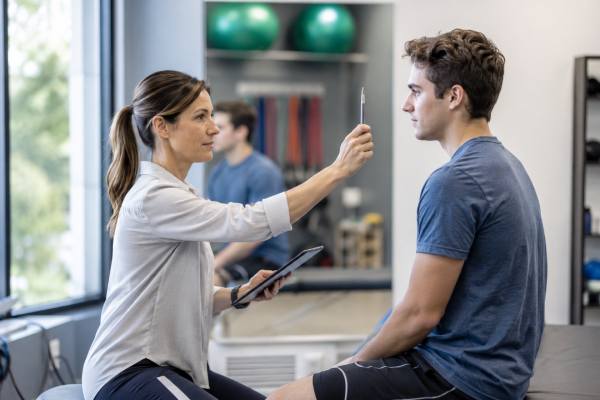
Vision and vestibular testing is especially important when symptoms include dizziness, nausea, blurred vision, motion sensitivity, trouble reading, or feeling worse in busy visual environments. A clinician may assess smooth pursuit, saccades, convergence, gaze stability, and symptom provocation with head or eye movement. Problems in this area can make school, screens, driving, grocery stores, and scrolling feel much harder after concussion.
The neck is also part of a good concussion evaluation. Whiplash-like injuries can cause headache, dizziness, visual strain, and balance symptoms that overlap with concussion. Checking neck range of motion, tenderness, strength, and nerve signs can identify whether cervical treatment should be part of recovery.
| Test area | What it checks | Why it matters |
|---|---|---|
| Symptom scale | Type and severity of symptoms | Tracks recovery and identifies symptom clusters |
| Cognitive screen | Memory, attention, concentration, recall | Helps detect slowed thinking or reduced mental efficiency |
| Balance and gait | Postural control and walking stability | Identifies fall risk and vestibular or motor effects |
| Vision and vestibular exam | Eye tracking, convergence, dizziness triggers | Guides treatment for reading, screen, and motion sensitivity |
| Neurological exam | Strength, sensation, reflexes, pupils, speech, coordination | Screens for signs that may need urgent evaluation |
| Exertion testing | Symptoms during controlled activity | Helps plan safe return to exercise or sport |
No single row in the table confirms concussion by itself. The value comes from the pattern, timing, and change from the person’s usual function.
SCAT6, ImPACT, and Sports Testing
Sports concussion tools structure the evaluation, but they do not replace clinical judgment. They are most useful when used by trained professionals and interpreted in the full context of the injury.
The SCAT6 is a standardized sport concussion assessment tool for adolescents age 13 and older and adults. It includes immediate assessment, symptom reporting, cognitive screening, balance, coordination, delayed recall, and neurological screening. The Child SCAT6 is designed for younger children. These tools are intended for healthcare professionals and are most useful in the acute phase, especially within the first several days.
The SCOAT6 is a related office-based tool for a more detailed subacute assessment. It is used after the immediate injury period and can include broader domains such as symptom review, cognitive function, balance, vestibular and ocular motor testing, sleep, mood, neck assessment, and exercise tolerance. In practical terms, SCAT6 helps organize early evaluation, while SCOAT6 helps guide more detailed office follow-up.
Computerized neurocognitive tests are also common in athletic programs. The ImPACT test is one example. It measures areas such as verbal memory, visual memory, processing speed, reaction time, and symptom reporting. Used correctly, tools like ImPACT concussion testing can add helpful information, especially when compared with a valid baseline. Used incorrectly, they can be misleading.
Baseline testing records a person’s pre-injury performance before a season or high-risk activity. It may include symptom scores, cognitive tasks, balance measures, or computerized testing. Baselines can help because people differ naturally in processing speed, attention, language, learning history, sleep patterns, and test-taking style. However, baseline results are not required to diagnose concussion, and a poor-quality baseline can create false reassurance or unnecessary concern. A fuller discussion of baseline concussion testing for athletes can help families and teams understand when it adds value.
Sports testing has several limitations. Athletes may underreport symptoms because they want to keep playing. Test scores can be affected by effort, fatigue, distraction, pain, ADHD, learning differences, anxiety, depression, migraine, or poor sleep. Some athletes can perform normally on a brief cognitive test while still having exertional dizziness, light sensitivity, or visual tracking problems.
For that reason, return-to-play decisions should not be based on one score. A safer approach uses a stepwise progression: symptom-limited activity, light aerobic exercise, sport-specific exercise, non-contact training, full-contact practice only after medical clearance when appropriate, and return to competition. Symptoms that return during the progression are a signal to stop, reassess, and move more gradually.
Imaging, Blood Tests, and Other Medical Tests
CT scans, MRI, blood biomarkers, and EEG are not routine “concussion confirmation” tests. They are used selectively when the clinician needs to rule out complications, explain atypical symptoms, or evaluate a different diagnosis.
A CT scan is the most common emergency imaging test after head trauma when there is concern for bleeding, skull fracture, or another acute structural injury. CT is fast and useful in urgent settings, but it exposes the person to radiation and is not needed for every mild head injury. A normal brain CT scan does not rule out concussion; it mainly helps rule out injuries that may need emergency treatment.
MRI gives more detailed images of brain tissue and may be considered when symptoms are unusual, prolonged, worsening, or not explained by the initial evaluation. MRI is not usually the first test for a straightforward concussion in the emergency setting. A standard brain MRI may still be normal after concussion, even when symptoms are significant.
Blood biomarker tests for traumatic brain injury are an evolving area. Some tests measure proteins released after brain injury, such as GFAP and UCH-L1, and may help clinicians decide whether CT-detectable injury is likely in selected adult patients within a specific time window after injury. These tests are not general wellness screens, do not measure “how bad” every concussion is, and do not replace a clinical exam. Availability also varies by setting.
EEG is not a standard concussion test. It may be ordered if there are seizure-like episodes, unexplained spells, prolonged altered awareness, or concern for epilepsy or non-epileptic events. An EEG test measures electrical activity in the brain, but a normal EEG does not prove that a concussion did not occur.
Other tests may be used when symptoms suggest another contributor. For example, a clinician may order vision testing for persistent reading problems, vestibular testing for dizziness, cervical spine evaluation for neck-related headache, sleep assessment for severe fatigue, or laboratory tests when brain fog may also involve anemia, thyroid disease, vitamin B12 deficiency, infection, medication effects, or metabolic problems.
The most useful test is the one that matches the clinical question. “Do we need to rule out bleeding?” points toward CT in selected cases. “Why is dizziness persisting?” may point toward vestibular and ocular motor testing. “Why is school or work still so hard?” may point toward neuropsychological, sleep, mood, headache, or vision assessment.
Testing Persistent Post-Concussion Symptoms
When symptoms last longer than expected, the evaluation should become more specific, not simply repeat the same early screening test. Persistent symptoms often come from overlapping treatable systems.
Many people improve substantially within days to weeks. Others have ongoing headaches, dizziness, fatigue, light sensitivity, poor concentration, irritability, sleep disruption, anxiety, or exercise intolerance. Persistent symptoms do not always mean ongoing brain injury in a simple one-to-one way. They may reflect a combination of concussion physiology, migraine activation, vestibular dysfunction, visual strain, neck injury, sleep problems, mood changes, deconditioning, pain, and stress.
Testing may include a more detailed neurological exam, vestibular and ocular motor assessment, headache evaluation, cervical spine assessment, graded exertion testing, and review of sleep, medications, mood, school or work load, and prior concussion history. The pattern often matters more than any single score. Dizziness triggered by head movement suggests one pathway; headache triggered by neck motion suggests another; symptoms that spike with reading may point toward visual convergence or tracking problems.
Neuropsychological testing may be considered when cognitive symptoms interfere with school, work, driving decisions, disability planning, or complex return-to-learn and return-to-work decisions. This testing is more detailed than a sideline memory screen. It can assess attention, processing speed, learning, memory, language, executive function, mood, effort, and daily functioning. A focused resource on neuropsychological testing after concussion can help clarify when it is worth pursuing.
Persistent symptoms may also require screening for mental health effects. Anxiety, depression, irritability, trauma responses, and sleep disruption can appear after an injury, especially when symptoms interrupt school, work, sport identity, parenting, or independence. Identifying these factors does not mean the concussion is “just psychological.” It means recovery is broader than the initial impact.
For people with ongoing post-concussion symptoms, the best follow-up plan is usually active and targeted. That may include vestibular therapy, vision therapy in selected cases, headache treatment, neck physical therapy, sleep intervention, gradual aerobic exercise, school or work accommodations, and mental health support when needed. Prolonged strict rest is rarely helpful after the first brief period. Most recovery plans now emphasize relative rest early, followed by gradual, symptom-limited return to activity.
How Results Guide Next Steps
Concussion test results should guide decisions about safety, activity level, accommodations, treatment, and follow-up. They should not be used as a pass-fail label without clinical context.
In the first 24 to 48 hours, many clinicians recommend relative rest. This means reducing activities that significantly worsen symptoms, while still allowing basic daily activities as tolerated. It does not usually mean lying in a dark room for days with no movement, no conversation, and no normal routine. After the early period, gradual return to cognitive and physical activity is usually encouraged, as long as symptoms remain mild and brief.
Testing helps identify what needs to be adjusted. A high symptom burden may support a temporary reduction in screen time, school load, driving, work shifts, or noisy environments. Balance or vestibular findings may support fall precautions and vestibular rehabilitation. Visual symptoms may support reading breaks, reduced screen brightness, printed materials, larger font, or referral for vision assessment. Neck findings may support physical therapy. Cognitive testing may support a staged return to school or work.
For students, results can guide return-to-learn plans. Helpful accommodations may include shortened school days, rest breaks, reduced homework volume, extra time on assignments or tests, postponement of high-stakes exams, sunglasses or hat use for light sensitivity, reduced exposure to loud settings, or temporary limits on sports and physical education.
For adults, results may guide return-to-work planning. A person with light sensitivity and slowed processing may need reduced screen time, flexible scheduling, fewer meetings, or temporary limits on driving and hazardous tasks. A worker in construction, transportation, healthcare, law enforcement, or machinery operation may need a more cautious plan because a lapse in balance, reaction time, or attention can create safety risks.
For athletes, results guide return-to-play progression. Being symptom-free at rest is not the same as being ready for full contact. The person should tolerate increasing physical and sport-specific demands without symptom recurrence and should meet any required medical clearance standards.
Test results can also show when another diagnosis needs attention. Worsening headaches may require migraine management or imaging. Severe fatigue may require sleep evaluation. New mood symptoms may require mental health care. Repeated vomiting, seizure, focal weakness, or declining alertness changes the situation entirely and should be treated as urgent rather than routine follow-up.
When to Get Urgent Medical Care
Urgent medical evaluation is needed when symptoms suggest possible bleeding, skull fracture, seizure, spinal injury, or worsening brain function. When in doubt after a head injury, it is safer to seek medical advice promptly.
Call emergency services or go to an emergency department if any of the following occur after a head injury:
- Loss of consciousness, especially if prolonged or followed by worsening symptoms
- Increasing confusion, agitation, unusual behavior, or inability to stay awake
- Repeated vomiting
- Seizure or convulsion
- Weakness, numbness, facial droop, slurred speech, or trouble walking
- One pupil larger than the other or new vision loss
- Severe or worsening headache
- Neck pain with neurological symptoms or concern for spinal injury
- Clear fluid or blood from the nose or ears after trauma
- Suspected skull fracture, penetrating injury, or high-energy impact
- Symptoms in an infant, very young child, older adult, or person who cannot reliably describe symptoms
- Head injury while taking blood thinners or with a known bleeding disorder
- Any deterioration after the person initially seemed stable
Children need special caution because symptoms may be harder to interpret. A child may not clearly describe dizziness, visual strain, nausea, or feeling slowed down. Watch for repeated vomiting, worsening headache, unusual sleepiness, inconsolable crying, confusion, poor coordination, seizure, or behavior that is clearly not normal for that child.
Medical care is also important when symptoms interfere with daily life beyond the first few days, even if there are no emergency signs. Persistent dizziness, headaches, school or work difficulty, mood changes, sleep disruption, or exercise intolerance can often be treated more effectively when the specific drivers are identified.
The safest principle is simple: a suspected concussion deserves respect, observation, and a gradual return to normal demands. Testing helps organize that process, but recovery decisions should be based on the whole clinical picture, not a single score, app result, or normal scan.
References
- The American Congress of Rehabilitation Medicine Diagnostic Criteria for Mild Traumatic Brain Injury 2023 (Consensus Criteria)
- Clinical Policy: Critical Issues in the Management of Adult Patients Presenting to the Emergency Department With Mild Traumatic Brain Injury 2023 (Clinical Policy)
- Head injury: assessment and early management 2023 (Guideline)
- Consensus statement on concussion in sport: the 6th International Conference on Concussion in Sport–Amsterdam, October 2022 2023 (Consensus Statement)
- Sport Concussion Assessment Tool 6 – SCAT6TM 2023 (Assessment Tool)
- Blood biomarkers for traumatic brain injury: A narrative review of current evidence 2024 (Review)
Disclaimer
This article is for general educational purposes only and is not a substitute for professional medical advice, diagnosis, or treatment. A suspected concussion, worsening symptoms, or any neurological warning sign after a head injury should be assessed by a qualified healthcare professional.
Please share this article on Facebook, X (formerly Twitter), or any platform where it may help someone understand concussion testing and safer next steps.