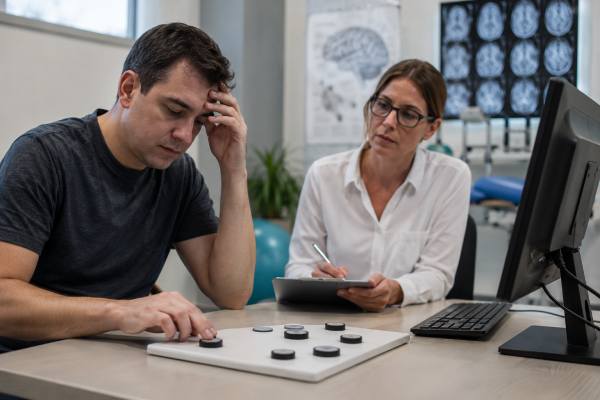
After a concussion or traumatic brain injury, symptoms can be hard to interpret. Headaches, fatigue, slower thinking, memory lapses, irritability, dizziness, poor sleep, and trouble concentrating may come from the injury itself, but they can also be shaped by pain, anxiety, depression, medication effects, disrupted routines, or sleep problems. Neuropsychological testing helps sort out these overlapping factors by measuring how different thinking skills are working and how symptoms are affecting daily life.
The goal is not simply to “pass” or “fail” a brain test. A well-done evaluation can clarify strengths and weaknesses, guide school or work accommodations, support rehabilitation planning, and help doctors decide what additional care may be needed. It is most useful when the timing, referral question, and test selection match the person’s injury history and current problems.
Table of Contents
- What Neuropsychological Testing Can Show
- When Testing Is Recommended After Brain Injury
- What the Evaluation Includes
- Best Timing After Concussion or TBI
- How to Understand Test Results
- How Results Guide Recovery and Accommodations
- Limits, Red Flags, and Urgent Care
- How to Prepare for Testing
What Neuropsychological Testing Can Show
Neuropsychological testing can show patterns in thinking, behavior, and emotional functioning after a concussion or brain injury. It is especially helpful when someone feels “not like themselves” but routine medical tests do not fully explain the problem.
A neuropsychological evaluation measures brain-related skills through standardized tasks and questionnaires. These may include attention, processing speed, memory, language, visual-spatial skills, executive function, emotional adjustment, and everyday functioning. The results are compared with what is expected for a person’s age and, when appropriate, education, language background, and occupational demands.
This type of testing can help answer questions such as:
- Is slowed thinking measurable, or does it mainly appear during fatigue, pain, or stress?
- Are memory complaints due to poor learning, poor attention, poor retrieval, or all three?
- Is the person safe to return to school, work, driving, sports, or complex responsibilities?
- Are symptoms consistent with concussion recovery, a more complex traumatic brain injury, or another condition?
- What supports would make daily life more manageable while recovery continues?
Neuropsychological testing is different from a CT scan or MRI. Imaging looks at brain structure, bleeding, swelling, lesions, or other visible changes. Testing looks at how the person is functioning. Someone can have ongoing cognitive symptoms after a concussion even when imaging is normal. The reverse can also happen: imaging may show an old or subtle abnormality that does not clearly explain current symptoms. When imaging questions are part of the workup, a clinician may discuss whether a brain MRI, CT scan, or other test is appropriate.
| It can help clarify | It usually cannot do by itself |
|---|---|
| Patterns of attention, memory, processing speed, and executive function | Prove exactly when or how an injury happened |
| How symptoms affect school, work, driving, and daily responsibilities | Replace emergency evaluation after a new or worsening head injury |
| Whether mood, sleep, pain, or fatigue may be worsening cognitive symptoms | Diagnose every possible medical cause of brain fog or confusion |
| What accommodations or rehabilitation strategies are likely to help | Guarantee a specific recovery timeline for every person |
The most useful evaluations connect test scores to real life. A person who performs normally in a quiet testing room may still struggle with multitasking at work, noisy classrooms, long screen time, or complex decision-making. A good report should explain that gap rather than reduce the person’s experience to a single number.
When Testing Is Recommended After Brain Injury
Testing is most often recommended when symptoms persist, decisions are complex, or the person’s responsibilities require a clearer picture of cognitive functioning. Not every concussion needs a full neuropsychological evaluation.
Many mild concussions improve with education, gradual return to activity, symptom monitoring, and medical follow-up. In those cases, brief clinical assessment may be enough. A more detailed evaluation becomes more useful when symptoms interfere with daily life or when recovery is not following the expected path.
A clinician may refer for neuropsychological testing after concussion or brain injury when there is:
- Ongoing trouble with memory, attention, word-finding, organization, or mental speed
- Difficulty returning to school, work, sports, driving, caregiving, or independent living
- A history of multiple concussions or a more severe traumatic brain injury
- A complicated recovery involving headaches, dizziness, vision problems, sleep disruption, mood symptoms, or pain
- A need for school accommodations, workplace modifications, disability documentation, or rehabilitation planning
- Uncertainty about whether symptoms are primarily cognitive, emotional, sleep-related, medical, or mixed
- Concern about changes in judgment, impulse control, personality, or self-awareness after injury
In sports settings, neuropsychological testing may be part of a broader concussion management plan, but it should not be the only factor used to clear someone for return to play. Symptom history, neurological exam, balance, vestibular or visual symptoms, exertional tolerance, academic function, and clinical judgment all matter. Readers comparing different concussion tools may also find it helpful to understand common concussion tests and how they fit into the broader assessment.
Some athletes complete preseason baseline testing. This can be useful in selected situations, especially when interpreted by trained clinicians and combined with a careful clinical evaluation. However, baseline scores are not a perfect personal “brain fingerprint.” Poor sleep, anxiety, effort, distractions, language differences, or previous learning issues can affect baseline performance. A baseline can help, but it does not replace clinical judgment. For a deeper look at this issue, see baseline concussion testing.
Computerized tools may also be used after concussion. These tests can quickly measure reaction time, processing speed, memory, and attention, but they are not the same as a comprehensive neuropsychological evaluation. A tool such as ImPACT testing may be one piece of the picture, especially in sports medicine, but results need context.
For moderate or severe traumatic brain injury, testing often has a broader role. It may help rehabilitation teams understand memory loss, language changes, slowed processing, executive dysfunction, emotional regulation problems, or reduced insight. It can also help plan therapy goals, family education, home supports, school re-entry, work modifications, or long-term care needs.
What the Evaluation Includes
A neuropsychological evaluation usually includes an interview, record review, standardized testing, symptom questionnaires, and a written interpretation. The exact test battery depends on the injury, symptoms, age, referral question, and medical history.
The evaluation often begins with a detailed clinical interview. The neuropsychologist may ask about the injury itself, including loss of consciousness, amnesia, confusion, emergency care, imaging, prior concussions, and current symptoms. They also ask about school or work history, sleep, headaches, pain, medications, mental health, substance use, learning history, ADHD, developmental conditions, and previous neurological problems. This background is essential because a test score without context can be misleading.
Testing may cover several domains:
- Attention and concentration: staying focused, resisting distraction, and holding information briefly in mind
- Processing speed: how quickly the person can take in information and respond accurately
- Learning and memory: how well new verbal or visual information is learned, stored, and recalled
- Executive function: planning, organizing, shifting between tasks, problem-solving, self-monitoring, and impulse control
- Language: naming, fluency, comprehension, and word retrieval
- Visual-spatial skills: judging patterns, copying designs, or understanding spatial relationships
- Motor speed and coordination: hand speed, dexterity, or visual-motor tracking when relevant
- Mood and behavior: depression, anxiety, irritability, trauma symptoms, emotional regulation, and symptom burden
- Performance validity: whether the test results are likely to be a reliable estimate of the person’s abilities that day
Performance validity testing is often misunderstood. It is not simply a test of honesty. Pain, fatigue, misunderstanding instructions, severe emotional distress, low motivation, medication effects, or inconsistent engagement can all affect results. Validity measures help the neuropsychologist decide how much confidence to place in the scores.
For children and teenagers, the evaluation may include parent questionnaires, teacher input, academic history, and school functioning. A concussion can temporarily worsen attention, reading stamina, emotional control, or tolerance for busy environments. In some cases, testing may also reveal a pre-existing learning disorder, ADHD, anxiety, or other issue that became more obvious after the injury.
For adults, the evaluation may focus on work demands, driving, household management, financial decision-making, emotional regulation, and stamina. A person in a cognitively demanding job may notice deficits that would be less obvious in a less demanding environment. Someone who manages medications, finances, caregiving, or safety-sensitive work may need more specific recommendations.
Full evaluations can take several hours, sometimes across more than one appointment. The length depends on the referral question and the person’s stamina. More detail on appointment length and flow is covered in how long neuropsychological testing takes.
Best Timing After Concussion or TBI
Timing matters because cognitive symptoms often change quickly in the days and weeks after injury. Testing too early can capture temporary effects of pain, poor sleep, stress, medications, or acute symptoms rather than stable cognitive functioning.
In the first hours or days after a head injury, the priority is medical assessment, safety, and monitoring for worsening symptoms. Brief cognitive screening may be used in emergency, sports, military, or clinical settings, but a full neuropsychological evaluation is not usually the first step for an uncomplicated new concussion. Early test scores may be useful in certain contexts, but they are not always the best basis for long-term decisions.
For many uncomplicated mild traumatic brain injuries, clinicians focus first on symptom education, relative rest for a short period, gradual return to light activity, and follow-up. If symptoms are improving steadily, comprehensive testing may not be needed. When symptoms remain disruptive beyond the early recovery period, neuropsychological evaluation becomes more useful.
The timing may be earlier or later depending on the situation:
- Within days: brief sideline, emergency, military, or clinic-based screening may help identify acute impairment, but it is not the same as a full evaluation.
- Within the first few weeks: targeted assessment may be considered when return-to-learn, return-to-work, or return-to-play decisions are difficult.
- After several weeks of persistent symptoms: a fuller evaluation may help clarify why recovery is slow and what treatments or accommodations are needed.
- Months after injury: testing may be useful for persistent cognitive complaints, rehabilitation planning, disability documentation, or complex differential diagnosis.
- After moderate or severe TBI: testing may be repeated at different stages because functioning can change significantly during recovery.
Repeat testing is sometimes appropriate, but it should be planned carefully. Taking the same or similar tests too often can create practice effects, where performance improves because the person has seen the tasks before. Neuropsychologists account for this by choosing alternate forms when available, spacing evaluations appropriately, and interpreting changes cautiously.
Timing also depends on symptom stability. Testing on a day of severe migraine, very poor sleep, acute emotional distress, or medication changes may not reflect the person’s usual functioning. That does not mean testing must wait until the person feels perfect, but the report should explain how symptoms on the testing day may have affected performance.
For students, timing often revolves around school demands. A student may need short-term adjustments before formal testing is complete, such as reduced workload, rest breaks, extra time, reduced screen exposure, or delayed exams. Neuropsychological results can later refine those supports.
For workers, the timing may be shaped by job safety and cognitive load. A person operating machinery, driving professionally, managing complex decisions, or working in a high-risk environment may need a more cautious return plan than someone with flexible duties.
How to Understand Test Results
Neuropsychological results are interpreted as patterns, not isolated scores. A single low score does not automatically mean brain damage, and a set of normal scores does not always mean the person is symptom-free.
Most test scores are standardized. This means the person’s performance is compared with a reference group. Reports may use standard scores, scaled scores, T-scores, percentiles, or descriptive ranges such as average, low average, below average, or exceptionally low. Percentiles are often easier to understand: a score at the 25th percentile means the person performed as well as or better than about 25 out of 100 people in the comparison group.
However, interpretation is more complex than ranking. A neuropsychologist considers the person’s likely baseline abilities, educational history, language background, cultural factors, sensory or motor limitations, emotional state, sleep, pain, medications, and test validity. A score that is technically “average” may still represent a decline for someone who previously functioned at a very high level. Conversely, a low score may reflect a long-standing learning issue rather than a new injury effect.
Common post-injury patterns include slowed processing speed, reduced mental stamina, weaker attention, inefficient learning, and difficulty with divided attention or multitasking. Memory complaints after concussion often come from attention and processing problems. If the brain does not fully register information in the first place, recall later feels poor even when storage is not the main issue.
A report should also explain emotional and physical symptom findings. Depression, anxiety, PTSD symptoms, sleep disorders, pain, vestibular problems, and headaches can all worsen cognitive performance. This does not mean symptoms are “all psychological.” It means brain recovery is affected by the whole person and the whole context.
When reviewing results, focus on the practical conclusions:
- Which cognitive areas are clear strengths?
- Which areas are weaker than expected?
- Are the findings consistent with the injury history?
- What other factors may be contributing?
- What changes are recommended for school, work, home, or treatment?
- Is repeat testing recommended, and when?
If a report is difficult to understand, ask the clinician to translate the scores into daily-life examples. “Processing speed weakness” might mean the person needs more time to read dense material, respond in meetings, complete timed exams, or switch between tasks. “Executive dysfunction” might mean they need written plans, reduced multitasking, reminders, or help breaking work into steps. More detail on score interpretation is available in neuropsychological test results.
How Results Guide Recovery and Accommodations
The main value of testing is that it can turn vague symptoms into a practical plan. Good recommendations connect the person’s test pattern with the demands they face at home, school, work, or in rehabilitation.
For students, results may support return-to-learn planning. Depending on the findings, recommendations may include reduced workload, extra time on tests, postponed high-stakes exams, shorter reading assignments, rest breaks, reduced screen exposure, access to notes, quieter testing settings, or gradual re-entry to full academic demands. The goal is not to avoid all effort. It is to increase demands in a way that does not worsen symptoms or create avoidable setbacks.
For adults returning to work, recommendations may include shorter shifts, flexible scheduling, reduced multitasking, written instructions, fewer back-to-back meetings, extra time for complex tasks, temporary reassignment away from safety-sensitive duties, or planned rest breaks. A person with slowed processing speed may be capable of accurate work but need more time and fewer interruptions.
For people in rehabilitation after moderate or severe TBI, testing can help prioritize therapy. For example, prominent memory problems may lead to external memory systems, caregiver training, medication routines, and environmental cues. Executive function problems may call for structured planning tools, error-reduction strategies, goal management training, or occupational therapy. Social cognition or emotional regulation changes may require psychotherapy, family education, or specialized brain injury rehabilitation.
Testing can also identify when symptoms are being driven by treatable contributors. A person with poor concentration may need sleep treatment, headache management, vestibular therapy, vision rehabilitation, psychotherapy, medication review, or treatment for depression or anxiety. In some cases, testing supports referral for cognitive rehabilitation, speech-language therapy, occupational therapy, physical therapy, neurology, psychiatry, or sleep medicine.
The best recommendations are specific. “Use accommodations” is too vague. Better recommendations explain what to change, why it matters, and how long to try it. For example:
- Reduce work shifts to four hours for two weeks because mental fatigue increases after sustained attention tasks.
- Use written task lists and meeting summaries because delayed verbal recall is weaker than visual organization.
- Take a 10-minute break after 30 to 45 minutes of screen-based work because symptoms worsen with prolonged visual concentration.
- Reassess workload after symptoms are stable for one to two weeks at the current level.
Results can also help families understand behavior changes. Irritability, reduced initiative, impulsivity, emotional outbursts, or poor follow-through may reflect brain injury effects, stress, pain, sleep loss, or mood symptoms. Naming the pattern can reduce blame and improve support, but it should also lead to concrete strategies.
Neuropsychological testing may have legal, disability, school, or insurance implications. When documentation is needed, the referral question should be clear before testing begins. A clinical evaluation for treatment planning may not always answer every forensic or disability question, and some situations require a clinician with specific expertise.
Limits, Red Flags, and Urgent Care
Neuropsychological testing is not an emergency tool and should not delay urgent medical care. After a new head injury, rapidly worsening or dangerous symptoms need prompt evaluation before any outpatient cognitive testing is considered.
Emergency care is important if a person develops a severe or worsening headache, repeated vomiting, seizure, increasing confusion, weakness or numbness, slurred speech, unequal pupils, inability to wake, worsening drowsiness, unusual behavior, fluid or blood from the nose or ears, significant neck pain, or a new loss of consciousness. Extra caution is also needed for infants, older adults, people taking blood thinners, people with bleeding disorders, and anyone injured in a high-force accident. For broader guidance, see ER-level neurological symptoms.
Testing also has diagnostic limits. A neuropsychological evaluation can identify cognitive patterns, but it cannot always determine whether every symptom was caused by the concussion. Persistent symptoms after mild TBI are often multifactorial. Headache, dizziness, sleep disruption, anxiety, depression, trauma reactions, chronic pain, medications, hormonal changes, vision problems, and life stress can all affect cognitive functioning.
A normal test result does not mean someone is exaggerating. Some people have symptoms that appear under real-world demands but not during structured testing. Others have deficits in endurance, sensory tolerance, or symptom flare-ups that are difficult to capture in a single appointment. The clinician should consider this when writing recommendations.
An abnormal result also does not automatically prove permanent impairment. Cognitive performance may improve as sleep, pain, mood, vestibular symptoms, or headaches improve. Recovery after concussion is often dynamic, and even after more serious TBI, function can change with rehabilitation, time, compensatory strategies, and environmental support.
Another limitation is that tests depend on the person’s ability to participate. Severe fatigue, intoxication, acute psychiatric crisis, uncontrolled pain, active withdrawal, delirium, or major language barriers may make results unreliable. In those cases, stabilizing the medical or mental health situation may be the priority.
Finally, neuropsychological testing cannot diagnose chronic traumatic encephalopathy, or CTE, in a living person. It may document cognitive, mood, or behavioral symptoms in someone with a history of repetitive head impacts, but it cannot confirm that specific disease process. Any concern about progressive decline, major personality change, movement symptoms, or worsening function should be evaluated medically rather than assumed to be concussion-related.
How to Prepare for Testing
Preparation helps make the evaluation more accurate and less stressful. The goal is not to study for the tests, but to arrive with the right information and conditions for a fair assessment.
Bring relevant medical records if available, including emergency notes, imaging reports, neurology visits, concussion clinic notes, rehabilitation records, school plans, workplace forms, medication lists, and prior testing. If the injury involved loss of consciousness, amnesia, emergency care, or a witnessed event, it can help to bring a written timeline. A family member, teammate, coworker, or caregiver may remember details the injured person does not.
Before the appointment, write down the main problems you want addressed. Examples include forgetting conversations, losing track of tasks, reading more slowly, headaches after screen use, difficulty driving, emotional changes, problems returning to school, or mistakes at work. Real examples are often more useful than broad statements such as “my memory is bad.”
In the day or two before testing:
- Try to sleep as normally as possible.
- Avoid alcohol or recreational drugs.
- Take prescribed medications as directed unless the testing clinician gives different instructions.
- Bring glasses, hearing aids, mobility aids, snacks, water, and any needed comfort items.
- Tell the office ahead of time about severe light sensitivity, migraine, fatigue, mobility limits, language needs, or sensory concerns.
- Ask whether testing can be split across sessions if stamina is limited.
Do not practice online brain tests to prepare. Practice can distort results and make interpretation harder. The best preparation is to be rested, honest, and clear about symptoms.
During testing, tell the examiner if pain, dizziness, nausea, vision strain, or fatigue becomes significant. The clinician may offer breaks, adjust pacing, or note symptom changes in the report. Pushing through severe symptoms without saying anything may make the results less useful.
After testing, ask when feedback will occur and what the final report will include. A useful report should explain the referral question, relevant history, test results, interpretation, diagnoses when appropriate, and practical recommendations. It should be understandable enough that the patient, family, school, workplace, and treating clinicians can act on it.
For a more detailed appointment checklist, see preparing for neuropsychological testing. Good preparation cannot change the injury, but it can help the evaluation answer the right questions.
References
- Consensus statement on concussion in sport: the 6th International Conference on Concussion in Sport-Amsterdam, October 2022 2023 (Consensus Statement)
- Mild TBI Management Guideline 2025 (Guideline)
- Clinical Policy: Critical Issues in the Management of Adult Patients Presenting to the Emergency Department With Mild Traumatic Brain Injury 2023 (Clinical Policy)
- Factors Associated With Persisting Symptoms After Concussion in Adults With Mild TBI: A Systematic Review and Meta-Analysis 2025 (Systematic Review and Meta-Analysis)
- Neuropsychological Assessment in Patients with Traumatic Brain Injury: A Comprehensive Review with Clinical Recommendations 2023 (Review)
- Neuropsychological Rehabilitation for Traumatic Brain Injury: A Systematic Review 2025 (Systematic Review)
Disclaimer
This article is for general educational purposes only and is not a substitute for professional medical advice, diagnosis, or treatment. After a head injury, seek urgent medical care for worsening neurological symptoms, severe headache, repeated vomiting, seizure, increasing confusion, weakness, or unusual drowsiness.
Please share this article on Facebook, X (formerly Twitter), or your preferred platform to help others understand when neuropsychological testing may be useful after concussion or brain injury.