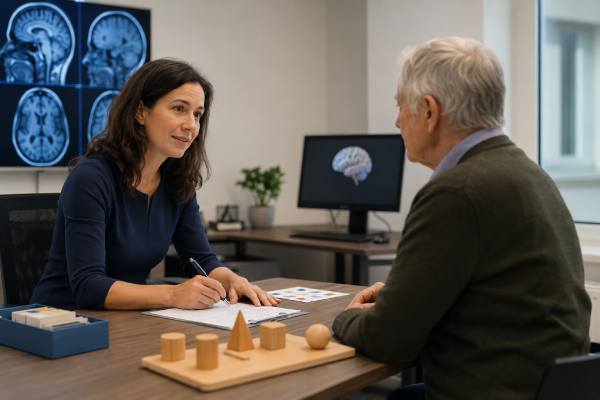
Memory changes can be unsettling, especially when they affect conversations, finances, appointments, driving, work, or daily routines. Neuropsychological testing helps clarify whether those changes fit normal aging, mild cognitive impairment, dementia, depression, sleep problems, medication effects, brain injury, or another medical issue.
This kind of testing does not rely on one score or one short memory quiz. It looks at patterns across memory, attention, language, problem-solving, visuospatial skills, mood, behavior, and real-world function. The goal is not only to name a condition, but to understand what is changing, what may still be strong, what else should be checked, and what practical supports may help.
Table of Contents
- When Neuropsychological Testing Is Used
- What the Testing Measures
- What Happens During Testing
- How Results Help Diagnosis
- Different Causes of Memory Loss
- Preparing for the Evaluation
- Understanding Results and Next Steps
- When Memory Symptoms Are Urgent
When Neuropsychological Testing Is Used
Neuropsychological testing is most useful when memory loss or thinking changes need more explanation than a brief office screen can provide. It is often ordered when symptoms are real but the cause, severity, or pattern is still unclear.
A primary care clinician, neurologist, geriatrician, psychiatrist, or memory clinic may recommend testing after an initial evaluation. That first step may include a medical history, medication review, physical or neurological exam, lab work, and a short cognitive screen such as the MoCA, MMSE, Mini-Cog, SLUMS, or another tool. For a broader look at the first-line testing process, early dementia screening tests can help explain where brief screens fit before a fuller workup.
Neuropsychological testing may be considered when:
- Memory problems are noticeable but everyday independence is mostly preserved.
- A person has trouble managing complex tasks, such as bills, medication schedules, technology, or work duties.
- Family members notice changes that the person does not fully recognize.
- Brief screening results are abnormal, borderline, or inconsistent with the person’s daily function.
- Symptoms could reflect depression, anxiety, sleep deprivation, ADHD, medication side effects, alcohol use, brain injury, stroke, or dementia.
- A diagnosis has already been made, but the clinician needs a baseline to track change over time.
- There are questions about driving, work capacity, independent living, financial decision-making, or care planning.
It can also be helpful when a highly educated or cognitively demanding person performs “normally” on a short screen despite clear decline from their usual level. Brief screens are useful, but they may miss subtle changes in people with strong baseline abilities. A longer battery can compare performance across several domains and identify patterns that are easier to miss in a short visit.
Testing is not always necessary. If dementia is already advanced and the clinical picture is clear, a long testing session may add little and may be tiring. If symptoms are sudden, fluctuating, or linked to acute illness, delirium or another urgent condition may need to be addressed before formal testing. The decision depends on the question being asked: Is the goal diagnosis, staging, care planning, safety assessment, disability documentation, treatment monitoring, or distinguishing one condition from another?
What the Testing Measures
Neuropsychological testing measures how different thinking skills are working, not just whether someone “has memory loss.” The pattern of strengths and weaknesses often matters more than any single score.
Most evaluations include several cognitive domains. The exact tests vary by clinician, referral question, age, language, education, culture, sensory needs, and medical history. A dementia-focused battery may assess immediate learning, delayed recall, recognition memory, word-finding, attention, processing speed, executive function, visuospatial skills, mood, and daily functioning.
| Area tested | What it can show | Everyday examples |
|---|---|---|
| Learning and memory | Whether new information is encoded, stored, and retrieved | Repeating questions, forgetting appointments, losing track of conversations |
| Attention and working memory | How well a person holds and manipulates information briefly | Following multi-step directions, mental math, keeping track of tasks |
| Processing speed | How quickly and accurately a person handles simple mental tasks | Slower paperwork, slower driving decisions, fatigue with complex tasks |
| Executive function | Planning, flexibility, judgment, organization, impulse control | Medication mistakes, poor financial decisions, difficulty solving problems |
| Language | Naming, word fluency, comprehension, repetition, speech patterns | Word-finding trouble, reduced vocabulary, difficulty understanding speech |
| Visuospatial skills | How the brain understands space, shapes, and visual organization | Getting lost, trouble parking, difficulty copying designs or reading maps |
| Mood and behavior | Whether depression, anxiety, apathy, irritability, or personality change is affecting cognition | Withdrawal, loss of motivation, agitation, worry, reduced initiative |
A full evaluation also considers effort, fatigue, pain, sleep, medications, sensory impairment, and language comfort. For example, poor hearing can make verbal memory testing look worse than it truly is. Low sleep, sedating medication, untreated sleep apnea, or severe anxiety can also reduce attention and processing speed.
The testing is usually standardized, meaning a person’s scores are compared with appropriate reference groups when possible. Norms may adjust for age, and sometimes education, language, or other demographic factors. These adjustments are important because a raw score can mean different things for different people. A low score in one area may be less meaningful than a repeated pattern of low scores across related tasks.
This is one reason neuropsychological testing differs from a quick cognitive screen. A short screen asks whether more evaluation may be needed. A neuropsychological evaluation asks what kind of cognitive change is present, how reliable the pattern is, how it compares with expected ability, and how it affects daily life. For readers who want a broader foundation, what neuropsychological testing measures explains the general role of this type of evaluation beyond dementia alone.
What Happens During Testing
A dementia-focused neuropsychological evaluation usually includes an interview, standardized testing, questionnaires, and feedback. The appointment may last a few hours, though timing depends on the referral question, the person’s stamina, and whether breaks are needed.
The evaluation often begins with a clinical interview. The neuropsychologist asks about the main concerns, when symptoms began, whether they are getting worse, and how they affect daily life. They may ask about medical conditions, head injuries, strokes, seizures, sleep, mood, medications, alcohol or substance use, family history, education, work history, and language background.
A family member, close friend, or care partner may be asked to provide additional information. This is not because the person being tested is not trusted. Memory and insight can be affected by the same brain changes being evaluated, and outside observations often clarify when symptoms began and what has changed. Concerns about finances, driving, cooking safety, missed medications, repeated questions, personality change, or wandering may be easier for another person to describe.
The testing itself is usually pencil-and-paper, verbal, computer-based, or a mix. The person may be asked to remember words or stories, copy figures, name objects, solve puzzles, follow instructions, switch between rules, draw a clock, answer questions, or complete timed tasks. Some items feel easy, while others are intentionally challenging. The point is not to “pass” every item, but to see how the brain handles different kinds of demands.
Breaks are common and appropriate. A good evaluation should account for fatigue, pain, frustration, vision, hearing, language, and motor limitations. The examiner may note how the person approaches tasks, whether they use strategies, whether they become overwhelmed, and whether cueing helps. These observations can be as useful as the scores.
People sometimes worry that testing will be embarrassing. It can feel uncomfortable to struggle with tasks, but the examiner’s role is not to judge intelligence. Many people perform well in some areas and poorly in others. That uneven pattern is often exactly what helps the clinician understand the problem.
Preparation is usually simple: bring glasses, hearing aids, medication lists, prior test results, brain imaging reports, and a trusted informant when requested. More detailed steps are covered in how to prepare for neuropsychological testing, especially for people who are anxious about the appointment.
How Results Help Diagnosis
Neuropsychological results help diagnosis by showing whether cognitive changes are measurable, which domains are affected, and whether the pattern fits a known condition. The results are interpreted together with medical history, daily function, neurological findings, labs, imaging, and sometimes biomarker tests.
A key distinction is whether testing suggests normal aging, mild cognitive impairment, or dementia. Normal aging may involve slower recall, occasional word-finding trouble, or needing more time to learn new information. Mild cognitive impairment involves measurable decline beyond what is expected for age, but daily independence is largely preserved. Dementia involves cognitive decline that interferes with independent daily functioning.
Testing can help clarify these boundaries. For example, someone may score low on delayed recall but improve with recognition cues, suggesting retrieval difficulty rather than complete loss of stored information. Another person may rapidly forget information even with cues, which can raise concern for certain memory-system disorders. Someone else may show slowed processing and executive dysfunction more than primary memory loss, suggesting a different pattern.
The neuropsychologist also looks for consistency across tests. A single low score may occur for many reasons, including fatigue, distraction, misunderstanding, anxiety, or normal variation. A repeated pattern across related tasks is more meaningful. This is why comprehensive testing can be more informative than relying on one memory task.
Results may also help determine whether more testing is needed. Abnormal patterns may lead a clinician to order or review lab work, medication changes, sleep evaluation, brain MRI, CT, PET imaging, or Alzheimer’s-related biomarkers. For example, blood tests used in memory-loss workups may help identify treatable contributors such as thyroid disease, vitamin B12 deficiency, metabolic problems, infection, inflammation, or medication-related effects. In other cases, brain imaging for memory loss may help assess stroke, tumor, hydrocephalus, vascular disease, atrophy patterns, or other structural causes.
Importantly, neuropsychological testing does not diagnose Alzheimer’s disease by itself. Alzheimer’s disease is one possible cause of a dementia syndrome, but many conditions can affect cognition. A careful report usually states whether the pattern is consistent with a particular diagnosis, whether other explanations remain possible, and what follow-up is recommended.
Different Causes of Memory Loss
Memory loss is not one condition, and neuropsychological testing is valuable because different causes often produce different cognitive patterns. The evaluation helps separate memory storage problems, attention problems, language changes, executive dysfunction, mood-related cognitive symptoms, and functional decline.
In Alzheimer’s disease, early testing often shows prominent difficulty learning and retaining new information. A person may forget recent conversations, repeat questions, misplace items, or lose track of appointments. As symptoms progress, language, orientation, visuospatial skills, and executive function may also decline. A broader diagnostic workup is often needed, and Alzheimer’s testing and diagnosis usually involves more than cognitive testing alone.
Vascular cognitive impairment may show a different pattern. People may have slowed thinking, reduced attention, executive dysfunction, and difficulty organizing tasks, sometimes with memory problems that are partly due to poor retrieval. A history of stroke, transient ischemic attack, high blood pressure, diabetes, atrial fibrillation, smoking, or small vessel disease on imaging may support this possibility.
Lewy body dementia often involves fluctuating attention, visuospatial problems, slowed processing, visual hallucinations, REM sleep behavior disorder, and parkinsonian movement symptoms. Memory may be less impaired early than attention and visual processing, although mixed pathology is common in older adults.
Frontotemporal dementia may begin with personality, behavior, judgment, empathy, compulsive behaviors, or language changes rather than classic forgetfulness. Neuropsychological testing may show executive dysfunction, social cognition changes, or language-specific patterns. Families may describe a person as “not themselves” before they notice obvious memory loss.
Depression, anxiety, grief, trauma, chronic stress, and sleep disorders can also affect cognition. Depression may cause poor concentration, slowed thinking, low motivation, and memory complaints that can resemble dementia in some cases. The distinction can be difficult because depression and dementia can also occur together. For a focused comparison, depression versus dementia explains why mood symptoms deserve careful evaluation in memory complaints.
Medication effects are another common contributor. Sedatives, sleep aids, some antihistamines, anticholinergic drugs, opioids, some bladder medications, and medication interactions can affect attention and memory, especially in older adults. Alcohol use, untreated sleep apnea, hearing loss, pain, dehydration, and infections can also worsen thinking.
The most useful testing reports avoid oversimplifying. They do not just say “memory is impaired.” They explain the pattern: what is weak, what is preserved, what the pattern suggests, what could be reversible, what needs monitoring, and what practical changes may reduce risk.
Preparing for the Evaluation
Good preparation helps the test results reflect the person’s usual thinking ability as accurately as possible. The goal is not to study for the test, but to reduce avoidable factors that can distort performance.
Before the appointment, gather relevant records. These may include medication lists, recent lab results, brain imaging reports, hospital discharge summaries, prior cognitive screens, hearing or vision information, and school or work history if relevant. A written timeline can also help: when symptoms began, what changed first, whether the changes are gradual or sudden, and which daily tasks have become harder.
It is usually helpful to bring a care partner who knows the person well. They can describe changes in real-world functioning, such as missed bills, repeated calls, medication errors, getting lost, reduced hygiene, unsafe cooking, personality shifts, or trouble using familiar devices. These details help connect test scores to daily life.
The person being tested should try to sleep as normally as possible the night before, eat beforehand if allowed, bring glasses and hearing aids, and take usual medications unless the ordering clinician gives different instructions. They should avoid alcohol or recreational substances before testing. If pain, illness, poor sleep, or severe anxiety is unusually bad on the day of testing, tell the examiner. That context matters.
Do not practice online memory tests beforehand. Practice can make some tasks less valid without improving the underlying concern. It is fine to understand the general process, but trying to rehearse test-like material may make results harder to interpret.
During the appointment, honesty is more useful than trying to appear better or worse. The examiner needs to know when instructions are unclear, when hearing is difficult, when fatigue is rising, or when a break is needed. Frustration is common, but it should be reported rather than hidden.
Families can prepare emotionally, too. Testing may confirm concerns, but it may also reveal treatable contributors or preserved strengths. Even when the diagnosis is serious, the results can support practical planning: medication management, driving conversations, legal and financial planning, home safety, work accommodations, caregiver support, and follow-up intervals.
Understanding Results and Next Steps
A neuropsychological report should translate scores into a practical explanation of cognitive strengths, weaknesses, diagnosis, and recommendations. The most useful reports connect test findings to everyday decisions.
Results are often described with terms such as average, low average, below average, impaired, or exceptionally low. These terms compare performance with a reference group, but they do not tell the whole story. A score that is technically “average” may still represent decline for a person who previously functioned at a very high level. Likewise, a low score may be less concerning if it matches lifelong learning history, language background, limited education, poor sleep, or sensory barriers.
The report may include diagnoses such as mild neurocognitive disorder, major neurocognitive disorder, mild cognitive impairment, probable dementia due to a specific cause, or cognitive symptoms related to mood, sleep, medical illness, or medication effects. In many cases, the wording is cautious because diagnosis requires clinical judgment, not just test data.
Common next steps may include:
- Reviewing results with the referring clinician and the neuropsychologist when possible.
- Completing recommended lab work, imaging, sleep testing, or specialist referral.
- Addressing treatable contributors such as depression, anxiety, sleep apnea, hearing loss, medication burden, thyroid disease, or vitamin deficiency.
- Creating practical supports for medication, finances, transportation, cooking, appointments, and safety.
- Repeating testing later if the clinician needs to measure change over time.
A baseline evaluation can be especially valuable. If symptoms worsen, repeat testing can show whether decline is occurring, which domains are changing, and how quickly. If symptoms improve after treating sleep, mood, medication effects, or medical problems, testing can also document recovery.
Families should ask clear questions during feedback: What diagnosis is most likely? What else could explain the pattern? Which abilities are still strong? What daily tasks need supervision? Is driving a concern? Should work duties change? Is repeat testing recommended? What symptoms should prompt urgent care?
Understanding scores can be confusing, and a report may use statistical language that is unfamiliar. A plain-language explanation of neuropsychological test results can help families interpret percentiles, standard scores, and patterns without overreacting to one number.
When Memory Symptoms Are Urgent
Most memory concerns can be evaluated through scheduled medical care, but sudden or dangerous changes need urgent attention. Rapid confusion, new neurological symptoms, or major safety risks should not wait for outpatient neuropsychological testing.
Seek urgent medical evaluation if memory or thinking changes come on suddenly, fluctuate sharply, or occur with fever, dehydration, infection symptoms, medication changes, intoxication, severe sleepiness, or recent surgery. Delirium is a medical condition involving acute changes in attention and awareness, and it can be mistaken for dementia. It is especially common in older adults and can signal infection, metabolic problems, medication effects, or another serious illness.
Emergency care is also appropriate for stroke-like symptoms, including sudden weakness, facial drooping, trouble speaking, new vision loss, severe dizziness, sudden confusion, or loss of coordination. Other urgent signs include a first seizure, head injury with worsening confusion, sudden severe headache, new hallucinations with unsafe behavior, or rapidly worsening cognition over days to weeks.
Safety concerns matter too. A person who is wandering, leaving the stove on, getting lost while driving, making dangerous financial decisions, threatening self-harm, or becoming aggressive may need immediate support even if the underlying diagnosis is not yet clear. In these situations, the priority is safety and medical assessment, not completing cognitive testing first. For broader guidance, when to go to the ER for neurological or mental health symptoms can help clarify which warning signs should be treated as urgent.
Neuropsychological testing is usually best done when the person is medically stable. Testing during an acute infection, severe delirium, intoxication, medication reaction, or crisis may not reflect the person’s baseline ability. Once the urgent problem is treated, clinicians can decide whether formal testing is still needed.
Memory changes deserve careful evaluation, but they do not all mean the same thing. The most helpful approach is measured and thorough: identify urgent problems first, check treatable causes, use cognitive testing when it can answer a real clinical question, and turn the results into practical decisions that support the person and family.
References
- Neuropsychological Assessment for Early Detection and Diagnosis of Dementia: Current Knowledge and New Insights 2024 (Review)
- Mild cognitive impairment and neuropsychological examination 2025 (Review)
- New Clinical Practice Guideline for Evaluating Dementia 2024 (Guideline Announcement)
- Criteria for Diagnosis and Staging of Alzheimer’s Disease 2024 (Position Statement)
- Cognitive Assessment Tools 2026 (Clinical Resource)
- Dementia: assessment, management and support for people living with dementia and their carers 2018 (Guideline)
Disclaimer
This article is for general educational purposes only and is not a substitute for professional medical advice, diagnosis, or treatment. Memory loss, confusion, and dementia concerns should be evaluated by a qualified health professional, especially when symptoms are sudden, worsening, or affecting safety.
Please share this article on Facebook, X (formerly Twitter), or your preferred platform to help others understand how neuropsychological testing fits into memory-loss and dementia evaluation.