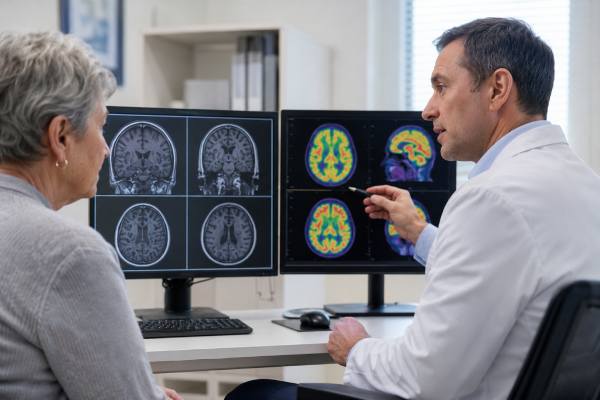
Memory loss can come from many different causes, including Alzheimer’s disease, vascular changes, medication effects, sleep problems, depression, vitamin deficiencies, prior head injury, and less common neurological conditions. Brain imaging helps doctors look for structural changes, injury, patterns of shrinkage, blood vessel disease, and certain disease markers that cannot be confirmed by conversation or memory testing alone.
MRI and PET scans are not used in the same way. MRI is often used to look at brain structure and rule out causes that may need a different treatment. PET is more specialized and may be used when doctors need information about brain metabolism or Alzheimer’s-related biomarkers. The best test depends on the person’s symptoms, age, exam findings, pace of change, medical history, and how the results would affect care.
Table of Contents
- Why Imaging Is Used
- When MRI Is Ordered
- What MRI Can Show
- When PET Is Used
- MRI vs PET for Memory Loss
- What to Expect Before and During Imaging
- How Results Guide Next Steps
- When to Seek Urgent Care
Why Imaging Is Used
Brain imaging is used when memory loss needs more explanation than symptoms, screening tests, and routine lab work can provide. It can help identify treatable or important causes of cognitive change, support a dementia diagnosis, and guide whether further testing is needed.
Doctors do not usually diagnose memory loss from a scan alone. Imaging is one part of a broader evaluation that may include a medical history, medication review, neurological exam, cognitive screening, blood tests, and sometimes formal neuropsychological testing. A normal scan does not always mean memory symptoms are imaginary or unimportant, and an abnormal scan does not automatically mean Alzheimer’s disease.
Imaging is especially useful when memory loss is new, progressive, unusual for the person’s age, or accompanied by other neurological signs. A scan may be considered when there are symptoms such as worsening confusion, trouble with language, changes in walking, personality change, seizures, headaches, weakness, falls, or a history of stroke or head injury.
For many people, the first practical question is whether the memory problem looks like normal aging, mild cognitive impairment, dementia, or another medical issue. Memory testing and clinical assessment remain central to that distinction. Imaging helps by showing whether there are visible brain changes that match the clinical picture. For example, memory loss with prominent vascular changes on MRI may raise concern for vascular cognitive impairment, while a different pattern of shrinkage may support a neurodegenerative condition.
Imaging can also help rule out less common but important causes, such as a tumor, subdural hematoma, hydrocephalus, prior silent strokes, inflammatory disease, or significant small vessel disease. These findings may change treatment, referral urgency, or the need for follow-up imaging.
A practical workup often starts with basic clinical steps before advanced imaging. Many reversible or contributing causes of cognitive symptoms are not visible on MRI or PET. Thyroid disease, vitamin B12 deficiency, anemia, kidney or liver disease, medication side effects, alcohol use, depression, anxiety, poor sleep, and sleep apnea may all affect thinking. That is why doctors often combine imaging with blood tests for memory loss and a careful review of the person’s day-to-day functioning.
Imaging is most valuable when the result can answer a specific question. The question might be “Is there a structural problem?” “Is this pattern typical of Alzheimer’s disease?” “Could this be frontotemporal dementia?” “Is there enough vascular disease to explain the symptoms?” or “Does the person have amyloid evidence needed for a disease-specific treatment decision?” Without a clear question, a scan may find incidental changes that create worry but do not explain the memory problem.
When MRI Is Ordered
MRI is commonly ordered when doctors need a detailed look at brain structure in someone with persistent, progressive, or unexplained memory loss. It is often preferred over CT when the situation is not an emergency because it shows more detail in brain tissue, blood vessel injury, and patterns of atrophy.
MRI may be used early in a cognitive workup, especially if the person has symptoms that go beyond mild forgetfulness. It can be helpful when family members notice clear decline in daily tasks, repeated conversations, missed bills, medication mistakes, getting lost, or changes in judgment. MRI may also be ordered when cognitive screening scores are abnormal or when symptoms suggest more than normal aging.
Common reasons doctors order MRI for memory loss include:
- Memory loss that is getting worse over months or years
- New cognitive symptoms before age 65
- Rapid decline or an unusual symptom pattern
- Neurological signs such as weakness, imbalance, tremor, seizures, or vision changes
- Concern for prior strokes or vascular dementia
- A history of head injury, cancer, immune disease, or infection risk
- New headaches or personality changes along with cognitive decline
- Planning for certain dementia treatments that require baseline brain imaging
MRI is also important when the symptoms do not fit a straightforward Alzheimer’s pattern. Alzheimer’s disease often begins with difficulty forming new memories, but other dementias may first affect behavior, language, movement, attention, or visual processing. When the pattern is atypical, imaging can help doctors decide whether to consider frontotemporal dementia, Lewy body dementia, vascular cognitive impairment, normal pressure hydrocephalus, or another neurological disorder.
For a broader explanation of how clinicians approach symptoms before ordering tests, memory loss evaluation is usually built around history, exam findings, cognitive testing, labs, and imaging together. The scan supports the diagnosis; it does not replace the clinical process.
MRI is not always needed for every person who notices occasional forgetfulness. Misplacing keys, forgetting a name that comes back later, or having more trouble concentrating during stress or poor sleep does not automatically call for imaging. Doctors usually look for persistence, progression, functional impact, or concerning associated symptoms before ordering a scan.
CT may be used instead of MRI in urgent settings, when MRI is not available, or when a person cannot safely have MRI because of certain implanted devices or severe claustrophobia. For non-urgent memory loss, however, MRI often gives more useful detail. A discussion of MRI and CT for brain symptoms can help clarify why one test may be chosen over the other.
What MRI Can Show
MRI can show structural brain changes that may explain, contribute to, or complicate memory loss. It is especially useful for detecting strokes, small vessel disease, tumors, bleeding, fluid buildup, and patterns of brain shrinkage.
A typical brain MRI for memory loss may include several sequences that highlight different tissue features. The radiologist may assess the size of brain structures, the ventricles, the hippocampus, white matter changes, prior infarcts, microbleeds, and signs of inflammation or mass effect. Some scans use contrast dye, but many memory-loss MRIs can be done without contrast unless there is a specific concern such as tumor, infection, inflammation, or abnormal enhancement.
MRI findings that may matter in memory loss include:
| Finding | What it may suggest | Why it matters |
|---|---|---|
| Hippocampal or medial temporal atrophy | May support Alzheimer’s-type neurodegeneration | The hippocampus is important for forming new memories |
| White matter disease | Often reflects small vessel changes | Can contribute to slower thinking, gait problems, and executive dysfunction |
| Old strokes or silent infarcts | May support vascular cognitive impairment | Can shift attention to vascular risk control and stroke prevention |
| Enlarged ventricles with suggestive features | May raise concern for normal pressure hydrocephalus | Can be relevant when memory loss occurs with gait and bladder symptoms |
| Subdural hematoma, tumor, or mass effect | May indicate a structural cause | Can require urgent or specialized treatment |
| Microbleeds or superficial siderosis | May suggest cerebral amyloid angiopathy or other bleeding risk | Can affect treatment decisions, including anti-amyloid therapy eligibility |
MRI can also help distinguish dementia patterns, although it is not perfect. Alzheimer’s disease may be associated with shrinkage in medial temporal and parietal regions. Frontotemporal dementia may show more frontal or anterior temporal atrophy. Vascular dementia may show strokes, lacunes, or extensive white matter disease. Lewy body dementia may have less striking early structural change, so MRI may be less definitive.
These patterns are clues, not stand-alone diagnoses. Older adults may have more than one process at the same time, such as Alzheimer’s disease plus vascular disease. A person can also have visible age-related changes that do not fully explain the severity of symptoms. That is why the radiology report must be interpreted in context.
MRI can be particularly useful when vascular disease is suspected. High blood pressure, diabetes, smoking, atrial fibrillation, high cholesterol, and prior stroke can all increase the chance that blood vessel injury is contributing to cognitive decline. In that setting, vascular dementia testing may include MRI findings plus cognitive profile, risk-factor review, and sometimes additional vascular studies.
For people who want a more general explanation of MRI as a test, brain MRI findings are best understood as structural information, not a direct measurement of memory ability.
When PET Is Used
PET is used when doctors need information about brain activity or disease-specific biomarkers that MRI cannot show. It is usually a specialist test, most often considered after clinical evaluation, cognitive testing, lab work, and structural imaging have not fully answered the diagnostic question.
A PET scan uses a small amount of radioactive tracer. The tracer depends on the clinical question. In memory-loss evaluations, the main types are FDG PET, amyloid PET, and tau PET.
FDG PET shows patterns of glucose metabolism in the brain. Areas that are less active may point toward certain neurodegenerative patterns. For example, reduced metabolism in temporoparietal regions may support Alzheimer’s disease, while frontal and anterior temporal patterns may support frontotemporal dementia. FDG PET may be helpful when symptoms are atypical or when MRI does not clearly match the clinical picture.
Amyloid PET looks for amyloid plaque burden, a key biological feature of Alzheimer’s disease. A negative amyloid PET scan makes Alzheimer’s disease less likely as the main cause of cognitive symptoms at that time. A positive scan means amyloid is present, but it does not prove that amyloid is the only cause of symptoms. Some older adults have amyloid plaques without dementia, and some people have mixed causes of cognitive decline.
Tau PET can show the distribution of tau pathology, which tends to relate more closely to Alzheimer’s symptom stage and regional brain involvement. It is more specialized than amyloid PET and may be used in selected cases, especially when the clinical picture is unclear or when determining whether Alzheimer’s disease biology fits the symptoms.
PET may be considered when:
- The diagnosis remains uncertain after standard evaluation
- Symptoms begin at a younger age or follow an atypical pattern
- Doctors need to distinguish Alzheimer’s disease from frontotemporal dementia or another disorder
- Confirmation of amyloid is needed before certain Alzheimer’s treatments
- Clinical trial eligibility depends on biomarker evidence
- MRI shows changes that do not fully explain the symptoms
Amyloid PET has become more clinically important because some Alzheimer’s treatments target amyloid and require evidence that amyloid pathology is present. In that setting, imaging is not just about diagnosis; it may affect whether a treatment is appropriate, whether risks are acceptable, and how monitoring is planned. A focused explanation of amyloid PET in Alzheimer’s diagnosis can help separate what a positive result means from what it does not mean.
PET is not usually the first test for ordinary forgetfulness. It is expensive, less widely available than MRI, and may not be covered in every situation. It also gives highly specific information that can be misunderstood without specialist interpretation. For a broader view of this imaging method, PET scans for brain disorders are best understood as functional or molecular tests, not general-purpose pictures of the brain.
MRI vs PET for Memory Loss
MRI and PET answer different questions. MRI shows brain structure, while PET shows metabolism or specific molecular markers, depending on the tracer used.
In many evaluations, MRI comes before PET because doctors first need to rule out structural causes and look for vascular disease, tumors, fluid buildup, bleeding, or patterns of atrophy. PET is more likely when the remaining question is about the underlying disease process, especially Alzheimer’s disease or another neurodegenerative disorder.
| Feature | MRI | PET |
|---|---|---|
| Main purpose | Shows brain structure | Shows metabolism or disease markers |
| Common role | Often part of initial evaluation | Usually used selectively after specialist assessment |
| Can detect | Stroke, atrophy, tumor, bleeding, hydrocephalus, white matter disease | FDG metabolism patterns, amyloid plaques, tau distribution |
| Radiation | No ionizing radiation | Uses a low-dose radioactive tracer |
| Typical limitation | May not confirm the exact disease biology | May not show structural problems as well as MRI |
| Best use | Ruling out structural causes and assessing vascular or atrophy patterns | Clarifying selected dementia diagnoses or confirming Alzheimer’s biomarkers |
The two tests can complement each other. A person with memory loss may have MRI findings that suggest vascular disease and PET findings that show amyloid positivity. That combination may point to mixed cognitive impairment rather than a single cause. Another person may have a fairly nonspecific MRI but an FDG PET pattern that supports frontotemporal dementia. A third person may have a positive amyloid PET but symptoms driven largely by depression, sleep apnea, medications, or another condition, which is why clinical judgment remains essential.
A common misunderstanding is that a “normal MRI” rules out dementia. Early Alzheimer’s disease, Lewy body dementia, and other cognitive disorders may not produce obvious structural changes at first. Another misunderstanding is that a positive amyloid PET automatically means dementia. Amyloid is a biological marker, but symptoms, function, cognitive testing, and other medical factors determine the diagnosis and care plan.
In some cases, neither MRI nor PET is the most important next test. Formal neuropsychological testing for memory loss may better define the pattern of strengths and weaknesses, especially when symptoms are subtle, complex, or affected by mood, sleep, attention, language, or education history.
What to Expect Before and During Imaging
Most brain imaging for memory loss is outpatient, planned in advance, and not painful. The main preparation depends on whether the test is MRI, FDG PET, amyloid PET, or tau PET.
Before MRI, the imaging center screens for implanted devices, metal fragments, aneurysm clips, pacemakers, cochlear implants, medication pumps, and other safety issues. Many modern implants are MRI-compatible, but the details matter. People are usually asked to remove jewelry, hearing aids, hairpins, watches, credit cards, and removable metal objects.
MRI involves lying still on a table that slides into a scanner. The machine makes loud knocking or thumping sounds, so ear protection is provided. The scan may take roughly 20 to 60 minutes depending on the protocol. Some people feel claustrophobic. If that is a concern, it is worth telling the ordering clinician before the appointment because options may include coaching, a wider-bore scanner, mild medication, or a different imaging plan.
If contrast is needed, a gadolinium-based dye may be given through an IV. Contrast is not always required for memory loss. Doctors consider kidney function, allergy history, pregnancy status, and the reason for the scan before using it.
PET preparation depends on the tracer. FDG PET often requires fasting for several hours because blood sugar and recent food intake can affect glucose metabolism. The person may rest quietly after the tracer injection before the scan begins. Amyloid and tau PET may have different preparation steps and usually focus more on tracer timing than fasting. The imaging center should provide specific instructions.
During PET, a tracer is injected into a vein. After an uptake period, the scan is performed while the person lies still. The scan itself is generally quiet compared with MRI, though the visit can take longer because of the waiting period after tracer injection. The radiation exposure is typically low and medically controlled, but PET is still avoided unless there is a clear clinical reason.
People should bring a medication list, relevant prior imaging, and information about implanted devices. A family member or close friend may be helpful, especially when memory symptoms affect appointment details. If sedation or anti-anxiety medication is used, the person may need someone else to drive them home.
Results usually come as a radiology or nuclear medicine report sent to the ordering clinician. The report may use technical language, so the most useful conversation is often not “Is the scan normal?” but “Do the findings explain the symptoms, and what should we do next?”
How Results Guide Next Steps
Imaging results guide care by narrowing possibilities, identifying risks, and helping doctors decide whether more testing, treatment, monitoring, or referral is needed. The next step depends on how well the scan matches the person’s symptoms and cognitive testing.
If MRI shows a structural problem such as a mass, bleeding, hydrocephalus, or significant stroke, the next step may involve a neurologist, neurosurgeon, stroke specialist, or additional imaging. If it shows vascular disease, care may focus on blood pressure, cholesterol, diabetes, sleep apnea, smoking cessation, exercise, and stroke prevention. If it shows a pattern of atrophy, doctors may combine that information with cognitive testing and biomarkers to refine the diagnosis.
If PET supports Alzheimer’s disease biology, the clinician may discuss Alzheimer’s diagnosis, safety planning, medications, lifestyle supports, treatment eligibility, and whether additional biomarkers are needed. A complete Alzheimer’s diagnostic workup may include cognitive testing, lab work, structural imaging, and sometimes amyloid PET, tau PET, blood biomarkers, or cerebrospinal fluid testing depending on the clinical situation.
If amyloid PET is negative, Alzheimer’s disease is less likely to be the main cause of symptoms, and the doctor may look more closely at other explanations. These may include frontotemporal dementia, Lewy body dementia, vascular cognitive impairment, depression, medication effects, sleep disorders, alcohol-related cognitive changes, autoimmune or inflammatory disorders, or functional cognitive disorder.
If tau PET is used, the result may help clarify whether the distribution of tau fits Alzheimer’s disease and whether it matches the person’s symptoms. Tau imaging is not needed for every patient, but in selected cases it can add information about disease pattern and stage. A more focused discussion of tau PET in dementia testing may be useful when a specialist recommends it.
Sometimes imaging finds incidental abnormalities. These are findings unrelated to the memory problem, such as benign cysts, old minor changes, or nonspecific white matter spots. Incidental findings can still require follow-up, but they do not always explain symptoms. A careful clinician will separate “found on the scan” from “causing the problem.”
When scan results are abnormal, the best next step is a clear review with the ordering clinician. Useful questions include:
- What did the scan show in plain language?
- Does this finding explain the memory symptoms?
- Are there signs of stroke, bleeding, tumor, hydrocephalus, or inflammation?
- Is the pattern typical of Alzheimer’s disease or another dementia?
- Do the results change treatment, driving advice, work safety, medication choices, or follow-up timing?
- Is more testing needed, such as neuropsychological testing, blood biomarkers, CSF testing, or repeat imaging?
- Should a neurologist, memory clinic, geriatric psychiatrist, or dementia specialist be involved?
If results are unclear, that does not mean the evaluation has failed. Cognitive diagnoses often require putting several pieces together over time. Follow-up may show whether symptoms are stable, improving, or progressing, which can be as important as a single scan.
When to Seek Urgent Care
Memory loss needs urgent medical evaluation when it starts suddenly, worsens rapidly, or appears with signs of a possible stroke, seizure, infection, bleeding, or dangerous confusion. In those situations, waiting for routine outpatient imaging may not be safe.
Seek emergency care right away for memory loss or confusion with any of the following:
- Sudden weakness, numbness, facial drooping, or trouble speaking
- New severe headache, especially if abrupt or unusual
- New seizure or loss of consciousness
- Confusion that develops over hours or days
- Fever, stiff neck, severe drowsiness, or signs of infection
- Recent head injury, especially with worsening confusion or sleepiness
- New trouble walking, repeated falls, or loss of bladder control with confusion
- Sudden vision loss, double vision, or severe dizziness
- Major personality change, hallucinations, agitation, or unsafe behavior
- Rapid decline over days to weeks
Sudden confusion may be delirium, which is different from dementia. Delirium can be caused by infection, medication reactions, dehydration, metabolic problems, withdrawal, pain, surgery, or serious illness. It is especially common in older adults and can fluctuate during the day. Because delirium can signal a medical emergency, it should not be dismissed as ordinary memory loss.
Stroke is another reason urgency matters. Cognitive symptoms can occur with or without obvious paralysis. A person may suddenly seem unable to find words, follow conversation, recognize familiar places, or handle simple tasks. In suspected stroke, emergency evaluation is time-sensitive.
Rapidly progressive memory loss also deserves prompt specialist attention. Most dementia develops gradually, so a steep decline over weeks or a few months raises different concerns. Doctors may consider inflammatory, infectious, autoimmune, seizure-related, toxic, metabolic, cancer-related, or prion-related causes, depending on the full picture.
For non-urgent but concerning memory changes, timely outpatient care is still important. Early evaluation can identify reversible contributors, document a baseline, support planning, and help families understand what is changing. Imaging is one tool in that process, but the most useful care usually comes from combining scans with clinical judgment, cognitive testing, medical review, and follow-up.
References
- Revised criteria for diagnosis and staging of Alzheimer’s disease: Alzheimer’s Association Workgroup 2024 (Guideline)
- Updated appropriate use criteria for amyloid and tau PET: A report from the Alzheimer’s Association and Society for Nuclear Medicine and Molecular Imaging Workgroup 2025 (Appropriate Use Criteria)
- ACR Appropriateness Criteria® Dementia: 2024 Update 2025 (Guideline)
- EANM procedure guidelines for brain PET imaging using [18F]FDG, version 3 2022 (Practice Guideline)
- The Alzheimer’s Association clinical practice guideline for the diagnostic evaluation, testing, counseling, and disclosure of suspected Alzheimer’s disease and related disorders (DETeCD-ADRD): Executive summary of recommendations for specialty care 2024 (Clinical Practice Guideline)
- Dementia: assessment, management and support for people living with dementia and their carers 2018, reviewed 2025 (Guideline)
Disclaimer
This content is for general educational purposes only and is not a substitute for professional medical advice, diagnosis, or treatment. Memory loss, confusion, and abnormal imaging results should be reviewed with a qualified clinician who can interpret them in the context of symptoms, exam findings, medical history, and other test results.
Share this article on Facebook, X (formerly Twitter), or your preferred platform to help others understand when brain imaging may be used for memory loss.