Memory loss, confusion, word-finding trouble, and changes in daily function can have many causes. Alzheimer’s disease is one important possibility, but it is not the only one. Depression, sleep disorders, medication effects, vitamin deficiencies, vascular disease, Lewy body dementia, frontotemporal dementia, and other conditions can look similar, especially early on.
An amyloid PET scan is one tool that can help when the diagnosis remains uncertain after a careful clinical evaluation. It looks for amyloid plaques in the brain, one of the biological hallmarks of Alzheimer’s disease. The scan does not replace a medical history, cognitive testing, neurological examination, blood work, or MRI, but it can provide evidence that helps doctors decide whether Alzheimer’s biology is likely contributing to a person’s symptoms.
Table of Contents
- What Amyloid PET Shows
- When Amyloid PET Is Considered
- What Happens During the Scan
- How Amyloid PET Results Are Read
- Amyloid PET vs Other Tests
- Benefits, Limitations, and Risks
- What Results Mean for Next Steps
What Amyloid PET Shows
An amyloid PET scan shows whether there is a significant buildup of beta-amyloid plaques in the brain. These plaques are one of the defining brain changes associated with Alzheimer’s disease, and detecting them can help clarify whether Alzheimer’s biology is present.
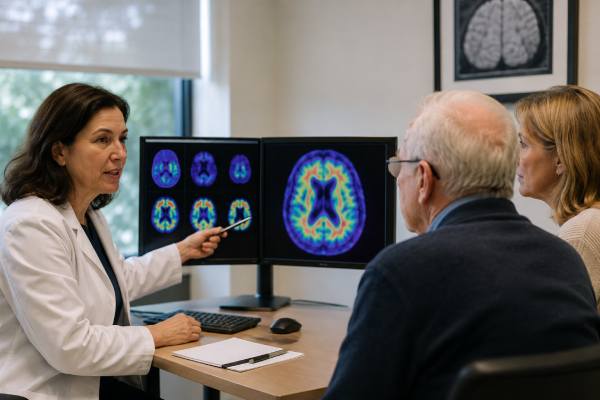
PET stands for positron emission tomography. During the scan, a small amount of radioactive tracer is injected into a vein. The tracer travels through the bloodstream and binds to amyloid plaques if they are present. A PET camera then detects the signal and creates images that a trained nuclear medicine physician or radiologist interprets.
A key point is that amyloid PET is a biomarker test. It does not measure memory performance directly. It measures a biological feature that may help explain why memory or thinking symptoms are happening. This is why amyloid PET is usually considered after the person has already had a broader cognitive workup, often including cognitive screening, neurological examination, laboratory testing, and structural imaging.
A positive amyloid PET scan supports the presence of Alzheimer’s-type amyloid pathology, but it does not automatically prove that Alzheimer’s disease is the only cause of the person’s symptoms. Some people, especially older adults, may have amyloid plaques along with vascular brain changes, Lewy body disease, depression, medication effects, or other contributors. Amyloid can also be present in some people who do not yet have noticeable cognitive symptoms.
A negative amyloid PET scan is often very useful. If a person has cognitive impairment and the scan is clearly negative, Alzheimer’s disease is much less likely to be the cause of the current symptoms. That can redirect the evaluation toward other explanations, such as frontotemporal dementia, vascular cognitive impairment, sleep apnea, medication side effects, mood disorders, thyroid disease, vitamin B12 deficiency, or other neurological conditions.
Amyloid PET is part of a broader shift toward biological testing in dementia care. The idea is not to diagnose Alzheimer’s disease from a single scan in isolation, but to combine the scan with the person’s symptoms, cognitive profile, medical history, neurological findings, and other tests. For a wider view of how this fits into a diagnostic workup, see Alzheimer’s testing and diagnosis.
When Amyloid PET Is Considered
Amyloid PET is most useful when Alzheimer’s disease is suspected but the diagnosis remains uncertain, and when knowing amyloid status would change medical decisions. It is generally not a first test for every person with forgetfulness.
Doctors usually start with a clinical evaluation. This may include a detailed history from the patient and a close family member, review of medications, screening for depression and sleep problems, neurological examination, blood tests, cognitive testing, and often MRI or CT to look for strokes, tumors, bleeding, hydrocephalus, or patterns of brain atrophy. Amyloid PET is considered when those steps do not fully answer the question.
Situations where amyloid PET may be considered include:
- Mild cognitive impairment with unclear cause. A person has measurable cognitive changes, but daily independence is mostly preserved, and doctors need to know whether Alzheimer’s biology is likely involved.
- Atypical symptoms. Alzheimer’s disease does not always begin with classic short-term memory loss. Some people first have language, visual-spatial, executive function, or behavior changes.
- Early-onset cognitive decline. Symptoms beginning before the usual older-adult age range often require a more detailed evaluation because the differential diagnosis is broader.
- Mixed or complicated medical history. Stroke, traumatic brain injury, depression, sleep apnea, medication burden, or other neurological conditions may make the clinical picture harder to interpret.
- Treatment planning. In some patients being evaluated for amyloid-targeting therapies, confirming amyloid pathology is part of determining whether the treatment target is actually present.
- Clinical trial eligibility. Many Alzheimer’s research studies require evidence of amyloid pathology before enrollment.
Amyloid PET is usually less appropriate when the result would not change care. For example, it may not be helpful for someone with advanced dementia when the cause is already clear and no management decision depends on amyloid status. It is also generally not used as a general screening test in people with no cognitive symptoms, even if they have a family history of Alzheimer’s disease.
This distinction matters because many people worry about normal age-related forgetfulness. Misplacing keys, occasionally forgetting a name, or needing reminders does not automatically mean a PET scan is needed. Initial assessment often starts with simpler tools, such as brief cognitive screening or more formal cognitive testing. Families trying to understand that first stage may find cognitive testing for older adults helpful.
Amyloid PET should also not be used to replace genetic counseling when a rare inherited form of Alzheimer’s disease is suspected. In families with very early onset across multiple generations, genetic evaluation may be more relevant than amyloid imaging. For many people with typical later-life memory symptoms, however, APOE or other risk information is not the same as diagnosing the cause of current cognitive impairment.
What Happens During the Scan
An amyloid PET scan is usually an outpatient imaging test. The experience is similar to other PET scans: an IV injection, a waiting period while the tracer distributes, and then lying still while images are taken.
The exact timing depends on the imaging center and the tracer used. In general, the visit may take a few hours from check-in to completion, while the actual scan time is often much shorter than the full appointment. The care team will explain the schedule, whether any medication adjustments are needed, and what to do before arrival.
The basic steps are usually:
- Check-in and safety review. Staff confirm identity, medical history, allergies, pregnancy or breastfeeding status, and the reason for the scan.
- IV placement. A small IV line is placed, usually in the arm or hand.
- Tracer injection. The amyloid tracer is injected through the IV.
- Waiting period. The tracer circulates and binds to amyloid plaques if they are present. The person may rest quietly during this time.
- Image acquisition. The person lies on the scanner table with the head positioned carefully. Staying still is important because motion can blur the images.
- Post-scan instructions. Most people can resume normal activities afterward, though they may be told to drink fluids to help clear the tracer.
The scan itself is not painful, aside from the IV placement. The scanner does not usually feel closed in the same way an MRI can, but some people still feel uncomfortable lying still. Anyone with significant claustrophobia, severe pain, tremor, agitation, or difficulty remaining flat should tell the ordering doctor and imaging center ahead of time.
Preparation is usually straightforward. The imaging center may ask about current medications, recent imaging tests, and whether the person can lie still. A support person may be helpful, especially if the patient has memory impairment, anxiety, mobility limitations, or trouble following instructions.
The radiation exposure from amyloid PET is considered low and is generally in the range used for diagnostic nuclear medicine tests. Still, it is radiation exposure, so the scan should have a clear medical purpose. People who are pregnant, might be pregnant, or are breastfeeding should tell the medical team before the test is performed.
After the scan, results are not usually given immediately by the technologist. The images need to be reviewed by a qualified physician, and the report is sent to the ordering clinician. The most important conversation often happens afterward, when the doctor explains what the scan means in the context of the person’s symptoms and other test results.
How Amyloid PET Results Are Read
Amyloid PET results are usually reported as positive or negative for significant amyloid plaque burden. Some centers also use quantitative measures, but the clinical question is often whether amyloid pathology is present at a level that supports Alzheimer’s biology.
A positive amyloid PET scan means the scan pattern is consistent with moderate to frequent amyloid plaque deposition. In a person with cognitive impairment, that supports Alzheimer’s disease as a possible or likely contributor. It may increase diagnostic confidence, help explain symptoms, and guide decisions about medication, safety planning, counseling, or eligibility for certain treatments or studies.
A negative amyloid PET scan means there is little or no detectable amyloid plaque burden. In a symptomatic person, this makes Alzheimer’s disease much less likely as the main cause of the current cognitive problem. It does not mean the symptoms are not real. It means the medical team should look harder for other causes.
Interpreting the scan requires context. A positive scan in a person with a classic Alzheimer’s pattern of progressive short-term memory loss has a different meaning from a positive scan in an older adult with multiple strokes and fluctuating attention. Similarly, a negative scan in someone with prominent language or behavior changes may shift attention toward frontotemporal dementia or another non-Alzheimer’s condition.
Amyloid PET also does not show how severe dementia is. A person with a high amyloid burden is not necessarily more impaired than someone with a lower burden. Symptoms depend on many factors, including tau pathology, neurodegeneration, brain reserve, vascular disease, other medical conditions, and the specific brain networks affected. This is one reason tau PET, MRI, FDG-PET, and neuropsychological testing may provide different but complementary information.
The result should be explained in plain language. Useful questions to ask the clinician include:
- Does the result make Alzheimer’s disease more or less likely in this case?
- Could more than one condition be contributing to the symptoms?
- Does the result change the diagnosis?
- Does it change medication, safety planning, driving advice, work planning, or follow-up?
- Are more tests needed, such as MRI, blood biomarkers, CSF testing, tau PET, or neuropsychological testing?
- Does the result affect eligibility for disease-modifying treatment or a clinical trial?
When scan results are unexpected, follow-up matters. A positive result may raise emotional, financial, and family planning concerns. A negative result may be relieving, but it can also be frustrating if symptoms continue without a clear explanation. Either way, the next step should be a practical plan, not just a label. If a scan or cognitive test result is abnormal, what happens after abnormal brain scan or cognitive test results can help frame the follow-up conversation.
Amyloid PET vs Other Tests
Amyloid PET answers one specific question: is there significant amyloid plaque deposition in the brain? Other tests answer different questions, which is why Alzheimer’s diagnosis often uses several tools rather than relying on one result.
| Test | What it helps show | Main limitation |
|---|---|---|
| Amyloid PET | Whether significant amyloid plaque burden is present in the brain | Does not measure symptom severity or prove amyloid is the only cause |
| Brain MRI or CT | Stroke, tumors, bleeding, hydrocephalus, atrophy, vascular disease | Does not directly show amyloid plaques |
| Cognitive testing | Pattern and severity of memory, language, attention, and executive changes | Shows performance, not the underlying brain protein pathology |
| CSF testing | Amyloid and tau-related changes in cerebrospinal fluid | Requires lumbar puncture and careful interpretation |
| Blood biomarkers | Alzheimer’s-related protein changes that may help triage or support diagnosis | Availability, accuracy, and clinical use vary by test and setting |
| Tau PET | Tau tangle distribution, which may relate more closely to disease stage | Less widely used than amyloid PET in routine care |
MRI is often ordered before PET because it can identify structural problems that need different care. A person with memory loss may have silent strokes, a brain tumor, normal pressure hydrocephalus, bleeding, or marked vascular disease. Amyloid PET would not be the right first tool for those questions. For that broader imaging context, see brain imaging for memory loss.
CSF testing can measure Alzheimer’s-related amyloid and tau changes through a lumbar puncture. It may be less expensive or more available than PET in some settings, but some patients prefer imaging over spinal fluid testing. Others prefer CSF because it can provide multiple biomarker measures at once. The best choice depends on local expertise, access, medical history, patient preference, and what decision the test is meant to support.
Blood biomarkers are changing the diagnostic landscape. Some blood tests can measure Alzheimer’s-related proteins such as phosphorylated tau and amyloid ratios. These tests may help identify who needs confirmatory testing or specialist evaluation, but they are not all interchangeable, and not every blood test marketed for brain health has the same evidence. A more detailed explanation is available in blood biomarker tests for Alzheimer’s disease.
Tau PET is different from amyloid PET. Amyloid plaques often build up early, sometimes before symptoms. Tau pathology tends to track more closely with neurodegeneration and clinical progression in Alzheimer’s disease. In some cases, doctors may consider tau PET in dementia testing, especially when staging, prognosis, or atypical presentations are part of the question.
APOE genetic testing is another separate category. APOE can influence Alzheimer’s risk and may matter in some treatment-risk discussions, but it does not diagnose Alzheimer’s disease by itself. A person can carry an APOE risk variant and never develop dementia, and a person without that variant can still develop Alzheimer’s disease.
Benefits, Limitations, and Risks
The main benefit of amyloid PET is diagnostic clarity when the cause of cognitive impairment is uncertain. Its main limitation is that amyloid positivity must still be interpreted alongside symptoms, function, and other medical findings.
A clear amyloid result can help in several ways. It may reduce diagnostic uncertainty, prevent mislabeling a non-Alzheimer’s condition as Alzheimer’s disease, or support earlier planning when Alzheimer’s biology is present. It may also help avoid treatments that are unlikely to help if the scan is negative. In some cases, the result changes medication decisions, counseling, referrals, safety planning, or clinical trial options.
Amyloid PET can also be emotionally meaningful. Some people and families feel better having a more biologically grounded answer, even when the answer is difficult. Others may experience anxiety, grief, or confusion after learning amyloid is present. A good diagnostic process should include time to discuss what the result means and what it does not mean.
Important limitations include:
- A positive scan is not the whole diagnosis. It shows amyloid pathology, not the complete cause of symptoms.
- Amyloid can coexist with other diseases. Vascular disease, Lewy body disease, medication effects, depression, and sleep disorders can still matter.
- The scan does not predict an exact timeline. It cannot say precisely how quickly symptoms will progress.
- It is not a general screening tool. Testing people without cognitive symptoms can create uncertainty and distress without a clear medical action.
- Access and coverage vary. Availability, referral pathways, and insurance coverage depend on location, health system, and clinical indication.
- Results require specialist interpretation. The value of the test depends on choosing the right patient and integrating the result into a broader evaluation.
There are also practical risks and burdens. The scan involves a radioactive tracer, although the dose is generally low. It requires an IV, travel to an imaging center, time in the scanner, and the ability to lie still. False reassurance or overinterpretation can happen if results are discussed without enough clinical context.
Amyloid PET is not an emergency test. Sudden confusion, new weakness on one side, trouble speaking, seizure, severe headache, head injury, fever with confusion, or rapidly worsening mental status needs urgent medical evaluation. These symptoms may reflect stroke, infection, bleeding, delirium, seizure, medication toxicity, or another urgent condition. In those situations, emergency assessment and often CT, MRI, labs, or other acute testing are more appropriate than outpatient amyloid imaging.
For people worried about inherited risk, amyloid PET is not a substitute for careful counseling. Decisions about genetic risk, family implications, and whether testing is appropriate are best handled with a clinician experienced in dementia genetics. See APOE genetic testing for Alzheimer’s risk for more context on what risk testing can and cannot tell you.
What Results Mean for Next Steps
The most useful amyloid PET result is one that leads to a clearer plan. After the scan, the next steps should connect the imaging result to diagnosis, treatment options, safety, family planning, and follow-up.
If the scan is positive, the clinician may explain that Alzheimer’s disease is more likely to be contributing to the person’s cognitive symptoms. The care plan may include reviewing medications, considering Alzheimer’s-specific treatment options, discussing eligibility for amyloid-targeting therapy if appropriate, addressing vascular and lifestyle risk factors, and planning follow-up cognitive assessment. The doctor may also review driving, finances, work responsibilities, home safety, and caregiver support depending on symptom severity.
If the scan is negative, the plan should shift toward other causes. That may mean more detailed neuropsychological testing, sleep evaluation, medication review, psychiatric assessment, vascular risk management, additional imaging, or referral to a specialist in movement disorders, epilepsy, autoimmune neurology, or cognitive neurology. A negative amyloid scan can be especially helpful when it prevents months or years of assuming Alzheimer’s disease is the explanation.
A practical post-scan discussion should cover four areas:
- Diagnosis. What condition is now most likely, and what uncertainty remains?
- Treatment. Are medications, lifestyle changes, rehabilitation, or specialist referrals recommended?
- Monitoring. How often should symptoms, function, and cognition be reassessed?
- Planning. What should the person and family do now to support safety, independence, and decision-making?
Amyloid PET may also affect whether additional biomarkers are needed. In some cases, amyloid PET is enough to answer the immediate question. In others, the clinician may recommend tau PET, CSF testing, blood biomarkers, MRI follow-up, or formal neuropsychological testing to understand the full pattern.
For people diagnosed with Alzheimer’s disease, the result is only one part of care. Management may include medication decisions, exercise and vascular risk reduction, sleep treatment, hearing and vision support, cognitive and occupational strategies, caregiver education, legal and financial planning, and monitoring for mood, behavior, and safety changes. A diagnosis should open the door to care, not end the conversation. For treatment and support planning, see Alzheimer’s disease treatment and care management.
The bottom line is that amyloid PET is most valuable when it is ordered for a specific clinical question. It can strongly support or argue against Alzheimer’s biology, but it works best as part of a thoughtful diagnostic process led by clinicians who understand cognitive disorders and can translate results into practical next steps.
References
- Updated Appropriate Use Criteria for Amyloid and Tau PET: A Report from the Alzheimer’s Association and Society of Nuclear Medicine and Molecular Imaging Workgroup 2025 (Guideline)
- Criteria for Diagnosis and Staging of Alzheimer’s Disease 2024 (Guideline Resource)
- Use of Amyloid Positron-Emission Tomography to Diagnose Alzheimer’s Disease in Clinical Practice in South Korea: Expert Recommendations 2025 (Expert Recommendations)
- Amyloid PET and clinical management in a diverse, cognitively impaired population: The New IDEAS Study 2025 (Cohort Study)
- Beta Amyloid Positron Emission Tomography in Dementia and Neurodegenerative Disease 2023 (Decision Memo)
- A Systematic Review and Aggregated Analysis on the Impact of Amyloid PET Brain Imaging on the Diagnosis, Diagnostic Confidence, and Management of Patients being Evaluated for Alzheimer’s Disease 2018 (Systematic Review)
Disclaimer
This content is for general educational purposes only and is not a substitute for professional medical advice, diagnosis, or treatment. Memory loss, confusion, or abnormal imaging results should be discussed with a qualified clinician, especially if symptoms are sudden, rapidly worsening, or affecting safety.
Share this article on Facebook, X, or your preferred platform to help others understand how amyloid PET fits into Alzheimer’s diagnosis.