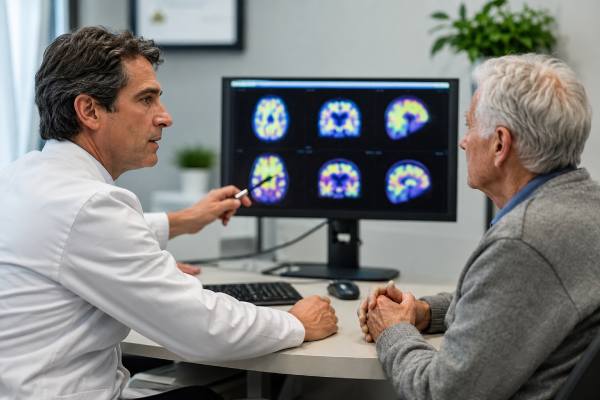
Tau PET is a specialized brain imaging test used in some dementia evaluations to look for abnormal tau protein patterns in the brain. It is not a first-step memory test, and it is not used for every person with forgetfulness. Its value is greatest when a clinician is trying to clarify whether Alzheimer’s disease is likely contributing to cognitive symptoms, especially when the diagnosis remains uncertain after a standard workup.
The test can feel confusing because “tau” also appears in blood tests, spinal fluid tests, and research discussions about Alzheimer’s disease. A tau PET scan is different: it creates a brain image showing where a tau-binding radioactive tracer has collected. That pattern may help clinicians understand whether the distribution of tau looks consistent with Alzheimer’s disease, how advanced the biological process may be, and how the result fits with symptoms, cognitive testing, MRI, amyloid testing, and medical history.
Table of Contents
- What a tau PET scan measures
- How tau PET fits in dementia testing
- Who may be considered for tau PET
- What happens during the scan
- How tau PET results are read
- Benefits, limits, and risks
- Tau PET vs other biomarker tests
- Questions to ask your clinician
What a tau PET scan measures
A tau PET scan measures the brain distribution of abnormal aggregated tau protein, usually in the form of neurofibrillary tangles associated with Alzheimer’s disease. It does not measure memory directly, and it does not show thoughts, personality, intelligence, or day-to-day functioning by itself.
Tau is a normal protein inside nerve cells, where it helps stabilize internal cell structures. In Alzheimer’s disease, tau can become abnormally modified and clump into tangles. These tangles are one of the core brain changes of Alzheimer’s disease, along with beta-amyloid plaques. A tau PET scan uses a radiotracer that is injected into a vein and designed to bind to certain abnormal tau aggregates. The PET scanner then detects the radioactive signal and creates images of where the tracer has accumulated.
The practical question is not simply whether tau exists somewhere in the brain. Small amounts of age-related tau change can occur, especially in medial temporal structures involved in memory. In dementia testing, clinicians are more interested in whether tau has spread into a broader neocortical pattern that is more typical of Alzheimer’s disease. The neocortex includes outer brain regions involved in language, attention, visuospatial skills, memory networks, and executive function.
Tau PET is different from a structural brain scan. A brain MRI or CT scan can show strokes, bleeding, tumors, shrinkage patterns, hydrocephalus, and other structural causes of symptoms. A tau PET scan is a molecular imaging test: it looks for a biological marker, not just anatomy. For that reason, it may be discussed alongside other biomarker tests, including amyloid PET, cerebrospinal fluid testing, and blood biomarker tests.
The word “tau” can also be confusing because not all tau-related tests answer the same question. A blood or spinal fluid test may measure forms of tau that suggest Alzheimer’s-related biology is active. A tau PET scan adds a spatial map: it shows where tracer binding appears in the brain. That location matters because Alzheimer’s disease tends to follow recognizable patterns of spread, and those patterns may help explain why one person has mainly memory trouble while another has language, visual, or executive-function symptoms.
A positive tau PET pattern does not automatically replace a clinical diagnosis. Dementia diagnoses still depend on symptoms, daily functioning, cognitive testing, medical history, neurological examination, and exclusion of other causes. Tau PET is one piece of evidence, not a stand-alone answer.
How tau PET fits in dementia testing
Tau PET is usually considered after a broader dementia evaluation has already raised a specific diagnostic question. Most people being evaluated for memory loss start with clinical assessment, cognitive testing, medication review, lab work, and often MRI or CT before a specialist considers PET imaging.
A typical workup begins by confirming what kind of cognitive change is present. Is the main problem short-term memory, language, judgment, attention, navigation, visual processing, mood, sleepiness, or fluctuating alertness? Is the person still independent, or are daily tasks such as finances, cooking, driving, medications, or work becoming unsafe? These details help distinguish mild cognitive impairment, dementia, delirium, depression, sleep disorders, medication effects, and other medical causes.
Tau PET usually enters the discussion when Alzheimer’s disease is a serious possibility but the clinical picture is not fully clear. For example, a person may have progressive cognitive symptoms at a younger-than-usual age, an atypical pattern such as language-led or visual-spatial symptoms, or mixed findings on MRI. In these situations, tau PET may help clarify whether the pattern of brain pathology supports Alzheimer’s disease. It may be considered alongside a broader Alzheimer’s diagnostic workup, rather than as a replacement for it.
Cognitive testing remains central because it shows how symptoms are affecting thinking skills. Brief screening tools can detect possible impairment, while formal neuropsychological testing can describe strengths and weaknesses in more detail. When the clinical picture is complex, neuropsychological testing for dementia and memory loss can help connect the person’s symptoms to likely brain networks. Tau PET may then add biological context.
Clinicians also use imaging to look for non-Alzheimer’s explanations. MRI may show strokes, small vessel disease, tumor, prior traumatic injury, normal pressure hydrocephalus, or patterns of atrophy that suggest a particular dementia syndrome. A PET scan does not remove the need for this structural review. In many cases, clinicians need both kinds of information: structure and molecular biology.
Tau PET can also have a prognostic role in selected cases. In mild cognitive impairment, higher and more widespread tau signal may suggest a higher risk of progression to dementia, especially when other Alzheimer’s biomarkers are also abnormal. That kind of information can help with planning, but it should be handled carefully. A scan result does not predict the exact timeline for an individual person, and many factors influence progression, including age, vascular health, other brain diseases, sleep, hearing, medications, and overall medical status.
Who may be considered for tau PET
Tau PET may be considered for adults with cognitive impairment when a dementia specialist believes Alzheimer’s disease is a plausible cause and the result could meaningfully change diagnosis, counseling, or care planning. It is generally not used as a casual screening test for people who are simply worried about future risk.
A clinician may discuss tau PET in situations such as:
- Mild cognitive impairment where the cause remains uncertain after standard evaluation
- Early-onset cognitive decline, especially before the typical age range for Alzheimer’s disease
- Atypical symptoms, such as language-led, visual-spatial, or executive-function presentations
- Possible Alzheimer’s disease mixed with vascular disease, Lewy body disease, frontotemporal dementia, depression, sleep disorders, or medication effects
- Cases where amyloid testing is positive but the clinician needs more information about disease stage or regional involvement
- Specialist-level decisions about prognosis, research eligibility, or treatment planning
The test is less likely to be useful when the clinical diagnosis is already clear and the result would not change management. It is also usually not appropriate for people with no cognitive symptoms who want to know whether they might develop dementia someday. A positive biomarker in an asymptomatic person can raise difficult questions without necessarily providing a clear medical action.
Tau PET is not a general test for all dementia types. Alzheimer’s disease is strongly linked to abnormal amyloid and tau, but other dementias have different dominant biology. Dementia with Lewy bodies involves alpha-synuclein pathology. Vascular dementia involves blood vessel injury and strokes. Frontotemporal dementia can involve tau in some cases, but many tau PET tracers used for Alzheimer’s disease do not reliably detect all forms of tau seen in frontotemporal lobar degeneration. For that reason, a negative or unclear tau PET scan does not rule out every neurodegenerative disease.
It is also important to separate gradual cognitive decline from urgent neurological symptoms. Sudden confusion, new weakness on one side, trouble speaking, seizure, severe sudden headache, head injury, fever with confusion, or rapidly worsening alertness needs urgent medical evaluation, not routine dementia testing. In older adults, sudden confusion may be delirium, infection, medication toxicity, dehydration, stroke, or another acute condition.
Access also matters. Tau PET is less widely available than MRI, cognitive screening, and many blood tests. Insurance coverage varies, and some centers use tau PET mainly in specialty clinics or research settings. A clinician may recommend a different test first, such as brain imaging for memory loss, amyloid testing, or spinal fluid analysis, depending on the question being asked.
What happens during the scan
A tau PET scan is usually an outpatient imaging test involving an intravenous tracer injection, a waiting period, and PET image acquisition while the person lies still. The exact timing depends on the tracer and imaging center protocol.
Before the scan, the imaging team reviews the person’s medical history, medications, allergies, pregnancy status when relevant, and ability to lie still. The person may be asked to remove metal items, change into a gown, and use the restroom before imaging. Unlike some MRI scans, PET scanning itself is not noisy in the same way, but the person must remain still so the images are clear.
For flortaucipir F 18, the FDA-approved tau PET tracer in the United States, the tracer is injected through an IV. Imaging begins after a waiting period, commonly around 80 minutes, and the scan acquisition may take about 20 minutes. Other tracers or research protocols may use different timing. The purpose of the waiting period is to allow the tracer to distribute and clear enough background activity so the brain signal can be interpreted.
During the scan, the person lies on a narrow table with the head positioned in the scanner. Soft restraints or supports may be used to reduce motion. Movement can blur the image, so comfort matters. People who have back pain, anxiety in scanners, tremor, or difficulty lying flat should tell the imaging team in advance. Some centers can use positioning supports or other strategies to make the scan easier.
The scan does not usually require sedation. If a person has severe claustrophobia, agitation, or inability to remain still because of advanced dementia or another condition, the ordering clinician and imaging center need to discuss whether the test is feasible and whether the likely benefit justifies the difficulty.
After the scan, most people can return to normal activities unless the imaging center gives specific instructions. Because the tracer is radioactive, the body clears it over time, and hydration may be encouraged. Breastfeeding instructions depend on the tracer; for flortaucipir F 18, lactating patients are advised to avoid breastfeeding for a short period after administration. Anyone who is pregnant, may be pregnant, or breastfeeding should discuss this before the tracer is given.
The person receiving the scan usually does not get an immediate interpretation from the technologist. A nuclear medicine physician or radiologist reviews the images, often with access to the clinical indication and prior imaging. The report is then sent to the ordering clinician, who should explain what the result means in the context of the full evaluation.
How tau PET results are read
Tau PET results are interpreted by looking at whether tracer uptake appears in brain regions and patterns consistent with Alzheimer’s-related tau pathology. The meaning depends on the distribution, intensity, clinical symptoms, and other test results.
A report may describe the scan as positive, negative, or showing a pattern that is limited, borderline, or not clearly diagnostic. In practical terms, clinicians often want to know whether there is abnormal neocortical tau uptake. When tau signal is mainly absent or confined to areas where age-related changes can occur, the scan may be less supportive of Alzheimer’s disease as the cause of current symptoms. When tau signal is more widespread in Alzheimer’s-typical cortical regions, it may strengthen the case that Alzheimer’s disease is contributing.
Location matters. Alzheimer’s-related tau often begins in medial temporal memory structures and may later spread to lateral temporal, parietal, occipital, and frontal association cortices. Symptoms may roughly align with the affected networks, although the relationship is not perfect. A person with prominent posterior cortical involvement may have visual-spatial problems, while another with temporal and parietal involvement may have memory and language difficulties.
A positive tau PET scan is not the same as a diagnosis made in isolation. Alzheimer’s disease diagnosis usually requires clinical impairment plus biological evidence interpreted in context. Amyloid status is also important because Alzheimer’s disease is defined by the combination of amyloid plaques and tau tangles. Tau PET may show a pattern that strongly supports Alzheimer’s disease, but clinicians still need to consider whether other conditions are also present.
A negative tau PET result can be helpful but is not always final. It may make advanced Alzheimer’s-type tau pathology less likely, especially if symptoms are significant. However, very early Alzheimer’s disease may have limited tau spread. Technical factors, tracer limitations, image motion, and atypical disease biology can also affect interpretation. If symptoms are progressing, a clinician may still recommend follow-up, repeat cognitive testing, MRI review, amyloid testing, blood biomarkers, or cerebrospinal fluid testing.
Tau PET reports can also mention limitations such as off-target binding. This means tracer signal may appear in areas not directly related to the Alzheimer’s tau pattern being evaluated. Experienced readers know which regions are most relevant and which signals should be interpreted cautiously.
The most useful question after receiving a result is not simply “positive or negative?” It is: “How does this result change the diagnosis, prognosis, or next step?” A scan that does not change care may add cost and anxiety without much benefit. A scan that resolves a major uncertainty may help families plan, qualify for appropriate therapies or trials, or avoid treatments aimed at the wrong condition.
Benefits, limits, and risks
The main benefit of tau PET is that it can provide visual, brain-region-specific evidence of Alzheimer’s-type tau pathology in selected patients. Its main limitation is that it is not a stand-alone dementia diagnosis and is not equally useful for every cognitive problem.
Potential benefits include greater diagnostic confidence, especially in atypical or uncertain cases. A tau PET result can help distinguish Alzheimer’s-type pathology from some other causes of cognitive decline, particularly when paired with amyloid testing, MRI, and cognitive results. It may also help clinicians discuss prognosis more concretely, because tau burden and spread are often more closely related to symptoms and clinical stage than amyloid plaque burden alone.
Tau PET may also support treatment planning. Newer Alzheimer’s treatments and clinical trials often require evidence of Alzheimer’s biology, especially amyloid positivity. Tau PET is not always required for treatment eligibility, but it may provide additional staging or prognostic information in some specialist settings. Decisions about anti-amyloid therapy also require careful assessment of disease stage, MRI safety factors, bleeding risk, medications, and expected benefit.
The limitations are just as important. Tau PET cannot tell whether a person is safe to drive, manage finances, live alone, or make complex decisions. Those questions require functional history, cognitive assessment, clinical judgment, and sometimes occupational or driving evaluation. Tau PET also does not diagnose depression, sleep apnea, medication side effects, delirium, or vitamin deficiencies, all of which can affect cognition.
Tau PET is not approved or established for diagnosing chronic traumatic encephalopathy in living patients. This is an important point for former athletes, military veterans, or people with repetitive head impacts. A person with head injury history and cognitive symptoms still needs a careful neurological evaluation, but an Alzheimer’s-type tau PET scan is not a definitive test for CTE.
Risks are usually modest but real. Tau PET involves exposure to a small amount of ionizing radiation from the radioactive tracer. The dose is generally within the range used for diagnostic nuclear medicine tests, but it should still be justified by a meaningful clinical question. IV placement can cause discomfort or bruising. Reported side effects with flortaucipir F 18 have included headache, injection-site pain, and increased blood pressure in a small proportion of patients.
Cost and emotional impact also deserve attention. Biomarker results can affect a person’s sense of future, family planning, work decisions, insurance concerns, and anxiety level. Before testing, families should understand what the scan can and cannot answer, who will explain the result, and what decisions may follow. For some people, next steps after abnormal brain or cognitive test results are as important as the test itself.
Tau PET vs other biomarker tests
Tau PET is one biomarker option among several, and the best test depends on the clinical question. Some tests are better for detecting Alzheimer’s biology, some are better for showing brain structure, and some are better for estimating disease stage or ruling out other causes.
Amyloid PET looks for beta-amyloid plaques. A positive amyloid PET scan supports the presence of amyloid pathology, but amyloid can be present years before symptoms and may not explain the severity or pattern of current impairment by itself. Tau PET looks more directly at tangle distribution, which often tracks more closely with symptomatic Alzheimer’s disease. In some evaluations, amyloid PET in Alzheimer’s diagnosis is considered before or alongside tau PET.
Blood biomarker testing is changing dementia care quickly. Tests involving phosphorylated tau, amyloid ratios, and other markers can help identify Alzheimer’s-related biology with a simple blood draw in appropriate clinical settings. Blood tests are easier to access than PET in many places, but performance varies by assay, population, setting, and how results are interpreted. A specialist may use blood biomarker tests for Alzheimer’s disease as part of a stepwise approach, sometimes followed by PET or spinal fluid confirmation.
Cerebrospinal fluid testing, done through lumbar puncture, can measure amyloid and tau-related changes in the fluid around the brain and spinal cord. It can be very informative but is more invasive than a blood test. MRI remains essential for structural causes and safety screening, while cognitive testing shows functional impact.
| Test | What it mainly shows | Where it is most useful | Key limitation |
|---|---|---|---|
| Tau PET | Location and burden of Alzheimer’s-type tau tracer uptake | Atypical or uncertain cognitive impairment, staging, prognosis | Limited availability, cost, radiation, not a stand-alone diagnosis |
| Amyloid PET | Brain amyloid plaque burden | Confirming or excluding amyloid pathology when diagnosis is uncertain | Positive results may occur before symptoms and do not show symptom severity well |
| Blood biomarkers | Blood-based signals linked to Alzheimer’s biology | Specialist diagnostic workups, triage, follow-up testing decisions | Assay quality and interpretation vary; may need confirmation |
| CSF testing | Amyloid and tau changes in spinal fluid | Biological confirmation when PET is unavailable or not preferred | Requires lumbar puncture |
| MRI or CT | Brain structure, strokes, tumors, bleeding, atrophy patterns | Most memory-loss workups and safety screening | Does not directly show amyloid plaques or tau tangles |
Tau blood tests deserve special clarification. They do not create a picture of tau deposits in the brain. Instead, they measure tau-related molecules in blood, such as phosphorylated tau forms, that can reflect Alzheimer’s-related processes. A clinician may discuss tau blood tests for dementia when deciding whether a person needs more specialized testing.
No biomarker should be interpreted away from the person. Age, symptom pattern, neurological exam, mood, sleep, vascular risk, medications, family input, and functional change all matter. The most accurate dementia evaluations usually combine several types of evidence rather than relying on a single test.
Questions to ask your clinician
The best reason to get a tau PET scan is that the result will answer a specific clinical question and influence the next step. Before scheduling the test, it is reasonable to ask what decision the scan is expected to clarify.
Helpful questions include:
- What diagnosis is currently most likely, and what remains uncertain?
- Would the scan change treatment, follow-up, safety planning, or eligibility for a therapy or clinical trial?
- Should amyloid testing, MRI, blood biomarkers, or spinal fluid testing be done first?
- What would a positive, negative, or unclear tau PET result mean in this case?
- How much radiation exposure is involved, and are there pregnancy or breastfeeding precautions?
- Is the scan covered by insurance, and what out-of-pocket cost should be expected?
- Who will explain the result, and will the explanation include the full cognitive and imaging picture?
Families should also ask how the result will be communicated. A brief imaging report may be technically accurate but not emotionally or practically sufficient. A person living with cognitive symptoms may need a clear explanation of what the result means for diagnosis, daily life, future planning, and follow-up. When possible, it can help to have a trusted family member or care partner present for the results visit.
If the scan supports Alzheimer’s disease, next steps may include reviewing medication options, discussing anti-amyloid therapy eligibility if appropriate, managing vascular and sleep risk factors, planning for safety and legal needs, and arranging follow-up cognitive monitoring. If the scan does not support Alzheimer’s-type tau pathology, the clinician may revisit other possibilities, such as Lewy body disease, frontotemporal dementia, vascular cognitive impairment, depression, sleep apnea, medication effects, autoimmune or inflammatory causes, or another neurological condition.
A tau PET scan can be powerful because it shows biology that used to be visible only after death. But it is most useful when ordered thoughtfully, interpreted by experienced clinicians, and connected to real decisions. For many people, the scan is not the beginning of the dementia evaluation. It is a later, more specialized tool used to refine an already careful clinical assessment.
References
- Updated Appropriate Use Criteria for Amyloid and Tau PET: A Report from the Alzheimer’s Association and Society for Nuclear Medicine and Molecular Imaging Workgroup 2025 (Appropriate Use Criteria)
- Revised criteria for diagnosis and staging of Alzheimer’s disease: Alzheimer’s Association Workgroup 2024 (Guideline)
- Tau Positron Emission Tomography for Predicting Dementia in Individuals With Mild Cognitive Impairment 2024 (Clinical Study)
- Alzheimer’s Association Clinical Practice Guideline on the use of blood-based biomarkers in the diagnostic workup of suspected Alzheimer’s disease within specialized care settings 2025 (Guideline)
- TAUVID™ (flortaucipir F 18 injection), for intravenous use 2024 (Prescribing Information)
Disclaimer
This article is for general educational purposes only and is not a substitute for medical advice, diagnosis, or treatment. Decisions about tau PET imaging, dementia testing, and Alzheimer’s disease evaluation should be made with a qualified clinician who can interpret results in the context of symptoms, exam findings, cognitive testing, and other medical information.
Share this article on Facebook, X, or your preferred platform to help others understand what tau PET can and cannot show in dementia testing.