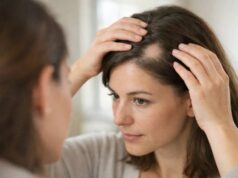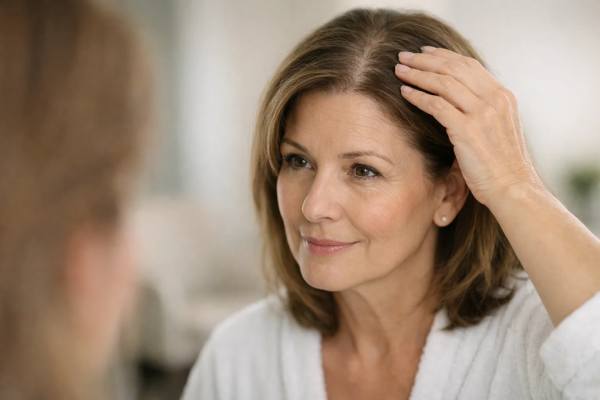
Hair thinning often becomes more noticeable during the menopausal transition, when the scalp is dealing with more than one change at once. Falling estrogen, changing progesterone patterns, relative androgen influence, aging of the follicle, stress, sleep disruption, and common midlife issues such as thyroid disease or low iron can all overlap. That is why menopause-related hair loss rarely has a single, tidy cause.
Hormone therapy can absolutely improve quality of life for the right patient, especially when hot flashes, night sweats, sleep disruption, or genitourinary symptoms are driving daily distress. The harder question is whether it reliably improves scalp hair. The answer is nuanced. Some women notice less shedding or modest improvement once symptoms and hormone shifts are better controlled, but hormone therapy is not considered a primary hair-loss treatment on its own.
The best way to approach the issue is to see hair thinning as part of a wider menopausal picture, then decide whether hormone therapy belongs in the plan for overall health, comfort, and hair goals together.
Core Points
- Menopause-related hair thinning often reflects both hormonal change and common overlapping triggers such as thyroid shifts, iron deficiency, stress, and patterned hair loss.
- Hormone therapy may help some women indirectly, and possibly modestly in selected cases, but it is not a proven first-line treatment for hair loss alone.
- The strongest direct hair treatments usually come from hair-focused therapy rather than menopause therapy by itself.
- Systemic hormone therapy should not be started solely for thinning hair when there are no other clear menopausal indications.
- A practical starting point is to evaluate the pattern of thinning, review menopausal symptoms, and discuss hormone therapy only as part of a broader treatment plan.
Table of Contents
- Why hair often changes during menopause
- Can hormone therapy actually help hair
- Who might consider hormone therapy
- Treatments that target hair more directly
- How long results take and what to expect
- When to get evaluated and build a plan
Why hair often changes during menopause
Hair thinning during menopause is common, but the biology behind it is more layered than a simple drop in estrogen. The hair follicle responds to hormones, age, inflammation, nutrition, stress, and blood supply all at once. As ovarian estrogen declines, the balance between estrogen and androgens shifts. Even when absolute androgen levels are not dramatically high, their relative influence can become more noticeable at the follicle. In a genetically susceptible scalp, that can push hairs to become finer, shorter, and less pigmented over time.
This is one reason menopausal thinning often looks different from sudden shedding after illness. Instead of handfuls of hair coming out at once, many women notice a widening part, more scalp show-through at the crown, less density at the temples, or a ponytail that feels smaller. Others develop a mixed picture: pattern thinning plus a temporary telogen-effluvium-type shed layered on top because sleep, stress, low intake, or medical issues are also present.
Several processes may be happening together:
- shortened growth phases, so hairs do not stay thick and long for as long
- progressive miniaturization of follicles in female pattern hair loss
- slower recovery from inflammatory or metabolic stress
- changes in hair shaft diameter, texture, and manageability
- age-related scalp and follicle changes that are not purely hormonal
That overlap matters because “menopause hair loss” is not a single diagnosis. The most common possibilities include female pattern hair loss, chronic telogen effluvium, hair changes related to thyroid disease, iron depletion, medication effects, and less commonly inflammatory or scarring disorders. Eyebrow loss, scalp pain, itching, redness, or recession at the frontal hairline can signal something more specific than routine menopausal thinning.
Another important point is that estrogen is not the whole story. Progesterone changes, aromatase activity, insulin resistance, cortisol burden, and thyroid status may all influence what the patient sees in the mirror. That is why two women of the same age can have very different hair experiences during the transition.
A useful mindset is to stop asking, “Is menopause causing this?” and start asking, “Which type of hair loss is showing up during menopause?” That shift leads to better treatment choices and fewer false hopes.
If the pattern still feels unclear, it helps to review the broader landscape of common causes of hair loss in women before assuming hormones are the only driver.
Can hormone therapy actually help hair
Hormone therapy can help some women with hair thinning, but the key word is can, not does. The evidence for direct scalp-hair improvement is limited, and it is much weaker than the evidence for hormone therapy helping classic menopausal symptoms such as hot flashes, night sweats, sleep disruption, and genitourinary symptoms.
That distinction is important. Hormone therapy is well established as a menopause treatment. It is not well established as a primary hair-growth treatment.
What the research suggests so far is a mixed picture. A small pilot study found modest improvements in some hair measurements and in frontal hairline appearance after estradiol-based therapy in postmenopausal women, which is encouraging but far from definitive. The study was small, short, and not the kind of evidence strong enough to turn hormone therapy into a standard hair-loss prescription. Broader reviews also support the idea that estrogen matters to the follicle, yet they stop short of showing that systemic hormone therapy reliably reverses menopausal scalp thinning in everyday practice.
In real life, hormone therapy may help hair in three different ways:
- Indirectly by improving sleep, vasomotor symptoms, and stress load.
Better sleep and fewer night sweats may reduce a background shedding burden. - Possibly directly in selected women whose follicles are especially sensitive to estrogen decline.
This is biologically plausible, but the clinical evidence remains limited. - Not at all when the main problem is established female pattern hair loss, thyroid disease, iron deficiency, or an inflammatory scalp disorder.
In those cases, hormone therapy may improve the person while leaving the hair problem mostly unchanged.
This is why menopause specialists and dermatologists tend to frame the question carefully. If a woman already has strong reasons to use hormone therapy for menopausal symptoms and is a good candidate, it is reasonable to discuss hair as a possible secondary benefit. What is not reasonable is promising regrowth from hormone therapy alone or starting systemic estrogen-containing therapy solely because the scalp is thinning.
Another nuance is terminology. Many menopause experts now prefer the term hormone therapy over hormone replacement therapy because the goal is not to “replace” every age-related hormonal change back to youth. The goal is targeted treatment of symptoms and risks when the benefits outweigh the harms.
So can hormone therapy help? Yes, sometimes. Is it the most reliable hair treatment in menopause? No. In most cases, hair loss still needs its own diagnosis and its own plan. For women whose pattern looks more like ongoing miniaturization than simple shedding, understanding how female pattern thinning is assessed and treated is often more useful than assuming hormone therapy alone will solve it.
Who might consider hormone therapy
The best candidate for hormone therapy is not simply a menopausal woman with hair thinning. It is someone with bothersome menopausal symptoms, an appropriate timing window, and a risk profile that makes treatment reasonable after an individualized discussion. Hair can be part of that conversation, but it should not be the only reason the conversation happens.
In general, the benefit-risk balance tends to be most favorable for healthy women who are younger than 60 or within about 10 years of menopause onset and who have moderate to severe vasomotor symptoms, sleep disruption linked to menopause, or genitourinary symptoms that are affecting quality of life. In that setting, hair may be discussed as a possible secondary concern rather than the central indication.
A patient might reasonably discuss hormone therapy when she has:
- troublesome hot flashes or night sweats
- poor sleep clearly linked to menopausal symptoms
- vaginal dryness, discomfort, or urinary symptoms of menopause
- early menopause or premature ovarian insufficiency
- bone-health reasons that fit the broader clinical picture
- hair thinning that worsened during the transition and seems part of the whole symptom pattern
On the other hand, a patient should be cautious about using hormone therapy for hair alone. Major menopause guidance does not support systemic estrogen-containing therapy as a treatment for age-related changes such as hair loss by itself. That is one of the most important points to get right. If the only problem is scalp thinning and the person otherwise has no meaningful menopausal symptoms, hair-directed treatment is usually the more appropriate path.
Risk assessment matters too. Hormone therapy may be unsuitable or require very careful specialist review in people with certain histories, such as estrogen-sensitive cancers, unexplained vaginal bleeding, active liver disease, prior venous thromboembolism, stroke, or other major contraindications. Route, dose, and whether progesterone is needed also change the safety discussion. The safest formulation for one person may not be the safest for another, and hair should never be the reason that risk details are brushed aside.
There is also an important caution around testosterone. Some women ask whether testosterone-based therapies will help energy, libido, and hair all at once. That is not how scalp hair biology reliably works. In susceptible women, androgen exposure can actually worsen scalp miniaturization even while increasing body or facial hair.
Before deciding on hormone therapy, it is often worth checking whether the thinning could be amplified by another correctable issue. A broader review of key lab tests used in hair-loss evaluation can help explain why clinicians often look beyond hormones alone.
Treatments that target hair more directly
When the question is “What is most likely to help the hair itself?” the answer usually lies outside hormone therapy. Menopause care and hair-loss care often overlap, but they are not interchangeable. A woman can benefit from hormone therapy and still need separate treatment for follicle miniaturization or chronic shedding.
The most established direct treatment for female pattern hair loss remains minoxidil-based therapy. It works at the follicle level rather than at the menopause-symptom level, which is why it often plays a bigger role in visible hair improvement than hormone therapy does. Topical treatment is the usual starting point. Low-dose oral minoxidil is also used in selected patients, but that decision belongs in a clinician-guided risk discussion.
Other treatment paths may be considered depending on the pattern and the patient:
- antiandrogen therapy in selected postmenopausal women
- correction of iron deficiency or other nutritional gaps when confirmed
- treatment of thyroid disease if present
- management of scalp inflammation, seborrheic dermatitis, or psoriasis
- review of medications that may worsen shedding
- nutritional and protein support when intake has fallen
This is where false expectations can become expensive. Many women spend months trying collagen powders, “menopause hair vitamins,” or expensive cosmetic serums while a treatable pattern loss continues to progress. Those products may improve feel or shine, but they often do little for ongoing follicle miniaturization.
A more effective approach is to match treatment to the pattern:
- widening part and crown visibility: think female pattern hair loss
- sudden diffuse shedding: think telogen effluvium, illness, medication, thyroid, iron, or calorie deficit
- itch, scale, redness, burning, or recession with eyebrow loss: think inflammatory or scarring causes that need a faster expert look
Hormone therapy can still have a place inside this plan. If it improves sleep, mood, and vasomotor symptoms, it may reduce background stress on the hair. But it is rarely the main engine of regrowth. Direct hair treatment is usually what changes the follicle’s trajectory more reliably.
This is also why the most productive clinical conversation is often not “HRT or hair medicine?” but “Which combination makes sense for this patient?” A menopause clinician may help choose hormone therapy. A dermatologist may help diagnose the hair pattern. In many cases, the best result comes from using both lanes of care for different reasons.
For women wanting the hair-focused side explained more clearly, how minoxidil works for thinning hair is often the most useful place to start.
How long results take and what to expect
Hair responds slowly, even when the treatment plan is correct. This is one of the biggest reasons menopausal hair care feels confusing. Hot flashes may improve within weeks of starting hormone therapy, but scalp hair does not follow the same timetable. A follicle needs time to shift cycle behavior, produce a new shaft, and create enough visible length for the patient to notice a change.
That means realistic expectations matter. If hormone therapy helps hair at all, the first change is often not dramatic regrowth. It is more subtle:
- less daily shedding
- slightly improved texture or manageability
- less scalp show-through in certain lighting
- better stability of the frontal hairline or part over time
- slower worsening rather than obvious reversal
With more direct hair treatment, the general timeline still tends to be measured in months, not weeks. Many hair therapies need at least three to six months before the trend becomes visible, and fuller judgment often takes longer. This is especially true when the underlying issue is female pattern hair loss, where treatment is usually about slowing miniaturization and increasing hair caliber rather than restoring teenage density.
A practical expectation ladder looks like this:
- first 4 to 8 weeks: menopausal symptom relief may begin if hormone therapy is a good fit
- 2 to 4 months: shedding patterns may start to stabilize if treatment is helping
- 4 to 6 months: early hair improvement may become easier to photograph than to feel
- 6 to 12 months: texture, coverage, and density trends become more meaningful
This is also the stage where people often quit too early. If they do not see immediate thickening, they assume the plan failed. But hair biology is stubbornly slow. Stopping after six weeks tells you almost nothing.
It helps to measure progress in a disciplined way:
- take photos every four weeks in the same lighting
- track whether the part is widening or stabilizing
- note wash-day shedding rather than checking constantly
- separate texture improvement from actual density change
One more truth is worth stating clearly: if miniaturization is advanced, no realistic treatment may fully restore old density. The goal often becomes improvement, stabilization, and better cosmetic control rather than total reversal.
That slower rhythm makes more sense once you understand basic hair growth timelines and why visible change takes time. The follicle may be responding before the mirror proves it.
When to get evaluated and build a plan
The right time to seek help is earlier than many women think. Menopausal hair thinning is common, but common does not mean it should be guessed at casually. A careful evaluation can identify which women may do well with symptom-focused hormone therapy, which women need hair-directed therapy, and which women have a different diagnosis entirely.
A medical review is especially important when the pattern is not classic gradual thinning. Seek evaluation sooner if you notice:
- rapid shedding over weeks rather than gradual thinning over months
- scalp pain, burning, itching, or marked tenderness
- patchy bald areas
- frontal hairline recession with eyebrow thinning
- visible scale, redness, or pustules
- signs of androgen excess such as new facial hair, deepening acne, or sudden cycle-related changes earlier in transition
- fatigue, weight change, temperature intolerance, or other clues suggesting thyroid or nutritional issues
The visit should do more than assign the label “menopause hair.” A good workup looks at the pattern of loss, scalp exam findings, medication history, family history, menopausal symptom burden, and selected labs when indicated. That is how you separate female pattern hair loss from diffuse shedding, and how you catch inflammatory or scarring disorders before more permanent loss occurs.
A sensible plan often includes three layers:
- diagnosis
What type of hair loss is this? - menopause management
Are vasomotor or genitourinary symptoms strong enough that hormone therapy belongs in the conversation? - hair-directed treatment
What directly supports the follicle, reduces shedding, or treats miniaturization?
That layered approach keeps expectations honest. It also protects women from two common mistakes: starting hormone therapy for hair alone, or ignoring meaningful menopausal symptoms because the hair problem grabbed all the attention.
There is also value in timing. Earlier assessment can preserve more treatment options. Once miniaturization has progressed for years, or once scarring alopecia is overlooked, recovery becomes harder. Even when the problem turns out to be ordinary female pattern loss, treating it sooner usually gives a better cosmetic outcome than waiting until the scalp is much more visible.
If the picture is progressing, uncomfortable, or uncertain, a review of when hair loss warrants a specialist evaluation can help you decide how quickly to move.
References
- Menopause and hair loss in women: Exploring the hormonal transition 2025 (Review)
- Clinical and phototrichogrammatic evaluation of estradiol replacement therapy on hair growth in postmenopausal Japanese women with female pattern hair loss: a pilot study 2023 (Pilot Study)
- Female-pattern hair loss: therapeutic update 2023 (Review)
- The 2022 hormone therapy position statement of The North American Menopause Society 2022 (Position Statement)
- The Menopause Society Statement on Misinformation Surrounding Hormone Therapy 2024 (Official Statement)
Disclaimer
This article is for educational purposes only and is not a substitute for medical advice, diagnosis, or treatment. Menopausal hair thinning can overlap with female pattern hair loss, telogen effluvium, thyroid disease, nutritional deficiencies, medication-related shedding, and inflammatory scalp disorders. Hormone therapy has important benefits and risks that should be reviewed with a qualified clinician, and it should not be started or changed solely on the basis of hair concerns without a proper medical assessment.
If this article clarified the connection between menopause, hormone therapy, and hair thinning, please share it on Facebook, X, or another platform you use so more readers can make informed treatment decisions.