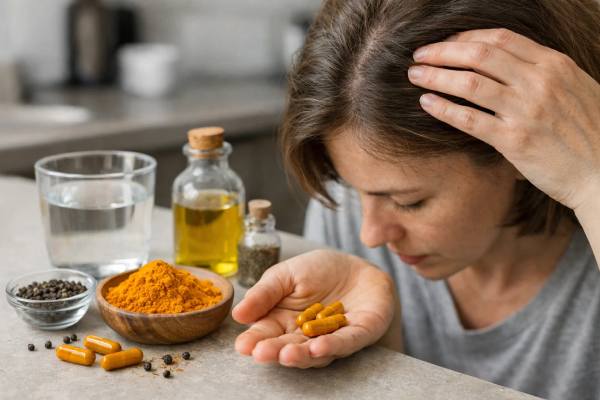
Scalp inflammation is rarely just “a little irritation.” When the scalp stays inflamed—whether from dandruff-like scaling, psoriasis, eczema, product reactions, or chronic follicle irritation—it can affect comfort, styling choices, and sometimes even shedding. Curcumin, the best-known active compound in turmeric, is widely studied for its anti-inflammatory and antioxidant effects in the body. That research has led many people to wonder if curcumin can help calm an inflamed scalp, reduce itch and redness, and support a healthier environment for hair.
The short answer is that curcumin is promising but not simple. Evidence is stronger in broader skin conditions than in scalp-specific trials, and results depend heavily on formulation because curcumin is naturally hard to absorb. Used thoughtfully, curcumin may be a reasonable adjunct for some people—especially when paired with an accurate diagnosis, a gentle scalp routine, and a clear plan to monitor benefit and safety.
Key Insights
- Curcumin may help reduce inflammatory signaling and oxidative stress, which can matter in several itchy, reactive scalp conditions.
- Benefits are more realistic for symptom control (itch, discomfort, redness) than for dramatic hair regrowth.
- Absorption is a major limitation; enhanced formulations and “with food” dosing often matter more than brand hype.
- Curcumin can interact with blood thinners and other medications, and piperine-containing products can amplify interaction risk.
- A structured 8–12 week trial with symptom tracking is a practical way to judge whether it is worth continuing.
Table of Contents
- Scalp inflammation and where curcumin fits
- How curcumin may calm inflammatory pathways
- What evidence suggests for scalp conditions
- Absorption and formulation tips that matter
- How to use curcumin in a scalp plan
- Interactions, side effects, and who should avoid
Scalp inflammation and where curcumin fits
“Scalp inflammation” is a broad umbrella. It can describe mild irritation from product buildup, but it can also signal an inflammatory skin condition that needs targeted treatment. Before adding any supplement, it helps to identify which pattern sounds most like you, because curcumin is more likely to be supportive for some problems than others.
Common inflammation patterns include:
- Seborrheic dermatitis (dandruff-like inflammation): greasy or powdery flakes, itch that worsens with stress or weather swings, and recurring scale around the hairline or crown.
- Scalp psoriasis: thicker plaques, well-defined scaling, soreness, and itch that may extend beyond the hairline.
- Eczema and irritant reactions: burning, stinging, or “tight” scalp after new products, dyes, fragrances, essential oils, or aggressive exfoliants.
- Follicle-centered inflammation: tender bumps, sensitivity around follicles, and flare-ups after occlusive oils, heavy styling products, or sweating under hats and wraps.
Curcumin generally makes the most sense as an adjunct—something you add alongside basic scalp care and, when needed, proven treatments like medicated shampoos or anti-inflammatory topicals. It is not a substitute for diagnosis when symptoms are intense or persistent.
When curcumin is a reasonable “maybe”
Curcumin may be worth considering if you have:
- Low-to-moderate itch and redness that cycles but never fully resolves
- Scalp discomfort that seems inflammatory (not simply dryness)
- Known inflammatory skin conditions where you are trying to reduce flare frequency
- A preference for a conservative, low-risk adjunct—while still staying open to medical care if symptoms continue
When you should not self-treat first
Supplements can delay care if the pattern is more serious. Seek evaluation sooner if you notice:
- Patchy hair loss, pustules, crusting, or severe pain
- Rapid worsening over weeks
- Bleeding, thick plaques, or widespread rash
- Symptoms that disrupt sleep or daily function
If your main symptom is itch and you are unsure what it signals, when an itchy scalp is more than a nuisance can help you recognize red flags worth addressing before you invest in supplements.
How curcumin may calm inflammatory pathways
Curcumin’s appeal is not that it “treats hair loss.” It is that it may influence several biological pathways that can keep the scalp inflamed: inflammatory signaling, oxidative stress, barrier disruption, and—depending on the context—microbial imbalance. That makes it conceptually relevant for scalp comfort and flare control, even if it is not a stand-alone solution.
Anti-inflammatory signaling
Inflamed scalp conditions often involve an overactive immune response in the skin. Curcumin has been studied for its ability to modulate inflammatory pathways that influence cytokines and enzymes associated with redness, swelling, and irritation. In practical terms, this is why people explore curcumin for conditions like psoriasis-like inflammation, eczema-like inflammation, and general irritation—where reducing inflammatory “noise” can reduce symptoms.
Antioxidant support
Inflammation and oxidative stress often travel together. Oxidative stress can worsen barrier function and amplify irritation, especially when the scalp is exposed to UV light, heat styling, scratching, and harsh surfactants. Curcumin’s antioxidant properties are part of what makes it interesting for skin health broadly. For scalp goals, the realistic target is not “new follicles,” but a calmer surface that is less reactive and more comfortable.
Barrier and sensitivity considerations
A reactive scalp often has a compromised barrier—meaning it loses water more easily and reacts more sharply to products. Curcumin is sometimes discussed as a barrier-supportive ingredient, but outcomes depend on formulation and tolerability. A key caution is that “natural” does not always mean gentle. Topical curcumin and turmeric-based DIY pastes can irritate some people, especially those with eczema-prone skin or fragrance allergies.
Scalp microbiome and irritation loops
In dandruff-like inflammation, the scalp microbiome can contribute to flaking and itch. Curcumin has shown antimicrobial activity in research settings, but translating that into safe, predictable scalp benefits is not straightforward. It is better to think of curcumin as a possible inflammation-modulator rather than a primary antifungal or antibacterial strategy.
If you want a clearer picture of why scalp inflammation can become self-perpetuating—itch, scratching, barrier disruption, and more irritation—how the scalp microbiome and barrier interact offers a useful foundation for choosing interventions that do not backfire.
What evidence suggests for scalp conditions
When you look for “curcumin for scalp inflammation” evidence, you quickly run into a common problem: many studies focus on skin conditions in general, not the scalp specifically. That does not make the research irrelevant, but it does mean you should translate the findings carefully and keep expectations realistic.
Where the evidence is most relevant
Curcumin has been studied most often in relation to inflammatory skin conditions that can involve the scalp, including:
- Psoriasis-like inflammation: Oral and topical curcumin approaches have been explored in psoriasis research, sometimes as an adjunct to standard care. In these contexts, curcumin is often discussed in terms of reducing inflammatory activity and improving symptom severity rather than acting as a primary therapy.
- Atopic dermatitis and eczema-like irritation: Some dermatology research examines curcumin’s potential to reduce itch and inflammatory markers in eczema-related patterns, though study quality and formulations vary.
- General dermatologic inflammation: Reviews frequently highlight curcumin’s anti-inflammatory and antioxidant potential across multiple skin disorders, while also emphasizing the need for better-designed trials.
What this means for the scalp
The scalp is a unique environment: dense follicles, higher oil output in many people, frequent product layering, and mechanical stress from combing and styling. These factors can change how well a topical ingredient is tolerated and how consistently it can be used. A topical curcumin product that looks promising on paper may be impractical if it stains, irritates, or clashes with your styling routine.
For oral curcumin, the challenge is different: scalp outcomes can be subtle and slow. You might notice changes in itch or tenderness before you see changes in scaling, and visible changes in density are not a reliable expectation unless inflammation was a major driver of shedding.
Strong limitations to keep in mind
A few limitations show up repeatedly in curcumin research:
- Formulations vary widely, and absorption changes results.
- Some studies use multi-ingredient products, so it is hard to credit curcumin alone.
- Scalp-specific outcomes are under-studied compared with facial or body skin outcomes.
- Natural symptom fluctuation (seasonality, stress, product changes) can mimic “improvement.”
A practical way to interpret the evidence
If you have a diagnosed scalp condition like psoriasis, use curcumin as a “supportive add-on” mindset: you are aiming for fewer flares, less itch, and a calmer scalp between flare-ups—not a replacement for medical treatment when symptoms are active.
If you suspect scalp psoriasis but are unsure, scalp psoriasis symptoms and treatment options can help you compare patterns and avoid chasing supplements when the core issue is a treatable inflammatory diagnosis.
Absorption and formulation tips that matter
Curcumin’s biggest practical limitation is absorption. Standard curcumin has low water solubility and is rapidly metabolized, which means that “taking more” does not always translate into higher active levels in the body. If you are using curcumin for inflammation-related goals, formulation and dosing strategy can matter as much as the ingredient itself.
Oral curcumin: what improves uptake
These approaches are commonly used to increase bioavailability:
- Take it with a meal that contains fat. Curcumin is fat-soluble, and food can improve tolerability and absorption.
- Choose an enhanced formulation (often labeled as phytosome, micellar, liposomal, or nanoparticle-based). These designs aim to improve solubility, stability, and absorption.
- Be cautious with piperine. Black pepper extract (piperine) can boost absorption by affecting metabolism and transport pathways. That can be helpful, but it can also raise the risk of interactions with medications (more on that later).
A practical label-reading tip: look for “curcuminoids” or “curcumin extract” with a clearly stated milligram amount, and note whether the product specifies an absorption technology rather than vague language like “maximum strength.”
Timing and consistency
There is no universally “best” time of day for curcumin. The best time is the one you will stick with consistently. For scalp inflammation goals, an 8–12 week consistent trial is usually more informative than skipping doses and hoping for a quick signal.
Topical use: what helps and what can backfire
Topical curcumin products for the scalp are less standardized than oral supplements. If you try a topical approach, consider these practical points:
- Avoid DIY turmeric pastes. They can be gritty, hard to rinse, staining, and surprisingly irritating—especially on compromised skin.
- Prefer leave-on products designed for scalp use (serums, lotions, or light oils) over heavy, occlusive mixtures that trap heat and sweat.
- Start with short contact time (for example, a wash-off mask once weekly) before committing to a leave-on, especially if you have a sensitive scalp.
- Expect staining risk on light hair, porous hair, towels, and pillowcases.
Absorption is not the only variable
If scalp inflammation is strongly driven by diet triggers, stress, or harsh hair practices, even a well-absorbed supplement may have limited impact without routine changes. If you want a grounded way to reduce inflammation pressure from the inside out, diet patterns that can worsen scalp inflammation can help you focus on changes that support any topical or supplement strategy you choose.
How to use curcumin in a scalp plan
A good curcumin plan is structured, measurable, and conservative. The goal is to learn whether curcumin helps your symptoms without creating new problems like irritation, interactions, or supplement overload.
Step 1: Decide what outcome you are tracking
Pick 2–3 outcomes you can observe reliably:
- Itch severity (0–10)
- Tenderness or burning (0–10)
- Flake burden (light / moderate / heavy)
- Frequency of flare days per week
- “Rescue” needs (how often you reach for medicated shampoo or anti-itch products)
Take baseline photos of the part line and hairline in consistent lighting if scaling is visible.
Step 2: Choose a dosing approach that matches real-world studies
Many human studies and clinical discussions use curcumin doses that fall roughly in the 500–2,000 mg per day range of curcumin or curcuminoids, depending on formulation. Enhanced-bioavailability forms may use lower labeled milligrams because absorption is improved.
A conservative, practical trial for many adults looks like:
- Start low (for example, a single daily dose with food).
- Increase gradually only if tolerated and only if your product’s dosing guidance supports it.
- Commit to 8–12 weeks before you judge results.
If you notice symptom improvement, continue for another 4–8 weeks and then reassess whether the benefit persists at the lowest effective dose.
Step 3: Pair it with scalp fundamentals
Curcumin is easier to evaluate when your routine is stable. During the trial:
- Keep washing frequency consistent and avoid introducing multiple new products.
- Reduce known irritants (strong fragrance, harsh exfoliants, high-alcohol tonics).
- Minimize heat and tight styles during active inflammation, because mechanical stress can keep symptoms going.
Step 4: If using topical curcumin, patch test first
Topical reactions can look like “worsening inflammation,” so patch testing matters. If you are not sure how to do this correctly, how to patch test scalp products safely provides a step-by-step method that helps you avoid weeks of avoidable irritation.
Step 5: Know when to pivot
If there is no meaningful symptom improvement after 12 weeks, or if symptoms worsen, it is reasonable to stop and pursue a diagnosis-driven plan instead of extending an expensive trial indefinitely.
Interactions, side effects, and who should avoid
Curcumin is often described as “natural,” but it can still cause side effects and interact with medications—especially at higher supplemental doses or when paired with absorption enhancers like piperine. If you treat curcumin like a real bioactive compound, you will make safer decisions.
Common side effects
Most side effects are digestive and dose-related:
- Nausea, reflux, or stomach upset
- Loose stools or abdominal cramping
- Headache (less common, but reported)
- Skin irritation with topical products, especially on compromised barrier skin
Taking curcumin with food, lowering the dose, or switching formulations can improve tolerability.
Medication interactions that deserve extra caution
Talk to a clinician or pharmacist before using curcumin supplements if you take:
- Anticoagulants or antiplatelet medications (for example, warfarin, DOACs, aspirin, clopidogrel), due to potential effects on bleeding risk
- NSAIDs on a regular basis, especially if you bruise easily or have GI bleeding history
- Diabetes medications if you are prone to low blood sugar
- Chemotherapy or immunosuppressive medications, where supplements can complicate monitoring and safety
Piperine-containing products can increase interaction risk because they may alter metabolism and transport of other compounds. If you are on multiple medications, it is usually safer to avoid piperine-enhanced formulas unless a clinician confirms it is appropriate.
Health situations where curcumin may not be a good idea
Use extra caution or avoid supplementation unless medically cleared if you:
- Are pregnant or breastfeeding
- Have gallbladder disease, bile duct obstruction, or recurrent gallbladder symptoms
- Have a planned surgery (many clinicians advise stopping certain supplements in advance)
- Have a history of kidney stones or are on a medically restricted diet plan where supplement choices matter
When scalp inflammation needs medical evaluation
Supplements can be a distraction if your scalp problem is driven by psoriasis, eczema, infection, or scarring inflammation. Get evaluated if you have severe pain, patchy hair loss, pustules, thick plaques, or persistent symptoms despite basic care. If you want a clear threshold for escalation, when to see a dermatologist for hair and scalp changes can help you act sooner rather than later.
Curcumin can be a reasonable adjunct for some people, but the safest way to use it is with a defined trial period, careful attention to interactions, and a willingness to pivot to diagnosis-based care when the scalp is signaling something more than mild irritation.
References
- Advancements in Dermatological Applications of Curcumin: Clinical Efficacy and Mechanistic Insights in the Management of Skin Disorders 2024 (Review)
- Potential of Curcumin in the Management of Skin Diseases 2024 (Review)
- Efficacy and safety of curcumin in psoriasis: preclinical and clinical evidence and possible mechanisms 2022 (Systematic Review)
- Enhancing the Bioavailability and Bioactivity of Curcumin for Disease Prevention and Treatment 2024 (Review)
- Regulatory Effects of Curcumin on Platelets: An Update and Future Directions 2022 (Review)
Disclaimer
This article is for educational purposes only and does not provide medical advice, diagnosis, or treatment. Curcumin supplements and topical products can affect the body and may not be appropriate for everyone, especially people who are pregnant or breastfeeding, have gallbladder disease, have bleeding disorders, are preparing for surgery, or take prescription medications such as anticoagulants, antiplatelet drugs, diabetes medications, chemotherapy, or immunosuppressants. Scalp inflammation can have many causes, some of which require targeted medical treatment. Seek professional care for severe pain, rapidly worsening symptoms, patchy hair loss, pustules, thick plaques, or persistent inflammation that does not improve with basic scalp care. Always consult a qualified clinician or pharmacist before starting or changing supplements if you have medical conditions, take medications, or are undergoing evaluation for hair or scalp symptoms.
If you found this guide helpful, consider sharing it on Facebook, X (formerly Twitter), or another platform you use so others can make safer, more informed decisions about scalp inflammation and supplements.