Cradle cap can look dramatic—thick yellow scales, crusty patches, and a scalp that seems suddenly “different”—yet in most babies it is harmless and temporary. It is the scalp form of infantile seborrheic dermatitis, a very common skin pattern in the first months of life. The good news is that cradle cap is usually not painful or itchy, it is not contagious, and it does not mean a baby is unclean or being bathed incorrectly. Many cases fade on their own within weeks to months, and gentle home care can speed the process without irritating delicate skin. The key is knowing what cradle cap typically looks like, how to remove scale safely, and which signs suggest a different rash or an infection that needs medical attention. This guide offers a clear, parent-friendly plan—from softening and lifting scale to choosing products carefully—so you can treat the scalp calmly and know exactly when to ask your pediatrician for help.
Quick Facts
- Most cradle cap improves with gentle scalp softening, mild shampooing, and careful brushing over 1–3 weeks.
- It is usually not itchy or painful and does not spread from baby to baby.
- Picking at crusts can cause bleeding and infection, so removal should be gradual and gentle.
- If you use oil or an emollient, loosen scale first, then wash it out with baby shampoo rather than leaving residue for days.
Table of Contents
- What cradle cap is and why it happens
- How to tell it from other rashes
- Gentle home treatment step by step
- When medicine is needed
- Common parent questions and myths
- When to see a doctor
What cradle cap is and why it happens
Cradle cap is a scaly, greasy-looking buildup on a baby’s scalp. The scale can be pale yellow, white, or brownish depending on skin tone and lighting. It often appears in the first weeks of life—commonly between about 3 weeks and 2 months—and many babies have their “peak” cradle cap around 2–4 months. Some infants also develop similar scale on eyebrows, behind the ears, in neck folds, or in the diaper area. When cradle cap shows up beyond the scalp, it is still considered part of the same infantile seborrheic dermatitis pattern.
What you are seeing on the scalp
Cradle cap forms when dead skin cells and oil (sebum) cling together instead of shedding invisibly. The scalp has many oil glands, and in early infancy those glands can be surprisingly active. The result is scale that looks “stuck on,” sometimes in thick plates, sometimes as scattered flakes. The skin underneath may look normal, slightly pink, or mildly red after a bath or brushing, but it is not usually intensely inflamed.
Why it happens
No single cause explains every case, but several factors likely contribute:
- Temporary influence of maternal hormones on a baby’s oil glands
- An immature skin barrier that sheds differently than older skin
- A normal skin yeast (often discussed in seborrheic dermatitis) interacting with skin oils in a way that promotes scale
- Individual sensitivity: some babies simply form more adherent scale than others
Cradle cap is not an infection, not a sign of poor hygiene, and not typically an allergic reaction. It also does not imply anything is “wrong” with the immune system in an otherwise thriving baby.
How long it lasts
Many cases resolve on their own within weeks to a few months. Most clear by 12 months, though mild flaky buildup can linger in some toddlers. The overall trend is toward improvement, especially once oil gland activity settles.
How to tell it from other rashes
Parents often worry that cradle cap is eczema, a fungal infection, or an allergy. Most of the time, cradle cap has a recognizable pattern: thick, greasy scale with minimal discomfort. Still, it is worth learning the “look-alikes,” because the treatment priorities can change.
Cradle cap versus atopic eczema
Eczema (atopic dermatitis) usually looks and behaves differently. It tends to be drier, redder, and itchier. Babies with eczema often rub their scalp or face, seem uncomfortable, and may have dry patches on cheeks, trunk, or arms and legs. Cradle cap, by contrast, is usually not very itchy and often looks oily rather than dry. If your baby has widespread itch, scratch marks, or recurring oozing patches, it may help to review typical eczema patterns and triggers in scalp eczema symptoms and relief strategies so you can discuss them clearly with your clinician.
Cradle cap versus infection
Infection is less common, but important to recognize. Call your clinician if you see:
- Honey-colored crusts that appear suddenly and spread (possible bacterial infection)
- Pus bumps, swelling, warmth, or rapidly increasing redness
- Foul odor plus weeping fluid
- Fever or a baby who seems unwell
Cradle cap scale can smell a bit “oily,” especially if emollients are used, but it should not smell sour or infected.
Cradle cap versus ringworm and other scalp conditions
True fungal infection of the scalp (tinea capitis) is less common in very young infants but can occur. Signs that raise suspicion include broken hairs, circular patches with scaling, tender scalp, and sometimes swollen lymph nodes in the neck. Psoriasis can also affect the scalp, but in infants it is less common and often shows more sharply bordered red plaques.
A practical self-check
Cradle cap is most likely when the scale is greasy and yellowish, the baby seems comfortable, and the rash is mainly on the scalp and other “oily” areas (eyebrows, behind ears, neck folds). When the skin is intensely red, very itchy, oozing, or spreading quickly, a clinician should confirm the diagnosis before you escalate treatment.
Gentle home treatment step by step
Home care for cradle cap is intentionally simple: soften the scale, lift it gently, and keep the scalp clean without stripping it. Many parents get into trouble by trying to remove everything in one session. The safest approach is gradual improvement over days to weeks.
Step 1: Soften the scale
If the scale is thick or tightly adherent, start by softening it:
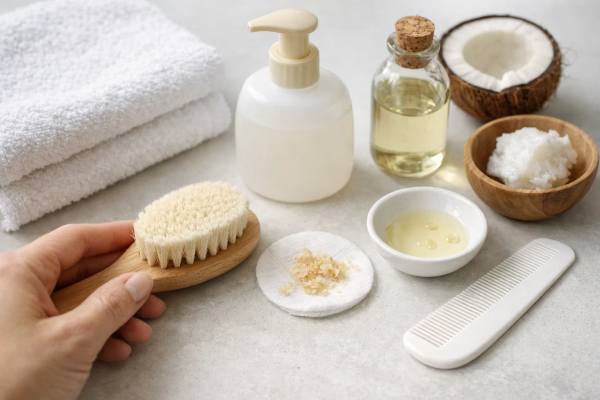
- Apply a small amount of mineral oil, petroleum jelly, or coconut oil to the scalp.
- Leave it for 15–60 minutes before bathing, or overnight if the scale is very stubborn and your baby tolerates it well.
- Use only a thin layer; heavy coating makes washing harder and can leave residue.
Avoid aggressive “scraping.” The goal is loosening, not peeling.
Step 2: Lift with gentle brushing
During bath time or after softening:
- Use a soft baby brush or fine-tooth baby comb.
- Brush in small circles or short strokes with light pressure.
- Stop if the scalp reddens significantly, bleeds, or your baby becomes upset.
Do not pick crusts with fingernails. Picking creates tiny wounds that can become infected.
Step 3: Wash it out with mild shampoo
Follow with a mild baby shampoo to remove oil and loosened scale:
- Wash every other day for many babies during the “treating” phase.
- Massage the scalp with fingertips, then rinse thoroughly.
- Conditioners are usually unnecessary for baby hair, but you can protect very dry hair by keeping shampoo mostly on the scalp.
Some parents worry that frequent washing causes hair loss. In cradle cap, hairs can come away with the scale, but that is not the same as damaging follicles. If this fear is keeping you from washing consistently, what washing does and does not do to hair loss can help you feel more confident about routine scalp care.
How fast should you expect results?
Many babies look better within 7–14 days of consistent gentle care. Thick plaques can take longer. If cradle cap is mild and your baby is comfortable, it is also reasonable to do minimal care and let it resolve naturally.
When medicine is needed
Most cradle cap improves with home care alone. Medication is usually considered when scale is severe, spreading beyond the scalp, causing significant redness, or not improving after a few weeks of consistent gentle treatment. In these situations, the goal is to calm inflammation and reduce the “stickiness” of scale without irritating a baby’s skin barrier.
Medicated shampoos and why guidance matters
Some anti-dandruff ingredients used in adults can be too harsh for infants if used incorrectly. If a clinician recommends a medicated shampoo, it is usually for limited, careful use with clear instructions about frequency and contact time. Common medical approaches may include:
- An antifungal ingredient used briefly to reduce seborrheic dermatitis activity
- A low-potency anti-inflammatory cream for very inflamed areas
- An emollient-based plan for skin folds and diaper area involvement
Because infants have more delicate skin and a higher surface-area-to-body-weight ratio, “stronger” does not mean “better.” More product, longer contact, or more frequent use can backfire by causing irritation.
Low-potency steroid and antifungal creams
When cradle cap spreads to the face, eyebrows, or skin folds, clinicians sometimes use short courses of mild topical treatments. A low-strength steroid may reduce redness quickly, and an antifungal cream can help when seborrheic dermatitis is prominent off the scalp. These are typically used sparingly and for limited durations. If you are given a prescription, follow the exact plan rather than improvising.
Ingredients and practices to avoid without medical advice
For babies, avoid experimenting with aggressive keratolytics or strong medicated options unless a clinician directs you. Also avoid essential oils and heavily fragranced “natural” blends on an infant’s scalp. Irritation can mimic worsening cradle cap and can create new problems—redness, burning, and more scaling—that are harder to interpret. If your baby’s scalp becomes reactive to products, how product irritation can injure skin may help you recognize early warning signs and simplify your approach.
What a careful escalation looks like
A reasonable “step up” plan often follows this sequence: optimize gentle home care first, then add a clinician-directed medicated product if needed, then reassess within 1–2 weeks. If the scalp is clearly improving, you taper to maintenance rather than continuing medicated products indefinitely.
Common parent questions and myths
Cradle cap is common, but it still triggers a lot of worry—partly because it looks stubborn and partly because advice online is inconsistent. Clearing up a few myths can make treatment simpler and safer.
Is cradle cap contagious?
No. Cradle cap cannot be “caught” from other babies and does not spread through contact. It is a skin pattern related to oil glands and skin shedding, not an infection passed between children.
Does cradle cap hurt or itch?
Most babies are not bothered by cradle cap. If your baby seems very itchy, is rubbing constantly, or has scratch marks, consider a different diagnosis (eczema, irritation, or infection) and ask your clinician to confirm.
Why does hair come out with the scales?
Hairs can get trapped in scale and come away when the scale loosens. This can be alarming, but it is usually temporary. The follicles are not being destroyed. Hair almost always regrows normally once the scalp settles. If you want a clearer way to talk about what you’re seeing, the difference between breakage and true hair loss offers language that can help you describe the issue accurately.
Should you use olive oil?
Many families have used olive oil traditionally, but some clinicians prefer mineral oil, petroleum jelly, or coconut oil because olive oil can be irritating for some babies and is not always well tolerated. The most important principle is to use a small amount, soften the scale, and then wash it out rather than leaving a heavy residue.
Should you shave the baby’s head?
Shaving is unnecessary and can irritate skin. Gentle brushing and shampooing work well without disrupting the scalp barrier. A short haircut is sometimes helpful for very thick hair because it makes scalp access easier, but it is rarely required.
Will it keep coming back?
Cradle cap can recur, especially if your baby has naturally oily skin or seborrheic dermatitis extends to skin folds. Maintenance usually means mild shampooing on a regular schedule and occasional softening if small patches reappear.
When to see a doctor
Most cradle cap can be handled at home. The role of a clinician is to confirm the diagnosis, rule out infection or eczema when the picture is unclear, and prescribe safe short-term treatments when home care is not enough. Parents often wait too long because cradle cap seems “cosmetic,” but certain changes deserve earlier attention.
Call your pediatrician for non-urgent evaluation if
- Cradle cap is not improving after a few weeks of consistent gentle care
- The rash is spreading widely beyond the scalp (especially to the body)
- Your baby seems uncomfortable, is scratching a lot, or sleep is disrupted
- The skin looks persistently very red, raw, or inflamed
- You are unsure whether it is cradle cap or eczema
Seek prompt medical care if you see signs of infection
These include swelling, warmth, tenderness, oozing fluid, bleeding that continues, pus bumps, or a rapidly spreading red area. Also seek care if your baby has fever, seems lethargic, feeds poorly, or you notice a strong unpleasant odor from the scalp or skin folds.
What the clinician may recommend
Depending on severity and location, a clinician might suggest:
- A short course of a mild anti-inflammatory cream for very red areas
- A brief antifungal regimen for more extensive seborrheic dermatitis
- Guidance on bathing frequency and emollient use in folds and diaper area
- Evaluation for other rashes if itching is prominent (common with eczema)
If you are unsure whether symptoms “count” as concerning, when scalp symptoms signal a medical issue can help you recognize patterns that justify an earlier visit—even though infants have their own unique considerations.
Reassurance that still matters
In otherwise healthy infants, cradle cap is typically a cosmetic issue with a favorable course. A doctor visit is not a sign that you have failed at home care; it is simply the safest way to confirm that the rash is truly cradle cap and to choose the mildest effective treatment when the scalp is stubborn.
References
- Interventions for infantile seborrhoeic dermatitis (including cradle cap) – PMC 2019 (Systematic Review)
- Cradle Cap – StatPearls – NCBI Bookshelf 2023 (Review)
- Pediatric Dermatitis Seborrhoica – A Clinical and Therapeutic Review – PMC 2024 (Review)
- What is Cradle Cap? – HealthyChildren.org 2023 (Clinical Guidance)
- Cradle cap – NHS 2025 (Clinical Guidance)
Disclaimer
This article is for educational purposes only and does not replace personalized medical advice. Babies can develop scalp scaling from several different conditions, including eczema, infection, and less common inflammatory disorders, which may look similar but require different treatment. Do not use adult-strength medicated shampoos, essential oils, or strong exfoliating ingredients on an infant unless a qualified clinician advises it. Seek medical care promptly if your baby has fever, appears unwell, has spreading redness, swelling, pus, persistent bleeding, or oozing fluid from the scalp or skin folds.
If you found this guide helpful, consider sharing it on Facebook, X (formerly Twitter), or your preferred platform so more parents can recognize cradle cap early and manage it gently and safely.