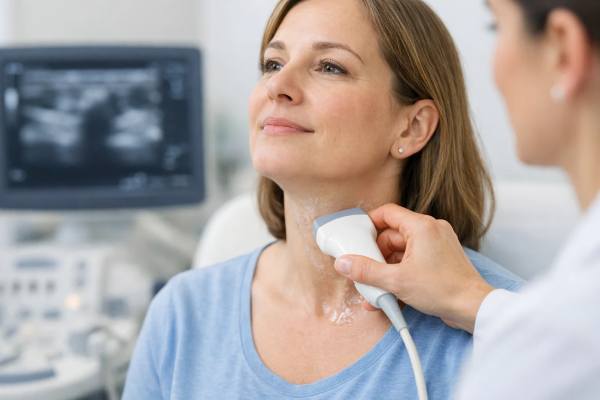
A thyroid ultrasound report can feel oddly technical for something so common. One sentence may say “mixed cystic and solid nodule,” another may mention “hypoechoic echotexture,” and then a final line may recommend follow-up, biopsy, or no action at all. For many people, the hardest part is not the scan itself. It is trying to understand what the words mean and whether any of them should be alarming.
The good news is that most thyroid ultrasound findings are not dangerous. Thyroid nodules are common, especially with age, and many cysts, small nodules, and incidental findings turn out to be low risk. The purpose of the ultrasound is not to label every lump as good or bad on sight. It is to describe what was seen in a structured way, estimate whether a nodule looks concerning, and help decide whether you need monitoring, a needle biopsy, or nothing more than reassurance.
Quick Facts
- Most thyroid nodules and simple cysts are benign and never become a serious problem.
- Ultrasound is very good at sorting low-risk from higher-risk patterns, but it cannot confirm cancer by itself.
- Words such as irregular margins, punctate echogenic foci, and taller-than-wide usually matter more than size alone.
- A TI-RADS score helps guide follow-up and biopsy decisions, but the score is interpreted together with nodule size and personal risk factors.
- The most useful next step is to read the impression line first, then compare it with the nodule features and any recommended follow-up interval.
Table of Contents
- What ultrasound can tell you
- Nodules cysts and mixed lesions
- Common report terms decoded
- How TI-RADS guides decisions
- Features that raise concern
- Follow-up and next steps
What ultrasound can tell you
A thyroid ultrasound is a structural test. It shows the shape, size, and texture of the thyroid gland and any nodules inside it. It can reveal whether a lump is solid, fluid-filled, mixed, smooth, irregular, calcified, or growing into nearby tissue. It can also examine nearby lymph nodes in the neck. What it cannot do is measure thyroid hormone levels or diagnose the cause of every abnormality with certainty. That is why ultrasound results are often paired with blood tests and, in selected cases, a fine-needle aspiration biopsy.
A useful way to read a report is to think in layers. First, the report describes the thyroid gland itself. It may say the gland is enlarged, normal in size, diffusely heterogeneous, hypervascular, or nodular. These background findings can suggest inflammation or chronic thyroid disease, but they do not automatically explain symptoms or tell you how the gland is functioning. A structurally abnormal gland can still have normal hormone levels, and a normal-looking gland can still have abnormal labs.
Second, the report describes individual nodules. Each nodule is usually measured in three dimensions and assigned a location, such as right lobe, left lobe, upper pole, lower pole, or isthmus. Those details matter because future scans compare the same nodule over time. Growth, stability, and changes in appearance can affect management.
Third, the report gives an interpretation. This is often the most important part. The impression may state that a nodule appears benign, likely colloid, predominantly cystic, moderately suspicious, or suitable for biopsy based on size and appearance. If the scan uses a formal system such as TI-RADS, you may also see a category number.
Ultrasound is excellent at risk sorting, not certainty. It helps identify patterns that are reassuring and patterns that deserve more attention. For example, a purely simple cyst often behaves very differently from a solid hypoechoic nodule with irregular margins. Both may be called “nodules” in casual conversation, but they do not carry the same meaning.
This is also why many scans lead to surveillance rather than immediate biopsy. Finding something in the thyroid is common. Finding something dangerous is far less common. The goal is to avoid both underreaction and overreaction.
If your report also mentions thyroid enlargement, pressure in the neck, or visible fullness, that overlaps with the broader picture of goiter symptoms and treatment options, which can exist with or without a worrisome nodule.
Nodules cysts and mixed lesions
One of the most confusing parts of a thyroid ultrasound report is the vocabulary around lumps. “Nodule” is the broad umbrella term. It simply means a distinct lesion in the thyroid that looks different from the surrounding tissue. A cyst is a fluid-filled lesion. A mixed lesion contains both fluid and solid material. These categories matter because they do not all behave the same way.
A simple cyst is usually one of the least concerning findings on a thyroid scan. It is filled with fluid, often appears dark on ultrasound, and may have smooth thin walls. Some simple cysts need no treatment at all. Others may cause pressure, discomfort, swallowing awareness, or a visible lump if they become large. In that case, management may focus on symptoms rather than cancer risk.
A solid nodule is exactly what it sounds like: tissue rather than fluid. Solid nodules are common and often benign, but this is the group where the report pays closest attention to other ultrasound features. A solid nodule can be reassuring or suspicious depending on echogenicity, margins, shape, calcifications, and nearby lymph nodes.
A mixed cystic and solid nodule sits in between. Many of these are benign degenerating nodules or colloid nodules, especially when the fluid component is prominent and the internal pattern is spongiform or accompanied by benign-leaning artifacts. But mixed composition alone does not settle the question. The solid portion is what often receives the most scrutiny.
You may also see terms such as:
- Spongiform: made up of many tiny cystic spaces. This is usually a low-risk appearance.
- Colloid nodule: a benign thyroid nodule that may contain colloid material and sometimes shows comet-tail artifact.
- Hemorrhagic cyst: a cyst that has bled internally, which can make the appearance more complex and sometimes suddenly painful.
- Degenerating nodule: an older nodule that is changing internally, often with cystic breakdown or irregular-looking debris that can mimic a more concerning lesion.
This is why a word like “complex” can sound scarier than it is. In ultrasound language, complex may simply mean the lesion is not purely fluid and not purely solid. It does not automatically mean cancer. The question is what the complex features actually are.
Size also needs context. A large cyst can be bothersome but still low risk. A smaller solid nodule with suspicious features may matter more than a larger bland-looking lesion. That is why modern reporting systems combine size with appearance instead of relying on diameter alone.
For patients, the most practical question is not “Do I have a nodule?” but “What kind of nodule is it, and what pattern does it show?” That is where the report becomes useful instead of just intimidating.
Common report terms decoded
Most thyroid ultrasound reports use repeated descriptive terms. Once you know a few of them, the whole report becomes easier to read.
Echogenicity describes how bright or dark the nodule looks compared with surrounding thyroid tissue.
- Anechoic means black on ultrasound, usually because the lesion is fluid-filled.
- Hyperechoic means brighter than surrounding tissue.
- Isoechoic means about the same brightness as surrounding tissue.
- Hypoechoic means darker than surrounding tissue.
- Markedly hypoechoic means very dark and is generally more concerning than mild hypoechogenicity.
Composition refers to what the nodule is made of.
- Cystic means fluid-filled.
- Solid means tissue-filled.
- Predominantly solid means mostly tissue with some fluid.
- Mixed cystic and solid means a combination of both.
Margins describe the borders of the nodule.
- Smooth margins are usually more reassuring.
- Ill-defined means the edges are not sharply seen, which is not always a danger sign.
- Lobulated or irregular margins are more concerning than smooth borders.
- Extrathyroidal extension means the lesion appears to extend beyond the thyroid, which is a more serious feature.
Shape matters too.
- Wider-than-tall is generally less suspicious.
- Taller-than-wide means the nodule is higher than it is wide on the scan plane, which raises concern because it suggests growth across normal tissue planes.
Calcifications can be tricky because not all bright spots are equal.
- Punctate echogenic foci are tiny bright dots that may correspond to microcalcifications and can raise suspicion.
- Macrocalcifications are larger calcium deposits and may make interpretation harder.
- Peripheral or rim calcifications outline the edge of the lesion. Their meaning depends on the overall pattern.
- Comet-tail artifact is often linked to benign colloid and can be reassuring in the right setting.
You may also see terms about the gland rather than a single nodule:
- Heterogeneous echotexture means the thyroid tissue looks uneven.
- Hypervascularity means increased blood flow.
- Diffuse enlargement means the gland is bigger overall.
These background terms can suggest inflammation or chronic autoimmune thyroid disease, but they are not a direct cancer label.
Another common source of confusion is the word vascularity inside a nodule. In the past, people often focused on whether a nodule had internal blood flow. Today, vascularity alone is usually not one of the strongest deciding features. It can add context, but it rarely settles the question by itself.
When reading your report, pay most attention to pattern language, not isolated adjectives. “Solid, hypoechoic, taller-than-wide, with irregular margins” means something very different from “mixed cystic and solid, spongiform, smooth margins.” The meaning comes from the combination.
How TI-RADS guides decisions
If your report includes TI-RADS, the scan is being translated into a structured risk system. That is useful because it helps reduce vague reporting and gives clinicians a more consistent way to decide whether a nodule should be watched, biopsied, or ignored.
The most commonly seen version is ACR TI-RADS. It scores a nodule based on five groups of ultrasound features: composition, echogenicity, shape, margins, and echogenic foci. The points are added, and the nodule is placed into a category:
- TR1: benign
- TR2: not suspicious
- TR3: mildly suspicious
- TR4: moderately suspicious
- TR5: highly suspicious
This does not mean a TR5 nodule is definitely cancer or a TR2 nodule can never matter. It means the ultrasound appearance falls into a higher- or lower-risk pattern. Management then depends on both the category and the nodule’s size.
That size rule is where many patients get confused. A report may describe a nodule as suspicious but still not recommend biopsy. That is not necessarily a contradiction. A small nodule with concerning features may still be watched if it is below the biopsy threshold, especially when there are no worrisome lymph nodes or high-risk clinical factors. Conversely, a larger lower-risk nodule may be followed because its size alone makes it worth monitoring, even if its appearance is not very suspicious.
In the ACR system, the higher the TI-RADS category, the lower the size threshold for biopsy or follow-up. The practical message is simple: ultrasound appearance matters, but appearance is filtered through size. That approach helps limit unnecessary needle biopsies on very small nodules that are unlikely to change management.
You may also encounter other systems, such as EU-TIRADS or local reporting methods used by a specific radiology practice. The categories and thresholds are not identical across systems, which is why two reports from different centers may not use exactly the same wording. That can be unsettling, but it does not always reflect disagreement about your actual risk. Often it is just a different reporting framework.
TI-RADS also is not the whole story. Personal history still matters. A clinician may recommend biopsy, referral, or shorter follow-up even for a relatively small nodule if there is a history of childhood neck radiation, a strong family history of thyroid cancer, compressive symptoms, or suspicious lymph nodes. The reverse is also true: a bland-appearing nodule may simply be observed.
The best way to use TI-RADS is as a guide, not a verdict. Read it as a standardized summary of ultrasound risk, then match it with the recommendation line. That is where the practical meaning shows up.
Features that raise concern
Most thyroid nodules are benign, but some ultrasound features increase concern enough that closer follow-up or biopsy becomes reasonable. It helps to know which details usually matter most.
The classic higher-risk pattern includes a nodule that is solid or predominantly solid, hypoechoic, taller-than-wide, has irregular or lobulated margins, and contains punctate echogenic foci. No single feature is perfect. What matters is the combination. A nodule with several suspicious features carries more concern than a nodule with only one mild red flag.
Among the commonly discussed features, the ones that tend to change management the most are:
- Marked hypoechogenicity
- Irregular or infiltrative margins
- Taller-than-wide shape
- Punctate echogenic foci suggestive of microcalcifications
- Evidence of spread beyond the thyroid
- Suspicious cervical lymph nodes
Suspicious lymph nodes deserve special attention because they can shift the whole picture. A very small thyroid nodule may not normally meet biopsy criteria, but if the ultrasound also shows abnormal neck lymph nodes, the workup becomes more urgent. Features that make a lymph node more concerning include loss of the normal fatty hilum, abnormal round shape, cystic change, calcifications, or unusual vascularity.
At the same time, it is important not to overread scary-sounding words. “Hypoechoic” alone does not equal cancer. “Calcification” alone does not equal cancer. Even “solid” does not equal cancer. Ultrasound identifies patterns of probability, not certainty. That is why biopsy remains the next step only when the overall pattern and size justify it.
Symptoms also matter, though not in a simple way. Many thyroid cancers cause no symptoms at all. Meanwhile, many benign nodules do cause symptoms, especially when they are large. Hoarseness, swallowing difficulty, choking sensation, neck pressure, rapidly increasing size, or a hard fixed neck mass deserve medical attention, but they are not a direct shortcut to diagnosis. They are clues that help the ultrasound findings make more sense.
This is also a good place to separate ultrasound concern from hormone concern. A suspicious-looking nodule may exist in someone with normal thyroid function. A person with hypothyroidism, thyroid antibodies, or thyroiditis may have an abnormal gland background but a benign nodule pattern. Structure and function overlap, but they are not interchangeable.
If your report sounds worrisome or your symptoms do not match a “routine follow-up” plan, that is a reasonable time to review the findings with a clinician who is used to thyroid imaging. Understanding when specialist input is appropriate can prevent both delay and unnecessary panic.
Follow-up and next steps
After reading a thyroid ultrasound report, most people want a simple answer: Do I need a biopsy, another scan, or nothing at all? The answer usually sits in the impression section, but it makes more sense when you know the logic behind it.
A common next step is no immediate action. That is typical for simple cysts, spongiform nodules, very low-risk nodules, and tiny incidental findings that do not meet follow-up criteria. This can feel unsatisfying, especially if the report used unfamiliar language, but it is often the most evidence-based choice.
Another common next step is repeat ultrasound. Follow-up intervals vary based on the system used, the nodule category, size, and your clinical history. A scan may be repeated in about a year, or sooner or later depending on the context. Stable nodules often require less frequent monitoring over time. Growth can matter, but growth alone is not always a sign of cancer. Some benign nodules enlarge, and some cancers change little for long periods. What matters is whether the nodule is growing in a meaningful way and whether its internal features are changing.
The third main path is fine-needle aspiration biopsy. This is usually recommended when a nodule reaches a size threshold and has a pattern that makes tissue sampling worthwhile. A biopsy does not remove the nodule. It takes cells for cytology, which helps sort benign findings from indeterminate or malignant ones. Many biopsies come back benign.
Before your follow-up visit, it helps to ask four practical questions:
- What is the exact nodule category or risk pattern?
- Does the recommendation come from size, appearance, or both?
- Are there any suspicious lymph nodes or compressive symptoms?
- What interval is planned for follow-up, and what change would alter that plan?
It is also useful to know when the rest of the thyroid picture needs attention. If the ultrasound mentions diffuse heterogeneity, increased vascularity, or enlargement, your clinician may pair the imaging with labs and symptoms. People often need the broader context of neck fullness, thyroid blood work, or suspected endocrine disease rather than nodule management alone.
A calm, structured review almost always beats internet guessing. Read the impression. Match it to the ultrasound features. Clarify whether your report uses ACR TI-RADS, EU-TIRADS, or another system. Then focus on the actual plan rather than the scariest word in the document.
Most thyroid ultrasound reports are less ominous than they sound. Their real value is not in technical language. It is in helping the next decision become clearer.
References
- 2023 European Thyroid Association Clinical Practice Guidelines for thyroid nodule management 2023 (Guideline)
- International Expert Consensus on US Lexicon for Thyroid Nodules 2023 (Consensus Statement)
- Integrated Diagnostics of Thyroid Nodules 2024 (Review)
- Thyroid Nodule Characterization: Overview and State of the Art of Diagnosis with Recent Developments, from Imaging to Molecular Diagnosis and Artificial Intelligence 2024 (Review)
- ACR Thyroid Imaging, Reporting and Data System (TI-RADS): White Paper of the ACR TI-RADS Committee 2017 (Consensus Statement)
Disclaimer
This article is for education only and does not replace personal medical care. A thyroid ultrasound report should be interpreted together with your symptoms, exam, blood tests, and medical history. Seek prompt medical evaluation if you have a rapidly enlarging neck lump, new hoarseness, trouble swallowing, shortness of breath, or a report that mentions suspicious lymph nodes or spread beyond the thyroid.
If this article helped you understand your report, please share it on Facebook, X, or any platform where clear and reliable health information can help someone else.