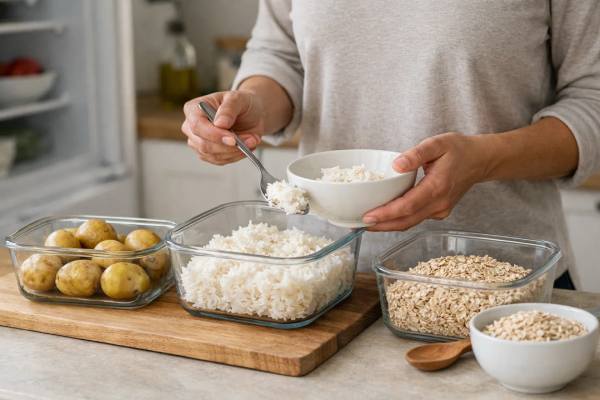
A bowl of cooled rice, last night’s potatoes, or a jar of overnight oats may not look like metabolic tools, yet the way starch is cooked, cooled, and eaten can change how the body handles it. When certain starchy foods cool after cooking, part of the starch becomes more resistant to digestion. That means less of it is rapidly broken down in the small intestine, which can soften the post-meal rise in glucose and insulin in some people.
This does not turn potatoes or rice into low-carb foods, and it does not guarantee dramatic changes in insulin sensitivity on its own. Still, it is one of the more practical food-prep strategies for people trying to improve blood sugar control without giving up starch completely.
The most useful question is not whether resistant starch is a miracle, but how to use it realistically. Some foods respond better than others, some people notice more benefit than others, and meal composition still matters. The details are where this strategy becomes genuinely helpful.
Quick Facts
- Resistant starch can lower post-meal glucose and insulin responses, especially when it replaces part of rapidly digestible starch.
- Cooked and cooled potatoes and rice often show a clearer resistant starch effect than oats.
- Long-term insulin sensitivity may improve modestly in some people, but the effect is not uniform and usually works best as part of a broader eating pattern.
- Rapidly increasing resistant starch can cause bloating, gas, or abdominal discomfort in sensitive people.
- A practical starting point is a half-cup to one-cup serving of cooked and chilled starch in a mixed meal, then adjusting based on tolerance and glucose response.
Table of Contents
- Why resistant starch matters
- What cook and cool actually does
- Potatoes, rice, and oats compared
- How to use it in real meals
- Who should be cautious
- What results to expect
Why resistant starch matters
Resistant starch is the fraction of starch that escapes digestion in the small intestine and reaches the colon more intact. There, gut microbes ferment it and produce short-chain fatty acids, including butyrate, acetate, and propionate. That process is one reason resistant starch is often discussed alongside insulin sensitivity, appetite regulation, gut health, and inflammation. It behaves differently from rapidly digested starch, which tends to move quickly into glucose and can drive a steeper post-meal rise in blood sugar and insulin.
For people focused on insulin sensitivity, this matters in two different ways. The first is acute and easier to notice: a meal made with more resistant starch may lead to a gentler glucose response after eating. The second is longer term and less dramatic: repeated use of resistant starch in place of more rapidly digested starch may modestly improve insulin-related markers in some adults, particularly those with overweight, prediabetes, metabolic syndrome, or type 2 diabetes. That does not mean every study shows the same benefit, and it does not mean the effect is large enough to replace medication or other lifestyle measures. But the direction of evidence is promising enough to make food preparation worth attention.
It is also important to separate resistant starch from total fiber. Some foods are high in both, but they are not identical. Resistant starch is a specific form of carbohydrate resistance to digestion. A food can be helpful for glucose control because of resistant starch, soluble fiber, intact grain structure, slower gastric emptying, or all of these at once. That is one reason real foods do not behave exactly like purified starch supplements.
Another practical point is that resistant starch is usually most helpful when it replaces part of the quickly digested starch load, not when it is simply added to an already high-carbohydrate meal. A giant plate of cooled rice may still spike someone more than a moderate portion of cooled rice eaten with protein, vegetables, and fat. The food matrix still matters.
This is where the concept becomes more useful than the trend. Resistant starch is not about turning every starch into a free food. It is about changing digestibility enough to improve metabolic handling. For someone working on early insulin resistance patterns and glucose stability, that can be a meaningful shift, especially when it is repeated consistently rather than treated as a one-off trick.
The most realistic promise of resistant starch is modest leverage. It can flatten the curve, reduce how hard the body has to work after some meals, and fit into normal eating patterns. That is more practical than perfection, and often more sustainable.
What cook and cool actually does
When starch-rich foods are cooked in water, their starch granules swell and gelatinize. In simple terms, heat and moisture make the starch easier for digestive enzymes to reach. That is one reason hot, freshly cooked rice or potatoes often raise blood glucose more quickly than the same foods in a less processed form. Cooling changes part of that story.
As cooked starch cools, some of the amylose and amylopectin chains realign into a tighter structure. This process is called retrogradation. Once retrograded, part of the starch becomes harder to digest in the small intestine. That portion is often referred to as resistant starch type 3. It is the form most relevant to the cook-and-cool method.
This does not happen equally in every food, and it does not happen to the whole serving. Cooling does not transform a potato into a bean or make white rice behave like lentils. It changes a fraction of the starch. That fraction may still be large enough to affect glucose response, especially if the original food is eaten in a moderate portion and in a mixed meal.
Several factors influence how much resistant starch forms:
- the type of starch in the food
- how long it is cooked
- how much water is used
- how long it is chilled
- the storage temperature
- whether it is reheated, and how aggressively
In practical kitchen terms, the pattern is usually straightforward. Cook the starch, cool it thoroughly, and refrigerate it for several hours or overnight. In many home settings, a 12-to-24-hour chill is a reasonable target. Some of the resistant starch remains even if the food is reheated later, though the exact amount varies. Gentle reheating tends to make more sense than repeated high-heat cooking.
This is why potato salad, chilled rice used for grain bowls, and overnight oats attract attention. They are familiar foods whose starch structure changes with cooling. The effect is not identical across them, but the basic principle is the same.
The method also fits a broader truth about glucose control: food preparation changes physiology. Cooking time, particle size, blending, mashing, and cooling can all shift how quickly glucose appears in the bloodstream. That is also why some popular advice gets oversimplified. The benefit is not just about eating leftovers. It is about changing digestibility in a measurable way and then placing that food in a meal that is already designed to be metabolically calmer.
Done well, cook and cool is not a gimmick. It is a small structural change that can make common starches behave better. Done poorly, it becomes an excuse for oversized portions and unrealistic expectations. The method matters, but the meal still decides a lot.
Potatoes, rice, and oats compared
Potatoes, rice, and oats are often grouped together in resistant starch discussions, but they do not behave in exactly the same way. If someone wants the simplest version of the comparison, cooled potatoes and cooled rice usually offer a clearer cook-and-cool resistant starch effect than oats. Oats can still be useful, but often for more than one reason.
Potatoes are one of the best-known everyday examples. Fresh hot potatoes are mostly rapidly digestible starch, especially when mashed or very soft. Once cooked and chilled, part of that starch retrogrades. Studies using chilled potatoes have shown lower insulin responses and, in some settings, better post-meal glucose handling compared with freshly prepared versions. Potatoes also have the advantage of being versatile. They can be eaten cold, turned into a potato salad, or reheated as part of a mixed meal.
Rice can also respond well to cooling. White rice is often viewed as a fast glucose food, and that is true in many contexts. But cooling cooked rice for a period in the refrigerator can increase resistant starch and reduce the post-meal glycemic rise. This is especially relevant because rice is so widely eaten and portion sizes can become large without much fiber or protein around them. Even a modest improvement in digestibility can matter.
Oats are more nuanced. Overnight oats and cooled oats often produce a favorable glucose response, but that benefit is not only about resistant starch. Oats also contain beta-glucan, a soluble fiber that increases viscosity and slows digestion. Their particle size and degree of processing matter too. Steel-cut oats, large flakes, and less processed oat forms usually behave better than instant oat products. Cooling can help, but oats are not simply “rice or potatoes in breakfast form.” Much of their glycemic advantage comes from their intact structure and soluble fiber, not just retrograded starch.
That distinction matters because people sometimes expect overnight oats to work like a metabolic hack when the real benefit depends on what kind of oats they use, what they add, and how large the portion is. A jar of oats with sweetened yogurt, honey, dried fruit, and nut butter can still be a dense carbohydrate load even if it is chilled.
A sensible way to rank these foods for practical resistant starch use is:
- Potatoes for a clear and flexible cook-and-cool option.
- Rice for a useful improvement in a commonly high-glycemic staple.
- Oats for a broader blood sugar benefit that includes some resistant starch but also relies heavily on fiber and food structure.
This is why meal design still matters more than labels. Even the better options work best when combined with protein and fiber. The same principle behind slowing carbohydrate absorption with meal structure applies here too. Resistant starch helps, but it works best as part of a calmer overall meal.
How to use it in real meals
The best resistant starch strategy is the one that actually fits your kitchen and your schedule. Most people do not need special powders or complicated food science. They need a few reliable ways to prepare starches so those foods work better for blood sugar without becoming bland or inconvenient.
A practical starting pattern looks like this:
- Cook a starch you already eat, such as potatoes, rice, or oats.
- Cool it fully and refrigerate it for at least several hours, ideally overnight.
- Eat it cold or reheat it gently.
- Pair it with protein, vegetables, and a moderate portion size.
For many adults, a useful starting portion is about half a cup to one cup of cooked and cooled rice or oats, or roughly a fist-sized serving of potatoes, inside a mixed meal. That is enough to test tolerance and glucose response without assuming bigger is better. The common mistake is taking a promising concept and turning it into a very large starch portion.
Some meal ideas work especially well:
- chilled potatoes with olive oil, herbs, Greek yogurt, and grilled fish
- cooled rice in a bowl with tofu, chicken, eggs, or beans plus non-starchy vegetables
- overnight oats with plain yogurt or kefir, chia seeds, nuts, and berries
- reheated cooked potatoes alongside eggs and vegetables rather than as the whole meal
- cooled rice mixed into a bean and vegetable salad instead of served alone
The logic is simple. Resistant starch may soften the carbohydrate response, but protein, fiber, fat, and meal order still influence the result. It often helps to think in layers rather than tricks. A mixed meal built around cooked and cooled starch is more likely to produce a smoother response than a plain bowl of starch eaten quickly on an empty stomach. This fits well with broader approaches like using fiber-rich foods to lower meal glycemic impact.
Consistency matters more than intensity. Adding resistant starch to one breakfast will not transform insulin sensitivity. Repeating it across several meals each week can be more meaningful. A reasonable approach is to use one cooked and cooled starch daily or several times a week, then adjust based on tolerance, hunger, and glucose response.
Food safety also matters. Rice and potatoes should be cooled promptly, refrigerated, and handled like normal leftovers. They are not meant to sit out for long periods at room temperature. Cook and cool should mean structured meal prep, not guesswork.
The most successful version of this habit is quiet and repeatable. Make a batch, chill it, build meals around it, keep portions sane, and notice what happens over time. That is how resistant starch moves from internet tip to useful routine.
Who should be cautious
Resistant starch is generally safe as a food-based strategy, but it is not equally easy for everyone. The first issue is gastrointestinal tolerance. Because resistant starch reaches the colon and is fermented by gut microbes, some people develop bloating, gas, abdominal pressure, or changes in bowel habits when they increase intake too quickly. This is not always a sign that the food is harmful. It often means the dose rose faster than the gut was ready for.
People with irritable bowel symptoms, significant bloating, small intestinal bacterial overgrowth concerns, or a history of reacting strongly to fermentable fibers may need a slower approach. In that setting, start with small amounts and focus on symptom response rather than trying to hit a theoretical target. A few forkfuls of cooled potatoes may be better tolerated than a large serving of overnight oats with several added fibers on top.
The second issue is medication and glucose-lowering intensity. Resistant starch may reduce post-meal glucose, which is usually the goal, but that can matter more in people using insulin or insulin secretagogues. For someone with type 1 diabetes, for example, cooled rice may lower the glucose rise enough that an unchanged insulin dose becomes too much for that meal. That does not make the food unsafe in itself, but it does mean the response is not purely academic.
People using insulin, sulfonylureas, or complex medication regimens may benefit from closer observation when they change how they prepare starches. In some cases, a continuous glucose monitor can make food-response patterns easier to see, especially if the person is trying to compare hot fresh starch with a cooled version of the same meal.
There is also a psychological caution. Resistant starch can become one more “glucose hack” that crowds out the basics. If someone is sleeping poorly, drinking sugary beverages, skipping protein, overeating at night, and moving very little, cooled rice alone is unlikely to solve much. The strategy works best when it improves a meal that is already moving in a healthier direction, not when it is used to justify an otherwise chaotic pattern. That is why it helps to understand where resistant starch fits among other popular blood sugar tactics and their real limits.
Finally, not everyone needs to care about resistant starch to the same degree. Someone with normal glucose tolerance and no digestive complaints may simply enjoy the extra fiber-like benefits. Someone with prediabetes, metabolic syndrome, or a family history of diabetes may have more reason to use it strategically. The tool is flexible, but it works best when the dose, food choice, and context match the person.
What results to expect
The most useful expectation is modest improvement, not dramatic reversal. Resistant starch can help lower post-meal glucose and insulin responses, and in some people it may support better insulin sensitivity over time. But the effect is variable, and the difference between acute meal effects and long-term metabolic change matters.
In the short term, the change people are most likely to notice is a calmer meal response. They may feel less sleepy after lunch, less hungry again an hour later, or see a lower post-meal glucose rise if they monitor at home. That is especially true when cooked and cooled starch replaces a hot, rapidly digested version of the same food. The effect can be meaningful without being extreme.
Over weeks to months, some people may see small improvements in fasting glucose, post-meal control, or insulin-related markers, especially if resistant starch is part of a broader pattern that includes better meal composition, weight management, and activity. Others may notice little change. That does not necessarily mean the strategy failed. It may mean the dose is too low, the portion is too high, the food choice is not ideal for that person, or other factors are dominating the picture.
A reasonable way to evaluate it is to watch three outcomes:
- Post-meal response.
Do you feel steadier, and if you monitor, do your glucose readings rise less sharply? - Tolerance.
Can you eat the food comfortably, or are bloating and gas making it unrealistic? - Consistency.
Are you using it often enough to matter, or only occasionally?
If you track blood sugar, compare like with like. Test a fresh hot rice meal and a cooled version with the same portion and similar add-ins. Otherwise, it is easy to credit resistant starch for what was actually caused by a smaller serving or more protein.
It is also wise to keep outcome measures realistic. Resistant starch may support better meal handling before it changes longer markers such as A1C. Someone who is unsure where their glucose stands overall may need a clearer baseline, including a better sense of what A1C can and cannot tell you about risk. A smoother lunch response is useful, but it is not the same as fully correcting insulin resistance.
The real strength of resistant starch is that it is practical, inexpensive, and compatible with normal foods. It asks for better preparation, not perfection. For many people, that is exactly why it is worth trying. The improvement may be modest, but modest changes that are easy to repeat are often the ones that last.
References
- Effects of resistant starch on glycaemic control: a systematic review and meta-analysis 2021 (Systematic Review and Meta-Analysis)
- The impact of slowly digestible and resistant starch on glucose homeostasis and insulin resistance 2024 (Review)
- Influence of resistant starch resulting from the cooling of rice on postprandial glycemia in type 1 diabetes 2022 (Clinical Trial)
- Chilled Potatoes Decrease Postprandial Glucose, Insulin, and Glucose-dependent Insulinotropic Peptide Compared to Boiled Potatoes in Females with Elevated Fasting Glucose and Insulin 2019 (Randomized Controlled Trial)
- Glycaemic and insulinaemic impact of oats soaked overnight in milk vs. cream of rice with and without sugar, nuts, and seeds: a randomized, controlled trial 2019 (Randomized Controlled Trial)
Disclaimer
This article is for educational purposes only and is not a substitute for personal medical advice. Resistant starch can affect post-meal glucose response, but it should not replace prescribed treatment for prediabetes or diabetes. People using insulin or glucose-lowering medications should be especially careful when changing meal composition, because the same dose may not fit the meal in the same way. Seek individualized care if you have diabetes, frequent hypoglycemia, significant digestive symptoms, or concerns about how food changes are affecting your glucose control.
If you found this article useful, please share it on Facebook, X, or another platform where it may help someone make smarter food choices.