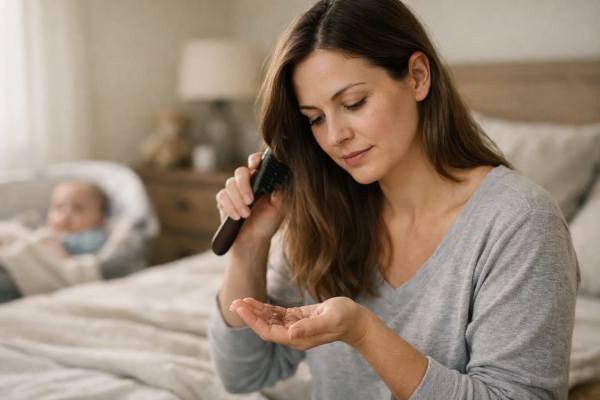
The weeks after birth can feel surprisingly intense, even when everything is going well. Many people expect sleep loss and healing, but they are less prepared for how dramatically hormones shift once the placenta is delivered. Estrogen and progesterone fall fast, prolactin and oxytocin rise with feeding, cortisol patterns get disrupted, and the body begins a complicated transition out of pregnancy. That hormonal reset can affect mood, appetite, temperature, vaginal tissue, libido, bleeding patterns, and the hair cycle.
At the same time, recovery is never shaped by hormones alone. Pain, blood loss, breastfeeding, interrupted sleep, prior mental health history, thyroid function, and day-to-day support all influence how the postpartum months feel. That is why one person may feel mostly steady while another feels emotionally raw, physically depleted, and worried by sudden hair shedding.
Understanding what is expected, what tends to happen later than many people realize, and what deserves medical attention can make this period feel less alarming and more manageable.
Essential Insights
- Rapid hormone withdrawal after birth can affect mood, sleep, temperature regulation, and energy, especially in the first two weeks.
- Postpartum hair shedding usually begins a few months after delivery rather than immediately after birth and often improves gradually with time.
- Recovery is shaped by more than hormones alone, with sleep loss, feeding demands, iron status, pain, and thyroid changes often playing a major role.
- Persistent depression, severe anxiety, racing thoughts, or hallucinations are not normal postpartum stress and need prompt medical care.
- The most helpful recovery plan is practical: protect sleep where possible, eat regularly, ask for hands-on help, and seek evaluation when symptoms do not ease or clearly worsen.
Table of Contents
- What shifts right after birth
- Why mood can feel so different
- Why hair shedding starts later
- A realistic recovery timeline
- What supports hormonal recovery
- Symptoms that deserve a closer look
What shifts right after birth
The single biggest hormonal event after delivery is the loss of the placenta. During pregnancy, the placenta produces large amounts of estrogen and progesterone. Once it is delivered, those levels drop sharply. That abrupt change helps trigger milk production, changes the uterus from pregnancy mode to recovery mode, and contributes to the emotional lability many people notice in the first days after birth.
At the same time, prolactin rises to support milk production, and oxytocin surges during feeding, skin-to-skin contact, and uterine contractions. Oxytocin is often described as a bonding hormone, but in real life its effects are more complex than a calm, glowing feeling. It can support connection, but it does not cancel exhaustion, anxiety, or pain. Prolactin can also suppress ovulation, which is one reason menstrual cycles may stay away for weeks or months, especially with frequent breastfeeding.
Cortisol, the body’s main stress hormone, also shifts in the postpartum period. Pregnancy and labor change stress signaling, and then the early weeks after birth layer on fragmented sleep, physical healing, and round-the-clock caregiving. That is one reason many people feel “wired and tired” at the same time: physically depleted, yet unable to fully relax. Night sweats, appetite swings, shakiness from missed meals, and temperature sensitivity can all feel dramatic without necessarily meaning something is wrong.
Low estrogen can be particularly noticeable during lactation. Some people experience vaginal dryness, lower libido, tender tissues, or a sense that their body feels more like menopause than like pregnancy. That can be startling, especially because it arrives during a season already filled with recovery demands.
It also helps to remember that hormones do not work in isolation. Blood loss, iron depletion, pain, infection, feeding challenges, medications, and emotional strain all shape the same symptoms people tend to blame on hormones alone. For example, fatigue may come from sleep loss, but it may also reflect anemia or thyroid dysfunction. Tearfulness may follow estrogen withdrawal, but it can also signal depression, anxiety, or overwhelm.
A useful frame is this: postpartum hormones are expected to change quickly, but the body does not reset in a straight line. The first six to eight weeks are only the beginning of recovery. For some people, the most intense hormonal symptoms cluster early. For others, the harder phase appears later, when adrenaline fades, support thins out, and the physical reality of ongoing caregiving sets in.
Why mood can feel so different
Mood changes in the postpartum period exist on a spectrum. At the milder end are the “baby blues,” which often show up in the first several days after birth. A person may cry easily, feel unusually sensitive, become irritable for no clear reason, or swing from joy to overwhelm within the same hour. That pattern is common, and it makes sense biologically: major hormone withdrawal is happening on top of pain, sleep fragmentation, identity change, and the relentless demands of a newborn.
What matters most is the pattern over time. Baby blues tend to be transient. Postpartum depression and postpartum anxiety are more persistent, more impairing, and often more confusing than the name suggests. Depression is not always obvious sadness. It can look like numbness, loss of interest, anger, guilt, constant self-criticism, hopelessness, or the feeling that caring for the baby has become emotionally flat and frighteningly joyless. Anxiety may look like racing thoughts, dread, panic, catastrophic checking, or intrusive images that make rest impossible.
Hormones likely contribute to this vulnerability, but they are not the whole story. Some people are especially sensitive to the rapid fall in estrogen and progesterone. Others are more affected by prior depression or anxiety, bipolar disorder, a traumatic birth, relationship strain, financial stress, pain, feeding problems, or lack of practical support. Sleep loss deserves special attention. Several nights of severely broken sleep can worsen irritability, anxiety, concentration, and mood in almost anyone, and in vulnerable people it can be a major trigger.
A key point many families miss is that postpartum mood symptoms do not always appear immediately. Some begin after the first two weeks, once visitors leave and the reality of recovery becomes more isolating. Others build slowly over months and get mislabeled as “just being tired.” That delay can make people dismiss their own symptoms because they expected any hormonal effect to happen only in the first week.
Partners and family members can help by watching for functional changes rather than waiting for a dramatic breakdown. Is the parent able to sleep when given the chance? Are they eating? Are they frightened by their own thoughts? Do they seem persistently flat, agitated, panicked, or disconnected? Are they saying everyone would be better off without them? Those are not signs to “push through.” They are signs to get support.
The most urgent end of the spectrum is postpartum psychosis. It is rare, but it is a medical emergency. Hallucinations, delusions, severe confusion, extreme agitation, or behavior that seems detached from reality require immediate emergency care. In that situation, safety comes first, and the parent should not be left alone with the baby.
Why hair shedding starts later
Postpartum hair loss often causes more alarm than it should, partly because it shows up later than many people expect. During pregnancy, higher estrogen helps keep more hairs in the active growth phase for longer. Hair can feel thicker, fuller, and less likely to shed. After delivery, that effect reverses. A larger number of hairs shift together into a resting phase and are shed later. This is why the shower drain may look normal in the first month and then suddenly alarming at month three.
Typical postpartum shedding is diffuse. In other words, it is more of an all-over increase in hair fall than one sharply defined bald spot. The temples and hairline can look thinner, and some people notice handfuls of hair during washing, brushing, or styling. As dramatic as that can feel, it usually reflects a reset of the hair cycle rather than permanent follicle damage.
The timing is useful reassurance. Shedding often begins around two to four months after birth, can peak a bit later, and often improves gradually over the following months. Many people start to see short regrowth hairs along the hairline before density fully feels normal again. Because regrowth takes time, the recovery phase can look messy before it looks better.
What helps most is gentle management rather than aggressive treatment. Tight hairstyles, heavy extensions, repeated heat styling, and harsh chemical processing can make already vulnerable hair look thinner or break more easily. A simpler routine usually works better: looser styling, careful detangling, enough protein and iron in the diet, and patience. Dramatic supplement stacks are rarely the first answer.
That said, not every postpartum shed is “just hormones.” Hair loss deserves a closer look if it is very patchy, associated with scalp pain or scarring, continues well beyond the usual window, or comes with other systemic symptoms. Heavy postpartum bleeding, low iron stores, rapid weight loss, restrictive eating, and thyroid dysfunction can worsen shedding or mimic the same complaint. If hair changes are paired with marked fatigue, constipation, dry skin, cold intolerance, or a slowed-down feeling, it is reasonable to consider whether signs of low thyroid function may be contributing.
Another reason people struggle with postpartum hair loss is emotional, not just cosmetic. Hair is tied to identity, recovery, and the hope of “getting back to normal.” When shedding starts just as someone thinks they should be feeling better, it can feel like a second hit. Naming it clearly helps: this is usually a delayed postpartum effect, not proof that recovery is failing.
A realistic recovery timeline
One of the most comforting things a postpartum parent can hear is that recovery is rarely linear. The body may improve in one area while feeling worse in another. A realistic timeline makes that less confusing.
In the first two weeks, the dominant themes are hormone withdrawal, bleeding, uterine cramping, fluid shifts, and sleep disruption. Emotions can swing quickly. Night sweats are common. Appetite may be erratic. If breastfeeding is underway, milk production is still being established, and feedings can feel nearly constant. This phase often feels physically raw and hormonally loud.
From about two to six weeks, some early chaos settles, but not always in the way people expect. The parent may be moving more easily and bleeding less, yet deeper fatigue often becomes more obvious. Adrenaline fades. The workload of feeding, pumping, soothing, and staying on a broken sleep schedule can hit harder. Vaginal dryness, low libido, and emotional fragility may be more noticeable, especially during lactation. This is also when people may start to realize that “I should be better by now” is not a useful benchmark.
From two to four months, a second wave often begins. Hair shedding may start. Mood symptoms that were initially masked by activity and visitors may become clearer. If menstrual cycles return, some people notice more hormonal volatility around that transition. If cycles do not return because of breastfeeding, low-estrogen symptoms can still continue. This middle stretch is often underestimated because the medical spotlight has usually moved away, even though recovery is still unfolding.
From four to six months, many parents describe a mixed picture. They may feel stronger and more competent in daily care, yet still not fully like themselves. Hair loss can peak here. Sleep deprivation can remain significant. Returning to work, pumping logistics, and childcare transitions add another layer of stress. Some people begin to notice thyroid-related symptoms during this broader postpartum window, which can muddy the picture further.
From six to twelve months, many hormone-related symptoms ease, but not all at once. Hair often begins to look fuller again. Cycles may normalize, though timing varies widely. Energy can improve, especially if sleep becomes less interrupted. Still, recovery may remain uneven if the parent is weaning, having recurrent mood symptoms, or developing postpartum thyroiditis.
A practical way to think about the timeline is in milestones rather than deadlines:
- Early stabilization: bleeding, feeding, and basic healing.
- Mid-postpartum adaptation: mood, sleep, and routine strain.
- Delayed effects: hair shedding, thyroid symptoms, return of cycles.
- Longer recovery: strength, sexual comfort, emotional steadiness, and hair regrowth.
If your recovery seems “late,” that does not automatically mean it is abnormal. But symptoms that intensify instead of gradually improving deserve attention.
What supports hormonal recovery
No food, supplement, or wellness routine can prevent the normal hormonal shifts of the postpartum period. The goal is not to stop the change, but to support the body through it. In practice, the best strategies are simple and often unglamorous.
Sleep protection matters more than almost anything else. For many parents, eight uninterrupted hours is unrealistic, but protected blocks still help. That may mean one partner handles the first stretch of the night, someone else takes the baby after a feed so the parent can go straight back to sleep, or the family prioritizes one recovery nap over nonessential chores. Mood is often more sensitive to sleep than people realize.
Regular eating is another major lever. Long gaps without food can worsen shakiness, anxiety, irritability, and milk-production stress. A steady pattern usually works better than aiming for “perfect” nutrition. Helpful meals and snacks tend to combine protein, fiber, fluids, and iron-containing foods. Postpartum depletion often feels worse when the parent is underfed or constantly grabbing only quick sugar.
Movement helps, but intensity should match healing. Gentle walks, stretching, breathing work, and medical clearance for more structured exercise are enough at first. The goal is circulation, mood support, and confidence, not rapid body changes. Trying to diet hard or train aggressively while sleep-deprived often backfires.
Hair care should be protective, not punishing. Avoid treating postpartum shedding as a damage-control emergency. Very tight buns, frequent heat, and harsh processing can increase breakage. A softer routine gives regrowth a better chance to become visible over time.
Support also has to be practical. “Let me know if you need anything” is much less useful than “I’ll bring dinner on Tuesday,” “I’ll hold the baby while you shower,” or “I’ll handle the laundry.” Emotional recovery improves when the parent is not carrying every invisible task alone.
When symptoms are persistent, testing may be more helpful than guessing. Severe fatigue, ongoing palpitations, dizziness, worsening mood, or prolonged shedding may justify checking for anemia, iron deficiency, thyroid issues, or other medical contributors. That is especially true if symptoms feel out of proportion to what is happening at home. Knowing when specialist endocrine follow-up makes sense can prevent months of assuming everything is “just postpartum.”
The most realistic postpartum recovery plan is not about optimization. It is about protecting basics: sleep, food, hydration, pain control, social support, follow-up care, and prompt evaluation when the pattern no longer looks typical.
Symptoms that deserve a closer look
Because the postpartum period is full of expected discomforts, truly important symptoms are sometimes normalized for too long. A good rule is to pay attention to duration, intensity, and function. If a symptom is not easing, is clearly escalating, or is interfering with the ability to care for yourself or the baby, it is worth discussing with a clinician.
Mood symptoms deserve prompt attention when they last beyond the very early postpartum window or feel severe at any point. Persistent hopelessness, constant dread, panic, inability to sleep even when the baby sleeps, intrusive thoughts that feel frightening, or feeling emotionally detached from life are not signs of weakness. They are reasons to seek care. Thoughts of self-harm, thoughts of harming the baby, hallucinations, or severe confusion are emergencies.
Physical symptoms matter too. Heavy bleeding, fainting, chest pain, shortness of breath, fever, severe headache, or one-sided leg swelling should never be written off as hormones. Those need urgent evaluation.
Thyroid symptoms are particularly easy to miss because they overlap so closely with normal postpartum exhaustion. In the months after birth, some people develop postpartum thyroiditis. Early on, it may look like feeling jittery, hot, sweaty, anxious, tremulous, or unusually aware of a racing heartbeat. Later, it can shift toward fatigue, constipation, feeling cold, dry skin, low mood, and slowed thinking. If that pattern sounds familiar, especially when the phases seem to change over time, an endocrine cause is worth considering. Symptoms that resemble overactive thyroid warning signs should not be dismissed as simple stress.
Hair loss also deserves a closer look when it is not diffuse, when it continues well past the usual postpartum window, or when it occurs alongside marked weight change, nutritional restriction, scalp inflammation, or obvious thyroid-type symptoms. Diffuse shedding is common. Bald patches, scarring, or inflammatory scalp symptoms are not the typical postpartum pattern.
Finally, trust the “this does not feel right” instinct. Postpartum recovery can be hard without being dangerous, emotional without being disordered, and messy without being abnormal. But it should not feel progressively more frightening, more disabling, or more medically concerning. The goal is not to pathologize every change. It is to recognize when normal adjustment has crossed into something that deserves more than reassurance.
References
- WHO recommendations on maternal and newborn care for a positive postnatal experience 2022 (Guideline). ([World Health Organization][1])
- Screening and Diagnosis of Mental Health Conditions During Pregnancy and Postpartum: ACOG Clinical Practice Guideline No. 4 2023 (Guideline). ([PubMed][2])
- Effects of postpartum hormonal changes on the immune system and their role in recovery 2025 (Review). ([PubMed][3])
- Investigation of exacerbating factors for postpartum hair loss: a questionnaire-based cross-sectional study 2023 (Cross-sectional study). ([PubMed][4])
- Postpartum Thyroiditis 2023 (Clinical review). ([NCBI][5])
Disclaimer
This article is for educational purposes only and is not a substitute for personal medical care. Postpartum symptoms can overlap with depression, anxiety disorders, anemia, infection, thyroid disease, and other medical conditions. Seek prompt medical attention for suicidal thoughts, thoughts of harming the baby, hallucinations, severe confusion, chest pain, shortness of breath, heavy bleeding, fainting, or any symptom that feels urgent or rapidly worsening.
If you found this helpful, please share it on Facebook, X, or your preferred platform so it can reach someone else who may need clear postpartum guidance.