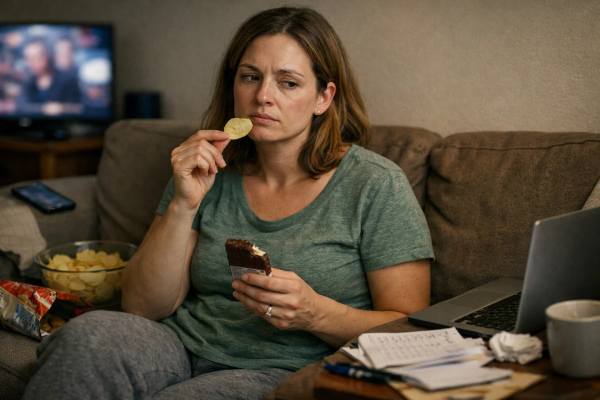
Sometimes the urge to eat has very little to do with physical hunger. You may find yourself standing in the kitchen because you feel wound up, emotionally drained, under-stimulated, or simply tired of whatever you were doing five minutes ago. That matters, because boredom eating and stress eating may look similar on the surface, but they usually come from different triggers and respond to different solutions.
The simplest way to tell them apart is this: stress eating is usually about relief, while boredom eating is usually about stimulation. Once you know which one is driving the urge, it gets much easier to respond in a way that actually helps instead of repeating the cycle.
Table of Contents
- What boredom eating and stress eating actually are
- How to tell the difference in real life
- A 60-second check before you eat
- How to stop stress eating
- How to stop boredom eating
- Habits that reduce both
- When to get extra help
What boredom eating and stress eating actually are
Both boredom eating and stress eating fall under the broader category of eating for reasons other than clear physical hunger. The difference is in what your brain is trying to get from food.
Stress eating usually happens when you feel tense, overwhelmed, anxious, frustrated, sad, or emotionally overloaded. Food becomes a quick way to change your internal state. It can feel soothing, numbing, rewarding, or grounding for a few minutes. This is why stress eating often shows up after conflict, deadlines, childcare overload, financial pressure, bad news, or the familiar crash at the end of a hard day. If you want to dig deeper into the pattern, it overlaps heavily with common emotional eating triggers and the broader connection between stress and cravings during weight loss.
Boredom eating is different. It usually starts when you feel flat, restless, unengaged, or mentally under-stimulated. Food becomes something to do. It adds texture, novelty, flavor, and a small hit of interest to a moment that feels dull. This is why boredom eating often shows up while scrolling, watching TV, working on repetitive tasks, procrastinating, or wandering the house at night.
The tricky part is that the two can overlap. You can be stressed and bored. You can feel mentally exhausted at the end of the day and mistake that emptiness for hunger. You can also use snacking to avoid both discomfort and under-stimulation at the same time.
That is why labeling every non-hunger urge as “emotional eating” is not always helpful. A better question is: What is food doing for me right now? If the answer is “calming me down,” stress is probably involved. If the answer is “giving me something interesting,” boredom is more likely.
One more important point: neither pattern means you lack discipline. Both are understandable human responses. Your brain learns quickly. If chips, sweets, takeout, or repeated grazing reliably make a tense moment easier or a dull moment more tolerable, the habit loop gets reinforced. The goal is not to shame yourself out of that loop. The goal is to notice it early and replace it with a response that fits the real problem.
How to tell the difference in real life
The clearest way to separate boredom eating from stress eating is to look at the feeling right before the urge, the pace of the urge, and what kind of relief you expect food to provide.
| Clue | Stress eating | Boredom eating |
|---|---|---|
| Feeling underneath the urge | Tense, anxious, irritated, sad, overwhelmed, emotionally worn down | Restless, flat, unmotivated, understimulated, distracted |
| What happened just before | A hard conversation, work pressure, bad news, decision overload, evening crash | Scrolling, repetitive work, TV, procrastination, idle time, staying up late |
| How the urge feels | Urgent, intense, relief-seeking | Casual at first, then repetitive and automatic |
| Typical food pull | Comfort foods, sweets, fast food, highly palatable foods | Snacky foods, crunchy foods, grazing foods, “something good” without a clear plan |
| What you hope food will do | Soothe, numb, reward, calm, release pressure | Occupy, entertain, wake you up, fill empty time |
| How eating often ends | Temporary relief followed by guilt, heaviness, or frustration | Little real satisfaction and a feeling of “Why did I just do that?” |
A few practical clues help even more:
- True hunger usually builds gradually. Stress eating is often sudden. Boredom eating can start as casual nibbling and quietly keep going.
- True hunger is flexible. If a balanced meal sounds appealing, you may actually be hungry. If only cookies, chips, or delivery sound acceptable, hunger may not be the main driver.
- Stress eating often feels emotional in the body. Tight chest, clenched jaw, racing thoughts, irritability, or that “I need something now” feeling are strong clues.
- Boredom eating often comes with aimlessness. You are not deeply upset. You are just drifting, opening cabinets, circling the kitchen, or pairing food with screens out of habit.
A useful sentence to remember is this: stress eating tries to change how you feel; boredom eating tries to change how the moment feels.
That said, do not expect perfect categories. Real life is messier than that. Some urges start as boredom and become stress because you feel annoyed with yourself. Some start as stress and turn into mindless grazing once the edge comes off. You do not need a perfect label to improve. You only need enough awareness to choose a better next move.
A 60-second check before you eat
When the urge hits, you do not need a long journal exercise. A short pause is usually enough to tell whether food is solving hunger, stress, boredom, or a mix of the three.
Try this quick check:
- Pause for three slow breaths. This creates just enough space to notice what is happening instead of running on autopilot.
- Ask what happened in the last 10 minutes. Did you just finish a stressful task, get irritated, feel lonely, hit a boring stretch of work, or sit down to watch TV?
- Scan your body. Is your stomach actually empty? Or are you feeling tension in your shoulders, mental fatigue, or restlessness in your body?
- Ask what food sounds good. If many foods sound fine, hunger may be real. If you want something very specific and intensely rewarding, that points more toward a non-hunger urge.
- Decide what you need most. Fuel, calm, stimulation, comfort, a break, movement, or a change of scenery.
This process gets easier if you practice even when the urge is mild. That is one reason mindful eating helps: it slows the gap between impulse and action just enough for your brain to make a choice instead of repeating a script.
A simple rule of thumb works well:
- If you seem physically hungry, eat a real meal or snack and do it on purpose.
- If you seem stressed, regulate first and eat second if needed.
- If you seem bored, change the activity, not just the flavor.
You can also use a short script:
“Am I hungry, tense, or under-stimulated?”
That question is fast, clear, and surprisingly effective. Many people discover that half their “cravings” are really requests for relief, distraction, rest, or a break from monotony.
If you still decide to eat, do it deliberately. Put the food on a plate, sit down, and remove the screen for a few minutes. Even that small change reduces the odds of sliding into automatic overeating. The point is not perfection. The point is ending the pattern where the urge decides for you before you have even named it.
How to stop stress eating
Stress eating rarely improves because you “try harder.” It improves when you lower the intensity of the moment before food becomes the first coping tool.
Start with a body-level reset
If your nervous system is activated, reasoning alone may not help much. Use something physical and simple first:
- Take 5 slow exhalations longer than your inhalations
- Walk for 5 to 10 minutes
- Wash your face or hold a cold glass of water
- Unclench your jaw and drop your shoulders
- Step away from the kitchen for a minute
This kind of reset works because stress eating is often driven by urgency. When urgency drops, the craving often becomes more manageable. A few structured breathing exercises for stress eating can be especially useful when the urge feels immediate.
Name the actual emotion
“Stressed” is often too vague. Are you angry? Lonely? Disappointed? Overstimulated? Mentally fried? The more precise the label, the better your response.
For example:
- Angry or keyed up: walk, vent on paper, or do a brisk chore
- Sad or lonely: text someone, sit with tea, or seek comfort that is not edible
- Overwhelmed: shrink the next task to one small step
- End-of-day depletion: build a transition ritual before dinner or snacks
This is where learning to self-soothe without food becomes powerful. Food gives short relief, but it rarely fixes the trigger. A replacement behavior should match the emotion, not just distract from it.
Do not let yourself get too hungry
Stress eating becomes much more likely when stress and under-fueling stack together. If you routinely skip meals, eat very lightly during the day, or go too long without protein and fiber, your evening coping capacity drops. A body that is both stressed and genuinely hungry will usually choose the fastest reward available.
That does not mean you need constant snacking. It means your meals should be regular enough and filling enough that stress is not landing on top of depletion.
Create an emergency plan for your predictable danger zones
Most stress eating is not random. It tends to happen:
- after work
- after arguments
- after bad sleep
- during deadlines
- late at night when your emotional guard is down
For each common situation, write one default response. Not ten. One.
Examples:
- “After work, I change clothes and walk for 8 minutes before I open the pantry.”
- “After a stressful meeting, I drink water and do two minutes of breathing before I decide about food.”
- “If I still want a snack, I choose one portion and sit down for it.”
That is how a craving plan becomes practical instead of theoretical.
How to stop boredom eating
Boredom eating is less about emotional distress and more about empty space. Because of that, the fix is usually not “more restraint.” It is more engagement.
Replace the snack cue with an activity cue
If you always eat when a task gets dull or the evening feels empty, your brain has learned that food is the easiest source of novelty. The best response is to make another source of stimulation just as easy.
Create a short “bored instead of hungry” list you can use without thinking. Keep it visible. Include low-effort options such as:
- make tea or sparkling water
- step outside for fresh air
- do a 5-minute tidy-up
- listen to one song standing up
- text a friend
- read 3 pages of a book
- do a quick puzzle, sketch, or game
- switch tasks for 10 minutes
If nighttime is your main danger zone, a more detailed plan for how to stop boredom eating at night can help, especially if your urges show up around TV, scrolling, or procrastinating bedtime.
Make mindless eating less automatic
Boredom eating thrives on convenience. You do not usually plan it. You drift into it. So reduce drift.
A few changes help a lot:
- keep trigger foods out of immediate sight
- buy fewer “open and graze” foods
- portion snacks before you sit down
- do not eat from bags or boxes
- keep something non-food in your hands during screen time
This kind of setup matters because boredom eating is highly cue-driven. An intentional home environment that makes better choices easier removes friction from the behavior you want and adds friction to the behavior you want less of.
Add more stimulation to your day on purpose
Some people boredom-eat mostly because their day is mentally flat. Too much repetitive work, too little sunlight, too much screen time, not enough movement, and very little novelty can all increase the pull of snack-based stimulation.
Ask yourself:
- Do I need more breaks, not more food?
- Do I need more challenge?
- Do I need more movement?
- Do I need something enjoyable that is not passive?
Boredom eating often shrinks when life gets slightly more varied and less drained. That can be as simple as taking calls while walking, changing work location, using music strategically, or planning one genuinely enjoyable activity before the evening slump starts.
Habits that reduce both
The best long-term strategy is not a different trick for every craving. It is building a daily rhythm that makes both stress eating and boredom eating less likely in the first place.
Eat predictably enough to avoid chaotic hunger
A consistent pattern of meals helps you tell the difference between hunger and emotion more accurately. When eating times are all over the place, every urge feels blurry. A structure based on more consistent meal times makes appetite easier to read and easier to manage.
You do not need a rigid schedule. You do need enough regularity that you are not constantly asking whether you are hungry, deprived, stressed, or all three.
Build meals that keep you steady
Meals that are too small, too low in protein, or low in fiber often leave you vulnerable later. That matters because both boredom eating and stress eating get stronger when you are physically underfed.
A helpful formula is:
- protein for staying power
- fiber for fullness
- enough carbs and fats to feel satisfied
- a realistic portion, not a “perfect” one
If cravings regularly hit between meals, a simple protein-and-fiber craving toolkit can make your backup options much more satisfying than random grazing.
Protect your sleep and decompression time
Poor sleep lowers patience, raises reactivity, and makes reward-seeking more tempting. On short-sleep days, stress hits harder and boring moments feel harder to tolerate. The result is often more impulsive snacking, especially at night.
Just as important is decompression. If your whole day is work, caretaking, commuting, or demands from other people, food can become the first moment that feels like yours. That is not really a food problem. It is a recovery problem. A short walk, shower, music break, or quiet transition ritual can reduce the urge to use eating as your only way to switch off.
Track patterns, not just calories
A lot of people know what they eat, but not why they eat. For one week, notice:
- time of urge
- feeling before eating
- location
- whether you were alone
- whether screens were involved
- how satisfied you felt after
Patterns usually appear fast. Maybe stress eating is mostly after work. Maybe boredom eating happens during meetings, while studying, or between 9 and 11 p.m. Once you see the pattern, prevention becomes much easier than reacting in the moment.
The goal is not to become hyper-controlled. It is to make your eating feel less random and less emotionally expensive.
When to get extra help
Occasional boredom eating or stress eating is common. Frequent episodes that leave you distressed, ashamed, or feeling out of control deserve more attention.
It is a good idea to seek extra support if:
- you often feel unable to stop once you start eating
- you regularly eat far past comfort
- you hide food or eat in secret
- food feels like your main coping tool every day
- the pattern is affecting your mood, sleep, weight, blood sugar, or self-esteem
- you have a history of binge eating or another eating disorder
In those cases, it can help to talk with a doctor, therapist, or registered dietitian who understands eating behavior. If the pattern includes repeated loss-of-control episodes, support around binge eating and weight loss may be especially relevant.
You do not need to wait until the problem feels extreme. The earlier you get support, the easier it often is to untangle the loop between food, stress, routine, and emotion.
The bigger message is this: boredom eating and stress eating are not the same, but both improve when you stop treating every urge like hunger. Ask what the food is trying to do for you. Then solve that problem. When you calm stress directly and add stimulation intentionally, eating becomes more deliberate, satisfying, and much easier to manage.
References
- The Association of Emotional Eating with Overweight/Obesity, Depression, Anxiety/Stress, and Dietary Patterns: A Review of the Current Clinical Evidence 2023 (Review)
- Emotional eating in healthy individuals and patients with an eating disorder: evidence from psychometric, experimental and naturalistic studies 2020 (Review)
- Emotional Eating Interventions for Adults Living with Overweight or Obesity: A Systematic Review and Meta-Analysis 2023 (Systematic Review)
- Tackling Cravings in Medical Weight Management: An Update on Pathophysiology and an Integrated Approach to Treatment 2024 (Review)
- Effects of mindfulness-based interventions on food craving in adults: a systematic review and meta-analysis of controlled clinical trials 2025 (Systematic Review)
Disclaimer
This article is for general educational purposes only. It is not a substitute for medical, nutrition, or mental health advice, diagnosis, or treatment. If you have frequent loss-of-control eating, significant distress around food, or concerns about an eating disorder, speak with a qualified healthcare professional.
If this article helped, share it on Facebook, X, or your preferred platform so someone else can use it too.