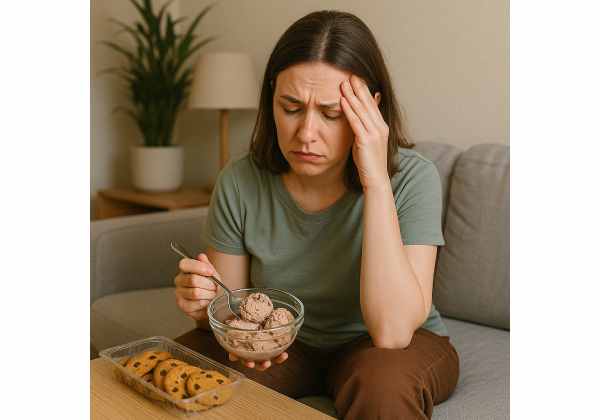
Emotional eating often feels like a food problem, but the real driver is usually something happening underneath the food. Stress, loneliness, boredom, frustration, exhaustion, and even relief can all push people toward eating when the body is not asking for fuel. That is why emotional eating can feel powerful, confusing, and hard to stop with simple rules alone.
The way out is not perfect self-control. It is learning how to spot your triggers, understand what the urge is trying to do for you, and build responses that actually help. Once you can separate emotional hunger from physical hunger, the pattern becomes much easier to interrupt.
Table of Contents
- What Emotional Eating Really Is
- The Most Common Emotional Eating Triggers
- Emotional Hunger or Physical Hunger?
- Why the Cycle Keeps Repeating
- What to Do When the Urge Hits
- Daily Habits That Make Emotional Eating Less Likely
- When to Seek Extra Support
What Emotional Eating Really Is
Emotional eating is eating that is driven mainly by feelings rather than physical hunger. It often happens when food becomes a coping tool, a distraction, a reward, or a way to change your internal state quickly. The food itself is not always the problem. The key issue is that eating is being used to regulate something that food can only soothe temporarily.
That is why emotional eating does not always look dramatic. It can be obvious, like ordering takeout after a painful conversation and eating past fullness. But it can also look ordinary: picking at snacks when bored, standing in the kitchen after a stressful day, or craving sweets every night once you finally have a quiet moment. Many people miss it because it is woven into normal routines rather than happening in a clearly separate episode.
It also helps to know that emotional eating is not only about negative emotions. Stress, sadness, and loneliness are common triggers, but relief, celebration, and the “I deserve this” feeling can trigger it too. Food can become linked to comfort, escape, reward, or permission to stop holding everything together for a while.
This is different from simply enjoying food. Eating a dessert because it tastes good is not automatically emotional eating. The difference is usually in the role the food is playing. If you are eating mainly to numb, calm, avoid, or change a feeling, emotion is probably driving the behavior. If you are eating because you are hungry or deliberately choosing something enjoyable and can stop when satisfied, that is a different pattern.
Emotional eating also exists on a spectrum. Some people notice mild patterns, such as stress snacking during busy afternoons. Others feel caught in a stronger cycle where emotions and eating are tightly linked. That is one reason it can overlap with patterns like stress snacking at work or stress eating at night. The timing and setting may differ, but the same emotional relief loop is often underneath both.
The goal is not to eliminate all comfort from food. Food is emotional for most human beings. The goal is to stop using it as your main strategy for coping. Once you understand that, you can approach the problem with more clarity and a lot less shame.
The Most Common Emotional Eating Triggers
People often assume emotional eating happens only after major stress, but the most common triggers are usually smaller and more repetitive. These small emotional cues can create powerful habits because they happen often and are easy to miss.
Stress is one of the biggest triggers. Work pressure, family tension, deadlines, financial worries, and mental overload can all make food feel unusually attractive. In stressful moments, people often want something quick, soothing, and familiar. Highly palatable foods fit that need well, even if the relief lasts only a short time.
Boredom is another major trigger. When the mind wants stimulation, food can fill the gap. This is especially common during repetitive work, evenings at home, long screen time, or weekends with too much unstructured time. If this is a familiar pattern, it may help to compare your experience with boredom vs stress eating, because the two can feel similar while needing slightly different fixes.
Other common triggers include:
- Loneliness: Eating can create comfort, company, or a sense of reward when connection feels low.
- Frustration: Food can act like a fast release valve after conflict, disappointment, or feeling stuck.
- Exhaustion: Tired people often crave easy, energy-dense foods and have less patience for deliberate decisions.
- Reward seeking: “I had a hard day” or “I was good all week” can turn food into payment.
- Avoidance: Starting a difficult task, having a hard conversation, or sitting with an unpleasant feeling can make snacking look oddly urgent.
Trigger patterns also depend on context. Some people eat emotionally in social situations because food gives them something to do. Others eat mostly when alone because privacy lowers inhibition. Some are driven by tension and others by emptiness or restlessness.
A useful way to think about triggers is to separate the surface event from the real driver. The event might be “I opened the pantry.” The driver may be “I felt under pressure and wanted a break.” That distinction matters because the pantry is not the full problem. The feeling and the habit loop are.
Over time, repeated triggers can become automatic cues. If you always eat when anxious, lonely, or mentally drained, your brain starts to treat food as the expected answer. That is why emotional eating can feel fast and almost preplanned, even when you are not consciously deciding to do it.
The more specifically you can name your triggers, the easier it becomes to interrupt the pattern before food enters the picture.
Emotional Hunger or Physical Hunger?
One of the most helpful skills is learning to tell emotional hunger from physical hunger. They can overlap, so this is not about being perfect. It is about getting clear enough to respond in a better way.
Physical hunger usually builds gradually. Emotional hunger often feels sudden and urgent. Physical hunger tends to be open to different foods. Emotional hunger often wants a specific comfort food right now. Physical hunger usually ends with satisfaction. Emotional hunger may continue even after fullness because the feeling underneath has not changed.
| Clue | Physical hunger | Emotional hunger |
|---|---|---|
| How it begins | Gradual and steady | Sudden and urgent |
| What you want | Several foods sound acceptable | Usually one specific comfort food sounds best |
| Body signals | Stomach emptiness, low energy, light hunger cues | Tension, restlessness, sadness, anxiety, boredom, emptiness |
| Eating speed | Can be moderate and calm | Often fast, distracted, or automatic |
| After eating | You feel fed and can move on | You may feel guilt, disappointment, or still emotionally unsettled |
A simple pause can help you sort it out. Ask yourself:
- When did I last eat a real meal or snack?
- What do I feel in my body right now?
- What emotion is present, even if it is mild?
- Would a balanced meal or snack help, or do I mainly want relief?
If you have not eaten in several hours, feel true body hunger, and many foods sound good, that is likely physical hunger. If you ate recently, feel tense or low, and only want chips, cookies, or something very specific, emotions are probably involved.
Still, avoid turning this into a strict either-or test. Sometimes it is both. You may be genuinely hungry and emotionally overwhelmed at the same time. In that case, the best response is often to eat something satisfying and also deal with the feeling directly.
This is why stable meal timing matters so much. When your eating is erratic, emotional urges can hide inside real hunger and become harder to identify. A steadier pattern of meals and snacks makes your signals easier to read. That is one reason meal timing habits for better appetite control can support emotional eating recovery even though the problem seems emotional on the surface.
The more often you ask these questions, the faster the distinction becomes. Awareness does not fix everything, but it creates the space you need to stop reacting automatically.
Why the Cycle Keeps Repeating
Emotional eating keeps repeating because it works just enough in the short term to teach your brain to do it again.
If you feel overwhelmed, eat something rewarding, and feel even slightly calmer for ten minutes, your brain learns a lesson: food helps. That short-term payoff matters more than the long-term downside in the moment. Over time, the pattern becomes more automatic. The feeling shows up, the urge appears, and food starts to feel like the obvious response.
This is the core of a habit loop: a cue, a behavior, and a reward. The cue might be stress, boredom, or loneliness. The behavior is eating. The reward is temporary relief, distraction, pleasure, or comfort. Once the loop is repeated enough times, you may find yourself halfway through a snack before you even notice the trigger. That is why understanding habit loops and eating behaviors can be so useful in this area.
Restriction also keeps the cycle alive. Many people react to emotional eating by becoming more rigid afterward. They skip meals, swear off favorite foods, or try to “make up for it” the next day. That often increases hunger, mental deprivation, and frustration, making the next emotional eating episode more likely. The pattern becomes: emotion, overeating, guilt, restriction, stronger urge, repeat.
Perfectionism makes this worse. If you see one episode as proof that the day is ruined, you may keep eating because it feels pointless to stop now. That is a classic form of all-or-nothing thinking. Instead of one difficult moment, it turns into a larger spiral.
Poor sleep can feed the cycle too. When people are tired, cravings often feel stronger, emotional regulation is weaker, and stopping points are harder to notice. If late-night or next-day cravings are a recurring problem, the bigger issue may involve poor sleep and increased hunger rather than food alone.
Another reason the cycle continues is that emotional eating can temporarily protect you from feeling what needs attention. The food becomes a buffer between you and anger, sadness, anxiety, disappointment, or emptiness. That does not make the behavior irrational. It means it is trying to serve a purpose. But if the only relief tool you trust is food, the pattern stays powerful.
Breaking the cycle works best when you stop asking only, “How do I eat less?” and start asking, “What is food doing for me here?” That question leads to better solutions than willpower alone ever can.
What to Do When the Urge Hits
The best time to break emotional eating is during the first few minutes of the urge, before you are deep into autopilot. That window can be short, which is why having a plan matters.
A simple response sequence works well:
- Pause before acting.
Tell yourself you can eat if you still want to, but you will wait five minutes first. This lowers urgency without forcing a harsh rule. - Name the feeling.
Use plain language: stressed, lonely, annoyed, overwhelmed, bored, sad, restless, tired. Naming the emotion often weakens the reflexive pull. - Match the response to the feeling.
If you are hungry, eat. If you are upset, regulate the feeling first. If it is both, do both. - Shrink the next action.
You do not need to solve your life in five minutes. You only need one better next step. - Make eating more deliberate if you still choose it.
Put the food on a plate, sit down, and avoid eating directly from a bag or container.
Useful non-food responses include:
- A short walk
- Ten slow breaths
- Sending one message to a supportive person
- Drinking water or tea
- Writing down what is bothering you
- Moving to a different room
- Doing one task that reduces stress instead of avoiding it
For many people, food is standing in for soothing. That is why learning how to self-soothe without food can be a turning point. The goal is not to pretend food never comforts you. It is to build other ways to calm, ground, or distract yourself when emotions spike.
Another helpful tool is a prewritten plan. Try a few simple if-then statements:
- If I want to eat because I am anxious, then I will take ten slow breaths first.
- If I want sweets after a hard day, then I will sit down and ask what I actually need.
- If I find myself in the kitchen without hunger, then I will step out and walk for three minutes.
These kinds of if-then plans for cravings work because they reduce the amount of thinking required during a vulnerable moment.
And if you do emotionally eat, do not turn that into a second problem by attacking yourself. Shame tends to deepen the cycle. Curiosity is far more useful. Ask what happened, what the urge was trying to do for you, and what you want to try next time.
Daily Habits That Make Emotional Eating Less Likely
Emotional eating is easier to interrupt in the moment when your daily routine is already supporting you. The goal is not to remove every trigger. It is to lower the background conditions that make urges harder to manage.
Start with meals. When you go too long without eating, emotions and hunger blur together. Balanced, regular meals make it easier to tell what is actually going on. Many people benefit from a simple structure: a steady first meal, a real lunch, a satisfying dinner, and planned snacks on longer days.
Your food environment matters too. If your most emotionally charged foods are always visible, open, and easy to grab, the habit loop has less resistance. A basic food environment reset can help by making impulsive eating a little less automatic and planned eating a little easier.
Sleep is another major factor. People are more emotionally reactive when exhausted, and that can make coping through food much more tempting. Consistent sleep will not solve emotional eating on its own, but it often makes every other strategy work better.
A few habit areas make a bigger difference than they seem:
- Regular meals and snacks: reduce rebound hunger
- Adequate protein and fiber: improve fullness and stability
- Sleep consistency: lowers emotional and appetite volatility
- Movement: helps shift mood and tension without using food
- Stress relief rituals: prevent pressure from building until food feels necessary
- Tracking patterns: makes triggers visible sooner
Mindfulness can also help, especially if you tend to eat quickly or automatically. This does not need to be formal or time-consuming. Practical mindful eating might simply mean noticing your first few bites, pausing halfway through, or checking whether the feeling changed after you started eating.
It also helps to reduce the number of decisions you need to make when emotions are high. Pre-deciding snacks, keeping simple meals available, and having two or three reliable coping tools can make emotional eating less likely without demanding constant motivation.
What works best is usually not one dramatic change. It is a small collection of habits that quietly make emotional eating less rewarding and less necessary. Over time, those habits shift the pattern from “food is my fastest answer” to “food is one option, but not my only one.”
When to Seek Extra Support
Emotional eating is common, but it can also be a sign that something deeper needs attention. If the pattern feels frequent, distressing, compulsive, or hard to interrupt even when you understand it, extra support can make a real difference.
Consider getting more help if any of these sound familiar:
- You feel out of control when you start eating
- Emotional eating episodes are happening several times a week
- You regularly eat in secret or feel ashamed afterward
- You swing between strict restriction and overeating
- Food feels like your main way to handle anxiety, sadness, or stress
- The pattern is interfering with your physical health, mood, or daily life
Professional support does not mean you failed to handle it on your own. It means the pattern may be tied to stress, anxiety, depression, trauma, binge eating, or other issues that deserve more than self-help alone. A registered dietitian, therapist, or physician can help you sort out what is driving the behavior and what kind of treatment fits best.
Support can also help if emotional eating overlaps with broader self-sabotage patterns. Some people do well for a while, then unravel after one hard day and feel stuck in the same reset cycle. In those cases, it may help to pair emotional eating work with tools for recovery and consistency, such as lapses vs relapses after a bad day.
The most important thing is not waiting until the problem feels severe before taking it seriously. Emotional eating often improves most when people respond early, with honesty and support, instead of waiting until frustration turns into hopelessness.
You do not need perfect behavior to make progress. You only need to understand the pattern more clearly, respond to it more skillfully, and keep practicing when things are imperfect.
References
- The global prevalence of emotional eating in overweight and obese populations: A systematic review and meta-analysis 2025 (Systematic Review and Meta-Analysis)
- The Association of Emotional Eating with Overweight/Obesity, Depression, Anxiety/Stress, and Dietary Patterns: A Review of the Current Clinical Evidence 2023 (Review)
- Emotional Eating Interventions for Adults Living with Overweight or Obesity: A Systematic Review and Meta-Analysis 2023 (Systematic Review and Meta-Analysis)
- Effects of mindfulness-based interventions on food craving in adults: a systematic review and meta-analysis of controlled clinical trials 2025 (Systematic Review and Meta-Analysis)
- A Narrative Review on Sleep and Eating Behavior 2025 (Review)
Disclaimer
This article is for general educational purposes only and is not a substitute for medical advice, diagnosis, or treatment. If emotional eating feels compulsive, is causing distress, or may be linked to binge eating, anxiety, depression, or another health concern, speak with a qualified healthcare professional.
If this article helped you, please share it on Facebook, X, or any platform where it could support someone else who is trying to break the emotional eating cycle.