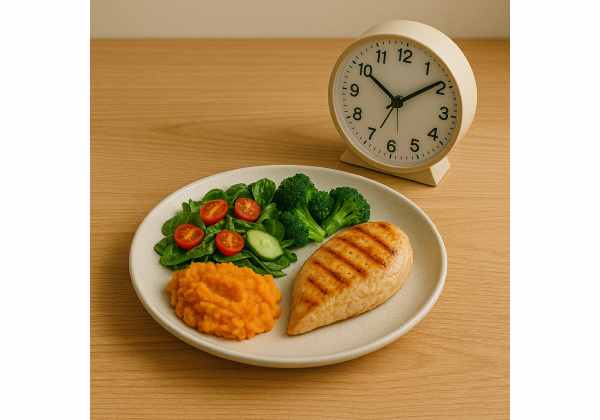
Meal timing can make healthy eating feel much easier or much harder. When meals are too delayed, too irregular, or pushed too late into the evening, hunger often becomes less predictable and food choices become more reactive. On the other hand, a perfectly “optimized” schedule is not required for better appetite control.
What usually helps most is not a rigid clock-based diet. It is building meal timing habits that reduce long hunger gaps, limit unplanned grazing, and fit your real life well enough to repeat. This article explains how meal timing affects hunger, what patterns tend to work better, how to handle mornings and late nights, and how to build a schedule that supports weight loss without becoming overly strict.
Table of Contents
- Why meal timing affects appetite
- Start with regularity, not perfection
- How long to go between meals
- Breakfast and the first half of the day
- Late eating, night snacking, and appetite drift
- Adapt meal timing to your real schedule
- Build meal timing habits that last
Why meal timing affects appetite
Meal timing matters because hunger is not driven by willpower alone. It is shaped by physiology, routine, sleep, stress, food composition, and the simple fact that your body responds to when you last ate. If meals happen at random times, appetite often becomes less stable. You may feel almost nothing for hours, then suddenly feel overly hungry and much more likely to overeat.
That pattern creates a common weight-loss problem: people think they have a discipline issue when they actually have a timing issue. They skip or delay meals while busy, then hit late afternoon or evening with a level of hunger that makes portion control much harder. At that point, even good intentions are working against stronger biological and behavioral cues.
Timing also interacts with circadian rhythm. Appetite, food preference, alertness, and glucose handling do not stay identical across the day. For many people, eating becomes more impulsive when the day runs long, stress accumulates, and fatigue builds. That is one reason appetite control often breaks down at night rather than at breakfast or lunch.
This does not mean you need a complicated chrononutrition plan. It does mean that your eating schedule can either support appetite regulation or constantly destabilize it. Common timing-related patterns that make appetite harder to manage include:
- Skipping meals and then overeating later
- Going long stretches with no food and then grazing all evening
- Eating lightly early in the day and doing most calorie intake late at night
- Letting work, errands, or stress decide when you eat
- Using caffeine to delay hunger until it comes back stronger
Meal timing also affects decision quality. A person who gets to dinner moderately hungry usually makes different choices than a person who arrives ravenous after nine hours with almost no real food. The second person is more likely to eat fast, eat past fullness, snack while cooking, and tell themselves they will “do better tomorrow.”
That is why appetite control improves when timing becomes more intentional. You are not just changing the clock. You are changing the conditions that shape hunger, cravings, and follow-through. In practice, better meal timing helps by creating steadier energy, fewer extreme swings, and fewer moments where you are trying to make good choices while already depleted.
A good timing routine is not about eating at perfect hours every day. It is about creating enough regularity that your body and your habits stop feeling ambushed by hunger.
Start with regularity, not perfection
The most useful meal timing habit for appetite control is usually regularity. Before worrying about fasting windows, exact breakfast rules, or the ideal dinner cutoff, it helps to get more consistent about when you generally eat. That is because appetite often responds better to a stable pattern than to a highly “optimized” schedule that you cannot maintain.
A regular eating pattern reduces the number of surprise hunger spikes in the day. It also lowers the mental load of deciding from scratch every few hours. When meals tend to happen within a familiar range, food decisions become less reactive and less tied to mood, stress, or convenience.
This is one reason many people do well with more consistent meal times for appetite control. The point is not that you must eat at exactly 8:00, 12:00, and 6:00 every day. The point is that a loose structure usually works better than an unpredictable one.
For example, compare these two patterns:
| Pattern | What it feels like | Common result | Better adjustment |
|---|---|---|---|
| Highly irregular eating | Some days breakfast, some days not, meals depend on stress | More reactive hunger and evening overeating | Create a repeatable first meal and dinner window |
| Very long daytime gaps | Busy workday, little food, intense hunger later | Fast eating, bigger portions, more snacking | Add a planned lunch or structured snack |
| Most intake pushed late | Light day, heavy night | Appetite drift and harder nighttime control | Shift some food earlier in the day |
| Moderately regular meals | Meals happen in a usual sequence even on busy days | More stable hunger and easier planning | Keep the pattern and adjust meal size as needed |
A realistic structure for many adults is three meals, or three meals plus one planned snack, eaten in a roughly similar order most days. That is not the only pattern that can work, but it is often easier to sustain than a schedule that changes dramatically from weekday to weekend or from calm days to stressful ones.
Regularity also helps you spot the real issue when appetite gets harder to manage. If your schedule is always shifting, it becomes difficult to tell whether the problem is meal size, food composition, stress, sleep, or timing itself. When the pattern is steadier, the cause of the problem is easier to see and fix.
This is also where people can get tripped up by overcorrection. They have one week of chaotic eating and respond by creating a rigid meal schedule that does not fit their actual life. Then the structure breaks, and they assume timing “doesn’t work” for them. In reality, the plan was just too tight. Better appetite control usually comes from moderate structure, not strict control.
If your appetite feels unpredictable, begin with the simplest question: are your meals happening in a reasonably repeatable rhythm? That one change often matters more than any advanced meal timing strategy.
How long to go between meals
There is no universal ideal gap between meals, but there is a practical principle that helps most people: do not wait so long that you become ravenous, and do not eat so frequently that hunger cues blur into constant grazing.
That means the right spacing is less about a perfect number and more about what your pattern produces. If you are getting to meals calm, hungry, and able to stop at comfortable fullness, the spacing is probably working. If you are arriving shaky, distracted by food, and likely to overeat, the gap is probably too long or the earlier meal was not satisfying enough.
For many people, a rough starting point is to eat every few hours rather than letting the day stretch into one long fast followed by an oversized dinner. But even that needs context. Meal spacing depends on:
- How large and filling the last meal was
- How much protein, fiber, and volume it included
- Your sleep, stress, and activity level
- Your work schedule
- Whether you naturally prefer bigger or smaller meals
A breakfast of coffee and toast is different from a breakfast with protein, fruit, and fiber. One may leave you hungry quickly. The other may carry you much longer. So when appetite control breaks down, the answer is not always “eat sooner.” Sometimes it is “eat more strategically earlier.”
This is why regular meal routine consistency often helps. It is easier to judge the right gap between meals when the sequence is stable enough to observe.
A useful self-check is to notice what happens in the hour before your next meal. Good spacing usually feels like this:
- You are ready to eat, but not desperate
- Food sounds good, but you are not fixated on it
- You can choose a normal portion and eat at a normal pace
Spacing that is too long often feels like this:
- You are thinking about food constantly
- You want the fastest, most energy-dense option
- You eat quickly and want more even after a full portion
- Evening cravings get worse after a light or delayed day
Spacing that is too short can also be unhelpful. Some people snack so often that they never let true meal hunger develop, which makes appetite signals more confusing and can encourage frequent nibbling without much satisfaction. That is different from using a planned snack well. A structured snack can be very useful. Constant unplanned eating usually is not.
If long gaps are one of your main problems, one fix is to use a deliberate snack rather than waiting until dinner. This works especially well if afternoons are your danger zone. A satisfying option from a list of high-protein snacks can prevent the kind of intense hunger that turns dinner into a recovery mission.
The best meal spacing is the spacing that leaves you in control at the next eating occasion. That may look different for different people, but the principle stays the same: manage hunger before it becomes a problem, not after.
Breakfast and the first half of the day
Breakfast is one of the most argued-about topics in meal timing. Some people feel much better eating in the morning. Others are not hungry early and do fine waiting longer. The more useful question is not whether breakfast is morally good or bad. It is whether your first half of the day supports stable appetite later on.
For many people, skipping breakfast is not a problem in itself. The problem is what skipping breakfast leads to. If missing the first meal causes a long stretch of under-eating followed by intense afternoon hunger, late-night snacking, or loss of control at dinner, then the pattern is probably not working for you. That is why guides on breakfast skipping and later cravings are so relevant to appetite control.
On the other hand, if you are not hungry early, can work comfortably, and still eat a balanced first meal before you become overly hungry, you may not need a traditional early breakfast. The goal is not to force a meal you do not want. It is to avoid starting the day in a way that makes the rest of your appetite harder to manage.
What often helps is to focus less on the label “breakfast” and more on the function of the first meal:
- Does it reduce later cravings?
- Does it help steady your energy?
- Does it prevent an extreme hunger rebound later?
- Is it satisfying enough to last a reasonable amount of time?
For many people trying to improve appetite control, the first meal works better when it includes protein and some fiber instead of only refined carbohydrate. A more balanced breakfast or late-morning first meal often reduces the pattern of “light all day, chaotic at night.”
That does not mean breakfast has to be large. A moderate meal can be enough. Examples include yogurt with fruit and seeds, eggs with toast and fruit, a protein-rich smoothie, oats with added protein, or leftovers if that is what fits your routine. If mornings are hectic, simple options from high-protein breakfast ideas often work better than elaborate meal-prep plans that are hard to maintain.
The first half of the day also matters because it sets the tone for food decisions later. When people start with only caffeine and vague plans, they often drift into appetite management by delay. That can feel productive at first, especially during a busy morning. But it often turns into compensation eating by late afternoon or evening.
A better approach is to make the first meal intentional, whether it happens at 7:00, 9:30, or 11:00. You do not need a universal breakfast rule. You need a morning pattern that keeps later appetite from becoming harder than it has to be.
Late eating, night snacking, and appetite drift
For many people, appetite control is hardest in the evening. That is partly about hunger, but it is also about fatigue, routine, reward-seeking, and how the earlier part of the day was structured. Night eating problems often begin long before nighttime.
A common pattern looks like this: breakfast is skipped or minimal, lunch is rushed, afternoon hunger rises, dinner gets delayed, and then the evening turns into a mix of overeating, grazing, and snacking while trying to relax. When people describe having “no control at night,” they often mean the day was too under-fueled or too unstructured to support a calm evening.
Late eating becomes especially tricky when dinner is very late, very large, or followed by automatic snacking. That does not mean every late dinner is harmful. Some people have schedules that make later dinners normal. The issue is whether the timing leads to overeating, poor satiety, disrupted sleep, or a habit of continuing to eat long after the meal is over.
This is where late dinner habits matter. A later meal can be manageable when it is planned, portioned, and follows a reasonably structured day. It becomes more problematic when it is the first real meal after hours of under-eating.
The other issue is appetite drift. As the day goes on, decision fatigue rises. Self-control tends to be lower. Food is often used as reward, comfort, or entertainment. That is why people can be “good” with meals and then lose the thread while standing in the kitchen, watching TV, or doing one last bit of work.
Helpful ways to reduce nighttime appetite drift include:
- Eat enough earlier in the day
- Do not let dinner get pushed too late if you can avoid it
- Make dinner satisfying enough that you are not immediately hunting for more
- Separate a real planned evening snack from random grazing
- Create a clear kitchen closing routine if late nibbling is habitual
If nighttime eating is a repeated problem, targeted strategies for stopping late-night snacking can help more than generic meal advice, because the issue is often behavioral as much as nutritional.
Sleep matters here too. Poor or inconsistent sleep can make appetite feel louder and reward-driven, especially in the evening. That is one reason late eating habits and poor sleep often reinforce each other. A tiring day increases cravings, late snacking delays bedtime, and the next day starts with worse hunger control.
You do not need a harsh rule that food must stop at a certain minute. But you do want an evening pattern that feels intentional rather than slippery. If nights are where your appetite goes off course, the most effective fix is usually to improve the structure of the whole day, then tighten the nighttime routine enough that it stops feeling automatic.
Adapt meal timing to your real schedule
Meal timing advice fails when it assumes everyone lives on the same timetable. People with early commutes, shift work, parenting demands, travel, remote work, or unpredictable meetings need timing habits that fit real constraints. Appetite control gets better when your routine is workable, not just theoretically ideal.
That means the best timing plan is not always the earliest, most disciplined, or most “clean.” It is the one you can repeat across ordinary weeks. If your schedule changes, your meal timing habits need flexibility built in.
For office workers, one of the biggest risks is letting meetings and convenience decide when food happens. Long gaps, desk snacking, and late lunches can make the evening much harder. That is why some people benefit from a more deliberate office routine for meals and movement rather than trying to out-discipline a chaotic workday.
For late chronotypes, meal timing may need to shift later overall, but still stay structured. Someone who naturally wakes later does not need to copy an early riser’s pattern to control appetite better. What matters more is that their meals happen in a consistent sequence and do not drift into a pattern of very light daytime eating followed by most intake at night. Readers with later schedules often do better by studying weight loss habits for night owls than by forcing an unrealistic early-day routine.
A practical way to adapt meal timing is to build anchor points instead of strict timestamps. For example:
- First meal within a consistent window after starting your day
- Lunch before you become overly hungry
- A planned snack on long-gap days
- Dinner in a usual window most nights
- A clear decision about whether an evening snack is planned or off the table
This anchor-based approach works well because it respects real life. It can also handle disruptions better. If a meeting runs over or travel shifts the day, you still know the next best move instead of feeling like the whole schedule is ruined.
You can also use if-then planning:
- If lunch will be delayed, then I will eat my packed snack first.
- If dinner will be late, then I will have something small in the afternoon.
- If I am traveling, then I will keep meal spacing steady even if meal times move.
- If I work late, then I will use a prepared backup dinner instead of grazing.
This is one of the simplest ways to keep timing habits functional under stress. A flexible plan prevents the “all structure is gone now” mindset that so often leads to overeating.
The more unpredictable your week is, the more you need repeatable timing rules that still leave room for adjustment. Appetite control rarely comes from rigid clock management. It comes from having a plan before hunger becomes urgent.
Build meal timing habits that last
The best meal timing habits are the ones you barely have to negotiate with yourself after a while. They become part of how your day runs, not a constant decision. That is why habit design matters as much as nutrition knowledge.
Start small. Do not try to overhaul your entire eating schedule in one week. Pick the one timing change that would make the biggest difference to appetite control. For one person, that might be eating lunch before 2:00 p.m. For another, it might be adding a structured afternoon snack. For someone else, it may be stopping the pattern of pushing most food intake into late evening.
Then make that change easier to repeat. Some practical ways to do that include:
- Tie meals to consistent parts of your schedule instead of only to motivation
- Prepare at least one backup food option for delayed days
- Put reminders in your calendar if you tend to lose track of time
- Keep a short list of satisfying go-to meals
- Decide in advance what evenings include a planned snack and what evenings do not
This is where habit stacking can help. Linking food timing to something you already do makes follow-through easier. For example, you might eat lunch right after a recurring meeting ends, have a snack when you shut your laptop, or start dinner prep as soon as you change clothes after work.
Another useful habit is reviewing what timing patterns actually support your appetite. Many people assume they should want less structure than they truly need. But once they notice that predictable meals reduce cravings and late-night overeating, consistency becomes easier to value. A brief weekly reflection can help here, especially if you keep asking:
- When did I get hungriest this week?
- What timing pattern worked best?
- Where did the day go too long without food?
- Which evening problems actually started earlier?
You also do not need to pair better meal timing with obsessive tracking. The goal is better regulation, not tighter control for its own sake. When timing is working, you should feel more stable, not more tense.
A good final test is whether the routine still works on a stressful Tuesday. If it only works on ideal days, it is not finished yet. Simplify it until it fits real life.
Meal timing habits that last usually share the same features: they are regular but flexible, structured but not rigid, and practical enough to repeat without daily drama. That is what makes them useful for appetite control. They reduce the moments where hunger takes over and increase the chances that you can eat on purpose instead of by reaction.
References
- Meal Timing and Anthropometric and Metabolic Outcomes: A Systematic Review and Meta-Analysis 2024 (Systematic Review)
- Meal patterns, including intermittent fasting – a scoping review for Nordic Nutrition Recommendations 2023 2024 (Scoping Review)
- Chrononutrition and Cardiometabolic Health: An Overview of Epidemiological Evidence and Key Future Research Directions 2024 (Review)
- Eating Around the Clock: Circadian Rhythms of Eating and Metabolism 2024 (Review)
- The role of insufficient sleep and circadian misalignment in obesity 2023 (Review)
Disclaimer
This article is for general educational purposes only and is not a substitute for medical, nutrition, or mental health advice. If your appetite feels extreme, your eating pattern feels out of control, or you have a medical condition, shift-work concerns, or a history of disordered eating, speak with a qualified clinician or registered dietitian for individualized guidance.
If this article helped, share it on Facebook, X, or your preferred platform so someone else can use it too.