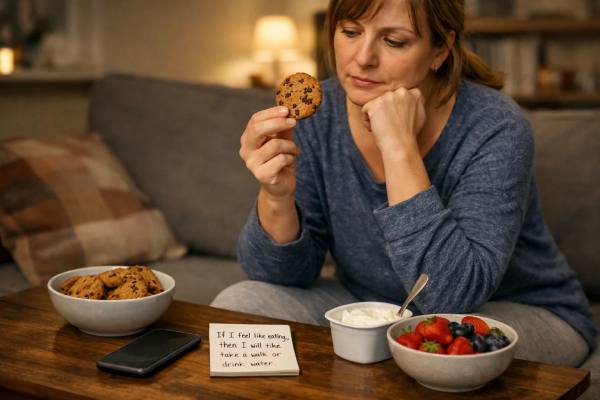
If you tend to eat when you are stressed, lonely, bored, overwhelmed, or mentally drained, the best moment to intervene is usually before the craving takes over. That is where if-then planning can help. Instead of waiting until you are standing in the kitchen arguing with yourself, you decide ahead of time what you will do when a predictable trigger shows up.
This works because emotional eating is rarely random. It usually follows a pattern: a cue, a feeling, an urge, and then a familiar response. In this article, you will learn what if-then planning is, why it can help reduce emotional eating, how to identify your real triggers, how to write plans that hold up in real life, which mistakes make plans fail, and when cravings need more support than planning alone.
Table of Contents
- What if-then planning actually does
- Why it works for emotional eating
- How to spot your real triggers
- How to write an if-then plan
- Real-life if-then examples
- Mistakes that make plans fail
- When you need more than planning
What if-then planning actually does
If-then planning is a simple way to turn a good intention into a specific response. The format is direct:
- If a certain trigger happens,
- then I will do a specific action.
For example:
- If I get home stressed and want to snack immediately, then I will drink a glass of water and sit down for 10 minutes before deciding what to eat.
- If I feel the urge to order dessert after a hard day, then I will make tea first and check whether I am physically hungry.
- If I want to eat because I feel anxious at night, then I will text a friend, shower, or do five slow breaths before opening the pantry.
The reason this matters is that cravings often do not fail at the motivation stage. They fail at the response stage. Most people already know they would like to eat less emotionally. What they do not have is a clear, pre-decided action for the moment the urge actually shows up.
That is why if-then planning is often discussed under the broader idea of implementation intentions. Instead of relying on willpower in the heat of the moment, you create a cue-response link in advance. The plan does not remove every craving, but it reduces hesitation and makes a better response easier to access under stress.
A good if-then plan does three things:
- It names a specific cue
- It gives a specific response
- It is realistic enough to use when you are tired, emotional, or busy
That last point is important. People often write vague plans such as “If I crave junk food, then I will be good.” That is not a plan. It is a wish. The brain needs a clearer instruction than that.
If-then planning also works best when you treat it as a pattern interrupt, not a punishment. The goal is not to scold yourself out of eating. The goal is to create a small pause between feeling and acting. In that pause, you regain options.
This is especially useful because emotional eating often feels fast and automatic. One thought becomes one snack, then one binge-like evening, then regret. If-then planning inserts a tiny decision point before the automatic response takes over.
It is not magic, and it does not mean you will never eat for emotional reasons again. What it does mean is that you stop entering difficult moments unprepared. Instead of hoping you will “be stronger this time,” you already know what you will do.
Why it works for emotional eating
Emotional eating usually happens fast because the urge is not just about food. It is often about relief. The craving is trying to solve something: stress, boredom, anger, loneliness, disappointment, exhaustion, or the need to shut your brain off. Food can become the fastest available comfort, reward, distraction, or numb-out tool.
That is why emotional eating usually starts earlier than the first bite. It begins with a cue: a hard conversation, a lonely evening, a stressful commute, an argument, a work deadline, a TV routine, or the moment you finally sit down after holding it together all day. If you have ever noticed that cravings spike after a certain feeling or situation, you are already seeing the value of identifying emotional eating triggers instead of treating every episode like it came out of nowhere.
If-then planning works because it targets that early part of the chain. It gives your brain a prepared response before the craving becomes the only idea in the room.
There are a few reasons this helps:
- It reduces decision-making under stress. A tired, emotional brain is not great at thoughtful choices.
- It makes coping more automatic. The more often you match the same trigger with the same healthier response, the easier that response becomes.
- It lowers the power of “I do not know what else to do.” Many people emotionally eat because food is the only response they have practiced.
- It interrupts urgency. Cravings often feel immediate. A plan creates a small buffer.
- It makes behavior measurable. “I will cope better” is hard to do. “If I feel stressed at 9 p.m., then I will walk for 10 minutes” is concrete.
This is especially helpful when cravings are linked to mental overload rather than extreme hunger. For example, someone who overeats after a demanding workday may not need another rule about calories. They may need fewer choices and a prepared alternative for the exact moment they hit the wall. That is one reason if-then planning often overlaps with articles on decision fatigue and overeating. The problem is often not knowledge. It is low bandwidth at the wrong moment.
There is also a psychological benefit: planning ahead reduces the feeling that cravings are random attacks. When you know your common triggers and already have a response, cravings feel more manageable and less personal. You stop thinking, “Why do I always do this?” and start thinking, “This is the moment I planned for.”
That shift matters. Emotional eating becomes easier to change when it feels predictable rather than shameful.
Still, the plan has to fit the real function of the eating. If the urge is driven by stress, the replacement response should help with stress. If it is driven by loneliness, the response should include comfort or connection. If it is driven by exhaustion, the response should lower effort, not raise it. That is why generic “just distract yourself” advice often falls flat. A useful plan matches the real reason the craving is happening.
How to spot your real triggers
The strongest if-then plans start with honest trigger awareness. Most people think their trigger is simply “craving food,” but that is usually too late in the chain. The better question is: What tends to happen right before I want to eat emotionally?
Start by looking for repeating patterns in four areas:
- Emotions: stress, sadness, boredom, frustration, loneliness, anxiety, resentment
- Situations: getting home from work, sitting on the couch, scrolling at night, working late, arguing with someone, being alone
- Times: late afternoon, after dinner, 9 p.m., weekends, Sunday nights
- States: tired, overstimulated, mentally drained, underfed, restless
A simple way to do this is to review your last five to 10 episodes of emotional eating and ask:
- What happened just before the urge?
- What was I feeling?
- What time was it?
- Was I physically hungry, emotionally activated, or both?
- What did I want food to do for me?
The answer is often more specific than people expect. It may not be “stress” in general. It may be “I want snacks right after I close my laptop because my brain needs the day to feel over.” Or “I start craving sweets when I feel lonely at night.” Or “I overeat when I skip lunch and then try to be disciplined through dinner.”
This matters because if-then plans only work well when the “if” part is concrete. “If I have emotions” is too broad. “If it is 8:30 p.m. and I start roaming the kitchen after a stressful day” is something you can actually work with.
A lot of people also discover that the trigger is not purely emotional. It is emotional plus routine. For example:
- stress + driving home past a fast-food place
- boredom + sitting down with TV
- exhaustion + being alone after dinner
- frustration + seeing snack foods on the counter
- anxiety + staying up too late
That combination is why emotional eating often feels automatic. It is not just a feeling. It is a feeling attached to a familiar cue and reward loop. If this happens mostly after dark, it may overlap with patterns seen in stress eating at night, where fatigue, routine, and emotional relief all pile up at once.
Keep in mind that some triggers are hidden under more acceptable labels. “I deserve this,” “I need a treat,” “I cannot deal with cooking,” and “I just want something” often signal an emotional or cognitive trigger, not just hunger.
One practical way to find your real triggers is to keep a very short note for one week. You do not need a full food diary. Just jot down:
- the time
- the trigger
- the feeling
- what you did
By the end of the week, you will often see that the cravings are not random at all. They are patterned, which means they are plan-able.
How to write an if-then plan
A good if-then plan is clear enough to follow when you are emotional, tired, distracted, or annoyed. That means it should be short, specific, and realistic.
The easiest format is:
If [clear trigger], then I will [clear action].
The trigger should describe a real moment, not an abstract concept. The action should be something you can actually do in under a few minutes without needing heroic motivation.
Here is the difference between weak and strong planning:
| Weak plan | Why it fails | Stronger plan |
|---|---|---|
| If I crave snacks, then I will be disciplined | Too vague and depends on willpower | If I open the pantry after dinner out of stress, then I will make tea and sit down for 10 minutes first |
| If I feel bad, then I will not eat | Does not offer an alternative | If I feel lonely at night, then I will text one friend before I decide about food |
| If I want sweets, then I will resist | Creates a fight, not a plan | If I want sweets after a hard day, then I will eat my planned snack and reassess 15 minutes later |
| If I am upset, then I will calm down | Not actionable | If I feel overwhelmed after work, then I will change clothes and walk for 10 minutes before going into the kitchen |
When writing your own plans, follow these rules:
- Pick one trigger at a time
- Make the action small enough to do
- Choose a response that matches the need behind the craving
- Keep the wording simple
- Avoid plans that require lots of preparation in the moment
A useful trick is to create response categories based on what the craving is asking for. For example:
- If the craving is asking for comfort, use tea, a shower, a blanket, music, journaling, or calling someone
- If it is asking for relief, use walking, breathing, leaving the kitchen, or ending work
- If it is asking for stimulation, use movement, going outside, or a task switch
- If it is asking for actual fuel, eat a real snack or meal
This is where a practical craving toolkit helps. Your plan becomes much easier to follow when you already know which options work for comfort, which ones work for true hunger, and which ones help with mental overload.
Do not try to write 20 plans at once. Start with one or two high-frequency situations. Repetition matters more than variety. If you nail one important trigger, that one change can reduce a surprising amount of emotional eating.
Also remember that the “then” part does not always have to mean “do not eat.” Sometimes the best plan is a more structured form of eating. For example: “If I get home starving and stressed, then I will eat my preplanned snack before making any other food decision.” That is still a successful if-then plan because it replaces chaos with structure.
Real-life if-then examples
The best if-then plans sound like something a real person would actually do in a real life, not something written by your most motivated self on a Sunday morning.
Here are examples for common emotional-eating situations.
After-work stress
- If I walk in the door feeling overwhelmed, then I will change clothes and take a 10-minute walk before opening the fridge.
- If I want to reward myself with takeout after a hard day, then I will eat the dinner I planned first and decide afterward whether I still want more.
Nighttime loneliness
- If I start wanting sweets because the house feels quiet and lonely, then I will text someone or put on calming music before deciding about food.
- If I feel emotionally flat after dinner, then I will do one non-food comfort activity from my list.
Anger or frustration
- If I want to eat because I am irritated, then I will get out of the kitchen and write down what I am actually angry about.
- If I start rage-snacking after an argument, then I will take a shower or go outside for five minutes before choosing food.
Boredom
- If I feel bored and want snacks while watching TV, then I will knit, stretch, fold laundry, or sip tea with the show instead.
- If I catch myself wandering into the kitchen just to do something, then I will start a five-minute task away from food.
Mental overload
- If my brain feels done and I want easy junk food, then I will choose my easiest decent meal instead of deciding from scratch.
- If I feel decision fatigue at 6 p.m., then I will use one of my default dinners and stop negotiating.
Late-night cravings
- If I want to snack after 9 p.m. and I am not truly hungry, then I will brush my teeth and go to my wind-down routine.
- If I am genuinely hungry before bed, then I will choose one planned option instead of grazing.
These work best when the alternative is both emotionally believable and physically easy. If your plan is too ambitious, your craving will simply ignore it. That is why many people do better with a low-effort option plus comfort. For example, pairing a real snack with a soothing activity can work better than asking yourself to “just stop.” If you need ideas beyond food, this is where learning to self-soothe without food can make your plans much stronger.
Environment also matters. A plan is easier to follow when the better option is visible and convenient. If your common trigger is kitchen roaming, it helps to make healthy choices easier at home before the craving starts, not after.
One more tip: read your plans out loud. If they sound stiff, unrealistic, or complicated, simplify them. Your real test is not whether the plan sounds smart. It is whether you can remember and use it while upset.
Mistakes that make plans fail
If-then planning is simple, but it can still fail for predictable reasons. Most of those failures do not mean the method is useless. They mean the plan was written in a way that could not survive real life.
The first common mistake is choosing a trigger that is too vague. “If I feel bad” does not tell your brain enough. A stronger cue sounds like “If it is 9 p.m. and I am walking toward the pantry after a stressful day.”
The second mistake is choosing a response that is too big. A plan like “If I feel upset, then I will do a full workout, meal prep, and journal” asks too much from the exact state that makes follow-through hard. Better plans are shorter and lower-friction.
The third mistake is forgetting physical hunger. Some people try to treat every craving like a pure emotion problem when the real issue is that meals were delayed, protein was low, or the day was under-fueled. In that situation, an if-then plan should include eating enough, not just resisting. This is one reason regular structure and meal routine consistency often reduce cravings before special coping strategies are even needed.
The fourth mistake is expecting the plan to erase the craving. The purpose of the plan is not to make you feel nothing. It is to guide what you do next. You can still want the food and follow the plan anyway.
The fifth mistake is using the plan as an all-or-nothing test. People sometimes miss one cue and then decide the whole approach failed. That turns one imperfect moment into another reason to emotionally eat. The better mindset is to treat the plan like practice, not proof of your worth.
The sixth mistake is ignoring fatigue and sleep. Cravings are harder to manage when you are under-rested, and even a good plan feels weaker when exhaustion is high. If you regularly overeat at night after short sleep, it may help to address the sleep side too, especially if poor sleep makes you hungrier than expected.
The seventh mistake is having no backup plan. Sometimes your first response will not fit the situation. If walking is not possible, what is your second option? Good planning often includes a backup:
- If I cannot leave the house for a walk, then I will pace indoors for five minutes.
- If I cannot call a friend, then I will voice-note what I am feeling.
- If I do not want my planned snack, then I will choose from my backup list.
A final mistake is creating plans that fight your life instead of fitting it. If your evenings are chaotic, your plan should be simple enough for chaotic evenings. If you have kids, shift work, or unpredictable stress, your plan needs to work in that reality.
A plan does not have to be perfect to be useful. It just has to be clear enough to interrupt the old pattern more often than it used to.
When you need more than planning
If-then planning is a strong tool, but it is not the whole answer for everyone.
If cravings feel occasional, predictable, and linked to everyday triggers, planning may help a lot. But if eating feels truly out of control, highly distressing, or tied to deeper emotional pain, the issue may need more support than a self-help strategy can provide.
Look more closely if you notice:
- frequent binge-like episodes
- eating in secret
- strong shame after eating
- repeated cycles of restriction and rebound overeating
- emotional eating that happens almost daily
- major anxiety, depression, trauma, or loneliness driving the urge
- little improvement even when your plans are specific and consistent
In those situations, if-then planning can still be part of the solution, but it may need to sit alongside therapy, nutrition support, treatment for binge eating, or broader work on stress, sleep, and mood. Sometimes the craving is not just a habit loop. It is a coping system that has been carrying too much for too long.
It also helps to be honest about whether the eating is emotional, environmental, or both. If your plan is good but every trigger food is visible, hyper-convenient, and tied to a nightly routine, environment may still be running the show. If your plan works during calm weeks but falls apart under stress, the deeper issue may be recovery, support, and nervous system load rather than planning alone.
That is why long-term progress often depends on building layers:
- one or two if-then plans
- better sleep and stress recovery
- steadier meals
- a less triggering home environment
- more realistic self-talk after slip-ups
And when you do slip, the response matters. A missed cue or an overeating episode does not cancel the method. It just gives you information about where the plan needs work. That is where a reset mindset, rather than shame, becomes useful. It can help to think in terms of lapses versus relapses: one rough moment is data, not destiny.
The bigger goal is not to become someone who never has cravings. It is to become someone who is ready for them. That shift alone can lower the feeling of chaos around food and make emotional eating easier to interrupt before it turns into another night of regret.
References
- Emotional Eating Interventions for Adults Living With Overweight and Obesity: A Systematic Review and Meta-Analysis of Behaviour Change Techniques 2025 (Systematic Review and Meta-Analysis)
- The role of emotion in eating behavior and decisions 2023 (Review)
- Feasibility and acceptability of a theory-based online tool for reducing stress-induced eating 2024 (Study)
- Effects of Information Length and Implementation Intentions on Adherence to Weight Management Strategies: Experimental Study 2025 (Experimental Study)
Disclaimer
This article is for general educational purposes only and is not a substitute for medical, nutrition, or mental health care. If emotional eating feels compulsive, causes significant distress, or happens alongside binge eating, depression, anxiety, or trauma-related symptoms, seek support from a qualified clinician.
If this article helped you, consider sharing it on Facebook, X, or your preferred platform with someone who wants a practical way to interrupt cravings before they turn into emotional eating.