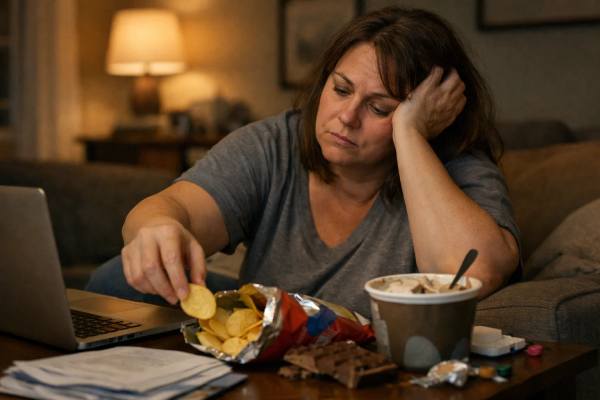
If you eat reasonably well earlier in the day and then suddenly want chips, sweets, takeout, or “whatever is easiest” by evening, that is not just a lack of discipline. Mental fatigue changes how you make decisions, and food decisions are some of the easiest to shift when your brain is running low on attention, patience, and self-control.
That is where decision fatigue and overeating often meet. After a long day of work, errands, messages, choices, stress, and interruptions, the brain starts leaning toward relief, reward, and convenience. This article explains what decision fatigue really is, why mentally tired days make cravings louder, what this looks like in daily life, and how to build routines that reduce overeating without relying on endless willpower.
Table of Contents
- What decision fatigue really means
- Why mental fatigue makes food harder to regulate
- How decision fatigue shows up around food
- Why evenings are often the danger zone
- What to do when a mentally tired craving hits
- How to build a low-decision eating system
- When it may be more than decision fatigue
What decision fatigue really means
Decision fatigue is the mental wear-and-tear that builds up after repeated choices, constant problem-solving, interruptions, and self-control demands. It is not a medical diagnosis, and it is not simply “being weak.” It is a practical way to describe what happens when the brain gets less willing to keep evaluating options carefully.
Food is one of the first places this shows up because eating decisions are frequent, emotional, convenient, and highly rewarding. By the time dinner or late-night snacking rolls around, you may have already spent hours choosing what to answer, fix, plan, prioritize, ignore, postpone, buy, sign, and remember. At that point, “What should I eat?” is not a small question. It is often one choice too many.
This does not mean every overeating episode is caused by decision fatigue. Hunger, stress, habit, poor sleep, skipped meals, emotions, and food environment all matter too. But mental fatigue often acts like an amplifier. It makes cravings feel more convincing, healthy choices feel more effortful, and quick comfort feel more justified.
A useful way to think about it is this:
- Decision fatigue reduces friction tolerance. You stop wanting to chop, prep, portion, cook, and think.
- It raises the appeal of reward. Hyper-palatable foods feel more tempting when your brain wants relief.
- It weakens pause-and-plan skills. You are less likely to ask, “Am I actually hungry?” before eating.
- It pushes you toward defaults. You repeat habits, order the usual, or grab what is closest.
This is why mentally tired people often say things like:
- “I just wanted something easy.”
- “I could not deal with cooking.”
- “I did not even think about it.”
- “I deserved a treat after that day.”
- “I was too tired to make the better choice.”
Those are not random excuses. They describe the exact conditions under which overeating becomes more likely: low mental energy, high reward-seeking, and a strong pull toward convenience.
There is also a subtle emotional side to this. Decision fatigue does not always feel dramatic. Sometimes it feels like irritability, boredom, indecision, restlessness, or the need to be “done” with the day. Food can become a fast way to end the mental effort. That is one reason decision fatigue often overlaps with emotional eating triggers, even when the main problem is cognitive overload rather than strong emotion.
The most helpful takeaway is that overeating on mentally tiring days is often less about knowledge and more about brain bandwidth. That changes how you should respond. You usually do not need more nutrition rules in that moment. You need fewer decisions.
Why mental fatigue makes food harder to regulate
When your brain is mentally tired, three things tend to happen at once.
First, your executive control gets less reliable. That is the set of skills involved in planning, inhibiting impulses, holding goals in mind, and choosing the better long-term option instead of the easiest short-term one. When those skills are taxed, it becomes harder to resist obvious food cues, stop at one portion, or follow through on a plan you made earlier in the day.
Second, your brain becomes more interested in reward and relief. After sustained effort, quick pleasure starts to feel more valuable. That does not always mean extreme overeating. Sometimes it looks smaller and sneakier: grazing while cooking, adding dessert you were not hungry for, ordering takeout instead of eating what you had planned, or eating “something sweet” because your brain wants the day to feel easier.
Third, mentally tired states often reduce your willingness to tolerate even minor effort. A healthy meal can suddenly feel like too much work if it requires chopping vegetables, washing dishes, defrosting protein, or deciding between three decent options. The result is not just impulsive eating. It is effort-avoidant eating.
This is one reason cravings often feel stronger when you are mentally drained even if your physical hunger is moderate. The craving is not always for calories alone. It is often for simplicity, stimulation, comfort, and closure.
A few common patterns drive this further:
- Choice overload: Too many possible meals, snacks, rules, or plans create more mental strain, not less.
- Skipped structure: If you have not eaten enough earlier, mental fatigue hits a body that is already under-fueled.
- Stress spillover: Pressure, time urgency, and frustration make reward-seeking more likely.
- Cue reactivity: Visible, convenient, high-reward foods become harder to ignore when control is low.
- All-or-nothing thinking: Once tired, people often stop aiming for “good enough” and switch to “forget it.”
That last point matters. Mentally tired people do not just crave more. They often judge themselves more harshly for craving more, which creates a second layer of stress. Then the thought becomes, “I already messed up, so I might as well keep going.” This is where decision fatigue can blend into all-or-nothing thinking and make one tired choice turn into a full evening of overeating.
There is also an indirect link through sleep and recovery. If you are consistently under-rested, your baseline mental bandwidth drops, and food decisions become harder earlier in the day. That is one reason poor sleep can make you hungrier and less able to regulate cravings even before stress enters the picture.
So when you crave more while mentally tired, the real story is often not “I have no self-control.” It is closer to: “My planning system is tired, my reward system is louder, and the easiest food option now has a much stronger pull.”
How decision fatigue shows up around food
Decision fatigue rarely announces itself clearly. Most people do not think, “I am now experiencing reduced executive control around food.” They think, “I need a snack,” “I cannot be bothered,” or “I earned this.”
That is why it helps to recognize the pattern.
Common signs include:
- Standing in the kitchen wanting food but not knowing what you want
- Rejecting several decent meal options because none sound easy enough
- Ordering takeout after already planning dinner
- Snacking while deciding what to eat
- Eating more from convenience foods simply because they require no effort
- Craving salty, crunchy, sweet, or highly processed foods after a mentally packed day
- Feeling strangely urgent around food, as if eating will make the day feel finished
- Continuing to eat even after the first few bites no longer taste especially good
A practical distinction is whether you are experiencing physical hunger or mental-depletion eating. They can overlap, but they are not identical.
| Pattern | Physical hunger | Decision-fatigue eating |
|---|---|---|
| Build-up | Comes on gradually | Often hits suddenly after work, stress, or many decisions |
| Food preference | Many foods sound acceptable | Usually wants something easy, rewarding, or specific |
| Thought pattern | “I need food” | “I cannot deal with this” or “I need something now” |
| After eating | Usually feels settled | May still feel unsatisfied, guilty, or ready for more |
| Best response | Eat a balanced meal or snack | Reduce effort, add structure, and pause before reacting |
The most important thing to notice is that decision-fatigue eating often looks less like true appetite and more like cognitive escape. You are trying to get out of effort. Food just happens to be one of the fastest exits.
This also explains why some cravings get stronger when the day has involved nonstop communication, caretaking, meetings, scheduling, or emotional labor. You may not be physically exhausted, but you are mentally saturated. That is especially common for people in caregiving roles, desk jobs, customer-facing work, and busy household management. If that sounds familiar, a lot of these patterns overlap with everyday office worker weight-loss habits and end-of-day food decisions.
Once you can spot the pattern, you stop treating every craving as a personal failure. You start seeing it as a predictable state that needs a smarter setup.
Why evenings are often the danger zone
Many people notice that decision fatigue and overeating hit hardest at night. That is not an accident.
By evening, several risk factors often stack on top of each other:
- Mental effort from the day has accumulated
- Food choices have already been made many times
- Stress may still be active in the body
- Physical hunger may be real if meals were delayed or too light
- Self-monitoring is weaker
- Reward-seeking is stronger
- Tempting foods are more available at home
- The social pressure to “be productive” is over, so permission to let go increases
This is why someone can feel in control at lunch and totally different at 9 p.m. The evening version of you is not operating with the same cognitive resources as the morning version of you.
Another reason nights are difficult is that food becomes a transition ritual. After work, parenting, commuting, or constant screen time, the brain wants a fast signal that the effort phase is over. Snacking, dessert, takeout, and mindless eating in front of a show can all serve that purpose. In many cases, the eating is not just about hunger. It is about decompression.
That is why decision fatigue often overlaps with stress eating after work and other nighttime habit loops. When people say, “I do great all day and then ruin it at night,” they are often describing the point where self-control, structure, and emotional bandwidth are at their lowest.
Sleep also matters here. If your schedule is inconsistent, bedtime is late, or you are regularly short on sleep, evening regulation tends to get worse. Mental fatigue builds faster, cravings feel louder, and “I will do better tomorrow” becomes a nightly script. That is one reason sleep consistency for weight loss matters even when the overeating itself happens in the kitchen, not the bedroom.
A second issue is meal timing. Some people interpret late-day cravings as proof that they have no control, when the real problem is that breakfast was tiny, lunch was rushed, and protein and fiber were too low. Decision fatigue makes that under-fueling problem harder to manage because it reduces your odds of making a steady correction. The tired brain does not usually ask for grilled chicken, potatoes, and vegetables. It asks for the fastest reward available. This is where regular eating patterns and consistent meal times can make overeating less likely before willpower even enters the picture.
Evening overeating is rarely caused by one thing. It is usually a pile-up: mental fatigue, delayed hunger, stress, habit, convenience, and poor recovery. That is why the fix works better when it reduces the whole pile-up instead of blaming one craving.
What to do when a mentally tired craving hits
When you are mentally tired and want to eat everything, the goal is not to deliver a lecture to yourself. The goal is to lower the chance of an automatic reaction.
A useful first step is a very short pause, not a long battle. Ask one question: What am I actually needing right now: food, relief, stimulation, or a break? You do not need a perfect answer. You just need enough awareness to interrupt autopilot.
Then use a simple response that reduces effort.
A practical sequence looks like this:
- Make the next choice smaller. Do not solve the entire night. Decide only what the next five to ten minutes will look like.
- Add something structured before something fun. For example, eat a real snack with protein and fiber first, then reassess.
- Reduce food exposure while deciding. Step away from open packages, delivery apps, and kitchen browsing.
- Use a preset plan. This is where implementation intentions can work well: “If I get home mentally wiped out and want to snack, then I will eat my preplanned snack and wait 10 minutes before deciding on anything else.”
- Change state, not just thoughts. Drink water, take a quick walk, wash your face, shower, or sit somewhere other than the kitchen.
The best “in the moment” foods are usually those that calm real hunger without turning into a full spiral. Think easy combinations such as yogurt and fruit, eggs on toast, cottage cheese and berries, a turkey wrap, protein oatmeal, or another simple option from your own craving toolkit. The point is not that these foods are magical. It is that they reduce both hunger and decision load.
A few phrases can also help when the tired brain starts negotiating:
- “I do not need the perfect dinner. I need the easiest decent one.”
- “This is probably mental fatigue, not a food emergency.”
- “I can eat, but I do not have to eat impulsively.”
- “Good enough beats regret.”
- “My future self needs fewer decisions, not more rules.”
One mistake to avoid is trying to white-knuckle the craving while staying in the same environment. If you are standing in front of snack foods, scrolling takeout apps, or arguing with yourself in the kitchen, you are still feeding the loop. Movement and environmental shifts often work better than more thinking.
Another mistake is waiting too long to eat because you are trying to “be good.” Mentally tired people often do better with a calm, structured snack or meal than with more restraint. Restriction and fatigue are a bad combination.
The main skill here is not heroic discipline. It is using a short, repeatable script that still works when your brain is tired.
How to build a low-decision eating system
The most effective way to manage decision fatigue and overeating is to make fewer food decisions when you are least able to make them well.
That means building a system that your tired self can follow without much thought.
Start by reducing unnecessary choice. Many people assume more options are better, but during mentally tiring weeks, too much choice often leads to takeout, snacking, or random eating. A short menu of repeat meals is usually more helpful than a huge list of “healthy ideas.”
A low-decision system often includes:
- Three to five default breakfasts
- Three to five default lunches
- A short rotation of easy dinners
- Two or three reliable emergency meals
- Pre-decided snacks that are filling and quick
- A grocery list that supports those same repeats
This is where meal planning habits help even if you dislike formal meal prep. Planning does not have to mean a full week of containers. It can just mean deciding in advance what your tired self is most likely to eat.
An effective setup also makes the better choice easier to see and the more impulsive choice slightly harder to reach. That might mean keeping fruit washed, protein ready, frozen vegetables stocked, bread or wraps on hand, and high-trigger foods less visible. The goal is not to create a punishment environment. It is to make healthy choices easier at home when your mental bandwidth is low.
A simple example of a low-decision dinner system:
- Protein: rotisserie chicken, eggs, Greek yogurt, tuna, tofu, or pre-cooked meat
- Carbs: rice, potatoes, wraps, pasta, or good frozen options
- Produce: bagged salad, frozen vegetables, pre-cut vegetables, fruit
- Flavor: one or two sauces you actually like
That turns dinner from an open-ended problem into assembly. Mentally tired people do better with assembly than with creative decision-making.
It also helps to match your food system to your real life rather than your ideal self. If you keep planning complicated weeknight recipes and then ordering food instead, the problem is probably not motivation. The plan is too effort-heavy for your actual evenings.
Finally, protect the non-food factors that lower decision fatigue in the first place:
- stable sleep
- realistic work boundaries
- breaks during the day
- not skipping meals
- fewer unnecessary food rules
- some movement to reset attention
When these are in place, your food choices do not need to depend so heavily on willpower. They become the path of least resistance, which is exactly what you want when mental energy is low.
When it may be more than decision fatigue
Decision fatigue is common, but it is not the right explanation for everything.
If overeating is frequent, intense, highly distressing, or feels truly out of control, there may be more going on than a mentally tiring day. That does not mean you are failing. It means the pattern may need a different kind of support.
Look more closely if you notice things like:
- recurrent episodes of feeling unable to stop eating
- eating very large amounts quickly and in secret
- strong shame after eating
- regular nighttime eating that feels compulsive
- using food mainly to numb anxiety, sadness, anger, or loneliness
- constant food noise that does not improve with better planning or sleep
- repeated cycles of restriction and rebound overeating
In those cases, decision fatigue may still be part of the picture, but it is probably not the whole picture. Emotional eating, chronic stress, sleep problems, depression, binge eating, medication effects, or overly restrictive dieting may also be involved. For example, some people believe they have a willpower problem when they are actually stuck in a cycle of under-eating and rebound snacking or in a pattern of stress eating at night that needs more than meal prep.
It is also worth paying attention to the emotional tone around the eating. Decision-fatigue eating often sounds like, “I was too tired to deal with dinner.” Emotional overeating more often sounds like, “I needed comfort,” “I wanted to shut my brain off,” or “Food was the only thing I was looking forward to.” The patterns can overlap, but the emphasis matters.
You should also consider professional support if the problem has become a major barrier to weight loss, mental health, or daily functioning. A doctor, registered dietitian, or therapist with experience in eating behavior can help you separate normal mental-fatigue eating from something more disruptive.
The reassuring part is that many people improve dramatically once they stop framing the issue as “I need more discipline” and start asking better questions: Am I under-rested? Am I under-fed? Is my food environment doing the deciding for me? Am I relying on self-control at the exact time of day when I have the least of it?
Those questions lead to better solutions than self-blame.
References
- The Effect of Decision Fatigue on Food Choices: A Narrative Review 2025 (Review)
- Self-Regulation in Eating Behaviors: The Role of Executive Function in Response to Food Stimuli 2024 (Study)
- Food Choices after Cognitive Load: An Affective Computing Approach 2023 (Study)
- Stress and eating behaviours in healthy adults: a systematic review and meta-analysis 2022 (Systematic Review and Meta-Analysis)
- Emotional Eating Interventions for Adults Living With Overweight and Obesity: A Systematic Review and Meta-Analysis of Behaviour Change Techniques 2025 (Systematic Review and Meta-Analysis)
Disclaimer
This article is for general educational purposes only and is not a substitute for medical, nutrition, or mental health care. If overeating feels compulsive, causes significant distress, or happens alongside binge eating, depression, or persistent sleep problems, seek personalized advice from a qualified clinician.
If this article helped you, consider sharing it on Facebook, X, or your preferred platform with someone who keeps blaming “willpower” when the real problem may be mental overload.