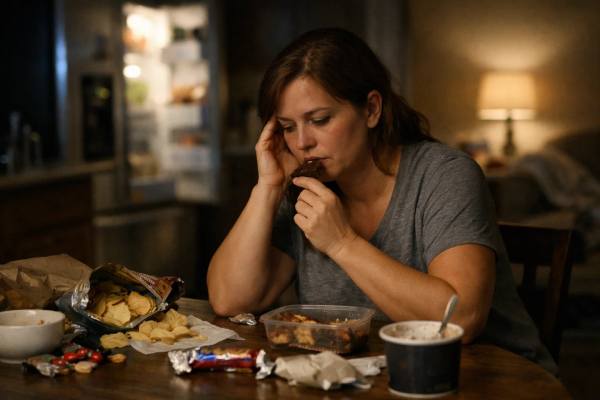
Stress eating at night often feels confusing because it can look like hunger, habit, exhaustion, and emotion all at once. You may get through the day feeling “good,” then suddenly want chips, sweets, takeout, or repeated trips to the kitchen once the evening gets quiet. That pattern is common, and it usually has less to do with weak willpower than with stress load, mental fatigue, sleep pressure, under-eating earlier in the day, and the way your environment is set up at night.
The good news is that night stress eating is usually very changeable. Once you understand what is driving it, you can reduce the urges, make nighttime eating less automatic, and handle genuine evening hunger without feeling out of control.
Table of Contents
- What night stress eating really is
- How to tell stress eating from hunger
- Why it keeps happening at night
- What to do when the urge hits
- How to build an evening routine that helps
- What to eat if you are actually hungry
- When to get extra support
What night stress eating really is
Stress eating at night is the pattern of turning to food in the evening mainly for relief, distraction, reward, or comfort rather than for clear physical hunger. It can happen after work, after the kids are asleep, after an argument, or simply when the day’s demands finally stop and your brain has enough space to notice how depleted you feel.
Nighttime makes this pattern more likely for several reasons. First, self-control is not endless. After a long day of decisions, deadlines, commuting, caregiving, or social masking, your brain is usually less interested in restraint and more interested in immediate relief. Second, evening is often the first quiet moment of the day. Emotions you pushed aside at 10 a.m. may show up at 9 p.m. Third, highly palatable foods are often easiest to access at night: snack foods in the pantry, delivery apps, leftovers, or desserts tied to “finally relaxing.”
Stress eating at night also tends to feel automatic. Many people do not sit down and decide, “I am stressed, so I will eat.” They drift into it. One snack becomes grazing. One small treat becomes a full second dinner. The eating may happen while standing in the kitchen, watching TV, scrolling on the phone, or cleaning up after everyone else. That automatic quality is important because it means the habit often runs on cues, not just cravings.
It is also important to separate night stress eating from moral language. This is not a character flaw. It is usually a coping pattern. Food works quickly: it gives sensory comfort, reward, structure, and a temporary drop in tension. The problem is not that it “works” in the moment. The problem is that it rarely solves the real issue underneath and often leaves behind discomfort, poor sleep, guilt, or the sense that evenings are out of control.
A helpful reframe is this: night stress eating is often your nervous system asking for relief in the fastest way it knows. When you treat it that way, you stop fighting yourself and start building better ways to recover at the end of the day.
How to tell stress eating from hunger
One reason this habit is hard to break is that real hunger and stress-driven eating can overlap. You might genuinely need food and also want comfort. You might be physically underfed from the day and emotionally worn down at the same time. The goal is not to become perfect at labeling every urge. The goal is to get good enough at spotting the dominant driver.
| Pattern | Usually shows up as | Typical clues | What helps most |
|---|---|---|---|
| Physical hunger | Gradual, steady need to eat | Stomach hunger, low energy, food sounds broadly appealing, you would eat a balanced snack or meal | A satisfying snack or meal with protein and fiber |
| Stress eating | Urgent desire for relief | Comes on fast, feels tied to a mood or event, specific craving for highly rewarding foods, eating does not fully satisfy | Pause, regulate stress, then decide whether food is still needed |
| Habit eating | Automatic routine | Starts at the same time or with the same cue, such as TV, couch time, or finishing chores | Change the cue or replace the routine |
A simple set of questions can help:
- Did this urge build gradually, or did it hit like a switch?
- Would a basic option like yogurt, eggs, fruit, soup, or toast sound good, or do I want only chips, chocolate, ice cream, or takeout?
- Did I eat enough earlier today?
- What happened in the last hour? Stressful email, loneliness, boredom, conflict, fatigue, or screen time?
- If I pause for ten minutes, does the urge drop, stay the same, or get stronger?
True hunger is usually more flexible. Stress eating is usually more specific and urgent. Habit eating is more clock-based and cue-based. Boredom eating can feel similar too, which is why it helps to understand the difference between boredom eating and stress eating when your evenings all start to blur together.
One more nuance matters: not every evening craving should be resisted. If you ate lightly all day, had a workout, or finished dinner too early, nighttime hunger may be normal. Trying to “be good” and ignore real hunger often backfires into stronger cravings later. The more accurate skill is not “never eat at night.” It is “respond to the right need.”
Why it keeps happening at night
Night stress eating usually has more than one cause. The most common pattern is a stack of smaller pressures rather than one dramatic trigger.
Stress and mental fatigue
A stressful day can raise emotional intensity and lower decision quality at the same time. By evening, you may be less patient, less planful, and more reward-seeking. Food becomes an easy off-switch. This is especially common after long workdays, caregiving, conflict, or emotional labor. If that sounds familiar, the pattern is closely related to emotional eating after a hard day.
Under-eating earlier in the day
Many people who struggle with nighttime overeating accidentally set it up in the morning and afternoon. Skipped breakfast, tiny lunches, “being good” all day, or trying to save calories for later can produce a rebound effect. By night, your body wants energy and your brain wants reward. That combination is powerful.
Poor sleep and circadian disruption
Sleep loss does not just make you tired. It tends to make appetite regulation harder, cravings louder, and highly rewarding foods more tempting. When your sleep is short, irregular, or low quality, nighttime eating often gets easier to justify and harder to stop. This is one reason poor sleep can intensify hunger and make evening cravings feel stronger than they “should.”
Conditioned cues
Your brain learns patterns quickly. Sit on the couch, open a streaming app, dim the lights, and your brain may expect snacks whether you are hungry or not. The same can happen with cleaning the kitchen, putting the kids to bed, answering late emails, or showering. Once the cue and the reward link up enough times, the urge appears before you even decide.
Delayed emotions
Some people do not feel stressed in real time. They feel “fine” during the day because they are in performance mode. Then, once the day ends, the nervous system drops out of task mode and the feelings show up. Food becomes a fast way to numb, soften, or distract from what finally surfaces.
Overrestriction and all-or-nothing thinking
If your mental rule is “I was perfect until 8 p.m. and then I blew it,” that mindset can turn one snack into a full binge-like evening. Shame does not prevent overeating; it often prolongs it. The more rigid the food rules, the more likely nighttime becomes the time they snap.
This is why lasting change rarely comes from more discipline alone. You have to reduce the load on the system: eat earlier, sleep better, lower friction around healthy options, change environmental cues, and build a better end-of-day recovery routine.
What to do when the urge hits
The best moment to interrupt stress eating is the first two minutes, before the pattern fully takes over. You do not need a dramatic intervention. You need a short sequence that is easy enough to use when you are tired.
Try this five-step reset:
- Name what is happening.
Say it plainly: “I want relief,” “I am overstimulated,” “I am lonely,” or “I am actually hungry.” Labeling the moment reduces autopilot. - Create a tiny pause.
Set a timer for ten minutes. You are not banning food. You are delaying the automatic reaction. - Regulate your body first.
Do one fast calming action:
- Take 5 slow breaths with a longer exhale
- Drink water or tea
- Wash your face
- Step outside for two minutes
- Stretch your shoulders and jaw
- Walk around the room once or twice If you need a simple starting point, these kinds of breathing exercises for stress eating cravings can take the edge off quickly.
- Decide whether the need is food, comfort, or both.
If it is food, eat something structured. If it is comfort, do one comfort action before or alongside food instead of expecting food to do the whole job. - Make eating intentional if you still want it.
Put the food on a plate or in a bowl. Sit down. Turn off the standing-at-the-counter mode. This alone can reduce the “what just happened?” feeling later.
A good in-the-moment rule is: pause, soothe, then choose.
That second step matters because a lot of night stress eating is really self-soothing. Food is only one version of self-soothing, not the only version. Building a few alternatives makes evenings much easier:
- a hot shower
- ten minutes of quiet music
- changing into comfortable clothes
- journaling one page
- texting one supportive person
- a short walk
- a heating pad or blanket
- herbal tea and a dimmer room
That is the same principle behind learning how to self-soothe without food. You are not trying to become someone who never wants comfort. You are becoming someone with more than one route to it.
If the urge feels overwhelming, lower the bar. Do not aim for perfection. Aim to make the episode smaller, slower, and more conscious than usual. That still counts as progress.
How to build an evening routine that helps
Night stress eating usually improves fastest when you stop treating it as a food problem only. It is often an evening structure problem. The less predictable and restorative your nights are, the easier it is for food to become the default.
A strong evening routine does three jobs:
- it lowers stress,
- it reduces cue-driven snacking,
- and it makes sleep easier.
Start by identifying your danger window. For many people, it is not “night” in general. It is a specific stretch, such as 8:30 to 10:30 p.m. That is the window to redesign.
Here is a simple template:
1. Close the day on purpose
Create a clear endpoint for work, chores, and mentally open loops. Spend five minutes writing tomorrow’s top tasks, tidying one visible surface, or setting out breakfast items. This helps your brain stop searching for unresolved problems.
2. Eat dinner that actually satisfies
A very light dinner often leads to pantry wandering later. Include protein, fiber, and enough total food volume to feel finished. A meal that is too small may look “disciplined” but often creates stronger urges an hour later.
3. Decide your post-dinner script in advance
Do not wait until you are drained to invent a better behavior. Choose it before night begins. This is where if-then planning for cravings works well. For example:
- If I want snacks right after a stressful email, then I will walk for five minutes first.
- If I want dessert because I feel flat, then I will make tea and sit down before deciding.
- If I am truly hungry at 9:30 p.m., then I will eat a planned snack.
4. Reduce exposure to your strongest cues
If TV triggers snacking, change the setup. Keep snacks out of the living room. Brush your teeth after dinner. Close the kitchen. Use smaller lights instead of bright kitchen lighting that keeps the “food zone” active. A full night routine to prevent overeating is often more effective than one isolated rule.
5. Make winding down feel rewarding
Many people snack because evening is their only reward. If all healthy advice feels like deprivation, it will not last. Build a wind-down you genuinely like: a show, book, blanket, bath, skin care, stretching, or low-effort hobby. The key is to make the new routine feel like relief, not punishment.
Do not try to overhaul everything in one week. Pick one friction point and one support:
- friction point: eating from the bag on the couch
- support: pre-portion a snack or close the kitchen after tea
Small evening systems beat big promises. The goal is not to create a perfect night. It is to make the easier choice visible when you are tired.
What to eat if you are actually hungry
Sometimes the right answer is simply to eat. The trick is choosing a snack that reduces hunger without turning into a long, unstructured eating session.
The most helpful late-evening snack is usually:
- moderate in calories,
- high enough in protein or fiber to satisfy,
- easy to portion,
- and calm enough that it does not trigger a “keep going” spiral.
Useful options include:
- Greek yogurt with berries
- cottage cheese and fruit
- apple with peanut butter
- toast with turkey or eggs
- oatmeal
- a small protein smoothie
- high-protein cereal with milk
- soup with crackers
- hummus with vegetables and pita
If you want more ideas, a list of late-night snacks for weight loss can help you build a few default options instead of improvising every night.
Two rules make a big difference here.
Choose structure over scavenging
“Just a few bites” from multiple foods often turns into more total intake than a real snack would. Pick one option, portion it, and sit down to eat it.
Fix the day, not just the night
If you need a snack every night because dinner is early or light, that may be fine. But if you need one because you are arriving at 9 p.m. underfed from the whole day, the better fix is earlier nutrition. More consistent eating patterns often reduce evening urgency. That is one reason regular meal timing for appetite control can make nighttime cravings easier to manage.
It also helps to know your trigger foods. Some foods are easy to eat moderately when hungry. Others are difficult to stop once opened, especially under stress. There is nothing morally wrong with that. It is just useful information. Foods that are highly salty, sweet, crunchy, creamy, or eaten directly from the package tend to be less forgiving during stressful evenings.
A practical compromise is to keep both kinds of foods in mind:
- stabilizing foods for real hunger
- high-trigger foods for times when you know stress is high and stopping will be harder
That way you are not relying on willpower at your most depleted time of day.
When to get extra support
Occasional stress eating at night is common. Frequent, distressing, or escalating night eating deserves more attention. The right response is not shame. It is support and a closer look at what is driving the pattern.
Consider professional help if:
- night eating happens most nights of the week
- you regularly feel out of control once eating starts
- you hide food or feel intense guilt afterward
- the pattern is affecting sleep, mood, digestion, or weight in a major way
- you wake up to eat repeatedly
- you restrict heavily during the day and then binge at night
- you have depression, anxiety, trauma symptoms, or chronic stress that feels unmanageable
- you have episodes of eating with little awareness or memory
A doctor, registered dietitian, therapist, or psychologist can help sort out whether the issue is mainly stress eating, rebound eating from under-fueling, a sleep-related pattern, or a more serious eating disorder concern. That distinction matters because the best solution depends on the true driver.
Treatment often helps more than people expect because it is not only about “stop eating at night.” It can include:
- better daytime meal structure
- cognitive behavioral strategies
- stress management skills
- sleep improvement
- emotional regulation work
- binge eating treatment when needed
One more reminder is important: you do not need to wait until the problem looks dramatic. If your evenings feel like a daily battle and it is wearing you down, that is already enough reason to ask for help.
The most effective mindset is not “I need more discipline tonight.” It is “What is this pattern trying to do for me, and what would help more?” Once you answer that honestly, change gets much easier.
References
- Stress and eating behaviours in healthy adults: a systematic review and meta-analysis 2022 (Systematic Review and Meta-Analysis)
- The role of insufficient sleep and circadian misalignment in obesity 2023 (Review)
- Emotional Eating Interventions for Adults Living with Overweight or Obesity: A Systematic Review and Meta-Analysis 2023 (Systematic Review and Meta-Analysis)
- Clinical and genetic associations for night eating syndrome in a patient biobank 2024 (Study)
- Managing Stress 2025 (Government Guidance)
Disclaimer
This article is for general educational purposes only and is not a substitute for medical advice, diagnosis, or treatment. If night eating feels compulsive, disrupts your sleep, involves bingeing or eating with little awareness, or happens alongside anxiety, depression, or major weight changes, speak with a doctor or licensed mental health professional.
If this article helped, consider sharing it on Facebook, X, or your preferred platform so someone else who struggles with nighttime stress eating can find it too.