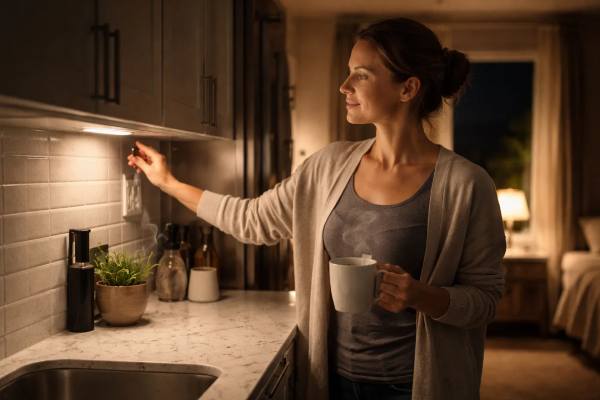
Nighttime overeating rarely starts with a lack of willpower at 9:30 p.m. It usually starts earlier, with accumulated hunger, stress, decision fatigue, screen time, and an evening that has no structure once the day slows down. That is why a good night routine can make such a big difference for weight loss. It reduces the number of choices you have to make when you are tired, lowers the pull of stress eating, and makes staying on track feel easier instead of stricter.
This article explains why nights are such a common problem spot, what a realistic anti-overeating routine actually looks like, how to handle real hunger without spiraling, and how to build evening habits that protect both your appetite and your sleep.
Table of Contents
- Why nighttime is such a common overeating window
- What a night routine needs to fix
- The first hour after dinner matters most
- How to build a simple night routine
- What to do if you are truly hungry at night
- How to handle stress, screens, and late-day fatigue
- How to recover after a bad night without giving up
Why nighttime is such a common overeating window
A lot of people do fairly well during the day, then feel as if everything falls apart at night. That pattern is so common because nighttime brings together several overeating triggers at once.
By evening, many people are dealing with some combination of physical hunger, mental fatigue, emotional stress, boredom, and easier access to snack foods. The structure of the day is also gone. Meetings are over, errands slow down, and there is finally space to feel tired, disappointed, lonely, restless, or under-rewarded. Food becomes an easy form of relief.
Nighttime overeating also tends to feel more automatic than daytime overeating. At lunch, you might still be making active decisions. At night, habits often take over. You sit in the same chair, turn on the same show, use the same app, or pass through the same kitchen path. Once that happens enough times, the brain begins to expect food as part of the evening script.
This is why overeating at night is often less about hunger alone and more about a pattern like this:
- You get through the day.
- Your structure drops.
- Stress or fatigue catches up.
- Food starts to feel like a reward, a break, or a shutdown button.
- Eating stretches longer than intended because there is no clear stopping point.
Another reason nights are tricky is that many people unintentionally set themselves up for them earlier. They may skip meals, under-eat to “be good,” rely on caffeine, or delay dinner too long. By the time evening arrives, appetite is louder and self-control is lower.
Poor sleep can make the problem even worse. When you stay up late or sleep badly, the eating window gets longer and cravings tend to feel stronger. That is one reason poor sleep makes you hungrier and why nighttime eating often overlaps with a weak bedtime structure.
If your evening eating is strongly emotion-driven, it may also connect with stress eating at night. But even when stress is part of the problem, the solution is usually not just “manage stress better.” It is to build a night routine that reduces the number of moments where food becomes the easiest answer.
The key shift is this: stop thinking of nighttime overeating as a single bad decision. It is usually the predictable outcome of an evening with too little structure and too many open loops. A good routine closes those loops before they turn into grazing, second dinners, or a nightly “I already messed up” spiral.
What a night routine needs to fix
A useful night routine is not just a list of healthy habits. It needs to solve the real reasons people overeat at night. If it does not address those reasons, it will feel nice in theory and fail in practice.
For most people, an effective night routine helps with five problems:
- carried-over hunger
- decision fatigue
- stress and emotional overflow
- easy access to grazing foods
- an open-ended evening with no stopping cues
That means a good routine should do more than say “do not snack after dinner.” It should reduce how often that urge becomes intense in the first place.
| Common nighttime problem | What usually happens | What a better routine does |
|---|---|---|
| You are too hungry by evening | Dinner turns into overeating or grazing continues after it | Creates earlier meal consistency and a satisfying dinner |
| You are mentally tired | You stop making deliberate choices | Reduces decisions with a repeatable sequence |
| You want comfort or reward | Food becomes the default stress relief | Adds a non-food decompression step |
| Snack foods are visible and easy | Eating starts before you even think about it | Uses environment and friction to slow impulsive eating |
| The evening has no endpoint | Snacking stretches for hours | Creates clear cues for dinner, kitchen close, and bedtime |
This is why the best night routines are simple, not impressive. They create a small number of predictable actions that reduce your exposure to the most common overeating triggers. They do not ask you to become a different person at 10 p.m.
A strong routine usually includes:
- a reasonably filling dinner
- a short transition out of work or chores
- some limit on random kitchen wandering
- a low-friction way to relax without food
- a clear plan for what happens if you are actually hungry later
It also helps to understand that the routine starts before bedtime. Many people think of a night routine as face wash, pajamas, and lights out. For overeating prevention, it usually begins right after dinner or even earlier. That is when the drifting starts.
If you notice that nights feel especially hard after mentally demanding days, decision fatigue and overeating is often part of the explanation. By evening, repeated small choices have worn you down. A routine works because it replaces those choices with defaults.
The most important principle is this: your night routine should make the better choice more automatic. If it depends on motivation every night, it is not a routine yet. It is still a wish.
The first hour after dinner matters most
If you want to prevent overeating at night, the first hour after dinner is often the highest-leverage part of the evening. This is the window where people either settle into a supportive rhythm or slide into random eating.
What makes this hour important is that dinner does not always produce a clear psychological finish. Even when you are physically fed, your brain may still be looking for reward, decompression, stimulation, or more flavor. That is when “just a little something” can turn into multiple rounds of eating.
A useful question is: What usually happens in the first hour after dinner in your house?
For many people, the answer is one of these:
- standing in the kitchen while cleaning and picking at leftovers
- sitting down with a screen and immediately wanting snacks
- looking for dessert automatically whether or not they are hungry
- checking work or social media and feeling stressed again
- eating because the day still does not feel complete
This is why the first post-dinner move matters. It should create separation between the meal and the next craving loop.
Helpful options include:
- clearing and putting food away right after the meal
- brushing your teeth or making tea
- taking a short walk
- moving to a different room
- turning off the “food available” cues in the kitchen
- starting one calming activity that is not screen-plus-snacks
A short walk can be especially helpful because it changes state without requiring much effort. It breaks the kitchen cue, gives stress somewhere to go, and makes the evening feel like it has chapters instead of one long eating opportunity. For some people, walking for stress relief and appetite control is a better post-dinner move than trying to “be careful” around the pantry.
Another effective tactic is to make a decision about dessert before dinner ends. Open-ended dessert thinking is where a lot of nighttime overeating grows. A planned dessert can fit perfectly well into a weight-loss routine. Unplanned, grazing-style dessert often feels much less satisfying and much harder to stop.
This is also where environment matters. If you leave snacks, sweets, or leftovers highly visible, the first hour after dinner becomes a test of restraint. If the kitchen looks closed and the food is put away, the same hour becomes much easier to navigate.
The goal is not to turn evenings into a rigid no-fun zone. It is to avoid the drift that turns one meal into a whole extra eating session. The first hour after dinner is often where that drift either gets stopped or quietly gains momentum.
How to build a simple night routine
A good night routine should be short enough to repeat and specific enough to work on ordinary days. It does not need 12 steps. In most cases, 4 to 6 repeatable actions are enough.
Here is a simple structure that works well for many people.
1. Eat a real dinner
If dinner is too small, too delayed, or built mostly around light snack foods, nighttime overeating becomes much more likely. A good dinner does not have to be huge, but it should be satisfying enough that your body is not still chasing food 45 minutes later.
A useful formula is protein, produce, and a carb or starch that actually makes the meal feel complete. Meals that are too “clean” but not satisfying often backfire at night. If dinner ideas are your weak spot, high-protein, low-calorie meals for weight loss or how to build a high-protein plate can help you make dinner more stabilizing.
2. Close the kitchen on purpose
This does not have to mean a hard rule that you can never eat again. It means signaling that dinner is over and random foraging is not the default.
A kitchen-close ritual might be:
- put leftovers away
- wipe counters
- portion tomorrow’s lunch
- turn off bright kitchen lights
- make tea or sparkling water
- leave the kitchen area
That signal matters. It tells your brain the eating phase of the evening has ended unless there is a specific reason to reopen it.
3. Build a decompression step
A lot of nighttime overeating is really unresolved stress or emotional backlog. If food is the first decompression tool you use, you will keep needing it. Add a non-food option that is easy enough to use when tired:
- shower
- stretch
- walk
- journal for five minutes
- listen to music
- change into comfortable clothes
- sit quietly without your phone for a few minutes
If stress is a strong trigger, breathing exercises for stress eating can be a useful low-effort option.
4. Reduce open-ended screen eating
Many people do not overeat because they are starving. They overeat because television, scrolling, and grazing have fused into one routine. If that is your pattern, try one change instead of ten:
- no food on the couch
- pre-portioned snack only
- one episode before kitchen close
- devices off 30 to 60 minutes before bed
5. Create a backup plan for real hunger
The routine works better when it includes a decision for later: if I am genuinely hungry, I will have a planned snack rather than graze.
That is important because rigid night rules often lead to rebound overeating. A good routine should lower impulsive eating without pretending genuine hunger never happens.
The best routine is the one you can perform on a stressful Tuesday, not just after reading about it on a calm Sunday.
What to do if you are truly hungry at night
A night routine should prevent unnecessary overeating, not deny real hunger. Sometimes you are genuinely hungry at night. Maybe dinner was too early, your day was more active than usual, you under-ate earlier, or your evening stretched longer than expected.
In those cases, the answer is not to white-knuckle it and then end up in the pantry 40 minutes later. The answer is to eat deliberately.
The easiest way to tell if it is real hunger is to ask two questions:
- Would a simple balanced snack sound okay, or do I only want a highly specific treat?
- If I had to sit down and plate it, would I still want it?
That is not a perfect test, but it helps separate physical hunger from vague reward-seeking.
A good nighttime snack is usually:
- moderate in size
- satisfying enough to stop the search for more food
- easy to portion
- not so sugary or snacky that it turns into another eating cycle
Good options often include:
- Greek yogurt and fruit
- cottage cheese and berries
- apple with peanut butter
- high-protein cereal with milk
- toast with eggs or turkey
- a planned protein snack
- oatmeal if you need something more substantial
This is where having a ready-made option matters. If your only nighttime foods are highly tempting snack foods, real hunger gets handled in the least helpful possible way. If you need ideas, late-night snacks for weight loss and a protein and fiber craving toolkit fit this situation well.
One of the biggest mistakes people make is labeling all nighttime eating as failure. That creates a cycle where they ignore real hunger, then overeat reactively, then feel guilty. A more useful approach is: if you are hungry, eat something planned, filling, and calm.
Another important point is that repeated night hunger is feedback. It may mean:
- dinner is not satisfying enough
- protein is too low
- daytime eating is too inconsistent
- bedtime is too late for your current meal pattern
- your evenings are simply too long and unstructured
If you are having a planned nighttime snack every single night, do not just ask whether the snack is “allowed.” Ask what is creating the need for it so consistently.
A night routine works best when it removes chaos, not when it denies basic signals. The point is to avoid accidental overeating, not to create a rule you eventually rebel against.
How to handle stress, screens, and late-day fatigue
Nighttime overeating is often less about food and more about overstimulation plus exhaustion. You are worn out, but not settled. You want relief, but not necessarily sleep yet. That combination makes screens and snack foods especially powerful.
Screens are a common problem because they do three things at once:
- keep you mentally engaged
- extend the evening
- make passive eating easier
It is not just the device itself. It is the environment the device creates. You stay awake longer, stop noticing fullness, and keep the reward loop going. If this sounds familiar, screen time and weight gain often overlaps heavily with nighttime overeating patterns.
Late-day fatigue adds another layer. By the time evening arrives, many people do not want another task. They want something easy and rewarding. Food fits that need perfectly unless another low-effort reward is already built into the routine.
Helpful alternatives usually share three features:
- low effort
- real comfort
- no food required
These can include:
- a shower
- dim lighting
- a heating pad or blanket
- gentle stretching
- tea
- music
- reading
- a short walk
- a simple “closing the day” task like laying out clothes or tidying one room
Another important lever is caffeine. Many people push through afternoon fatigue with coffee or energy drinks, then end up wired later, stay up longer, snack more, and sleep worse. That creates the exact cycle that makes night eating harder to control. If that pattern fits you, caffeine timing for weight loss is often more relevant than trying another snack rule.
Stress also needs an outlet. If food is the only thing that marks the end of effort, you will keep wanting it. Some people need a physical release, such as walking or stretching. Others need a quiet mental shift, like journaling or reading. Others need a very small pleasure that is not edible.
What does not work well is expecting yourself to go from full-speed day mode directly into “good choices.” The nervous system usually needs a bridge. A good night routine provides that bridge.
This is also why evenings often go better when your routine protects sleep rather than just food intake. The more you reduce overstimulation, late-night scrolling, and bedtime drift, the less time there is for random snacking to expand. That is where blue light and sleep for weight loss and a stronger sleep hygiene checklist can support appetite control indirectly by shortening the vulnerable nighttime window.
How to recover after a bad night without giving up
Even with a good routine, you will still have nights that do not go perfectly. The real test of a night routine is not whether it prevents every slip. It is whether it stops one bad night from turning into three more.
A lot of people make nighttime overeating worse by how they respond the next morning. They skip breakfast, promise extreme restriction, decide they “blew it,” or start over with an all-or-nothing mindset. That usually creates more hunger, more mental pressure, and another difficult night.
A better recovery approach is simple:
- Do not compensate aggressively.
- Eat normal meals the next day.
- Look at the trigger, not just the food.
- Tighten one part of the routine for tonight.
- Move on before the slip becomes an identity.
The most helpful question after a bad night is: What made that night easier to lose control in?
Common answers include:
- dinner was too light
- I was up too late
- I was stressed and never decompressed
- I ate while scrolling
- I kept tempting foods visible
- I told myself I could “just have a little” with no plan
- I was trying to be too strict earlier in the day
This is where all-or-nothing thinking and weight loss causes real damage. One overeating episode starts to sound like proof that nothing works, which then makes the next overeating episode more likely.
Instead, treat a bad night like data. You do not need a dramatic reset. You need one adjustment.
That might be:
- a more satisfying dinner
- a planned evening snack
- earlier device cutoff
- tea right after dinner
- no eating in front of television
- a walk after the meal
- putting snack foods out of sight
- going to bed 30 minutes earlier
If slip-ups make you feel like you always undo your progress, it helps to think in terms of recovery speed, not perfection. lapses vs. relapses is exactly this distinction. A lapse is one off-plan night. A relapse is what happens when that lapse becomes a story about yourself.
The best night routine is not the one that makes you rigid. It is the one that makes recovery fast. That is what keeps you on track long enough for the routine to become normal.
References
- Behavioral and psychological treatments for chronic insomnia disorder in adults: an American Academy of Sleep Medicine clinical practice guideline 2021 (Guideline)
- Sleep Deprivation: Effects on Weight Loss and Weight Loss Maintenance 2022 (Review)
- Effect of Sleep Extension on Objectively Assessed Energy Intake Among Adults With Overweight in Real-life Settings: A Randomized Clinical Trial 2022 (RCT)
- The effect of caffeine on subsequent sleep: A systematic review and meta-analysis 2023 (Systematic Review and Meta-Analysis)
- The relationship between sleep quantity, sleep quality and weight loss in adults: A scoping review 2024 (Scoping Review)
Disclaimer
This article is for general educational purposes only and is not a substitute for medical, nutrition, or mental health advice. If nighttime overeating feels compulsive, happens with binge eating symptoms, or is tied to insomnia, depression, anxiety, or another health condition, talk with a qualified clinician for personalized support.
If this article helped you, please share it on Facebook, X, or your preferred platform so others can build a night routine that makes staying on track easier.