If you are trying to lose weight, sleep is not a side issue. It affects hunger, cravings, food decisions, training energy, and the odds that you will stick with simple habits long enough to see results. That is why blue light gets so much attention. Phones, tablets, laptops, and TVs can all push your brain toward alertness at the exact time you want it to wind down. But blue light is only part of the story. What you watch, how bright the screen is, how close it is to your face, and whether it keeps you awake later than planned often matter just as much.
This article explains what evening screen light actually does, where night mode and blue-light filters help, where they fall short, and how to build a realistic screen routine that supports better sleep and steadier weight loss without turning your evenings into a perfection test.
Table of Contents
- Why blue light matters for weight loss
- Screens affect sleep in more than one way
- What night mode and filters can and cannot do
- The evening screen habits that matter most
- A practical screen plan before bed
- When poor sleep is not just about screens
Why blue light matters for weight loss
Blue light is a short-wavelength part of the visible spectrum that has a strong effect on the body clock. In the morning, that is useful. Daylight helps your brain feel awake and sets the timing of your circadian rhythm. At night, the same signal can work against you. Bright, blue-enriched light in the evening can delay melatonin release, increase alertness, and make it harder to fall asleep at the time you intended.
That matters for weight loss because poor sleep rarely stays confined to the bedroom. A short or delayed night can show up the next day as:
- stronger appetite
- more interest in calorie-dense foods
- weaker impulse control
- higher fatigue, which makes exercise and meal prep feel harder
- more evening snacking because you are awake longer
In other words, a bad sleep pattern does not magically cause fat gain on its own, but it can make a consistent calorie deficit much harder to maintain.
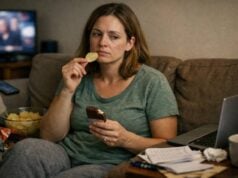
There is also a practical behavior loop here. Many people use screens most heavily at the exact time when self-control is already lower. You are tired, sitting still, and often close to easy snack foods. Add a bright phone and highly stimulating content, and the result is not just “less sleep.” It can become a full late-night pattern of scrolling, grazing, and pushing bedtime back by 30, 60, or 90 minutes.
That is why the goal is not to fear screens or chase perfect darkness. The better goal is to protect the part of the evening that has the biggest effect on sleep quality and sleep timing. For many adults, that is the last one to two hours before bed.
A useful way to think about it is this: screens are not only a light source, they are also a habit trigger. Blue light affects biology. Screen use affects behavior. Weight loss is influenced by both.
If you want a deeper look at the sleep side of the equation, it helps to understand how many hours you need and why hunger hormones and sleep are so closely linked when you are trying to eat with more control.
Screens affect sleep in more than one way
Blue light gets blamed for almost everything, but real life is messier. Screens can hurt sleep through at least four different pathways, and only one of them is spectral light.
1. Light delays your body clock
Evening light tells the brain that bedtime is not here yet. This can delay melatonin release and shift sleep later, especially if the screen is bright, close to your eyes, and used for a long stretch.
2. Content keeps your brain switched on
A calm recipe video and a tense work email do not have the same effect. Social media, news, gaming, emotionally charged texts, and work messages can raise mental arousal even if the light output is reduced. This is one reason some people still struggle with sleep while using night mode.
3. Screens displace sleep
This is the simplest mechanism and often the biggest one. You plan to sleep at 10:30. You start watching short videos at 9:50. Suddenly it is 11:20. Even if the blue-light effect were modest, staying awake longer still cuts sleep time.
4. Devices create interruption
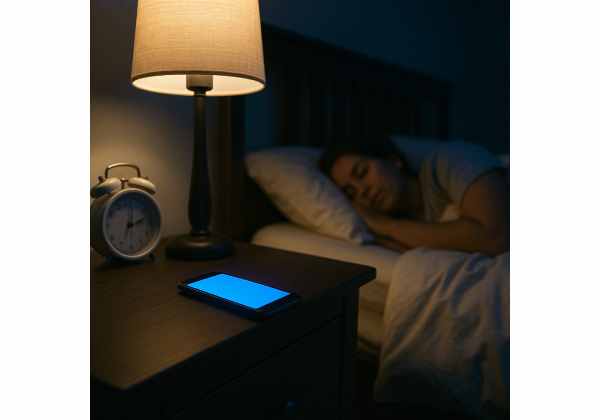
Notifications, buzzing phones, and the habit of “one last check” can fragment the process of falling asleep. Some people also wake during the night, look at their phone, and restart the entire alerting cycle.
This broader view matters because it changes the solution. If you think the problem is only wavelength, you might turn on a warm filter and keep doing everything else the same. But if the real issue is a mix of light, stimulation, and bedtime drift, then the fix needs to include behavior.
A few examples make this clearer:
- Watching a bright tablet from 20 centimeters away in a dark room is more disruptive than watching a dim TV across the room.
- Reading a neutral article for 15 minutes is usually less activating than rapid-fire social media for an hour.
- A phone on night mode at full brightness is still bright.
- Dark mode is not the same as reducing blue-rich output. It changes contrast and appearance, but it does not automatically solve the circadian problem.
This is why blanket advice like “all screens are bad” is not very useful. It is more helpful to ask four questions:
- How bright is it?
- How long are you using it?
- How stimulating is the content?
- Is it pushing bedtime later?
Once you answer those, your most effective changes become obvious. For many people, the most valuable step is not buying anything. It is simply reducing stimulating handheld screen use in the final stretch before bed and replacing it with a more repeatable bedtime routine.
What night mode and filters can and cannot do
Night mode, Night Shift, blue-light filters, warm color temperature settings, dark mode, and blue-blocking glasses all get lumped together, but they are not the same tool.
Night mode and warm filters
These settings shift the screen toward warmer colors and usually reduce short-wavelength output. That can lower some of the light signal that affects circadian timing. In plain terms, they can make a screen less biologically activating than the default cool setting.
That said, “less disruptive” does not mean “harmless.” A warm screen can still be too bright, too close, too interesting, and too easy to use for too long.
Dark mode
Dark mode mainly changes the interface to lighter text on a darker background. It can reduce overall brightness for some tasks, which may help comfort in dim settings, but it is not a complete substitute for spectral filtering. A bright white video or image inside a dark-mode app is still bright.
Blue-blocking glasses
These can reduce short-wavelength light reaching the eye, especially stronger amber lenses. The evidence is promising but mixed. They may help some people, particularly those with heavy evening light exposure or who are sensitive to sleep disruption, but they are not a license for unlimited late-night screen use.
A practical ranking looks like this:
- best: use screens less in the last hour before bed
- next best: if you must use them, combine lower brightness, warmer display settings, and less stimulating content
- useful add-on: blue-blocking glasses when evening device use is hard to avoid
- least helpful approach: turning on night mode while continuing intense scrolling in bed
One original but important point here is that brightness often gets overlooked because it is less marketable than “blue light.” Yet from a habit standpoint, lowering brightness and reducing exposure time may matter more than chasing the perfect filter. Warm color temperature is a helper, not a free pass.
So do filters and night mode work? Yes, to a point. They can reduce part of the problem. They do not cancel the whole problem.
That means the most realistic advice is not “never use screens at night.” It is this:
- use warmer settings automatically after sunset
- dim the screen aggressively
- avoid highly engaging content late at night
- stop handheld screen use before you are already exhausted
- treat software filters as a backup layer, not the main solution
If late-night scrolling tends to overlap with stress, cravings, or emotional decompression, it may also help to look at stress and weight loss, because the screen is sometimes only the visible part of a bigger evening pattern.
The evening screen habits that matter most
If you want the biggest payoff, focus less on tiny technical tweaks and more on the handful of screen habits that reliably shape sleep.
Timing beats perfection
The last 30 to 60 minutes before bed usually matter more than what you did at 7:00 pm. If you cannot cut all evening screen use, protect the final stretch first.
Handheld devices are often the worst offenders
Phones and tablets tend to be closer to the face, more interactive, and more likely to pull you into fast switching between apps. That combination is a strong recipe for “just a few minutes” turning into an hour.
Brightness matters a lot
Many people turn on night mode but leave brightness far too high. In a dark room, a very bright screen remains a strong light source. Lower it until it feels merely readable, not vivid.
Room lighting matters too
A bright overhead light plus a bright phone gives you stacked light exposure. A dim room with a dim, warm screen is a better combination. You do not need candlelight, just a softer evening environment.
Distance helps
A television across the room is not identical to a phone a few inches from your eyes. When possible, choose farther viewing distance and larger text instead of pulling a small device close.
Content selection is a real sleep tool
This is underused. If you need a screen at night, pick low-friction activities:
- a familiar show instead of competitive gaming
- a simple article instead of doomscrolling
- audio, podcasts, or music instead of visually intense content
- downloaded content instead of live messaging threads that invite replies
A useful rule is “less interactive, less emotional, less endless.” That one sentence can improve sleep more than many accessories.
You can also make the environment do some work for you:
- charge your phone outside the bedroom or across the room
- turn off nonessential notifications after a set hour
- use app limits or focus mode in the evening
- avoid starting any task that has no natural stopping point
For people who struggle with late eating, the screen often acts like a bridge to the kitchen. More wake time means more exposure to cues, more boredom, and more chances to snack. That is one reason late-night screen habits overlap so often with late-night snacking and night-time sugar cravings. Better sleep hygiene does not replace nutrition strategy, but it can make your nutrition plan easier to follow.
A practical screen plan before bed
The best plan is the one you will actually use on a normal Tuesday, not the one that sounds ideal in theory. Here is a realistic approach that works even if you cannot avoid screens completely.
Start with one anchor time
Pick a target bedtime and count backward 60 minutes. That hour becomes your lower-stimulation zone.
Set your devices before you get tired
Automate as much as possible:
- Schedule night mode or warm display settings to turn on before sunset or at least two hours before bed.
- Reduce brightness manually in the evening.
- Enable focus mode or do-not-disturb.
- Charge your phone away from the bed if possible.
Use a two-stage shutdown
This works better than an all-or-nothing rule.
- Stage one: 60 to 30 minutes before bed. Screens allowed, but only for low-stimulation tasks. No work, arguments, shopping, gaming, or algorithm-driven scrolling.
- Stage two: final 30 minutes before bed. No handheld screens. Switch to audio, paper reading, stretching, light prep for tomorrow, or basic hygiene.
Keep the room sleep friendly
Use softer lamps instead of bright overhead light. Keep your bedroom associated with sleep, not with prolonged phone sessions. If you need a screen for background sound, audio-only is often better than video.
Have a replacement ready
Most people do not fail because they love blue light. They fail because they remove a habit and leave an empty hole. Make that last half hour easy to fill:
- shower
- prep breakfast or lunch
- gentle mobility
- read a physical book
- journal for five minutes
- make a short to-do list for the next day
This is also where caffeine can quietly undermine progress. An evening phone habit plus late caffeine is a common one-two punch against sleep. If that sounds familiar, cleaning up caffeine timing can make your screen changes work better.
The key is consistency, not purity. A plan you follow five nights out of seven is more useful than a rigid system you abandon after three days. And if your evenings are busy, aim for the minimum effective version: warm filter on, brightness down, no doomscrolling, and no phone in the final 30 minutes before sleep.
When poor sleep is not just about screens
Sometimes screens are the trigger. Sometimes they are just the easiest thing to notice.
If you have cleaned up your evening device habits and your sleep is still poor, look for other drivers that can blunt weight-loss progress:
- inconsistent sleep and wake times
- late caffeine or alcohol
- chronic stress and rumination
- a bedroom that is too hot, noisy, or bright
- shift work or frequent travel
- snoring, gasping, or unrefreshing sleep
- anxiety, depression, or insomnia symptoms
- medications or medical conditions that affect sleep
This matters because people often put all their energy into night mode settings when the bigger issue is elsewhere. A person sleeping five and a half hours because of rotating shifts will not fix the problem with a warmer phone display. Someone with untreated sleep apnea will not solve daytime fatigue by buying blue-light glasses.
A few signs suggest you should widen the lens:
- you fall asleep very late even on screen-free nights
- you wake often and cannot stay asleep
- you snore heavily or wake with headaches
- you need caffeine all day to function
- your cravings and fatigue stay high despite improving your routine
In those cases, it may help to explore shift work and weight loss or sleep apnea and weight loss, depending on what fits your situation.
The main takeaway is simple. Blue light matters, but it is rarely the only reason sleep slips. The most effective approach is layered:
- protect your last hour before bed
- reduce bright, blue-rich, close-up light
- avoid stimulating content
- keep a regular sleep schedule
- address bigger sleep barriers when present
That approach is far more useful than trying to win an argument about whether blue light is “the real problem.” For most people trying to lose weight, the right question is not whether screens are bad in theory. It is whether your current evening screen routine is making good sleep harder than it needs to be. If the answer is yes, even modest changes can improve the next day’s appetite, energy, and follow-through.
References
- Efficacy of blue-light blocking glasses on actigraphic sleep outcomes: a systematic review and meta-analysis of randomized controlled crossover trials 2025 (Systematic Review and Meta-analysis)
- The association of screen time and the risk of sleep outcomes: a systematic review and meta-analysis 2025 (Systematic Review and Meta-analysis)
- Electronic Screen Use and Sleep Duration and Timing in Adults 2025 (Observational Study)
- Melanopic irradiance defines the impact of evening display light on sleep latency, melatonin and alertness 2023 (Experimental Study)
- Effect of restricting bedtime mobile phone use on sleep, arousal, mood, and working memory: A randomized pilot trial 2020 (RCT)
Disclaimer
This article is for general educational purposes only. It explains sleep, light exposure, and weight-loss habits, but it is not a substitute for personal medical advice, diagnosis, or treatment. If you have severe insomnia, heavy snoring, suspected sleep apnea, mood symptoms, or ongoing trouble losing weight despite good habits, speak with a qualified clinician.
If this article helped, please share it on Facebook, X, or any platform your friends, family, or clients use most.