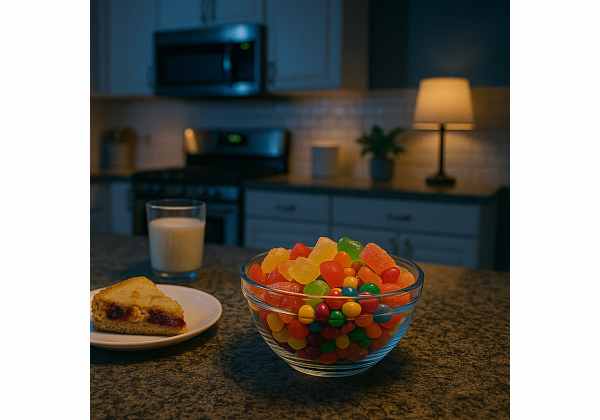
Night-time sugar cravings can feel strangely powerful. You may get through the day fairly well, only to want cookies, chocolate, cereal, ice cream, or something sweet the moment dinner is over or the house gets quiet. That pattern is common, and it usually is not about “bad willpower.” Night cravings often come from a mix of habit, stress, poor sleep, under-eating earlier, and an evening routine that makes sugar feel like relief.
The good news is that these cravings are usually fixable. This article explains why they show up at night, how to tell whether you are actually hungry or just pulled by a cue, and what to change so weight loss feels steadier instead of turning into a nightly battle.
Table of Contents
- Why sugar cravings hit at night
- The most common causes of night-time sugar cravings
- How to tell hunger from habit or stress
- Fix the day so the night gets easier
- What to do when a craving hits
- Build a night routine that lowers cravings
- When sugar cravings may point to a bigger issue
Why sugar cravings hit at night
Night-time sugar cravings usually feel intense because several pressure points tend to stack up at the same time. By evening, you have already spent a full day making decisions, dealing with stress, and resisting distractions. Your mental energy is lower, your environment is often more relaxed, and the foods you crave may be more available. That makes sweet foods feel more rewarding than they did earlier.
There is also a pattern effect. If you often eat something sweet at night, your brain starts to expect it. Over time, dinner, the couch, certain TV shows, scrolling on your phone, or even brushing your teeth late can become cues that predict a treat. Once that link is established, the craving can appear even if your body does not need more food. That is why repeated cravings often make more sense when viewed as a learned loop than as a character flaw.
Night can also expose problems from earlier in the day. If breakfast was tiny, lunch was rushed, protein was low, or dinner did not keep you full, sugar cravings later can be partly biological. Many people do not notice how under-fueled they are until the quiet of the evening makes the hunger obvious. In that situation, the craving is not random. It is your body asking for fast, easy energy and comfort.
Sleep and stress matter too. Poor sleep increases reward-seeking and can make sweet, high-calorie foods feel harder to resist. Emotional fatigue can do the same. That is why people often notice a strong overlap between late sugar cravings, rough workdays, and bad sleep. If that pattern sounds familiar, articles on sugar cravings after bad sleep and stress eating at night often describe the same real-world cycle from slightly different angles.
Another reason night cravings feel so convincing is that evening is when many people finally stop moving. During the day, you are busy enough to ignore mild hunger or cravings. At night, the brain gets room to notice every urge. That does not automatically mean you should ignore the craving. It means you should understand it before you respond.
The most useful mindset is this: a night-time sugar craving is a clue, not a command. Sometimes it means you need a better meal pattern. Sometimes it means you need a better wind-down. Sometimes it means you are simply tired and conditioned to expect sugar at the end of the day. The fix depends on the cause.
The most common causes of night-time sugar cravings
Most night-time sugar cravings come from a short list of repeat offenders. If you can identify which one is driving your pattern, the solution becomes much more practical.
| Cause | What it often looks like | Most useful fix |
|---|---|---|
| Under-eating earlier | You are “good” all day, then want sweets after dinner | Eat more consistently, especially protein and fiber earlier |
| Habit loop | The craving starts when you sit down to relax | Change the cue, routine, and environment |
| Stress or emotional depletion | You want relief, reward, or comfort more than food | Use a decompression routine before eating |
| Poor sleep | Cravings are worse after short, broken, or late sleep | Protect sleep timing and reduce late-night drift |
| Unstructured evenings | You snack while scrolling, watching shows, or standing in the kitchen | Create a defined evening plan and a kitchen cutoff |
| Restriction backlash | You avoid sweets too rigidly, then rebound hard at night | Use flexible structure instead of all-or-nothing rules |
Under-eating earlier is more common than people realize. A light breakfast, a salad with little protein, skipped snacks, and a small dinner can add up to strong cravings by 9 p.m. This does not always feel like classic stomach hunger. It may show up as, “I need something sweet,” when what you really need is more total food and more satiety earlier in the day.
Habit is another major driver. If dessert or candy has become your nightly “off switch,” your body can start expecting sugar even when you are not truly hungry. That is why understanding habit loops and eating behavior is so helpful. The craving is often tied to a cue and a routine, not only a nutrient need.
Stress matters because sweet foods are fast comfort. After a draining day, sugar can feel like relief, distraction, reward, or a way to soften emotions. Night cravings often rise when people are not only hungry but also mentally done. If evenings are your hardest time emotionally, the issue may be less about dessert and more about what happens when the day ends.
Sleep loss pushes the pattern even further. Short sleep and later nights create more exposure to food cues and more fatigue-based impulsivity. If you regularly stay up late, your cravings may reflect both tiredness and extended eating opportunity.
Finally, some people create the problem by trying to be too strict. If sweets are framed as forbidden, the brain can become more preoccupied with them. The rebound often shows up when discipline is lowest: at night. That is one reason rigid dieting can backfire even in people who are very motivated.
How to tell hunger from habit or stress
One of the most useful skills for weight loss is learning to separate physical hunger from evening cravings driven by routine, emotion, or fatigue. The answer changes what you should do next.
Physical hunger usually builds more gradually. It may feel like stomach emptiness, light-headedness, fading energy, difficulty concentrating, or the sense that a normal meal sounds appealing. If you are truly hungry, a simple balanced option sounds good. Yogurt, fruit, eggs, oatmeal, cottage cheese, or a sandwich all seem reasonable.
Habit or emotional cravings are usually more specific. They tend to sound like: “I need chocolate,” “I want ice cream,” or “I just need something sweet while I relax.” The urge often appears suddenly and is closely tied to a cue, such as a show starting, dishes being done, or getting the kids to bed. If someone offered you plain yogurt or a turkey sandwich and you felt disappointed, that is often a clue that you are not just hungry.
A quick self-check can help:
- Did I eat enough earlier today?
- Would a normal balanced snack satisfy me?
- Did this craving start because I sat down, got stressed, or saw food?
- Am I tired, bored, lonely, or trying to reward myself?
- If I wait 10 minutes and do something calming, does the urge change?
None of these questions are perfect, but together they help you respond with more accuracy.
It also helps to notice timing patterns. If your sugar craving hits at roughly the same time every evening, that suggests routine is a strong driver. If it shows up mainly after rough workdays or poor sleep, stress or fatigue may be leading the pattern. If it tends to happen only on days when meals were scattered, under-fueling is the likely culprit.
Some people experience a mix. They are a little hungry, a little stressed, and strongly cued by their environment. In those cases, the best solution is often not “resist harder,” but a combination approach: eat something structured if needed, move away from the trigger setting, and use a calmer replacement ritual.
This is where mindful awareness helps, but not in a vague way. You do not need to sit in lotus position and analyze every craving. You just need enough pause to identify what bucket the urge belongs in. Even a short check-in can prevent the common mistake of treating all cravings the same.
If you repeatedly discover that you are not physically hungry but still feel pulled to eat, the next step is not self-criticism. It is to change the situation so the cue is weaker and the replacement is easier. That is far more effective than trying to “win” the same argument every night.
Fix the day so the night gets easier
Many night-time sugar cravings are fixed before dinner, not after it. If your day is set up poorly, your evening will usually show the consequences.
The first and most important fix is meal consistency. You do not need perfect meal timing, but long stretches without enough food often make night cravings worse. A more reliable pattern of breakfast, lunch, dinner, and one or two useful snacks can lower the feeling of “food chaos” that leads to evening rebound eating. That is why consistent meal routines often help even when the specific problem seems to be nighttime sweets.
Protein matters because it improves fullness and helps meals hold longer. If breakfast and lunch are mostly refined carbs or very light meals, your appetite may catch up aggressively later. Aim to include a meaningful protein source in your earlier meals, not just dinner. Fiber helps too. Fruit, vegetables, beans, oats, and higher-fiber starches can make the day feel more stable and reduce the “I need something now” feeling at night.
Dinner deserves attention as well. A dinner that is too small, too low in protein, or overly “diet” in tone can set you up to hunt for sweets an hour later. This is especially true when dinner feels virtuous but unsatisfying. Many people do better with a balanced dinner that includes protein, produce, and some carbs than with a tiny meal followed by a nightly battle over dessert.
A few practical daytime adjustments often help quickly:
- Eat within a reasonable window after waking
- Avoid letting lunch become an afterthought
- Build meals around protein instead of treating it as optional
- Include enough volume and fiber to feel physically fed
- Do not save most of your calories for night unless that pattern truly suits you
If cravings tend to hit hardest on days when you are rushed, keep some low-effort options on hand. A small list of reliable foods can prevent under-eating from turning into evening sugar scavenging. This is also where a simple protein and fiber craving toolkit becomes useful. The goal is not to be perfect. It is to stop the day from setting up the night to fail.
Hydration can help a little, but it is rarely the whole answer. Do not assume every craving is thirst. Focus first on food quality, meal timing, and evening cues. Those are usually much bigger levers.
The key idea is simple: night cravings are often a late symptom of an early setup problem. When the day is more structured, the night usually becomes more negotiable.
What to do when a craving hits
When the craving is already there, you need a plan that is realistic enough to use while tired. The best response depends on whether you are truly hungry, emotionally triggered, or just pulled by habit.
Start with a short pause. Not a dramatic struggle. Just enough time to prevent autopilot. A practical sequence looks like this:
- Name the craving clearly.
- Ask whether you are physically hungry, emotionally drained, or cued by routine.
- Decide on one response before opening the pantry.
- Follow that response without renegotiating five times.
If you are physically hungry, eat something structured instead of drifting into sweets. A planned snack with protein tends to work better than trying to “be good” for 20 minutes and then eating twice as much. Options from high-protein snack ideas or a modest choice from late-night snacks for weight loss can take the edge off hunger far more effectively than random bites of sugary food.
If the craving is not real hunger, a delay-and-divert strategy often works better. Try:
- Making tea or sparkling water
- Brushing your teeth
- Taking a short walk around the house or outside
- Changing rooms
- Stretching for five minutes
- Doing one small task with your hands before deciding again
The point is not to “distract yourself forever.” It is to interrupt the immediate cue-response loop. Very often, the first 10 minutes are the strongest.
If you still want something sweet after the pause, avoid eating from packages. Portion it. Sit down. Eat it on purpose. This matters because the real damage often comes from mindless, standing, scrolling, or TV-based eating rather than from the existence of dessert itself. Even a sweet choice becomes more manageable when it is deliberate and finite.
One more useful rule is to decide what the craving is allowed to become. For example:
- one portion, not an open-ended snack session
- eaten at the table, not on the couch
- followed by the rest of your evening routine, not more grazing
This protects you from the common “I already messed up” spiral.
The most effective craving plan is often boring. It is a repeatable script, not a heroic moment of restraint. That is why if-then planning for cravings works so well. You do not have to invent a better choice while your brain is negotiating with chocolate. You already decided what happens next.
Build a night routine that lowers cravings
Night-time sugar cravings are easier to control when the whole evening is less chaotic. A good night routine does not need to be elaborate. It simply needs to reduce the conditions that make sugar feel automatic.
The first helpful shift is to create a clearer end to eating. That might mean cleaning the kitchen after dinner, turning off the bright kitchen lights, portioning tomorrow’s breakfast, or setting a general “kitchen closed” time. The point is to stop leaving the evening open-ended. Unstructured evenings invite grazing.
A simple night routine might look like this:
- Finish dinner
- Clear the kitchen
- Make a non-caloric drink
- Do one calming action before sitting down
- Decide whether you are eating again tonight
- If yes, choose the planned option
- If no, continue with your wind-down
That decision point is powerful. Pre-deciding is easier than re-deciding every time a craving shows up.
Sleep protection matters here too. The later the night goes, the harder cravings often become. Fatigue lowers resistance, and the extra hours create more eating opportunities. If sugar cravings keep showing up during long, screen-heavy evenings, a better night routine to prevent overeating can help more than food rules alone. A calmer evening reduces the need for sugar as a transition tool.
The environment matters as well. If sweets are visible on the counter, frozen desserts are your main comfort food, and the couch is automatically paired with snacks, the routine is doing part of the craving work for you. Small environmental changes can help:
- Keep sweets less visible
- Avoid storing open treats at eye level
- Put high-trigger foods in inconvenient spots
- Keep tea, fruit, yogurt, or another planned option easy to reach
- Do not bring large snack containers to the couch
Another smart change is adding a brief decompression habit before your usual craving window. Evening sugar cravings are often partly about coming down from the day. A short walk, shower, light stretching, or quiet music can reduce the need to use sugar for that job. This is one reason articles on sleep hygiene habits often help with appetite control too. Better evenings support better nights, and better nights support better food choices.
If your cravings are especially tied to boredom, keep your hands busy during the danger window. Folding laundry, journaling, doing skincare, knitting, or even holding a mug can help more than people expect. The goal is not to white-knuckle the urge. It is to make the old pattern less automatic.
When sugar cravings may point to a bigger issue
Most night-time sugar cravings are behavioral and fixable, but sometimes they point to something broader than “I like dessert.”
Pay closer attention if your cravings come with repeated loss of control, waking from sleep to eat, large episodes of binge-like eating, strong shame, or the feeling that you cannot stop once you start. In those cases, the problem may be closer to night eating syndrome, binge eating, or a more serious emotional eating pattern than a simple habit.
It is also worth taking a broader look if cravings are tied to major sleep problems, intense fatigue, mood changes, or medication shifts. Some people notice a sharp increase in cravings when sleep gets worse, stress becomes chronic, or antidepressants and other medications change appetite patterns. Others may experience stronger cravings during hormonal transitions, high stress periods, or times of very aggressive dieting.
Medical issues can also matter. Recurrent intense hunger, unusual fatigue, increased thirst, shakiness, or symptoms that feel out of proportion to your meals deserve attention from a clinician. Night cravings alone do not mean you have a medical problem, but persistent patterns paired with other symptoms are worth discussing.
Another sign to step back is when your response to cravings becomes harsher and harsher without improving anything. If you are swinging between strict restriction and nighttime overeating, the structure itself may be part of the problem. This is where all-or-nothing thinking quietly keeps the cycle alive. You eat sugar, feel guilty, tighten the rules, then crave more the next night. That loop does not usually improve with more self-criticism.
A better benchmark is not “Do I ever crave sugar at night?” It is “Can I understand the pattern and respond in a stable way?” If the answer keeps being no despite genuine effort, more support may help. A dietitian can help sort out meal structure and appetite patterns. A therapist can help when the craving is tied to stress, reward, or emotional coping. A doctor can help if sleep problems, medications, or medical symptoms may be involved.
Night-time sugar cravings do not make you undisciplined. In many cases, they are a message that something in your routine, sleep, stress load, or food pattern needs adjusting. Once you identify which piece is driving the urge, the fix becomes much more practical and far less personal.
References
- The effects of sleep disruption on metabolism, hunger, and satiety, and the influence of psychosocial stress and exercise: A narrative review 2024 (Review)
- Meal Timing and Anthropometric and Metabolic Outcomes: A Systematic Review and Meta-Analysis 2024 (Systematic Review and Meta-Analysis)
- Tackling Cravings in Medical Weight Management: An Update on Pathophysiology and an Integrated Approach to Treatment 2024 (Review)
- Emotional Eating Interventions for Adults Living With Overweight and Obesity: A Systematic Review and Meta-Analysis of Behaviour Change Techniques 2025 (Systematic Review and Meta-Analysis)
- A Narrative Review on Sleep and Eating Behavior 2025 (Review)
Disclaimer
This article is for general educational purposes only and is not a substitute for medical advice, diagnosis, or treatment. If night-time sugar cravings come with binge eating, waking to eat, major sleep problems, unusual fatigue, medication changes, or other concerning symptoms, talk with a qualified healthcare professional.
If this article helped you, please share it on Facebook, X, or your preferred platform so others can better understand and manage night-time sugar cravings.