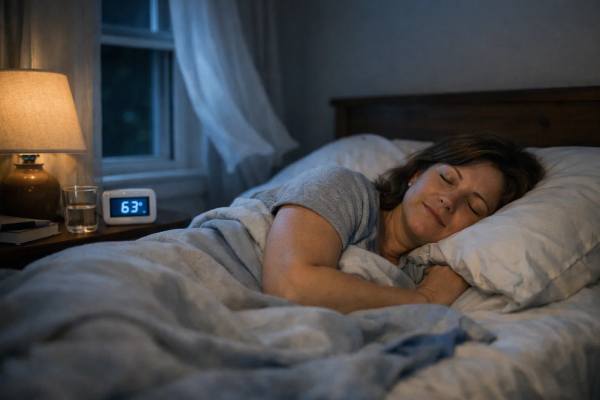
A slightly cooler bedroom can help sleep, and that can support weight loss. The key word is support. Lowering the thermostat does not melt body fat overnight, but it can make it easier to fall asleep, stay asleep, and wake up feeling more in control of hunger, cravings, energy, and food choices the next day.
That is why bedroom temperature matters more than it first appears. If your room is too warm, sleep can get lighter and more fragmented. If it is too cold, discomfort can also keep you awake. The goal is not a freezing room. It is a sleep-friendly environment that lets your body cool down naturally at night and recover well enough to make weight-loss habits easier to maintain.
Table of Contents
- Does a cooler room actually help?
- Why temperature changes your sleep
- How better sleep supports weight loss
- Best bedroom temperature range to try
- How to cool your room without overdoing it
- When cooler is not better
- A simple 7-night temperature test
Does a cooler room actually help?
Yes, for many people it does. A cooler bedroom often improves sleep because healthy sleep is tied to a natural drop in core body temperature in the evening. When the room is too warm, your body has a harder time shedding heat, and that can delay sleep onset, increase tossing and turning, and make sleep feel less refreshing. A moderately cool room usually makes that process easier.
Where this connects to weight loss is more indirect than dramatic. Better sleep tends to help with appetite regulation, food decisions, stress tolerance, recovery, and consistency. People who sleep better are often less likely to chase quick energy from sugary snacks, overeat late at night, or skip exercise because they feel drained. In other words, a cooler room can help weight loss if it helps you sleep better enough to improve the habits that actually drive fat loss.
That distinction matters, because this topic is often oversold. You may see claims that sleeping cold “boosts metabolism” or “activates brown fat” in a way that makes the pounds fall off. There is some interesting research on cold exposure and energy metabolism, but that is not the same as saying a chilly bedroom is a reliable fat-loss tool. Real-world weight loss still depends mainly on a sustainable calorie deficit, adequate protein, movement, stress management, and sleep that is good enough to help you follow through.
A more useful way to think about it is this:
- A cooler room can be a sleep strategy.
- Better sleep can be a weight-loss support.
- A cold room is not a standalone fat-loss method.
That makes bedroom temperature worth caring about, but not obsessing over. If your room runs hot, cooling it down may be one of the easier changes you can make. If your room is already comfortable, pushing it colder and colder will not automatically create better results. The right setup is the one that leaves you sleepy at night, asleep through more of the night, and reasonably alert the next morning.
Why temperature changes your sleep
Sleep and temperature are closely connected because your body clock does not just control when you feel sleepy. It also helps regulate when your body temperature rises and falls. As evening approaches, core temperature starts to drift downward. That cooling process is one of the signals that nudges the body toward sleep. If you want a deeper explanation of how timing affects appetite, sleep, and metabolism, it helps to understand your circadian rhythm as a whole.
A bedroom that is too warm can interfere with that nightly cooling. Heat buildup under heavy bedding, poor airflow, humid air, or an overly warm mattress can make it harder to settle into sleep and stay comfortable once asleep. Even if you do not fully wake up, you may shift more, spend less time in deeper sleep, or feel that your sleep was “off.”
A cooler room helps because it supports heat loss. Your body can release warmth more easily through the skin, especially when air moves a little and bedding is breathable. This is one reason some people notice they fall asleep faster in a slightly cool room, even when they did not expect temperature to matter much.
But colder is not always better. If the room is too cold, your muscles may tense up, your hands and feet may feel icy, and you may spend the night trying to get comfortable. Some people sleep poorly when they feel chilled, even if the air temperature sounds ideal on paper. That is why the best setup is usually described as cool, not cold.
A useful detail that gets overlooked is that “bedroom temperature” is only part of the picture. Sleep comfort also depends on:
- Mattress heat retention
- Pillow material
- Sleepwear thickness
- Blanket weight
- Air movement from a fan
- Humidity level
- Whether you naturally sleep hot or cold
This is why two people can sleep in the same room and have completely different opinions about whether it feels perfect. One person may need a lighter blanket and lower thermostat. Another may need a slightly warmer room but breathable sheets. The thermostat matters, but the whole sleep system matters more.
For weight loss, this matters because poor sleep is often caused by small, fixable friction points rather than one huge issue. If a warm room is quietly disrupting your sleep every night, fixing that can create a surprisingly noticeable improvement in recovery, mood, and appetite control.
How better sleep supports weight loss
The strongest case for a cooler bedroom is not that it burns many more calories while you sleep. It is that better sleep tends to make weight-loss behaviors easier the next day.
Poor sleep changes hunger in several ways. It can increase appetite, raise the pull of highly rewarding foods, reduce patience, and make “I deserve a treat” decisions feel more reasonable. If this pattern sounds familiar, the link between sleep loss and appetite is a major reason poor sleep makes you hungrier than you expect.
Better sleep can support weight loss through several practical pathways:
- Less late-night snacking: When you are awake longer and mentally worn down, there is simply more opportunity to eat.
- Better appetite control the next day: Sleep loss tends to increase cravings for calorie-dense foods.
- More stable energy: When you are less exhausted, you are less likely to use sugar and caffeine as a rescue plan.
- Improved training and recovery: Good sleep helps you show up for exercise and recover from it.
- Better decision-making: Small food choices are harder when you are tired, stressed, or irritable.
- More consistency: Good sleep makes it easier to repeat healthy routines instead of relying on motivation.
This is why sleep is not just a “nice extra” in fat loss. It is one of the factors that determines whether your plan feels manageable or constantly uphill. If you regularly sleep badly because your room is too warm, then improving that one variable may reduce the friction around food and routine adherence.
A cooler room can also help people who tend to wake sweaty, restless, or overheated in the early morning. Those broken nights do not just leave you tired. They often increase next-day grazing, emotional eating, and missed workouts. Getting your room temperature right may not change your body composition directly, but it can improve the conditions that make a calorie deficit more sustainable.
At the same time, it is important not to make sleep carry all the weight of your results. Better sleep helps, but it does not cancel out overeating, a very low activity level, or inconsistent meals. It is a force multiplier, not a magic fix.
For most adults, the sweet spot is to use sleep as one of the foundations of the plan. That includes enough total rest, not just a cooler room. If you are trying to improve body composition, it is worth knowing how many hours of sleep support weight loss rather than focusing only on temperature.
Best bedroom temperature range to try
For most adults, a reasonable starting point is a bedroom temperature around 60 to 67°F, or about 16 to 19°C. That range is commonly recommended because it feels cool enough to support the body’s normal drop in temperature without feeling harsh or uncomfortable.
Still, there is no single perfect number for everyone. Real-life studies suggest that ideal sleep temperature can vary by person, age, bedding, humidity, and the conditions of the home. In some cases, especially among older adults, the best range may be a bit warmer than popular advice suggests. The broad lesson is not that everyone needs exactly the same temperature. It is that overheating tends to hurt sleep, while a stable, comfortable cool environment usually helps.
That is why “find your range” is better advice than “copy someone else’s number.” If you sleep hot, you may prefer the lower end. If you get cold easily, a slightly warmer room with breathable bedding may work better.
| Bedroom feels like | Likely sleep effect | What to try |
|---|---|---|
| Too warm | Harder to fall asleep, more sweating, more restlessness, earlier wake-ups | Lower thermostat slightly, improve airflow, switch to lighter bedding |
| Comfortably cool | Easier sleep onset, fewer heat-related wake-ups, more refreshed mornings | Keep the setup stable for several nights before changing it |
| Too cold | Chilled feet or hands, muscle tension, waking to adjust blankets, poor comfort | Raise temperature a bit, keep the room cool but add light layers or socks |
One of the best practical rules is this: if you are shivering, the room is too cold; if you are sweating under the covers, it is too warm. The right range is the one where your body can cool down without fighting to stay warm.
A second rule is to change temperature in small steps. Big swings make it harder to tell what actually works. A one- or two-degree adjustment often teaches you more than a dramatic thermostat drop.
How to cool your room without overdoing it
You do not need a high-end smart sleep system to make your room more sleep-friendly. In many cases, a few ordinary changes work well.
Start with the easiest lever: lower the thermostat slightly before bed rather than blasting the room cold all night. Small adjustments are easier to tolerate and easier to test. If you do not control the thermostat, focus on airflow and bedding instead.
Useful ways to cool your sleep environment include:
- Use lighter, breathable sheets instead of heavy heat-trapping fabrics
- Swap a thick comforter for layered blankets you can adjust
- Run a fan for airflow, even if it does not drop the room temperature much
- Keep blinds or curtains closed during the day if the room heats up from sun exposure
- Take a warm shower an hour or two before bed if it helps you relax and cool down afterward
- Wear lighter sleep clothes, or fewer layers, if you tend to sleep hot
- Keep your feet warm if cold feet keep you awake, even while the room stays cool
That last point surprises people. A cool room and warm feet can work very well together. If your feet are icy, you may not relax into sleep easily even if the rest of the room is ideal. Thin socks or a lighter blanket over the feet can solve that without overheating the rest of your body.
It also helps to look beyond temperature alone. Bedroom heat often combines with other sleep disruptors such as bright screens, inconsistent bedtimes, noise, and late caffeine. A cooler room works best as part of a broader sleep hygiene checklist, not as a standalone trick.
One especially common problem is using the thermostat to compensate for behaviors that are keeping you wired. If you stay under bright screens until bedtime, temperature will not fully undo the alerting effects of light. In that case, improving your evening environment may matter just as much as cooling the room, especially if blue light and sleep are already a weak point for you.
The big practical idea is to remove friction. Make the room easy to sleep in. You should not need to win a battle with heat, blankets, screens, and discomfort every night.
When cooler is not better
A cooler room is helpful for many adults, but not all sleep problems are temperature problems. If lowering the temperature leaves you feeling tense, cold, or awake, you are not failing at sleep hygiene. You are just outside your personal comfort zone.
Cooler may not be better when:
- You wake up cold and spend the night pulling blankets up
- Your hands and feet stay icy
- You feel muscle tension instead of relaxation
- You are very lean or generally cold-sensitive
- You are using room temperature alone to fix a bigger sleep issue
There are also cases where temperature is only one piece of the story. Someone with chronic insomnia, loud snoring, frequent gasping, major anxiety at bedtime, severe night sweats, or repeated early waking may need more than a cooler room. If sleep stays poor even after you improve the environment, it is worth looking more broadly at possible causes. Persistent sleep trouble can also make fat loss harder, which is why articles on insomnia and weight loss often focus on both physiology and behavior, not just bedroom setup.
Personal context matters, too. People who sleep hot, have hot flashes, or wake sweaty may benefit from the cooler end of the range. Older adults, people with cold intolerance, or those who feel chilly easily may do better a little warmer. The right answer is not ideological. It is whatever creates the best actual sleep.
This is also where perfectionism can creep in. Some people start chasing a mythical “ideal” temperature with constant nightly adjustments, expensive gadgets, and too much attention on small sensations. That can backfire by turning bedtime into a project. Sleep usually improves more from a stable, repeatable setup than from endless tweaking.
So if your room is already comfortable and your sleep is good, there is no need to force it colder because you heard 65°F is the magic number. Use the guidance as a starting point, not a rule you must obey.
A simple 7-night temperature test
The easiest way to find your best bedroom temperature is to test it like a habit, not guess it based on what works for someone else.
Try this for one week:
- Nights 1 and 2: Keep your usual setup and notice how long it takes to fall asleep, how often you wake up, and how you feel in the morning.
- Nights 3 and 4: Lower the room by about 1 to 2°F, or 0.5 to 1°C.
- Nights 5 and 6: Keep that temperature if it helped, or adjust by another small step if you were still too warm.
- Night 7: Use the setup that gave you the best mix of comfort, sleep quality, and next-day energy.
During the test, track only a few simple things:
- Time to fall asleep
- Number of wake-ups you remember
- Whether you woke sweaty or chilled
- Morning alertness
- Evening cravings the next day
That last point is important. The best temperature is not just the one that feels good at 2 a.m. It is the one that seems to leave you steadier the next day, especially around appetite, snack urges, and energy.
Keep the rest of your routine as consistent as possible while you test. Do not change caffeine timing, bedtime, meal size, and room temperature all at once or you will not know what helped. If late coffee is still disrupting sleep, it makes sense to fix caffeine timing alongside your room setup. And if your schedule swings all over the place, a cooler bedroom will work better when paired with sleep consistency.
This is the realistic takeaway: a cooler room can help, but the real win is creating a bedtime environment that makes good sleep more likely night after night. When that happens, weight-loss habits usually feel less forced and more repeatable.
References
- A systematic review of ambient heat and sleep in a warming climate 2024 (Systematic Review)
- Nighttime ambient temperature and sleep in community-dwelling older adults 2023 (Observational Study)
- Effect of Sleep Extension on Objectively Assessed Energy Intake Among Adults With Overweight in Real-life Settings: A Randomized Clinical Trial 2022 (RCT)
- A Narrative Review on Sleep and Eating Behavior 2025 (Review)
- Does body cooling facilitated by bedding compared to control condition improve sleep among adults (18–64 years old)? A systematic review and meta-analysis 2025 (Systematic Review)
Disclaimer
This article is for general educational purposes only. It is not medical advice, and it is not a substitute for personalized guidance from a doctor or qualified sleep specialist, especially if you have chronic insomnia, severe night sweats, breathing-related sleep problems, or a medical condition that affects temperature tolerance.
If you found this article useful, consider sharing it on Facebook, X, or your preferred platform with someone working on better sleep and more sustainable weight-loss habits.