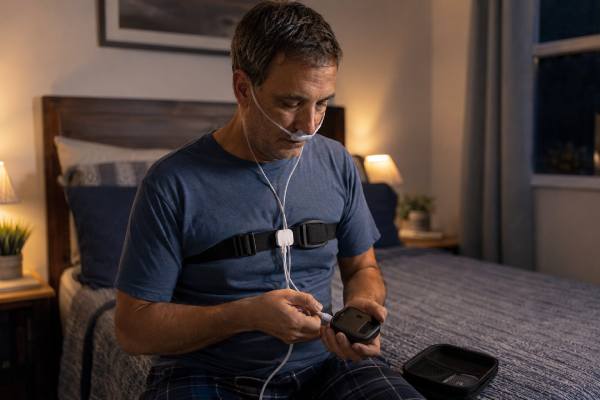
A home sleep apnea test can make it easier to evaluate suspected obstructive sleep apnea without spending the night in a sleep laboratory. Instead of recording every detail of sleep, it focuses on breathing, oxygen levels, and related signals that suggest the airway is repeatedly narrowing or closing during sleep.
That narrower focus is both its strength and its limitation. For the right person, home testing can be a practical, accurate path to diagnosis and treatment. For someone with complex sleep symptoms, major medical conditions, or a negative result that does not match the symptoms, an in-lab sleep study may be safer and more informative.
Table of Contents
- Who Home Sleep Apnea Testing Is For
- What a Home Sleep Apnea Test Measures
- What Home Testing Can Detect
- What Home Testing Can Miss
- How the Home Testing Process Works
- How to Understand Home Test Results
- What Happens After the Results
- When to Seek Lab Testing or Urgent Care
Who Home Sleep Apnea Testing Is For
Home sleep apnea testing is usually best for adults who have a clear, uncomplicated suspicion of moderate to severe obstructive sleep apnea. It is not meant to be a general sleep test for every kind of poor sleep, fatigue, or brain fog.
A typical candidate is someone who has symptoms such as loud habitual snoring, witnessed pauses in breathing, gasping or choking during sleep, morning dry mouth, morning headaches, or strong daytime sleepiness. Risk is higher when these symptoms occur with factors such as higher body weight, a larger neck circumference, high blood pressure, older age, male sex, postmenopausal status, or a family history of obstructive sleep apnea.
Clinicians may also consider home testing when the main complaint is less obvious. Some people do not describe themselves as “sleepy” but instead report poor concentration, forgetfulness, irritability, low mood, reduced motivation, or unrefreshing sleep. In that setting, the question is whether repeated breathing disruptions are fragmenting sleep enough to affect daytime functioning. The link between sleep-disordered breathing and concentration problems is one reason clinicians may consider sleep evaluation alongside other workups for cognitive or mental health symptoms.
Screening questionnaires can help estimate risk, but they do not diagnose sleep apnea by themselves. Tools such as the STOP-Bang questionnaire ask about snoring, tiredness, observed apneas, blood pressure, body size, age, neck size, and sex. The Epworth Sleepiness Scale focuses on how likely a person is to doze in common daytime situations. These tools can support the decision to test, but the diagnosis still depends on a sleep study interpreted in clinical context.
Home testing is most appropriate when the clinician expects the result to answer a focused question: “Does this adult likely have obstructive sleep apnea?” It is less appropriate when the question is broad, such as “Why can’t I sleep?” or “Why am I exhausted even after sleeping?” Those broader questions may involve insomnia, circadian rhythm problems, medication effects, mood disorders, neurologic disorders, narcolepsy, restless legs syndrome, or more than one condition at the same time.
What a Home Sleep Apnea Test Measures
A home sleep apnea test records selected breathing and oxygen signals while you sleep in your own bed. It does not measure as many channels as full polysomnography, which is the more comprehensive in-lab sleep study.
Most home tests include sensors for airflow, breathing effort, oxygen saturation, and heart rate. Depending on the device, there may also be body position tracking, snoring detection, actigraphy to estimate movement and sleep timing, or peripheral arterial tone, which reflects changes in blood vessel tone linked to breathing events and arousals.
The exact setup varies, but many tests include:
- A nasal cannula or airflow sensor under the nose
- A finger probe to measure oxygen saturation and pulse
- One or more belts around the chest or abdomen to measure breathing effort
- A small recorder worn on the chest, wrist, or beside the body
- Position or movement sensors in some devices
The key point is that a home test is designed around breathing. It looks for repeated reductions or pauses in airflow, oxygen drops, and patterns that suggest the upper airway is collapsing during sleep. This makes it useful for detecting obstructive sleep apnea, but not for capturing the full architecture of sleep.
An in-lab sleep study, also called polysomnography, usually records brain waves, eye movements, chin and leg muscle activity, heart rhythm, airflow, breathing effort, oxygen levels, body position, and sometimes video. Brain-wave monitoring allows the lab to tell whether a person is awake, in light sleep, in deep sleep, or in REM sleep. Most home sleep apnea tests do not measure brain waves, so they usually estimate breathing events over recording time rather than confirmed sleep time.
That distinction matters. If someone lies awake for long periods with the equipment on, the test may divide breathing events by total recording time, not true sleep time. This can make obstructive sleep apnea look milder than it really is. It is one reason severe insomnia, poor sleep during the test, or a result that does not fit the symptoms may require an in-lab study.
What Home Testing Can Detect
Home sleep apnea testing can detect signs of obstructive sleep apnea, estimate its severity, and show whether breathing problems are linked to oxygen drops or certain sleep positions. It can also provide practical information that helps guide treatment.
Obstructive sleep apnea happens when the upper airway repeatedly narrows or closes during sleep despite ongoing breathing effort. The result may be a complete pause in airflow, called an apnea, or a partial reduction in airflow, called a hypopnea. These events can lower oxygen levels, trigger brief arousals from sleep, increase stress on the cardiovascular system, and leave the person feeling unrefreshed.
A home test may detect:
| Finding | What it may show | Why it matters |
|---|---|---|
| Apneas and hypopneas | Repeated pauses or reductions in airflow | These are the core breathing events used to estimate sleep apnea severity. |
| Oxygen desaturation | Drops in blood oxygen during sleep | Frequent or deep oxygen drops can suggest more physiologic stress. |
| Lowest oxygen level | The lowest oxygen saturation recorded overnight | This helps clinicians judge how severe oxygen dips became during the test. |
| Time below a threshold | How long oxygen stayed below a level such as 90% | Prolonged low oxygen may require closer evaluation, especially with lung or heart disease. |
| Body position effects | Whether events are worse on the back | This may support positional therapy in selected people. |
| Snoring or vibration | Evidence of upper-airway resistance | Snoring alone is not diagnostic, but it can support the overall pattern. |
A home test can also help connect nighttime breathing problems with daytime symptoms. Sleep apnea can contribute to poor concentration, slowed thinking, memory lapses, irritability, morning headaches, and low energy. It may also overlap with symptoms that resemble ADHD, depression, or chronic fatigue. For that reason, clinicians sometimes consider sleep apnea when evaluating persistent brain fog or attention problems, especially when snoring, gasping, high blood pressure, or unrefreshing sleep are also present.
This does not mean a home sleep test is a cognitive or psychiatric test. It cannot diagnose ADHD, depression, anxiety, dementia, or another mental health condition. It can, however, identify a treatable sleep-related breathing disorder that may be worsening daytime functioning. This is especially relevant when someone is being evaluated for poor focus, mood changes, or fatigue and the history suggests possible sleep apnea. Related evaluation may also include broader sleep assessment for brain fog and poor concentration when symptoms are not explained by the home test alone.
What Home Testing Can Miss
A home sleep apnea test can miss sleep apnea in some situations and does not reliably diagnose many other sleep disorders. A normal or mild result is not always the final answer when symptoms remain strong.
The most important limitation is that many home tests do not directly measure sleep. They may not know when you were awake, when you were in REM sleep, or whether you spent enough time in the position where your breathing is usually worst. If you slept poorly, slept mostly on your side, or had little REM sleep during the recording, the test may underestimate the problem.
Home testing may be less reliable or inappropriate when there is concern for:
- Central sleep apnea, where breathing pauses occur because the brain’s breathing drive is unstable rather than because the upper airway is blocked
- Sleep-related hypoventilation, where breathing is too shallow or ineffective, causing carbon dioxide to rise
- Significant heart failure, chronic lung disease, neuromuscular disease, or other cardiorespiratory illness
- Chronic opioid use, which can affect breathing control during sleep
- Prior stroke or certain neurologic conditions
- Severe insomnia that makes sleep time difficult to estimate
- Narcolepsy or other central disorders of hypersomnolence
- Parasomnias such as dream enactment, sleepwalking, or unusual nighttime behaviors
- Periodic limb movement disorder or restless legs symptoms as the main concern
- Seizure-like events during sleep
Home testing also cannot explain every case of fatigue or poor sleep. Someone may have sleep apnea and insomnia together. Another person may have normal breathing but chronic insomnia, delayed sleep phase, restless legs syndrome, medication side effects, thyroid disease, depression, anxiety, or another medical cause of fatigue. When falling asleep or staying asleep is the main issue, insomnia screening may be more relevant than a breathing-only test.
It is also possible for sleep apnea to mimic or worsen mental health and attention symptoms. In adults, poor sleep quality can affect motivation, emotional regulation, memory, and attention. This overlap is one reason a careful clinician does not assume that concentration problems are always ADHD or that low mood is always depression. Sleep apnea may be part of the picture, especially when nighttime symptoms are present. A more detailed discussion of this overlap is covered in sleep apnea and ADHD-like or mood symptoms.
How the Home Testing Process Works
The home testing process usually starts with a sleep-focused clinical evaluation, not with the device itself. The test is most useful when the clinician has already decided that obstructive sleep apnea is a likely explanation.
Before ordering the test, a clinician may ask about snoring, witnessed breathing pauses, gasping, daytime sleepiness, morning headaches, nighttime urination, high blood pressure, weight changes, alcohol use, sedating medications, and family history. They may also ask about insomnia, restless legs symptoms, nightmares, abnormal movements, sleep schedule, shift work, neurologic symptoms, and mood or attention concerns. This helps determine whether home testing is appropriate or whether an in-lab study is needed.
The testing kit may be picked up, mailed, or delivered through a sleep clinic or medical equipment provider. Instructions should explain how to place each sensor, how to start the recorder, what lights or messages indicate a good signal, and what to do if a sensor comes loose. Some devices are disposable; others must be returned for data download.
On the night of the test, most people are advised to follow their usual sleep routine unless the clinician gives different instructions. That usually means sleeping at the usual time, using prescribed medications as directed, and avoiding unusual alcohol or sedative use unless already part of the routine and discussed with the clinician. The goal is to record a representative night, not an artificially perfect one.
A practical checklist can help:
- Read the instructions before bedtime, not when you are already tired.
- Place the sensors while sitting upright and with good lighting.
- Make sure the nasal sensor, finger probe, and belts feel secure but not painfully tight.
- Sleep in your usual position if possible.
- If a sensor comes loose, reattach it as instructed.
- In the morning, stop the recording and return or upload the device as directed.
Some people worry that they slept badly with the equipment on. That does not automatically ruin the test, but it may affect interpretation. A technically adequate recording usually requires enough usable airflow and oxygen data during the attempted sleep period. If the data are poor, the test may need to be repeated or replaced with in-lab testing.
How to Understand Home Test Results
Home sleep apnea results usually center on how often breathing events occurred and how much oxygen changed overnight. The numbers matter, but they should be interpreted with symptoms, medical history, and test quality.
One common result term is the respiratory event index, or REI. It estimates the number of breathing events per hour of recording time. Some reports may use AHI, or apnea-hypopnea index, especially if the device estimates sleep time or if the terminology is used broadly. In lab polysomnography, AHI usually means events per hour of confirmed sleep.
Severity is often described using these general ranges:
| Result range | Usual severity label | How to think about it |
|---|---|---|
| Fewer than 5 events per hour | Usually considered negative or below diagnostic threshold | This may be reassuring if the recording was good and suspicion was low, but it may not rule out sleep apnea if symptoms remain strong. |
| 5 to 14.9 events per hour | Mild | Symptoms, oxygen drops, sleepiness, blood pressure, and other health factors influence next steps. |
| 15 to 29.9 events per hour | Moderate | Treatment is commonly recommended, especially when symptoms or cardiovascular risks are present. |
| 30 or more events per hour | Severe | This usually calls for timely treatment discussion and follow-up. |
The oxygen data can be just as important as the event count. A person with a moderate event index but substantial oxygen drops may need more careful evaluation than the event number alone suggests. Reports may list the oxygen desaturation index, the lowest oxygen saturation, and time spent below a threshold such as 90%. These values help show how much breathing events affected oxygen levels.
The result should also say whether the test was technically adequate. A “negative” result from a poor-quality test is not very meaningful. Similarly, a negative home test in someone with loud snoring, witnessed apneas, hypertension, and significant sleepiness may require an in-lab study rather than simple reassurance.
It is helpful to ask the clinician several concrete questions after receiving results:
- Was the recording technically adequate?
- Did I appear to sleep enough for the result to be reliable?
- Were breathing events worse on my back or during parts of the night?
- How low did my oxygen go, and for how long?
- Do the results match my symptoms?
- Do I need treatment, repeat home testing, or an in-lab sleep study?
A sleep test result is not just a number. It is a piece of diagnostic evidence that should fit into a broader clinical picture.
What Happens After the Results
After home sleep apnea testing, the next step depends on whether the result is positive, negative, inconclusive, or inconsistent with the symptoms. A clear positive result usually leads to a treatment conversation rather than more testing.
For many adults with obstructive sleep apnea, positive airway pressure therapy is the first-line treatment discussion. This may involve CPAP or auto-adjusting PAP, which uses gentle air pressure to keep the airway open during sleep. Some people are candidates for an oral appliance made by a qualified dental sleep professional, especially for mild to moderate obstructive sleep apnea or when PAP therapy is not tolerated. Other approaches may include positional therapy, weight-management support when relevant, reducing alcohol or sedative exposure near bedtime, treating nasal obstruction, or considering surgical options in selected cases.
A positive home test may also help explain daytime symptoms. Some people notice that treatment improves morning headaches, sleepiness, concentration, irritability, or mental clarity. Others improve only partially, which may mean there are additional contributors such as insomnia, depression, anxiety, medication effects, restless legs syndrome, chronic pain, long work hours, or another medical condition.
If the test is negative but symptoms continue, next steps should be guided by the clinical picture. A clinician may recommend in-lab polysomnography, especially if suspicion for sleep apnea remains high. They may also evaluate for other sleep disorders or medical causes. For example, persistent brain fog may lead to review of sleep duration, mood symptoms, medications, blood pressure, thyroid function, blood sugar, vitamin B12, iron status, or neurologic symptoms depending on the situation.
An inconclusive or technically inadequate test usually should not be treated as a normal result. Common reasons include poor airflow signal, a loose oxygen probe, too little recording time, device failure, or a night that was not representative. In that case, repeating the home test may be reasonable if the person remains an appropriate candidate. If the same problem is likely to happen again, an in-lab test may be more useful.
Follow-up matters because diagnosis alone does not improve sleep or health. If treatment is started, clinicians usually check symptoms, device data if PAP is used, mask comfort, pressure tolerance, leak, residual breathing events, and daytime functioning. Sleep apnea care often requires adjustment, not just a one-time prescription.
When to Seek Lab Testing or Urgent Care
An in-lab sleep study is preferred when symptoms or medical conditions make home testing too limited or potentially misleading. Urgent care is needed when sleep-related symptoms occur with signs of immediate medical or safety risk.
Lab polysomnography is often the better choice for children, people with major heart or lung disease, suspected central sleep apnea, suspected hypoventilation, neuromuscular weakness, chronic opioid use, prior stroke, severe insomnia, unusual nighttime behaviors, possible nighttime seizures, or suspected narcolepsy. It may also be needed after a negative home test if symptoms strongly suggest sleep apnea.
A lab study can measure sleep stages, arousals, leg movements, heart rhythm, breathing effort, oxygen levels, and sometimes carbon dioxide. It also allows a technologist to observe the recording and fix sensor problems during the night. In some cases, PAP treatment can be tested during the same night or during a separate titration study.
Some symptoms should not wait for routine sleep testing. Seek urgent medical help if there are signs of stroke, new severe confusion, fainting, chest pain, severe shortness of breath, bluish lips, or dangerously low oxygen readings if already monitored. Severe drowsiness while driving or operating machinery is also a safety concern; the immediate step is to stop driving or using dangerous equipment until a clinician gives guidance.
Mental health symptoms can also require urgent attention. If poor sleep is accompanied by suicidal thoughts, thoughts of harming someone else, psychosis, severe agitation, or inability to care for basic needs, emergency mental health evaluation is appropriate. A sleep disorder may be part of the background, but acute safety comes first. For neurological or mental health warning signs that need immediate evaluation, see guidance on ER-level mental health or neurological symptoms.
For non-urgent but persistent symptoms, the main principle is follow-through. Loud snoring alone may be socially disruptive, but snoring plus witnessed pauses, gasping, high blood pressure, sleepiness, or cognitive changes deserves medical attention. A home sleep apnea test can be an efficient first step for the right adult, but it should be used as part of a thoughtful evaluation rather than as a shortcut around one.
References
- Clinical Practice Guideline for Diagnostic Testing for Adult Obstructive Sleep Apnea: An American Academy of Sleep Medicine Clinical Practice Guideline 2017 (Guideline)
- Use of polysomnography and home sleep apnea tests for the longitudinal management of obstructive sleep apnea in adults: an American Academy of Sleep Medicine clinical guidance statement 2021 (Clinical Guidance Statement)
- Home Sleep Apnea Testing for Obstructive Sleep Apnea 2024 (Review)
- Screening for Obstructive Sleep Apnea in Adults: US Preventive Services Task Force Recommendation Statement 2022 (Recommendation Statement)
- Obstructive Sleep Apnea in Adults: Common Questions and Answers 2024 (Review)
- Obstructive Sleep Apnea: Cognitive Outcomes 2021 (Review)
Disclaimer
This article is for general educational purposes only and is not a substitute for professional medical advice, diagnosis, or treatment. Home sleep apnea testing should be ordered, interpreted, and followed up by a qualified healthcare professional, especially when symptoms are severe, complex, or do not match the test result.
If you found this helpful, consider sharing it on Facebook, X (formerly Twitter), or another platform you use.