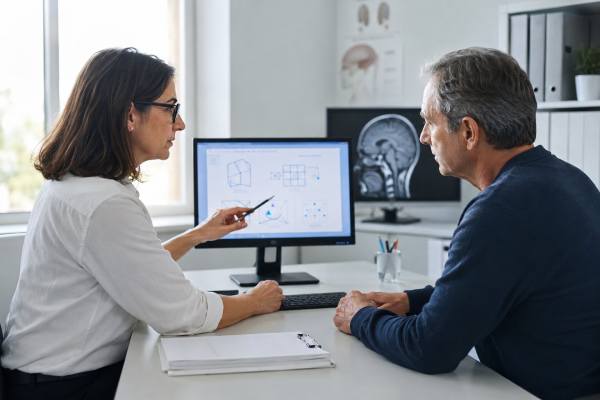
Artificial intelligence is beginning to change how cognitive testing is delivered, scored, and interpreted. The most visible changes are not robots diagnosing dementia or replacing neuropsychologists. They are more practical: tablet-based tests that capture response speed, speech tasks analyzed for subtle language patterns, digital clock-drawing tools, remote assessments, and systems that combine cognitive scores with medical history, imaging, or biomarker information.
These tools can make cognitive assessment more scalable and more sensitive to small changes over time. They may also introduce new risks, especially when results are treated as a diagnosis without enough clinical context. Understanding what AI can add, where it still falls short, and how clinicians use these results can help patients, families, and caregivers ask better questions before relying on any cognitive testing tool.
Table of Contents
- What AI Adds to Cognitive Testing
- AI Tools Used in Cognitive Assessment
- What AI Can and Cannot Measure
- Accuracy, Validation, and Bias
- Privacy, Consent, and Data Use
- How Clinicians Use AI Results
- Questions to Ask Before Using AI Tests
What AI Adds to Cognitive Testing
AI adds pattern recognition, automation, and repeated measurement to cognitive testing. It does not replace the basic purpose of cognitive assessment, which is to understand how a person is functioning across areas such as memory, attention, language, processing speed, executive function, and visuospatial skills.
Traditional cognitive testing often relies on structured tasks, standardized scoring, and clinical interpretation. A person may be asked to remember words, copy a figure, draw a clock, solve problems, name objects, switch between tasks, or answer orientation questions. These tests can be brief screens, such as a short memory test, or longer evaluations that take several hours. A broader explanation of standard testing is available in what cognitive testing measures.
AI changes the process by collecting and analyzing more data from the same or similar tasks. For example, a digital clock-drawing test can record not only whether the final clock looks correct, but also how long the person paused, where they started, how they corrected mistakes, and the order in which they drew the numbers and hands. A speech task can assess word choice, pauses, grammar, pronunciation, and acoustic features. A computerized reaction-time task can measure millisecond-level changes that paper tests cannot easily capture.
This extra detail can be useful because cognitive problems do not always appear as one obvious failed answer. Early changes may show up as slower processing, inconsistent performance, subtle word-finding patterns, or increasing effort on tasks that once felt automatic. AI systems may help detect these patterns earlier or track them more consistently over time.
The most important point is that AI is usually added to a testing workflow rather than standing alone. It may help with:
- Scoring: reducing manual scoring burden and improving consistency.
- Signal detection: finding patterns in timing, language, movement, or errors.
- Risk prediction: estimating whether a person may need more evaluation.
- Monitoring: tracking change across repeated tests at home or in clinic.
- Clinical decision support: helping clinicians decide what follow-up may be appropriate.
AI can also make testing more accessible. Some cognitive assessments can now be done on tablets, smartphones, or web platforms. Remote tools may help people who live far from specialty clinics, have mobility limitations, or need repeated testing during research or treatment monitoring. Still, easier access does not automatically mean better accuracy. A convenient test can be helpful as a screen, but it must be interpreted in the right clinical context.
AI Tools Used in Cognitive Assessment
AI is being used in several types of cognitive assessment, from clinic-based digital tests to speech analysis and passive monitoring. These tools vary widely in maturity: some are used in clinical settings, some are mainly research tools, and others are consumer-facing products with limited medical validation.
Computerized and tablet-based cognitive tests
Computerized tests present cognitive tasks on a screen and record responses automatically. AI may help score performance, identify unusual patterns, compare results with reference groups, or flag results that should be reviewed by a clinician. These tests can assess attention, memory, processing speed, executive function, reaction time, and learning across repeated trials.
Some systems are designed for clinics, primary care offices, memory clinics, concussion programs, or research studies. Others are used remotely. The key distinction is whether the tool has been validated for the population and purpose in question. A digital test used for dementia screening in older adults is not automatically valid for assessing ADHD, concussion recovery, medication effects, or workplace performance. For a closer look at this format, see computerized cognitive testing accuracy.
Digital drawing, tapping, and movement tasks
AI can analyze how a person completes a task, not just the final answer. Digital drawing tasks may capture planning, sequencing, hesitation, corrections, and spatial organization. Finger tapping, gait, balance, or movement tasks may provide clues about motor slowing, coordination, or neurological changes that overlap with cognitive symptoms.
These measures can be useful because cognition and movement often interact. For example, some conditions affect both thinking speed and motor control. In dementia workups, Parkinsonian disorders, concussion assessment, and certain neurological conditions, subtle motor or timing changes may add context to standard cognitive scores.
Speech and language analysis
Speech-based tools are one of the most active areas of AI cognitive research. A person may be asked to describe a picture, retell a story, name animals, read a passage, or speak freely. AI systems can analyze features such as pauses, word retrieval, sentence complexity, speech rhythm, articulation, and topic coherence.
These tools are being studied for early cognitive impairment, Alzheimer’s disease, frontotemporal dementia, Parkinson’s-related cognitive change, and other neurological conditions. They may be especially helpful because language can reveal changes in memory, executive function, and semantic knowledge. However, speech tools can also be affected by accent, education, bilingualism, hearing loss, anxiety, fatigue, depression, culture, and recording quality.
Wearables, apps, and passive monitoring
Some AI tools use data gathered outside formal testing sessions. Smartphones and wearables can record sleep patterns, activity levels, typing rhythms, walking speed, location patterns, voice features, or daily routines. These are often described as digital biomarkers when they are used as measurable signals related to health or disease. The concept is closely related to digital biomarkers for brain health.
Passive monitoring may eventually help detect functional changes earlier than clinic visits alone. For example, changes in daily movement, social rhythm, navigation, or sleep may appear before a person reports major memory problems. But passive monitoring raises major privacy and consent questions because it can collect sensitive information continuously.
AI-supported imaging and multimodal models
Some AI systems combine cognitive test results with other data, such as MRI, PET, blood biomarkers, spinal fluid results, genetics, medication history, mood symptoms, sleep data, and electronic health records. These multimodal models may estimate risk, support differential diagnosis, or help identify who may benefit from additional testing.
This approach is promising but complex. A model that performs well in a research dataset may not work as well in a busy clinic, a rural practice, a different country, or a population with different education levels, languages, medical conditions, or access to care.
What AI Can and Cannot Measure
AI can measure patterns in test performance, but it cannot fully explain why those patterns are present. That distinction matters because cognitive symptoms can come from many causes, including neurological disease, sleep problems, depression, anxiety, medication effects, substance use, thyroid disease, vitamin deficiencies, infections, pain, stress, and sensory problems such as poor hearing or vision.
An AI cognitive tool may detect that someone’s memory, speech fluency, or processing speed looks different from expected. It may show that performance has changed over time. It may estimate that a person’s pattern resembles a group with mild cognitive impairment, dementia, concussion, or another condition. But it cannot, by itself, determine the full medical explanation.
For example, slow processing speed might reflect early neurological disease. It might also reflect poor sleep, sedating medication, depression, pain, low blood sugar, alcohol use, or test anxiety. Word-finding problems may occur in Alzheimer’s disease, but they can also appear with normal aging, stress, migraine, ADHD, long COVID, hearing problems, or multilingual language switching. A low score is a clue, not a complete diagnosis.
This is why screening and diagnosis should not be treated as the same thing. A screening tool looks for signs that more evaluation may be needed. A diagnosis requires clinical history, symptom timeline, functional impact, examination, and often additional testing. The difference is especially important in brain and mental health because false reassurance and false alarm can both cause harm. More detail on this distinction is covered in screening versus diagnosis.
AI tools are usually strongest when the question is narrow and the data are well matched to that question. They may perform better when asked, “Does this pattern suggest a higher likelihood of cognitive impairment compared with a similar reference group?” They are weaker when asked broad questions such as, “Does this person have dementia?” or “What condition explains these symptoms?” without clinical context.
| AI may help with | AI should not be expected to do alone |
|---|---|
| Measure response speed, pauses, errors, and patterns across tasks | Explain the medical cause of a cognitive symptom |
| Track change over repeated assessments | Confirm dementia, ADHD, concussion, or another diagnosis by itself |
| Flag results that may need clinician review | Replace a neurological, psychiatric, or neuropsychological evaluation |
| Combine multiple data streams for risk estimation | Guarantee accuracy for every age, language, culture, or education level |
AI also cannot judge the lived impact of symptoms without human input. A person’s test score may look mildly abnormal, but the practical meaning depends on whether they are missing bills, getting lost, making medication mistakes, struggling at work, repeating questions, losing independence, or showing personality changes. Clinical interpretation connects numbers to real life.
Accuracy, Validation, and Bias
Accuracy depends on how the AI tool was trained, tested, validated, and used. A tool that looks impressive in a study may perform less well when used with different patients, different devices, different languages, or different clinical conditions.
Several terms are useful when evaluating AI-assisted cognitive tests. Sensitivity refers to how well a tool detects people who truly have the condition or impairment being screened for. Specificity refers to how well it avoids falsely flagging people who do not have it. External validation means the tool has been tested in a separate group from the one used to build it. Calibration means the predicted risk matches real-world outcomes reasonably well. Generalizability means the tool performs across different settings and populations.
A common problem is that AI models can learn patterns from narrow datasets. If a system is trained mostly on highly educated English-speaking research volunteers, it may not work as well for people with fewer years of education, limited literacy, different cultural backgrounds, bilingual speech patterns, sensory impairments, or complex medical histories. If a tool is trained mainly in specialty memory clinics, it may overestimate risk in primary care, where many cognitive complaints are caused by sleep, mood, medications, or reversible medical issues.
Bias can enter through many routes:
- The training data may not represent the people who will use the test.
- The “correct” diagnosis used to train the model may itself be uncertain.
- The test may depend on language, education, technology comfort, or motor speed.
- The device, microphone, internet connection, or testing environment may affect results.
- The model may perform differently across age, sex, race, ethnicity, disability, or socioeconomic groups.
AI tools can also be difficult to interpret. Some models are “black boxes,” meaning they produce a score without a clear explanation of which features drove the result. In medicine, that is a serious limitation. Clinicians need to know whether a result makes sense, whether it fits the patient’s history, and whether the tool may be wrong for understandable reasons.
Regulatory status is another important issue. Some digital tools are marketed for wellness, brain training, or self-checking. Others are intended for clinical screening or decision support. A tool intended to guide medical decisions should meet a higher standard than a consumer app that simply gives general feedback. Related concerns also apply to AI in mental health diagnosis, where algorithmic results can be misleading if treated as clinical certainty.
A practical rule is to ask whether the tool has been validated for the exact use being proposed. “AI-powered” is not a validation standard. The better question is: validated for whom, compared with what, in which setting, and for what decision?
Privacy, Consent, and Data Use
AI cognitive testing can involve sensitive data, including voice recordings, writing patterns, health history, location-related behavior, sleep patterns, device activity, and repeated measures of mental performance. Before using any tool, people should understand what data are collected, who can access them, how long they are stored, and whether they may be used to train future systems.
Privacy concerns are not limited to formal medical records. A short speech sample may reveal accent, emotional state, education, native language, and possible neurological changes. Passive monitoring may reveal routines, social isolation, sleep disruption, driving patterns, or time spent at home. Even when data are “de-identified,” some digital patterns may still carry re-identification risk if combined with other information.
Consent should be clear and specific. A person using an AI cognitive tool should be able to understand:
- Whether the test is for medical care, research, workplace screening, insurance, education, or personal use.
- Whether raw data, such as audio or drawing traces, are stored.
- Whether results are shared with clinicians, researchers, family members, employers, schools, or third parties.
- Whether the company may use the data to improve or train algorithms.
- Whether the person can delete data or withdraw from ongoing monitoring.
- Whether abnormal results trigger any automatic notification or follow-up.
Cognitive testing also has emotional and practical consequences. A person may feel anxious after a “high risk” result, even if the tool is only a screen. Families may change how they treat someone. Employers, insurers, or institutions could misuse cognitive data if protections are weak. For children, older adults, and people with cognitive impairment, consent may require extra care because the person may not fully understand the long-term implications of data collection.
Equity is part of privacy and safety. People should not be pressured into digital testing when they lack internet access, a suitable device, private space, hearing support, language support, or comfort with technology. A poor test environment can produce poor data. In cognitive assessment, bad data can lead to inaccurate conclusions.
For clinical use, AI tools should fit within normal standards of confidentiality, informed consent, medical documentation, and follow-up. If a tool collects data outside a clinical setting, the person should know whether it is protected like a medical record or handled under a consumer privacy policy. Those are not always the same.
How Clinicians Use AI Results
Clinicians use AI cognitive results as one piece of evidence, not as a stand-alone verdict. A responsible interpretation considers the person’s symptoms, timeline, daily functioning, medical history, medications, sleep, mood, neurological signs, sensory limitations, education, language, and prior test performance.
In primary care, an AI-assisted cognitive screen may help decide whether more evaluation is needed. If a result is normal but symptoms are concerning, the clinician may still order follow-up testing. If a result is abnormal, the next step may include a medical history, physical and neurological examination, lab work, medication review, depression or anxiety screening, sleep assessment, brain imaging, or referral to a specialist.
In memory clinics, AI tools may help quantify subtle changes, compare patterns across domains, or combine cognitive results with imaging and biomarkers. This can support evaluation for mild cognitive impairment, Alzheimer’s disease, vascular cognitive impairment, Lewy body dementia, frontotemporal dementia, and other causes of cognitive decline. Families trying to understand a memory workup may also benefit from learning how clinicians approach memory loss and confusion.
In neuropsychology, AI may improve scoring efficiency or add detailed timing and behavior data. But a full neuropsychological evaluation remains broader than a digital score. It includes test selection, behavioral observations, effort and validity assessment, mood and personality context, developmental history, functional impact, and interpretation across multiple cognitive domains. For more complex questions, such as separating ADHD from anxiety, depression from dementia, or brain injury from sleep deprivation, human expertise remains central.
In research, AI-assisted tools are being used to detect early change, monitor disease progression, improve trial recruitment, and measure treatment response. Repeated digital testing may be especially useful because a single score can be noisy. Trends over time often tell a more meaningful story than one isolated result.
Clinical use should also include a plan for abnormal findings. A tool that flags risk but provides no pathway for follow-up can create confusion. A useful process answers: Who reviews the result? How quickly? What symptoms require urgent care? What follow-up tests are appropriate? How will results be explained to the patient and family?
Urgent evaluation is important when cognitive symptoms appear suddenly or with neurological warning signs. Sudden confusion, new weakness, facial drooping, trouble speaking, severe headache, seizure, fainting, chest pain, high fever, head injury, new hallucinations with agitation, or risk of self-harm should not be managed through an app or at-home cognitive test. These situations need prompt medical attention. A practical safety resource is when to go to the ER for neurological or mental health symptoms.
Questions to Ask Before Using AI Tests
Before relying on an AI cognitive test, ask what decision the result is supposed to support. A tool may be reasonable for tracking general change, but not strong enough to diagnose a condition, determine capacity, guide medication, or rule out disease.
For a clinic-based tool, ask the clinician how the result will be interpreted. For an app or at-home tool, read the limitations carefully and avoid treating the result as a diagnosis. At-home tools can be useful for noticing patterns or deciding whether to seek care, but they are not a substitute for a medical workup. This is especially important when using at-home cognitive tests.
Useful questions include:
- What is the test intended to detect?
Is it screening for general cognitive impairment, monitoring change, estimating dementia risk, assessing concussion recovery, or measuring a specific domain such as attention or processing speed? - Has it been validated for people like me or my family member?
Ask about age, language, education, cultural background, diagnosis, device type, and clinical setting. - What was it compared with?
A strong study compares the tool with accepted clinical diagnoses, neuropsychological testing, established cognitive screens, biomarkers, imaging, or meaningful outcomes over time. - What happens after an abnormal result?
A good testing process includes follow-up, explanation, and a next-step plan. A risk score without guidance can increase anxiety without improving care. - Could something else explain the result?
Poor sleep, depression, anxiety, pain, hearing loss, vision problems, medications, alcohol, low blood sugar, thyroid disease, vitamin B12 deficiency, infection, or recent illness can affect cognitive performance. - How are my data handled?
Ask whether audio, writing, movement, or passive data are stored; whether they are shared; whether they are used for model training; and whether they can be deleted. - Is the tool regulated or only marketed as wellness technology?
Medical decision support tools should meet higher standards than consumer self-check apps or brain-training products.
It is also reasonable to ask for the result in plain language. A useful explanation should describe what was measured, what the score suggests, what it does not prove, and what follow-up is recommended. If the explanation is only a risk percentage or a vague “AI score,” it may not be enough for meaningful decision-making.
The best use of AI in cognitive testing is not to turn complex clinical questions into one number. It is to add useful data to a careful evaluation. When used well, AI may help detect subtle change, reduce scoring burden, improve access, and support earlier follow-up. When used poorly, it can overstate certainty, miss context, widen bias, or cause unnecessary alarm.
References
- A scoping review of remote and unsupervised digital cognitive assessments in preclinical Alzheimer’s disease 2025 (Scoping Review)
- Clinical prediction models using artificial intelligence approaches in dementia 2025 (Systematic Review)
- Ethics and governance of artificial intelligence for health: Guidance on large multi-modal models 2025 (Guidance)
- Clinical Decision Support Software Guidance for Industry and Food and Drug Administration Staff January 2026 2026 (Guidance)
- Applications of artificial intelligence to aid early detection of dementia: A scoping review on current capabilities and future directions 2022 (Scoping Review)
- Reporting guideline for the early-stage clinical evaluation of decision support systems driven by artificial intelligence: DECIDE-AI 2022 (Reporting Guideline)
Disclaimer
This article is for general educational purposes only and is not a substitute for professional medical advice, diagnosis, or treatment. AI-assisted cognitive test results should be reviewed with a qualified clinician, especially when symptoms are new, worsening, sudden, or affecting safety and daily functioning.
Share this article on Facebook, X, or your preferred platform to help others understand how AI is being used in cognitive testing.