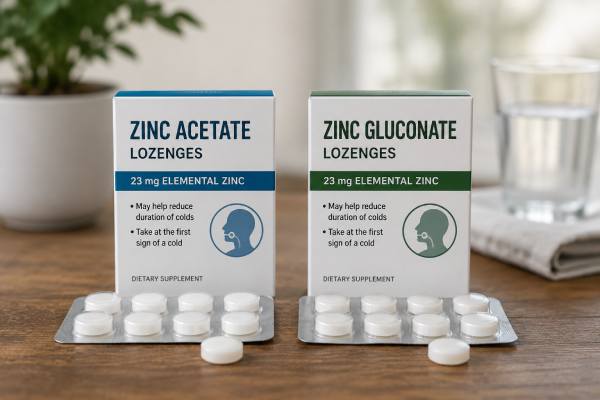
When a cold starts, zinc lozenges are one of the few over-the-counter options that may do more than simply mask symptoms. But the details matter. Many people buy a product that says “zinc” on the front, then assume all lozenges work the same. They do not. The type of zinc, the amount of elemental zinc, how quickly you start, how often you take it, and even the other ingredients in the lozenge can all affect the result.
That is why the real question is not only zinc acetate versus zinc gluconate. It is which form is more likely to release useful zinc ions in the mouth and throat, at a meaningful dose, early enough in the cold to matter. This guide breaks down what the better evidence suggests, where the differences between acetate and gluconate seem smaller than marketing claims imply, how to use zinc lozenges more effectively, and when they are not a smart choice.
Key Insights
- Zinc lozenges may shorten a cold for some adults, but the benefit depends heavily on dose, formulation, and early use.
- Zinc acetate has a stronger reputation, yet well-made zinc gluconate lozenges can also work and may not be clearly inferior.
- A label that says “zinc” is not enough; lozenges with too little elemental zinc or a poor formula may do very little.
- Nausea, bad taste, and stomach upset are common limits, and prolonged high-dose zinc can interfere with copper balance.
- Start within 24 hours of symptom onset, dissolve each lozenge slowly, and use the product only for a short cold-season window rather than as a daily long-term habit.
Table of Contents
- What matters most
- How zinc lozenges work
- Acetate vs gluconate
- How to use them
- Side effects and cautions
- When they are worth trying
What matters most
If you only remember one point from this article, make it this: the most important factor is usually not whether the lozenge uses zinc acetate or zinc gluconate, but whether the product delivers enough usable zinc in the right way. Many disappointing results with zinc lozenges seem to come from weak formulas, not necessarily from the zinc salt alone.
The better evidence suggests that zinc lozenges can modestly shorten the duration of a common cold in some adults, especially when started early. But the benefit is uneven. Some people feel that symptoms ease faster, while others notice no meaningful change. That variation is one reason zinc remains a “may help” intervention rather than a universally recommended one.
What tends to matter most:
- Timing: starting within the first 24 hours is more promising than starting on day three.
- Dose: low-dose products often underperform.
- Formulation: ingredients that bind zinc too tightly may reduce the amount of free zinc available where it matters.
- Delivery: a lozenge that dissolves slowly in the mouth is different from a pill that is swallowed quickly.
This helps explain why consumer experiences are so mixed. One person may take a well-formulated product every two to three hours from the first scratchy throat and see a benefit. Another may take a sweet, low-dose lozenge twice a day after the cold is fully established and conclude that zinc is useless. Both experiences can be real.
In practical terms, zinc lozenges are best viewed as a short-term cold intervention, not a general immune upgrade. They are not antibiotics, they do not treat flu or pneumonia, and they are not a substitute for rest, fluids, and symptom care. They also do not “boost” the immune system in the vague marketing sense. If you want the broader picture, a general guide to zinc forms and side effects can help separate cold treatment from everyday nutrition.
A second practical point is that product labels can be misleading. The front of the package may highlight zinc acetate as if that alone settles the matter. It does not. You still need to check the elemental zinc per lozenge, the number of lozenges per day, and whether the instructions line up with the way zinc lozenges were studied. That is why the better question is often, “Is this a high-enough, well-designed lozenge?” rather than, “Does it say acetate or gluconate?”
For most adults, the evidence-based takeaway is simple: zinc lozenges may be worth trying at the very start of a cold, but the product has to be chosen carefully and used correctly or the odds of benefit drop fast.
How zinc lozenges work
Zinc lozenges are thought to work mainly through local effects in the mouth and throat rather than through the slower, whole-body nutrition route that matters for correcting deficiency. That distinction is important. When you use zinc for a cold, you are not trying to “load” your body with zinc over weeks. You are trying to expose the tissues of the upper airway to zinc ions during the early phase of illness.
The theory is that free zinc ions in the oropharyngeal region may interfere with viral activity or reduce processes tied to inflammation and symptom persistence. That does not mean zinc kills every cold virus on contact. It means the local environment in the nose-throat pathway may become a little less favorable to the infection and the inflammatory response that comes with it.
This is why the way the lozenge dissolves matters so much. A good lozenge is meant to dissolve slowly and keep zinc in contact with the throat and nearby tissues. Chewing it quickly or swallowing it like a tablet likely defeats much of the point. A lozenge is closer to a slow-delivery format than a conventional supplement.
It also helps explain why formula details can be decisive. Some ingredients may bind zinc and reduce the amount of free ion available. In real-world terms, two lozenges can both contain the same headline amount of zinc while behaving differently in the mouth. That is one reason “same milligrams” does not always mean “same effect.”
There is also a reason zinc lozenges fit into the broader idea of airway defense. The mouth, throat, and nasal passages are part of the first-contact zone for respiratory viruses. If you want to understand that bigger picture, mucosal immunity is the key concept. Lozenges act at that surface level, which is why technique matters more here than with many other supplements.
A few practical implications follow from the mechanism:
- Let the lozenge dissolve slowly.
- Space doses through the day rather than taking them all at once.
- Start early, when symptoms are just beginning.
- Do not expect the same effect from zinc gummies, swallowed tablets, or random “immune candy.”
None of this guarantees success. Zinc lozenges are not a precise treatment with predictable results in every person. But understanding how they are supposed to work makes it easier to spot weak products and unrealistic claims. If a label emphasizes flavor, herbs, or vitamin blends more than the actual zinc delivery, it may be drifting away from what made the more successful lozenge studies look promising in the first place.
Acetate vs gluconate
This is the comparison most shoppers want, and the honest answer is more nuanced than a simple winner-takes-all verdict.
Zinc acetate is often presented as the superior option because acetate binds zinc less tightly than gluconate, which could leave more free zinc ions available in the mouth and throat. On paper, that sounds like a clear advantage. It is one reason many clinicians and evidence-minded shoppers lean toward acetate first.
But when researchers looked directly at higher-dose lozenge trials, the difference between zinc acetate and zinc gluconate was not clean or decisive. Acetate has looked strong in several trials, yet properly designed gluconate lozenges have also shown benefit. In other words, acetate may have a formulation advantage, but that advantage has not translated into a rock-solid conclusion that acetate always works better in practice.
Why the uncertainty? Because salt type is only one variable among several:
- Daily elemental zinc dose varies widely across products.
- Excipients may change free zinc ion availability.
- Dissolution time differs from one lozenge to another.
- Instructions for duration may be too short in some products.
- Study quality and symptom definitions are not identical.
This means a well-made gluconate lozenge can outperform a poorly designed acetate lozenge. That is the central point many marketing pages skip. The salt matters, but it is not the whole story.
A sensible way to think about the comparison is this:
- Acetate has the cleaner theoretical case.
- Gluconate still has meaningful supportive evidence when the product is well designed.
- Formulation and dose can outweigh the difference between the salts.
There is also a practical consumer angle. Acetate lozenges may be harder to find in certain markets, may cost more, or may have a taste some people dislike. If you cannot tolerate the product, you will not use it correctly. A good gluconate lozenge taken as directed is likely more useful than an acetate product you abandon after two doses.
This is why some careful reviewers end up with a measured conclusion: zinc acetate may be the first form to look for, but zinc gluconate should not be dismissed. The better evidence does not support the claim that gluconate is automatically ineffective. It supports a more careful statement: acetate may have an edge in theory and in some analyses, but high-quality lozenges of either form can be worth considering.
For readers who want the shortest answer, it is this: choose a high-dose, slowly dissolving zinc lozenge with a sensible formula, and treat acetate as a preference, not a guarantee. The product design may matter as much as the salt on the label.
How to use them
Using zinc lozenges well is where most of the real-world benefit is won or lost. Even a reasonable product can disappoint if the timing or technique is off.
A practical approach looks like this:
- Start early. The best chance of benefit is when you begin within 24 hours of the first signs of a cold, such as throat irritation, sneezing, or that familiar “coming down with something” feeling.
- Aim for a meaningful daily dose. In research discussions, benefit tends to cluster around total daily elemental zinc intakes above roughly 75 mg. That does not mean more is always better, and it does not mean megadosing is wise.
- Use divided doses across the day. Many lozenge protocols spread doses every two to three waking hours.
- Dissolve slowly. Do not crunch it, chew it, or swallow it like a pill.
- Keep the course short. Think in days, not weeks.
For many adults, a realistic plan is six to eight lozenges per day only if that matches the label and total elemental zinc stays in the studied short-term range. If a lozenge provides 10 to 15 mg elemental zinc, that can get you into the ballpark more effectively than products with tiny doses. Still, the label matters, because some products look strong on the front and deliver much less than expected over a full day.
When reading the package, check:
- elemental zinc per lozenge
- zinc form used
- number of lozenges per day
- whether the lozenge is meant to dissolve slowly
- whether there are lots of added ingredients that distract from the main purpose
Do not use zinc lozenges as a long-term daily supplement throughout the season unless a clinician has a separate reason for you to take zinc. Cold-use protocols are short-term and specific. The line between “helpful short course” and “too much for too long” can be easy to cross.
It is also smart to buy from brands that are more transparent about testing and labeling. If you are comparing products, guides on third-party tested supplements and a dedicated look at how to use zinc lozenges can make label reading much easier.
One more point: zinc lozenges are not a cure-all bundle. Pair them with basic cold care that actually helps you function better, such as fluids, sleep, and throat-soothing measures. They are most useful as one part of a calm, practical response to early cold symptoms.
A good result from zinc usually looks like a somewhat shorter illness or a less dragged-out tail of symptoms, not a dramatic overnight recovery. That expectation matters. If you expect a cold to vanish in twelve hours, you are likely to be disappointed. If you use a solid lozenge early and hope to trim the course by a day or two, that is closer to the range of what seems plausible.
Side effects and cautions
Zinc lozenges are usually tolerated well enough for short-term use, but “usually” does not mean “for everyone,” and “short-term” matters a lot.
The most common drawbacks are straightforward:
- bad taste or metallic taste
- nausea
- stomach upset
- mouth irritation
- occasional headache
These side effects are not trivial, because zinc lozenges only help if you keep using them during the early cold window. A product that makes you queasy after two doses is not a good fit, even if the formulation is theoretically strong.
The bigger concern is prolonged high zinc intake. Zinc lozenges often exceed the standard daily upper intake level when used in cold-treatment amounts, but that can be reasonable for a brief period if the product is used exactly as intended. The problem comes when people continue high-dose zinc long after the cold is gone, stack multiple zinc products, or take zinc lozenges alongside another daily immune supplement without doing the math.
Too much zinc over time can interfere with copper absorption. That is why long-term use can backfire and why the broader issue of zinc and copper balance matters. Short-term lozenge use for a cold is one thing. Repeating high-dose courses constantly or taking zinc every day “just in case” is another.
You should also be careful if you:
- take antibiotics that can interact with minerals
- use penicillamine or other medications affected by zinc
- are pregnant or breastfeeding and are unsure how a short-term high-dose product fits with your needs
- are giving zinc to a child, especially without pediatric guidance
- have chronic nausea, a sensitive stomach, or a history of supplement intolerance
Another important line: do not confuse zinc lozenges with intranasal zinc products. Zinc used in the nose is a different risk category because of the concern about smell loss. If that issue is unfamiliar, this guide to zinc nasal sprays and smell loss risk is worth reading before you buy anything labeled for cold relief.
In practical terms, the safest mindset is this: use zinc lozenges as a short, targeted trial at the start of a cold, not as an all-season routine. Stop if side effects are hard to tolerate. Do not layer zinc from several sources unless you have checked the total dose. And if you have a medical condition, take several prescription drugs, or are thinking about frequent repeated courses, it is reasonable to check with a clinician or pharmacist first.
When they are worth trying
Zinc lozenges are worth trying when the situation is simple and the goal is realistic: you are an adult, you feel a cold starting, symptoms are still early, and you want a low-cost intervention that might shorten the illness a bit if used correctly.
They are less worth trying when symptoms are already several days in, when the product is poorly labeled, when you cannot tolerate the taste, or when you tend to keep taking supplements far longer than intended. They are also not a substitute for medical evaluation when symptoms suggest something more serious than a routine cold.
A sensible candidate for zinc lozenges usually looks like this:
- scratchy throat or early sneezing started today
- you can begin immediately
- you found a lozenge with a clear zinc form and meaningful elemental dose
- you are comfortable using it for a few days only
- you are not already taking high-dose zinc elsewhere
On the other hand, skip the lozenge-first mindset and think more broadly if you have high fever, shortness of breath, worsening chest symptoms, dehydration, severe one-sided facial pain, or symptoms that simply are not behaving like a typical cold.
It also helps to decide what “success” means before you start. A reasonable goal is a shorter or less lingering cold, not total prevention after a major exposure. Zinc does not replace proven prevention tools such as hand hygiene, adequate sleep, staying home when sick, and common-sense respiratory etiquette.
For symptom support alongside zinc, gentle basics often matter more than another expensive supplement. A salt water gargle can help a sore throat, and staying ahead of dehydration when sick can make the entire illness easier to handle. Zinc works best as part of that practical framework, not as a stand-alone miracle fix.
So which form should you choose? If you have two otherwise similar products, zinc acetate gets the nod as the more appealing first pick. But if the acetate option is low dose, poorly formulated, or unpleasant enough that you will not take it correctly, a better-designed zinc gluconate lozenge may be the smarter buy.
That leads to the most honest bottom line: zinc acetate probably wins the label-level comparison, but not by enough to ignore dose, design, and usability. In real life, the best lozenge is the one with a thoughtful formula, enough elemental zinc, early use, and short-term tolerability. Those factors are what most often separate “this helped” from “this did nothing.”
References
- Zinc for prevention and treatment of the common cold 2024 (Systematic Review)
- Zinc – Health Professional Fact Sheet 2026 (Official Guidance)
- Zinc Toxicity: Understanding the Limits 2024 (Review)
- Zinc lozenges and the common cold: a meta-analysis comparing zinc acetate and zinc gluconate, and the role of zinc dosage 2017 (Meta-analysis)
- Quantile Treatment Effect of Zinc Lozenges on Common Cold Duration: A Novel Approach to Analyze the Effect of Treatment on Illness Duration 2022 (Analysis)
Disclaimer
This article is for educational purposes only and is not medical advice. Zinc lozenges may not be appropriate for everyone, especially children, people who are pregnant or breastfeeding, and anyone with medical conditions or medication interactions that affect zinc use. Seek medical care for severe symptoms, breathing trouble, chest pain, dehydration, symptoms that are rapidly worsening, or an illness that does not seem like a routine cold.
If you found this article useful, please consider sharing it on Facebook, X, or your preferred platform.