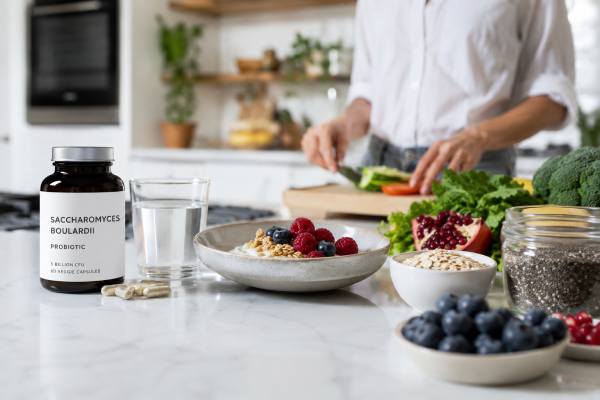
Saccharomyces boulardii is often described as an “immune-support probiotic,” but that phrase can be misleading if you do not know what it actually does. This is not a supplement that broadly powers up the immune system or acts like a daily shield against every infection. Its real strength is more specific and, in many ways, more useful: it can help protect the gut during and after antibiotics, support barrier function, and reduce the chance of certain kinds of antibiotic-related diarrhea in some people.
That matters because the gut is not separate from immune health. It is one of the body’s largest immune interfaces, constantly deciding what to tolerate and what to fight. When antibiotics disrupt that environment, symptoms such as diarrhea, bloating, and unstable digestion can follow, and immune signaling can become less balanced.
This article explains where Saccharomyces boulardii has its strongest evidence, how to use it well, what dose ranges are common, and who should be careful or avoid it altogether.
Quick Summary
- Saccharomyces boulardii is best supported for reducing antibiotic-associated diarrhea, not for broadly “boosting” immunity.
- Its practical advantage is that it is a yeast probiotic, so antibacterial antibiotics do not kill it during treatment.
- It may support gut barrier function and local immune signaling, but those benefits are strongest in the context of gut disruption rather than general wellness claims.
- It should be avoided or used only with specialist guidance in people who are critically ill, severely immunocompromised, or have central venous catheters.
- A common way to use it is to start early in an antibiotic course and continue through treatment, with the exact dose guided by the product label and clinical context.
Table of Contents
- What Saccharomyces boulardii actually does
- Where evidence is strongest
- How it connects to immune health
- Dosage, timing, and product choice
- When to avoid it
- Who might benefit most
What Saccharomyces boulardii actually does
Saccharomyces boulardii is different from the probiotics most people picture. It is not a Lactobacillus or Bifidobacterium species. It is a probiotic yeast, and that difference is central to why it is used. Because it is a yeast, it is not killed by antibacterial antibiotics in the way many bacterial probiotics are. That makes it especially attractive during antibiotic treatment, when the gut is under stress and microbial balance is being disrupted in real time.
Its main actions are concentrated in the gut. It appears to help by competing with unwanted microbes, interfering with some toxin-related effects, supporting the intestinal barrier, and shaping local immune signaling in ways that may reduce irritation and fluid loss. Some studies also suggest effects on secretory IgA and inflammatory signaling in the intestinal lining. That is why Saccharomyces boulardii is better understood as a gut-directed immune support tool than as a general immune enhancer.
This distinction matters because many supplement labels flatten all benefits into one vague promise. In practice, Saccharomyces boulardii is most relevant when the immune question is really a gut question. Antibiotics are a good example. They do not just target the infection being treated. They also disturb the larger microbial environment in the intestines, which can weaken colonization resistance and make diarrhea more likely. In that setting, a yeast probiotic has a logical role.
It is also helpful to separate what it may do from what people hope it does. Saccharomyces boulardii is not a proven way to prevent common colds, stop you from ever getting sick, or compensate for poor sleep and a low-fiber diet. It is not a broad answer to frequent illness, and it should not be used as a shortcut around the basics of gut-linked immune health.
The most useful way to think about it is this: Saccharomyces boulardii helps protect a stressed intestinal environment. That can matter for immune function because the gut barrier, gut microbes, and mucosal immune system are tightly connected. But the supplement’s value is usually greatest when there is a defined reason to use it, such as a course of antibiotics, a history of antibiotic-associated diarrhea, or a clinician-guided plan for recurrent gut disruption.
There is also a strain issue. Most of the well-known clinical discussion centers on Saccharomyces boulardii CNCM I-745, not every yeast probiotic on a shelf. Products can differ in quality, viability, and dose. So while the name “Saccharomyces boulardii” is widely used, evidence is not always interchangeable across products.
In short, this is a targeted probiotic with a clear niche. The closer your needs are to that niche, the more likely it is to be useful.
Where evidence is strongest
The strongest case for Saccharomyces boulardii is antibiotic protection, especially reducing the risk of antibiotic-associated diarrhea. That is where it has the most practical value and the clearest clinical identity. This is also where it is easiest to oversimplify the science.
Across trials and reviews, Saccharomyces boulardii has often shown benefit in lowering the risk of diarrhea that develops during or after antibiotic treatment. That matters because antibiotic-associated diarrhea is common, disruptive, and sometimes severe enough to stop a needed antibiotic early. The most convincing findings tend to appear when the probiotic is started early in the antibiotic course and continued consistently.
But the evidence is not perfectly uniform. Some studies show meaningful protection, while others do not find a significant benefit in lower-risk or mixed hospital populations. That does not make the supplement ineffective. It means results depend on the group being studied, the strain used, the outcome being measured, and the baseline risk of diarrhea. A person with a prior history of antibiotic-associated diarrhea is not the same as a generally healthy adult taking a short low-risk antibiotic course.
Clostridioides difficile is another area people often ask about. Here the evidence is more cautious. Some analyses suggest Saccharomyces boulardii may help reduce the risk of C. difficile-associated diarrhea or recurrence in selected settings, but the effect is less consistent and the certainty is lower than it is for ordinary antibiotic-associated diarrhea. This is one reason major clinical guidance does not treat probiotics as an automatic answer for everyone on antibiotics.
That nuance is important. Saccharomyces boulardii is most credible as a selective protective tool, not a universal rule. It may make the most sense in people who:
- have had antibiotic-associated diarrhea before
- are taking a longer or broader-spectrum antibiotic course
- are especially concerned about gut disruption during treatment
- have tolerated the product well in the past
- are not in a high-risk group for probiotic complications
At the same time, this is not an excuse to turn every antibiotic into a supplement stack. Some people will never develop diarrhea. Others may be better served by a broader recovery plan that includes hydration, fiber reintroduction, and attention to probiotic timing after antibiotics. Antibiotic-related gut disruption is also not solved by one capsule alone. The full picture includes diet, underlying health, medication burden, and how damaged the microbiome becomes during treatment, which is part of the larger story of antibiotics and immune recovery.
A balanced summary would be this: if you are asking where Saccharomyces boulardii is most likely to help, the answer is not vague immune support. It is antibiotic-related gut protection. That is its clearest role, and it is the main reason clinicians and patients keep returning to it.
How it connects to immune health
Calling Saccharomyces boulardii an immune-support supplement is not wrong, but it needs context. Its immune relevance comes through the gut, not through a broad, body-wide stimulating effect. That distinction helps avoid both exaggerated expectations and the common mistake of treating immune health as something separate from intestinal health.
The gut lining is one of the body’s most important immune surfaces. It acts as a selective barrier, allowing nutrients through while helping block toxins, irritants, and pathogens. It also hosts a large share of immune activity, much of it quiet and regulatory rather than dramatic. When antibiotics disrupt the microbiome, this environment becomes less stable. That can change short-chain fatty acid production, barrier integrity, local inflammation, and the balance between tolerance and defense.
Saccharomyces boulardii appears to support this system in several ways. It may help preserve barrier function, reduce the effects of certain microbial toxins, and influence signaling molecules involved in inflammation. Some experimental work also suggests an effect on secretory IgA, a key antibody involved in mucosal defense. These are plausible reasons it can support immune resilience during a period of gut stress.
That said, the phrase “immune support” can still mislead people if it makes them think of fewer colds, shorter flu symptoms, or a stronger response to every infection. The human evidence is much better for gut-focused outcomes than for those broader claims. In other words, Saccharomyces boulardii may support the terrain in which parts of the immune system operate, but it is not a proven shortcut to better immunity in the everyday consumer sense.
This is why it fits better within the framework of barrier health than the language of “boosting.” Healthy immune function depends on good barriers, diverse microbial signaling, adequate nutrition, and a body that is not constantly overwhelmed by inflammation or disruption. A yeast probiotic can help one piece of that puzzle, especially during antibiotic exposure, but it does not replace the rest.
The gut context also explains why Saccharomyces boulardii often works best when the basics are in place. It is more likely to be useful if you are also eating enough fiber once tolerated, reintroducing food variety after illness, and supporting microbial recovery through a pattern that includes prebiotic-rich foods. If everything else in the diet is working against the gut, the supplement’s effect may feel limited.
So the honest immune story is not flashy. Saccharomyces boulardii helps most when immune stress and gut stress overlap, especially under antibiotic pressure. That is a real and meaningful use, but it is narrower than the broad wellness claims that often surround probiotics.
Dosage, timing, and product choice
There is no single perfect dose of Saccharomyces boulardii for every situation, but there are clear patterns in how it is commonly used. Most over-the-counter products cluster around doses equivalent to 250 mg once or twice daily, and many clinical studies have used daily totals in the 250 to 1000 mg range. In practice, the label often gives a reasonable starting point, provided the product comes from a reputable manufacturer and clearly states the strain and viable count.
For antibiotic protection, timing matters as much as dose. The usual strategy is to begin early in the antibiotic course, ideally within the first day or two, and continue throughout treatment. Some clinicians and product instructions also extend use for several days to one or two weeks after the antibiotics end, especially in people who tend to have lingering digestive disruption. That is a practical habit rather than a universally standardized rule, but it matches how many people use the supplement in real life.
One advantage of Saccharomyces boulardii is that it does not need to be separated from antibacterial antibiotics for survival in the same way many bacterial probiotics do. Because it is a yeast, concurrent use is part of its appeal. That said, people still often spread doses through the day simply for convenience or stomach comfort.
Product choice deserves more attention than it gets. Not all probiotic labels are equally meaningful. A good product should make it easy to answer a few basic questions:
- Does it identify the strain clearly?
- Does it state viable count or dose in a transparent way?
- Does it have reasonable storage instructions?
- Does it come from a brand with credible quality control?
- Does it avoid vague proprietary blends?
This is especially important because probiotic benefits are often strain-specific. A generic label saying “probiotic yeast” is not the same as a well-characterized Saccharomyces boulardii product used in clinical research. Quality also matters for safety, storage stability, and whether the product actually contains what the label claims, which is why guidance on third-party tested supplements can be more useful than people realize.
There is one important interaction to remember: antifungal drugs can work against the supplement. If you are taking an antifungal medication such as fluconazole, itraconazole, or nystatin for an active fungal problem, Saccharomyces boulardii may be less useful or inappropriate because the medication may suppress or kill the probiotic yeast.
The practical lesson is simple. Use it for a defined reason, start early if the goal is antibiotic protection, choose a well-labeled product, and do not assume that a higher dose or a more crowded formula is automatically better. For many people, a straightforward single-ingredient product used for a limited window is the most sensible approach.
When to avoid it
Saccharomyces boulardii is generally well tolerated in healthy people, but it is not for everyone. This is where online supplement advice often becomes too casual. Because it is sold over the counter and usually causes no problem in lower-risk adults, people forget that it is a live yeast. In the wrong setting, that matters.
The most important safety concern is fungemia, a bloodstream infection caused by Saccharomyces species. This is rare, but it is real, and the risk is concentrated in medically fragile people. The main higher-risk groups include those who are critically ill, severely immunocompromised, dependent on central venous catheters, receiving intensive care, or being fed enterally or parenterally in complex hospital settings. In these patients, a product that is low-risk for the average adult may no longer be low-risk at all.
This is why Saccharomyces boulardii should not be treated as a harmless default for every hospitalized patient on antibiotics. It also helps explain why some clinicians are cautious about routine probiotic use in frail inpatients. A supplement that looks helpful in community settings may deserve a different risk calculation in the ICU.
There are other reasons to pause as well. You should be cautious or seek guidance first if you:
- take antifungal medication
- have a central line or other indwelling vascular device
- have severe immunosuppression from chemotherapy, transplant medication, or advanced illness
- are recovering from major abdominal surgery
- have an unstable critical illness
- have had a prior reaction to yeast-based products
Minor side effects are usually digestive: gas, bloating, or temporary discomfort. Some people simply do not tolerate it well. That is not dangerous, but it is still a reason to stop. Pregnancy and breastfeeding are also areas where a targeted discussion with a clinician is better than assuming every probiotic is automatically appropriate.
Another important point is that probiotics can distract from medical red flags. If antibiotic-associated diarrhea is severe, persistent, bloody, or accompanied by fever or significant abdominal pain, the issue may go well beyond routine gut upset. In that situation, self-managing with supplements is not enough. People with frequent infections, unexplained weight loss, or recurrent severe diarrhea may need evaluation for a deeper problem such as immune deficiency or another underlying condition, not just another “immune” product.
In short, Saccharomyces boulardii is low-risk for many people and clearly not low-risk for some. The more medically complex the situation, the more important it is to check the plan rather than assuming a probiotic is always benign.
Who might benefit most
The people most likely to benefit from Saccharomyces boulardii are those with a clear reason to use it and a gut-focused goal. This is not the ideal supplement for someone vaguely trying to “support immunity” without any specific problem in mind. It is better suited to situations where the intestine is under predictable stress.
A good example is someone who has developed diarrhea on past antibiotic courses. That person has a defined pattern, a clear trigger, and a supplement with a plausible and evidence-based role. Another example is someone taking a longer antibiotic course who wants to reduce the odds of gut disruption while also planning for sensible dietary recovery afterward. In both cases, Saccharomyces boulardii is being used as a tool, not as a wellness identity.
It may also be useful for people who want probiotic support during antibiotics but do not want to worry about the probiotic being wiped out by the antibiotic itself. That is one of the practical strengths of a yeast-based probiotic. It can stay in the conversation even while the antibiotic is active.
Where it makes less sense is in low-risk healthy adults who are simply collecting supplements. The evidence does not support treating Saccharomyces boulardii as daily immune insurance forever. Nor is it a substitute for other parts of recovery. People sometimes take a probiotic while continuing a pattern that is low in fiber, low in plant diversity, and heavy in ultra-processed food, then wonder why the effect feels modest. That is not a failure of the probiotic so much as a reminder that microbial recovery depends on the environment too.
This is also where expectations should be realistic. Saccharomyces boulardii may help reduce antibiotic-related diarrhea, support gut stability, and make recovery smoother. It will not reliably correct every digestive symptom, fix long-standing dysbiosis on its own, or stand in for broader strategies such as choosing the right probiotic for the goal and building a foundation of realistic supplement use.
If you want a simple decision rule, use this one: the more your question is about antibiotic protection and gut resilience, the more Saccharomyces boulardii deserves consideration. The more your question is about broad wellness, vague fatigue, or general fear of getting sick, the less likely it is to be the most useful place to start.
That makes the final takeaway refreshingly practical. Saccharomyces boulardii is not a miracle immune supplement. It is a targeted yeast probiotic with its clearest value during antibiotic-related gut disruption. Used in the right person, for the right reason, and with the right safety screen, it can be genuinely helpful.
References
- Unique Properties of Yeast Probiotic Saccharomyces boulardii CNCM I-745: A Narrative Review 2023 (Narrative Review)
- Emerging issues in probiotic safety: 2023 perspectives 2023 (Safety Review)
- Epidemiology of Saccharomyces fungemia: A systematic review 2023 (Systematic Review)
- Probiotics for the prevention of antibiotic-associated diarrhoea: a systematic review and meta-analysis 2021 (Systematic Review and Meta-Analysis)
- Systematic review and meta-analysis of Saccharomyces boulardii in adult patients 2010 (Systematic Review and Meta-Analysis)
Disclaimer
This article is for educational purposes only and is not medical advice. Saccharomyces boulardii is a live yeast probiotic and is not appropriate for everyone. People who are critically ill, severely immunocompromised, have central venous catheters, are receiving intensive hospital care, or are taking antifungal medication should not start it without medical guidance. If you have significant diarrhea, fever, blood in the stool, abdominal pain, or a complex medical history, seek advice from a qualified clinician rather than relying on self-treatment.
If you found this article helpful, please consider sharing it on Facebook, X, or another platform you use so others can find clear, practical information.