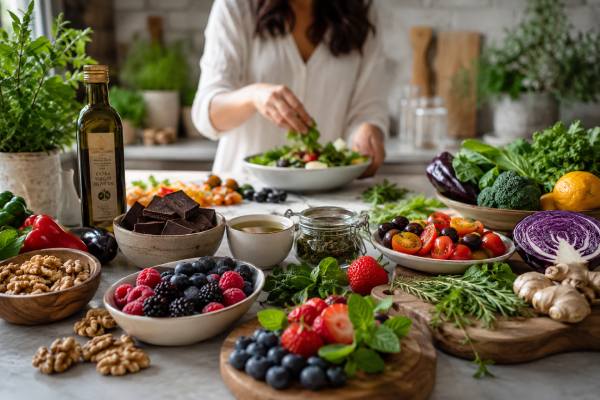
When people talk about foods that “support immunity,” the conversation often jumps straight to vitamin C, zinc, or supplements. Polyphenols deserve a place in that discussion too. These naturally occurring plant compounds are not nutrients in the classic sense, but they interact with the body in ways that matter for immune balance, inflammation, and the health of the gut lining and blood vessels. That makes them especially interesting in everyday foods like berries, cocoa, and extra virgin olive oil.
What makes polyphenols useful is not that they flip the immune system into overdrive. In fact, the better way to think about them is that they may help the body respond with less unnecessary inflammation and more resilience over time. In this article, you will learn what polyphenols are, why these three foods stand out, how they connect with gut and immune health, and how to use them in a practical, food-first way.
Key Insights
- Polyphenol-rich foods may help support immune balance by influencing inflammation, oxidative stress, gut microbes, and barrier health.
- Berries, cocoa, and extra virgin olive oil each provide different polyphenol families, so variety matters more than relying on one “superfood.”
- These foods are supportive, not protective on their own; they do not replace sleep, vaccines, medical care, or an overall healthy diet.
- The simplest way to use them is to eat berries regularly, choose minimally processed cocoa in modest portions, and use extra virgin olive oil as a main everyday fat.
Table of Contents
- What Polyphenols Actually Do
- Why Berries Punch Above Their Weight
- Where Cocoa Fits In
- Why Extra Virgin Olive Oil Stands Out
- The Gut Link and Food Patterns
- How to Put This Into Practice
What Polyphenols Actually Do
Polyphenols are a broad group of plant compounds found in fruits, vegetables, herbs, tea, cocoa, olives, and many other foods. They include families such as anthocyanins, flavanols, flavonols, phenolic acids, and more. Berries are best known for anthocyanins, cocoa for flavanols, and extra virgin olive oil for hydroxytyrosol and related olive phenols. Even though these compounds sound very different, they share a common theme: they appear to influence how the body handles stress, inflammation, and communication between cells.
That matters for immune health because the immune system does not work in isolation. It is tied closely to metabolism, the gut lining, the microbiome, and the body’s inflammatory signaling. A useful immune response needs to be strong enough to defend against threats, but not so excessive that it causes unnecessary damage. This is one reason the language of “boosting” your immune system can be misleading. More immune activity is not always better. In many everyday situations, what people really want is better regulation, better recovery, and fewer inputs that keep inflammation simmering in the background.
Polyphenols may help with that in a few overlapping ways. First, they can act directly and indirectly on oxidative stress. Oxidative stress is part of normal physiology, but when it becomes excessive, it can amplify inflammatory pathways and stress immune cells. Second, many polyphenols appear to affect signaling molecules involved in inflammatory tone. Third, and possibly most important in daily life, a large portion of dietary polyphenols reaches the large intestine, where gut microbes transform them into smaller metabolites. Those metabolites may be part of the reason polyphenol-rich diets are linked with better gut and immune outcomes.
This is why whole foods matter. A berry is not just anthocyanins. Cocoa is not just flavanols. Olive oil is not just monounsaturated fat. Each food arrives with a matrix of fiber, fats, minerals, and other plant compounds that shapes absorption, metabolism, and overall effect. That also helps explain why supplements do not always reproduce the same benefits seen with real foods and dietary patterns.
A practical way to frame polyphenols is this: they are not magic bullets, but they are meaningful contributors to immune resilience. When they show up regularly in a varied diet, they may help the body keep inflammation, barrier function, and microbial balance moving in a healthier direction.
Why Berries Punch Above Their Weight
Berries earn their reputation because they pack a large amount of polyphenols into a small serving. Blueberries, blackberries, raspberries, strawberries, cranberries, chokeberries, bilberries, and elderberries all bring something slightly different to the table, but many are rich in anthocyanins, the pigments that create blue, purple, and red colors. These compounds are often discussed for heart and brain health, yet they also matter for immune support because they intersect with gut health, inflammation, and epithelial barrier integrity.
The gut is one of the body’s largest immune interfaces. It must tolerate food and beneficial microbes while still reacting to harmful organisms. Berries appear especially helpful here because they combine polyphenols with fiber. That pairing gives them more than one route to benefit. The fiber helps feed gut microbes and supports regularity, while the polyphenols interact with those microbes and may encourage a more favorable environment. This is one reason berries fit naturally into a broader conversation about the gut-immune connection.
Another advantage is that berries are easy to use consistently. You do not need an elaborate protocol. A cup of fresh or frozen berries with breakfast, yogurt, oats, or a smoothie is realistic for most people. Frozen berries count. In some cases they are the easiest way to keep intake steady without worrying about seasonality, waste, or cost. Whole berries also usually beat juice for immune-supportive eating because they retain fiber and tend to be more filling.
That said, berries are not interchangeable with concentrated berry products. Sweetened berry snacks, syrups, or heavily diluted juices may carry the color and the marketing, but not the same nutritional profile. If the goal is immune-supportive eating, the better choices are plain or minimally processed. Mixed berries are often a smart buy because variety increases the range of polyphenols you get in a week.
There is also a good case for thinking beyond one “best” berry. Blueberries get most of the attention, but blackberries and raspberries bring useful fiber, strawberries are widely accessible, and tart berries such as cranberries and chokeberries add different phenolic profiles. The body likely benefits more from rotation than from rigid loyalty to a single fruit.
If you already eat fruit regularly, berries are a high-value upgrade. If you do not, they are an easy place to start. They fit naturally into the kind of fiber-rich eating pattern that supports immunity without asking you to overhaul your entire routine.
Where Cocoa Fits In
Cocoa is one of the more misunderstood polyphenol foods because it sits on the border between health food and dessert. The key distinction is between cocoa itself and the many products made from it. Cocoa powder and high-cocoa dark chocolate can provide flavanols, especially compounds such as epicatechin, but the amount varies widely based on processing, alkalization, formulation, and storage. In plain English, not all chocolate is a polyphenol-rich food, and not all dark chocolate delivers the same value.
The most useful immune-health lens for cocoa is not “chocolate prevents illness.” That overshoots the evidence. A better summary is that higher-flavanol cocoa may contribute to a healthier inflammatory and oxidative stress profile in some contexts, while also supporting vascular function. That vascular piece matters because blood vessels and immune activity are connected. Healthier endothelial signaling can help support appropriate circulation, tissue repair, and inflammatory balance.
Cocoa also interacts with the gut. Like many polyphenol-rich foods, some of its compounds are transformed by gut microbes into metabolites that may be biologically active. This makes cocoa another example of how food and microbiome effects overlap rather than operating in separate lanes. It also explains why a modest daily habit can be more meaningful than sporadic large intakes.
The challenge is choosing forms that make sense. Many commercial chocolate products bring large amounts of sugar, saturated fat, or calories with only modest polyphenol content. Chocolate candy is still candy. If your goal is polyphenol intake, unsweetened cocoa powder, natural cocoa added to oatmeal or yogurt, or a small serving of dark chocolate is usually a better fit than oversized bars, truffles, or sugary cocoa drinks.
A sensible approach is to think in small portions. One to two tablespoons of unsweetened cocoa powder in a meal or snack can be enough to make cocoa a regular food rather than a special event. For dark chocolate, a small square or two is more realistic than treating it like a free food. Higher cocoa percentages may be helpful, but percentage alone does not guarantee high flavanol content because manufacturing methods matter.
Cocoa works best when it is part of a broader plant-forward pattern, not when it is asked to do everything on its own. In practical terms, it can sit beside berries, nuts, yogurt, oats, and seeds as part of a higher-polyphenol breakfast or snack. That is a much more useful frame than treating chocolate as a stand-alone immune supplement.
Why Extra Virgin Olive Oil Stands Out
Extra virgin olive oil stands out because it is both a fat source and a polyphenol source. That is unusual. Many healthy fats are valuable for one reason or the other, but extra virgin olive oil brings monounsaturated fat together with a set of phenolic compounds that are strongly tied to the way the oil is made and handled. The words “extra virgin” matter here. Refining strips out much of what makes olive oil distinctive from a polyphenol standpoint.
Among the olive phenols, hydroxytyrosol and related compounds get the most attention, but the broader point is simpler: the more intact and higher-quality the oil, the more likely it is to retain the bitter, peppery, slightly pungent characteristics that often travel with higher phenolic content. A flat, very mild oil may still be useful as a cooking fat, but it is less likely to be the strongest choice if you are specifically aiming for polyphenols.
Why does this matter for immune support? First, extra virgin olive oil is a core part of the Mediterranean diet, one of the best-studied dietary patterns for inflammation, cardiometabolic health, and healthy aging. Second, olive phenols appear to influence oxidative stress and inflammatory pathways in ways that complement the benefits of the dietary pattern as a whole. Third, olive oil helps people eat more vegetables, legumes, and salads by making those foods more satisfying and more practical to keep eating.
This food-matrix effect is easy to overlook. Olive oil is not valuable only because of what is in the bottle. It is valuable because it helps build meals that are easier to repeat. A plate of beans, greens, tomatoes, herbs, and whole grains becomes more appetizing with a generous spoon of extra virgin olive oil. The same is true for roasted vegetables, soups, lentils, and grain bowls. In other words, olive oil supports polyphenol intake directly and indirectly.
Quality and storage matter. Light, heat, and oxygen reduce freshness over time. Buy oil in a dark bottle when possible, store it away from heat, and use it rather than saving it for rare “special” meals. You do not need to drink it straight. In fact, that is unnecessary. The easier and more sustainable strategy is to use it as your everyday finishing oil or primary dressing oil.
It is also worth separating olive oil from olive leaf extracts and similar products. They are not the same thing, and the evidence base is not interchangeable. If you want to compare those approaches, it helps to understand how olive leaf and olive oil differ in both composition and practical use. For most people, food-first extra virgin olive oil is the more grounded starting point.
The Gut Link and Food Patterns
If there is one idea that ties berries, cocoa, and olive oil together, it is this: polyphenols make the most sense when you stop thinking in single compounds and start thinking in food patterns. Much of their relevance to immune health appears to run through the gut, and the gut responds to the whole diet, not isolated ingredients.
A large share of polyphenols is not absorbed early in digestion. Instead, it reaches the colon, where gut microbes transform these compounds into smaller metabolites. That matters because the microbiome is not just a passive passenger. It shapes immune signaling, barrier integrity, mucus production, and the production of short-chain fatty acids and other metabolites that influence inflammation and immune tone. Polyphenols and microbes affect each other in both directions. The microbes change the polyphenols, and the polyphenols can shift which microbes thrive.
This is why polyphenols work best when paired with a pattern that also includes fiber-rich plants. In real life, the most supportive combination is not “berries or olive oil,” but berries and beans, cocoa and oats, olive oil and vegetables, nuts, legumes, herbs, and whole grains. Dietary diversity matters. People who build meals around a wider range of minimally processed plant foods tend to give both their microbiome and their immune system better raw material to work with.
That also helps explain why the strongest case for polyphenols often shows up in broader dietary patterns instead of supplement studies. Foods arrive with structure. The fats in olive oil, the fiber in berries, and the surrounding meal all shape digestion and metabolism. When you zoom out, polyphenols become part of a repeatable way of eating rather than a single intervention.
A practical takeaway is that no one food has to carry the burden. You do not need a daily perfect smoothie, a specific imported olive oil, and a prescription-strength cocoa habit. What you need is repetition. A bowl of oats with berries a few mornings a week, vegetables dressed with extra virgin olive oil at lunch, beans or lentils with dinner, and cocoa folded into a snack can be enough to shift your average intake meaningfully.
This approach also fits with other food-based strategies, such as building a grocery list around immune-supportive staples and aiming for more plant variety over the course of a week. The goal is not perfection. The goal is to make polyphenol-rich eating normal enough that your immune system benefits from the pattern, not from occasional bursts of enthusiasm.
How to Put This Into Practice
The biggest mistake people make with polyphenols is treating them like an advanced strategy when they are really a consistency strategy. You do not need exotic powders or complicated tracking. You need a few reliable habits that raise the polyphenol content of meals you already eat.
A simple framework looks like this:
- Add berries to one meal most days.
Fresh or frozen both work. Aim for about 1 cup when it fits your appetite and budget. - Use extra virgin olive oil daily.
Think in the range of 1 to 2 tablespoons across meals, mainly as dressing, finishing oil, or part of cooking. - Include cocoa in a minimally processed form.
Unsweetened cocoa powder in oats, yogurt, or smoothies is often easier to control than chocolate desserts. - Build around other plant foods too.
Polyphenols work better in a pattern that also includes beans, vegetables, nuts, seeds, herbs, and whole grains. - Keep expectations realistic.
These foods support immune health over time. They do not work like an overnight treatment.
It also helps to know the common pitfalls. Juice-heavy berry drinks can add sugar without much fiber. Dark chocolate can still be calorie-dense and easy to overeat. “Light” olive oil is not the same as extra virgin from a polyphenol standpoint. And polyphenol supplements or concentrated extracts may be more likely than whole foods to create medication questions or side effects.
For most healthy adults, a food-first approach is the safest and most sustainable. If you want a broader structure, place these foods inside an anti-inflammatory eating pattern rather than treating them as add-ons to an otherwise low-quality diet. They can improve a good pattern, but they cannot fully compensate for chronic sleep loss, heavy alcohol intake, smoking, ultra-processed eating, or long-term stress.
The good news is that polyphenol-rich foods are not niche. They are normal groceries. A carton of frozen berries, a bottle of decent extra virgin olive oil, and a tin of plain cocoa powder can take you surprisingly far. When used regularly, they add flavor, color, and meal satisfaction while also nudging your diet toward better immune resilience.
References
- Immunomodulatory properties of dietary polyphenols: a role for combating infections at mucosal surfaces? 2025 (Review)
- Polyphenols: immunonutrients tipping the balance of immunometabolism in chronic diseases 2024 (Review)
- The impact of the Mediterranean diet on immune function in older adults 2024 (Review)
- Effect of dark chocolate/ cocoa consumption on oxidative stress and inflammation in adults: A GRADE-assessed systematic review and dose-response meta-analysis of controlled trials 2024 (Systematic Review and Meta-analysis)
- Scientific Evidence for the Beneficial Effects of Dietary Blueberries on Gut Health: A Systematic Review 2023 (Systematic Review)
Disclaimer
This article is for educational purposes only and is not medical advice. Polyphenol-rich foods can be a helpful part of an immune-supportive diet, but they do not prevent, diagnose, treat, or cure infections on their own. Whole-food sources are usually appropriate for most people, yet concentrated extracts and supplements may not be suitable if you take prescription medicines, have digestive conditions, food allergies, kidney stone concerns, or other medical issues. If you are pregnant, breastfeeding, managing a chronic condition, or considering supplements rather than foods, get personalized advice from a qualified clinician.
If you found this article useful, please share it on Facebook, X, or any other platform where it may help someone eat with a little more confidence.