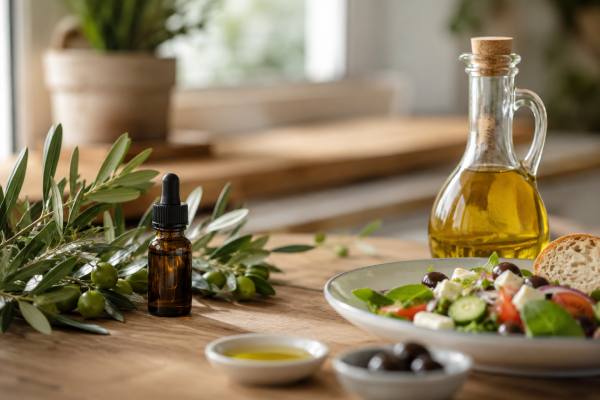
Olive leaf extract and olive oil often get grouped together because they come from the same tree, but they are not interchangeable. One is a concentrated supplement built around compounds such as oleuropein. The other is a traditional food, especially extra virgin olive oil, with a long research history tied to diet quality, inflammation, and cardiometabolic health. Because both are linked to polyphenols and antioxidant activity, it is easy to assume they offer similar immune benefits. That is where the confusion begins.
The better question is not whether either one sounds “natural” or promising. It is what each product actually is, what kind of evidence supports it, and what outcome you care about. Olive leaf extract may have interesting antimicrobial and anti-inflammatory properties, but its human evidence is limited. Olive oil, especially in the context of Mediterranean-style eating, has much stronger real-world evidence, though not as a quick-fix immune supplement. This article explains the difference and helps you choose more intelligently.
Key Insights
- Olive leaf extract and olive oil contain different compounds and should not be treated as the same kind of immune-support product.
- Olive leaf extract has intriguing lab and early human data, but the evidence for routine immune support remains limited and less consistent.
- Olive oil, especially extra virgin olive oil used regularly in a Mediterranean-style diet, has stronger human evidence for anti-inflammatory and overall health effects.
- Olive leaf extract may interact with blood pressure, blood sugar, or medication plans in ways food-based olive oil usually does not.
- A practical approach is to favor extra virgin olive oil as a food foundation and treat olive leaf extract as a more selective, lower-evidence supplement trial.
Table of Contents
- What Each One Really Is
- Different Compounds, Different Logic
- What Olive Leaf Evidence Shows
- What Olive Oil Evidence Shows
- Safety and Interaction Differences
- Which One Makes More Sense
What Each One Really Is
Olive leaf extract and olive oil come from the same plant, but in practical terms they belong to different health categories. Olive leaf extract is a supplement. Olive oil is a food. That distinction sounds simple, yet it shapes almost everything about the evidence, safety profile, and the kinds of claims each one can reasonably support.
Olive leaf extract is usually made from the leaves of the olive tree and standardized around compounds such as oleuropein, along with related phenolics. It is sold in capsules, liquids, powders, and combination formulas, often with claims about antimicrobial support, antioxidant effects, blood pressure, blood sugar, or “immune defense.” In supplement marketing, olive leaf is usually framed as active, concentrated, and targeted. That framing appeals to people who want a product that feels like it is doing something specific.
Olive oil, especially extra virgin olive oil, is different from the start. It is pressed from the fruit, not the leaf, and used in daily eating rather than mainly in capsules. Its health value does not depend on one isolated compound alone. It comes from a broader package: monounsaturated fats, polyphenols, culinary displacement of more processed fats, and the dietary pattern it usually belongs to. In other words, olive oil works less like a supplement and more like a foundational food.
That difference matters because people often compare them as if they were competing versions of the same intervention. They are not. Olive leaf extract is closer to the world of immune support supplements, where mechanisms are discussed heavily and real-world outcome data are often less complete than the marketing. Olive oil, by contrast, sits closer to a whole-diet approach. It makes more sense alongside articles on the Mediterranean diet and immune health than alongside “cold season supplement stack” content.
Another important difference is how people use them. Olive leaf extract is often started because someone wants a sharper effect: fewer colds, more antiviral defense, less inflammation, quicker recovery. Olive oil is usually used every day in cooking, dressings, vegetables, beans, fish, and grains. That everyday use pattern makes the evidence for olive oil broader and more behaviorally realistic. It also means olive oil has a much lower burden of proof for long-term use. People eat it as food whether or not they are thinking about immunity on a given day.
The useful takeaway is that olive leaf extract and olive oil are not just different sources of similar compounds. They are different interventions, used in different ways, with different evidence standards. Once you understand that, the comparison becomes much clearer.
Different Compounds, Different Logic
One reason olive leaf and olive oil get confused is that both are linked to olive polyphenols. But the overlap is partial, not complete, and the biological logic behind each one is different. Understanding that helps explain why the evidence base is so uneven.
Olive leaf extract is especially associated with oleuropein and compounds related to it. Oleuropein is one of the reasons olive leaf is often discussed in antimicrobial, antioxidant, and anti-inflammatory terms. In lab and animal models, olive leaf compounds have shown interesting effects on oxidative stress, inflammatory signaling, and sometimes microbial activity. That sounds promising, and it is one reason olive leaf extract keeps surfacing in immune-support conversations.
Extra virgin olive oil contains a different mix. It includes oleic acid and polyphenols such as hydroxytyrosol, oleocanthal, and others that vary by olive variety, harvest timing, and processing. Its effects are often discussed in relation to inflammation, endothelial function, oxidation, and cardiometabolic health rather than in the language of “natural antimicrobial action.” This is a subtle but important distinction. Olive oil is not usually sold as a direct antiviral or antibacterial solution. It is more often supported as part of an anti-inflammatory dietary pattern.
That is why the two products create different expectations. Olive leaf extract invites the mindset of targeted intervention. People hope for a measurable shift in infection risk, viral defense, or short-term immune response. Olive oil supports a slower, broader logic: improved dietary quality, lower inflammatory load, better metabolic terrain, and perhaps more resilient immune function over time. If that sounds less dramatic, it is. But it is also closer to how many health outcomes actually work.
This difference also explains why olive oil usually fits more comfortably inside a larger food-based pattern. When people ask what genuinely supports immunity, the strongest answers often point to sleep, diet quality, exercise, vaccination, stress regulation, and reduced exposure, not to a single “special” ingredient. The article on what’s real about immune boosting is useful here because it captures the exact problem. A concentrated compound may sound powerful, but that does not mean it has better human outcomes than a food that quietly improves the entire background pattern.
There is also a dose issue hidden inside this comparison. With olive leaf extract, dosing is often standardized around oleuropein content. With olive oil, intake is measured in tablespoons or grams as part of meals, and polyphenol content can vary naturally. That makes olive leaf seem more precise. But precision of labeling does not automatically equal stronger evidence.
So when someone asks whether olive leaf or olive oil is better for immune support, the most honest answer starts here: they are not just two versions of olive. They carry different compounds, different use cases, and different kinds of evidence. That is why the question cannot be solved by ingredient lists alone.
What Olive Leaf Evidence Shows
Olive leaf extract has enough scientific interest behind it to sound credible, but not enough strong human evidence to justify broad confidence. This is the core tension people need to understand. The supplement has a plausible mechanism, some encouraging preclinical findings, and a handful of human studies. What it does not yet have is a large, consistent body of real-world evidence showing clear immune-support benefits across normal adult use.
A good share of the olive leaf literature centers on antioxidant and anti-inflammatory effects. That is useful background, but it is not the same as showing that people taking olive leaf extract get fewer infections, recover faster, or become more resilient in a clinically meaningful way. Mechanistic promise and clinical payoff are not interchangeable. This is a common problem with many plant extracts that sound impressive in early research.
Direct human immune evidence is especially thin. One of the more relevant human studies looked at upper respiratory illness in adolescent athletes. It suggested that olive leaf extract may not reduce the number of infections but could shorten illness duration. That is interesting, and it is the kind of signal worth noting. Still, it is far from a sweeping endorsement. One modest trial in a very specific population does not establish olive leaf extract as a reliable immune-support tool for the general adult population.
This is where context matters. Olive leaf extract may still be a reasonable experiment for some people who want a time-limited trial and understand the uncertainty. But it belongs in the category of “possible but not well proven,” not “strongly supported.” In practical terms, that places it closer to the world of specialty extracts and less like something foundational. That is also why people comparing it with common wellness products should keep immune myths and misleading claims in mind. A supplement can sound sophisticated and still have a weak evidence-to-claim ratio.
Another issue is that olive leaf extract research often leans toward cardiometabolic or inflammatory outcomes rather than direct infection outcomes. Some reviews suggest it may influence blood pressure, lipids, or glycemic markers. Those findings may matter in other contexts, but they do not prove immune benefit. In fact, they reinforce the idea that olive leaf may be biologically active in ways that go beyond immunity, which is one reason it deserves more caution than its “natural” image suggests.
So what does the evidence show? It shows that olive leaf extract is not nonsense. It is biologically interesting, potentially active, and worth further study. But if the question is whether it has strong evidence for everyday immune support, the answer remains no. It is still better viewed as a lower-evidence supplement option than as a clearly established immune intervention.
What Olive Oil Evidence Shows
Olive oil, especially extra virgin olive oil, has a much stronger human evidence base than olive leaf extract, but its advantages come from a different kind of logic. Olive oil is not mainly supported because it looks antimicrobial in a lab. It is supported because it fits into a dietary pattern that repeatedly performs well in human studies and because it is associated with improvements in inflammatory and cardiometabolic markers over time.
This distinction matters. If someone wants a sharp, supplement-style effect, olive oil may seem less exciting. But if the real goal is healthier immune regulation, lower chronic inflammation, and more resilient overall physiology, olive oil has the better foundation. The data around extra virgin olive oil are strongest when it is used regularly as part of a Mediterranean-style pattern rich in vegetables, legumes, whole grains, nuts, and fish, rather than treated like a stand-alone shot of wellness.
That is one reason olive oil tends to fare better in evidence-based discussions of anti-inflammatory eating. It supports a broader dietary environment that appears more favorable for inflammatory balance and metabolic health, and those factors matter to immune function. Olive oil also has the advantage of displacement: when people cook with extra virgin olive oil, they often reduce reliance on more heavily processed fats or ultra-processed foods. That is not a glamorous mechanism, but it is a meaningful one.
The immune case for olive oil is still more indirect than people sometimes realize. Most human studies are not testing “olive oil for immunity” in the narrow supplement sense. They are measuring inflammatory biomarkers, vascular outcomes, oxidative stress, lipid markers, or the effects of Mediterranean-style eating. Even so, that body of evidence is much more real-world and reproducible than the thinner clinical literature around olive leaf extract. It aligns with a food pattern that people can sustain for years rather than a capsule they may take for a month.
This is why articles like olive oil polyphenols and immunity and best foods for immune support often make more practical sense than supplement-first content. They keep olive oil in the right lane: not a miracle immune enhancer, but a useful dietary component with good support for lower-inflammatory eating patterns.
Another advantage is consistency of use. Because olive oil is food, the barrier to regular intake is lower. A tablespoon or two in meals is easy to build into life. By contrast, supplements often create stop-start patterns, unrealistic expectations, and brand-driven overinterpretation.
So what does olive oil evidence show? It shows stronger support for long-term health and inflammatory balance than olive leaf extract, and a more credible path to indirect immune benefit through diet quality. It does not show that olive oil is a quick immune fix. But among the two, it clearly stands on firmer ground.
Safety and Interaction Differences
A comparison between olive leaf extract and olive oil is incomplete without looking at safety, because the more “active” product is not always the better choice. In everyday use, olive oil generally has the simpler safety profile. Olive leaf extract deserves more caution than many people assume.
For most adults, extra virgin olive oil used in normal culinary amounts is just food. Its main practical downsides are calorie density and the fact that not all products are equal in quality or freshness. But from an interaction standpoint, olive oil is usually straightforward. It can fit into many eating patterns with relatively little concern, aside from individual digestive tolerance or calorie goals.
Olive leaf extract is different because it behaves more like a supplement with physiological effects. Some studies suggest it may lower blood pressure or affect glucose regulation. Those effects may sound attractive, but they are exactly why the extract can become a poor fit for someone already taking medication for blood pressure or diabetes. A “natural” product that nudges these systems is not automatically harmless. It may add unpredictability, especially when layered on top of existing treatment.
There is also the issue of supplement quality and standardization. Olive leaf extract products vary in oleuropein content, extraction method, and purity. Some formulas combine olive leaf with other ingredients, making it even harder to know what is doing what. That is why the principles in how to choose safer immune products matter here. A simple, well-labeled product is easier to evaluate than a proprietary “immune defense” blend.
Digestive effects can happen with either one, but they usually show up differently. Olive oil can bother people if used in large amounts or if fat digestion is already an issue. Olive leaf extract may cause stomach upset, headaches, or general supplement intolerance in some users. Rarely, the problem is not a dramatic adverse effect but a slow mismatch between the product and the person taking it.
Interactions deserve special attention. People on antihypertensives, glucose-lowering medication, or multiple daily prescriptions should be more careful with olive leaf extract than with culinary olive oil. This is another reason the broader article on supplement and medication interactions is relevant. The more “medicinal” a plant extract sounds, the less casually it should be added.
A final safety point is conceptual. Olive oil can be integrated into a meal pattern without much expectation of acute effect. Olive leaf extract is often taken because someone wants an effect. That difference can encourage overuse, stacking with other products, or disappointment-driven dose escalation. In practice, the lower-risk option is often the food, especially when the food already has the better evidence base.
Which One Makes More Sense
If the question is which one has better evidence for immune support, olive oil wins, but not in the way many people expect. It wins because it is supported by stronger human evidence for anti-inflammatory dietary patterns and better long-term health outcomes, not because it acts like a direct immune supplement. Olive leaf extract remains more speculative: plausible, interesting, sometimes promising, but much less proven.
That means the better choice depends on your goal. If you want a daily, sustainable, low-drama option that fits into actual meals and supports a healthier inflammatory background, extra virgin olive oil makes far more sense. It works especially well when it replaces lower-quality fats and anchors a broader Mediterranean-style pattern. This is the sort of slow, boring intervention that often outperforms trendy supplements simply because people can keep doing it.
If you are specifically curious about olive leaf extract, the fairest approach is to treat it as a defined trial rather than a default habit. That means choosing a straightforward product, deciding why you are taking it, setting a time frame, and stopping if there is no clear benefit. It should not be treated as a substitute for a good diet, sleep, vaccination, medical care, or realistic prevention habits. In many cases, the conversation belongs inside evidence-based immune habits rather than inside supplement shopping.
A practical decision framework looks like this:
- Use extra virgin olive oil regularly if your goal is food-based support with stronger evidence.
- Choose olive leaf extract only if you understand that the evidence is thinner and the use case is more experimental.
- Avoid assuming that a concentrated extract is automatically more effective than a proven food pattern.
- Be more cautious with olive leaf extract if you take medications or already manage blood pressure or blood sugar closely.
- Judge both choices by real outcomes, not by how sophisticated the label sounds.
In the end, olive leaf extract and olive oil are not really rivals. One is a targeted supplement with limited direct immune evidence. The other is a food with stronger human support for the broader terrain in which immune health operates. If you want the better-evidenced option, choose olive oil. If you want to experiment with olive leaf extract, do it with modest expectations and more caution than the marketing usually encourages.
References
- The impact of the Mediterranean diet on immune function in older adults – PMC 2024 (Review)
- The effects of the mediterranean diet supplemented with olive oils on pro-inflammatory biomarkers and soluble adhesion molecules: a systematic review and meta-analysis of randomized controlled trials – PMC 2025 (Systematic Review)
- Health Outcomes Associated with Olive Oil Intake: An Umbrella Review of Meta-Analyses – PMC 2024 (Umbrella Review)
- Therapeutic Potential of Olive Leaf Extracts: A Comprehensive Review | MDPI 2024 (Review)
- The Effect of Olive Leaf Extract on Upper Respiratory Illness in High School Athletes: A Randomised Control Trial – PMC 2019 (RCT)
Disclaimer
This article is for general educational purposes and is not a substitute for medical advice, diagnosis, or treatment. Olive oil is a food, but olive leaf extract is a biologically active supplement that may not be appropriate for everyone. If you are pregnant, breastfeeding, taking medication for blood pressure or blood sugar, managing a chronic illness, or trying to use supplements alongside prescription treatment, seek personalized medical guidance before starting olive leaf extract.
If this comparison helped clarify the difference between olive leaf and olive oil, please share it on Facebook, X, or another platform where it may help someone else make a better-informed choice.