A good air purifier can make a room feel calmer, cleaner, and easier to breathe in. That is especially appealing during pollen season, when wildfire smoke drifts indoors, or when someone at home has a cold. But air purifier marketing often blurs an important line: a true HEPA filter can lower the amount of many harmful particles in the air, yet it cannot make indoor air perfect or erase infection risk.
The most useful way to think about a HEPA purifier is as one part of indoor air control. It can remove pollen, pet dander, dust, smoke particles, and many virus-containing aerosols from room air. What it cannot do is kill every germ on contact, fix dampness behind a wall, or replace ventilation, cleaning, vaccination, or common-sense isolation when someone is sick. The real value depends on airflow, room size, placement, and how consistently the machine runs. Those details matter more than the word “HEPA” alone.
Key Insights
- True HEPA filtration can meaningfully reduce airborne particles such as pollen, pet dander, smoke, and many virus-carrying aerosols.
- Benefits are usually strongest in the room where the unit runs, especially bedrooms, nurseries, offices, and other spaces with doors closed.
- HEPA purifiers can lower exposure risk, but they do not make close contact with a contagious person risk-free.
- A HEPA unit does not solve gases, odors, or moisture-driven mold unless it also has enough activated carbon and the source problem is fixed.
- Match the purifier’s airflow to your room size and run it long enough, ideally daily and often continuously during high-exposure periods.
Table of Contents
- How HEPA filtration actually works
- Where HEPA helps most with allergens
- What HEPA can do for viruses
- What HEPA filters cannot fix
- How to choose a unit that matters
- Placement, runtime, and maintenance
How HEPA filtration actually works
A true HEPA filter is a dense mechanical filter designed to trap airborne particles, not a chemical treatment and not a fragrance system. It works by pulling air through a fine mat of fibers. As air passes through, particles are captured by several physical mechanisms rather than by one simple sieve effect. That is why the common question, “But viruses are smaller than the holes, so how can HEPA work?” misses how filtration actually behaves in moving air.
HEPA ratings are based on a difficult test particle size, often described as 0.3 microns. That size is not the biggest particle a filter can catch. It is closer to the hardest size to capture. Larger and smaller particles are often trapped even more efficiently. This matters because indoor air is full of a mix of particle sizes: pollen grains, pet dander, dust fragments, smoke particles, and exhaled respiratory droplets and droplet nuclei.
For viruses, the key point is that they usually do not float around indoors as naked virus particles. They travel inside moisture droplets and aerosol particles released when people breathe, talk, cough, sing, or sneeze. A HEPA purifier reduces those suspended particles in room air. It does not “hunt down” viruses. It continuously cleans the air that passes through it.
That last phrase matters: the air that passes through it. A HEPA filter can be excellent, but the unit still needs enough airflow. This is why clean air delivery rate, or CADR, matters so much. CADR reflects how much cleaned air the machine can deliver. A purifier with a strong fan and a true HEPA filter will usually help more than a tiny stylish device with low airflow.
The purifier also works at the room level, not the whole home level, unless you use more than one unit or upgrade central filtration. If you place a unit in the bedroom, the bedroom benefits most. If the kitchen and living room are open to each other, the purifier has to handle that whole connected volume.
In practical terms, HEPA filtration is best understood as a way to lower the concentration of airborne particles over time. It is not instant, and it is not magic. But when the unit is correctly sized and allowed to run long enough, it can make a meaningful difference in exposure. That is why it sits alongside source control, ventilation, and good HVAC filtration rather than replacing them.
Where HEPA helps most with allergens
For allergy sufferers, HEPA purifiers can be genuinely useful, but the degree of benefit depends on the allergen, the room, and the rest of the home environment. They tend to help most when symptoms are driven by airborne particles that remain suspended long enough to reach the machine.
Pollen is a good example. During high-pollen periods, outdoor pollen enters through doors, windows, clothing, shoes, and pets. Once indoors, some of it stays airborne long enough for a purifier to capture it. That can make the bedroom or office feel noticeably easier to breathe in, especially overnight. People with seasonal allergies may benefit even more when a purifier is combined with closed windows during peak pollen hours and better timing of outdoor activities. For broader symptom control during peak seasons, it also helps to understand how seasonal allergy patterns can intensify symptoms indoors and out.
Pet allergens are more complicated. Dander and saliva proteins can hitch a ride on small particles that circulate in air, so a purifier can reduce some exposure. But if the pet sleeps on the bed, sits on upholstered furniture, or sheds heavily in the same room, a purifier alone will not offset constant fresh allergen release. It helps, but only as part of a bigger plan that may include bedroom boundaries, frequent cleaning, and washing fabrics.
Dust mite allergy is also easy to misunderstand. Dust mite allergens often live in bedding, mattresses, carpets, and upholstery. Some become airborne with movement, especially while making the bed or vacuuming, so a HEPA purifier may help a little. Still, the main exposure often comes from the source itself. Mattress covers, hot washing of bedding, humidity control, and reducing dust-holding surfaces usually matter more.
Wildfire smoke and traffic-related fine particles are another important use case. People often buy a purifier for allergies and discover it helps on smoky or polluted days too. HEPA filtration is especially good at reducing fine particulate matter, which can worsen allergic rhinitis, asthma, and eye irritation. In that sense, a purifier can support comfort during both pollen spikes and poor outdoor air episodes, much like other steps used to lower air pollution exposure indoors.
What kind of benefit should you expect? Often the change is modest but real: fewer nighttime symptoms, less morning congestion, easier breathing, fewer itchy eyes in the room where the unit runs. It may not eliminate medication needs or transform every symptom. But for many people, a well-sized HEPA purifier in the bedroom is one of the more practical home changes because it targets the place where they spend hours at a time.
What HEPA can do for viruses
HEPA air purifiers can reduce the amount of virus-containing aerosol in a room, which means they can lower exposure risk. That is the most accurate, least exaggerated way to say it. They do not create a sterile bubble, and they do not make shared indoor air harmless. But they can reduce the concentration of suspended particles that may carry respiratory viruses.
This matters most for viruses that spread efficiently through the air, especially in enclosed spaces with limited airflow. If one person is infectious and exhaling viral particles, a purifier can help remove some of those particles as room air cycles through the unit. Over time, this can lower the average amount of contaminated aerosol in the air. The benefit is stronger when the purifier is correctly sized, placed well, and run continuously while people are sharing the space.
The room context matters. HEPA works best against the background concentration in the space. It is less powerful against the short-range blast of fresh exhaled air when two people are face to face. That is why a purifier cannot fully offset sitting close to someone who is coughing, talking loudly, or breathing directly toward you. For that kind of near-field exposure, distance, masks, and staying out of the room remain more reliable. In other words, portable HEPA supports a layered strategy alongside better ventilation for airborne viruses and smart use of masks in higher-risk indoor settings.
At home, the biggest viral use cases are practical ones: a sick family member isolating in a bedroom, a shared office during cold and flu season, a living room with visitors, or a nursery where fresh outdoor ventilation is limited by weather or outdoor pollution. In those situations, a purifier can be valuable because it provides clean-air turnover without opening windows wide.
Schools, clinics, and waiting rooms can benefit too, especially where many people pass through and perfect ventilation is hard to achieve. But even there, HEPA is not a stand-alone infection-control solution. It works best when the space also has reasonable ventilation, appropriate HVAC filtration, and fewer people packed into the room.
A good rule of thumb is to think in terms of lowering cumulative exposure, not preventing every infection. If you spend three hours in a small room with stale air, a strong purifier can be a meaningful upgrade. If you spend ten minutes inches from a symptomatic person, it helps less than people often hope.
That distinction is important because it keeps expectations grounded. HEPA filtration is one of the most useful indoor air tools we have for shared spaces, but it is a risk-reduction tool, not a guarantee. The cleaner the air, the better the odds. Still, “better odds” is not the same as zero risk.
What HEPA filters cannot fix
The limits of HEPA matter just as much as the strengths. Many disappointing experiences come from expecting the right filter to solve the wrong problem.
First, HEPA is for particles, not gases. That means it is strong for smoke particles, pollen, dust, and many aerosols, but not for volatile organic compounds, cooking gases, formaldehyde, or most household odors on its own. If smells are the main complaint, the unit needs substantial activated carbon or another gas-removal medium. Even then, source control matters more. A purifier cannot fully compensate for constant off-gassing, heavy frying, or chemical fumes in a poorly ventilated room.
Second, HEPA does not fix moisture problems. If mold is growing because of leaks, condensation, or chronically high indoor humidity, the mold source must be addressed. A purifier may capture some airborne spores and reduce musty particles in the room, but it will not dry the wall, repair the leak, or stop future growth. That is why anyone dealing with repeated dampness should focus on fixing the home issue itself and reviewing practical steps for mold-related home triggers rather than relying on filtration alone.
Third, HEPA does not remove settled allergens from fabric, carpets, mattresses, or upholstery. If the trigger is embedded in the material, exposure can continue each time the surface is disturbed. The purifier helps with what becomes airborne, not what remains in the couch or rug.
Fourth, HEPA does not replace hygiene, vaccination, or staying home when contagious. A purifier can lower airborne exposure, but it does not clean hands, disinfect shared cups, or erase the risk of close-range exposure. It is one piece of prevention, not the whole picture.
Fifth, not every air-cleaning technology deserves the same trust. “HEPA-type,” “HEPA-style,” and similar phrases may sound reassuring without meeting true HEPA standards. Ionizers and other electronic cleaners can also create confusion. Some may remove particles under certain conditions, but some can generate ozone or other unwanted by-products. For most homes, mechanical filtration is the safer, simpler starting point. If a device leans heavily on electrical charging, plasma claims, or “active purification,” it is worth reading carefully before choosing it over a straightforward filter-based unit. That is especially true when comparing HEPA with ionizers and other higher-hype air-cleaning claims.
Finally, even the best purifier cannot do much when it is too small, run on low, blocked by furniture, or switched on only occasionally. In real life, underpowered use is one of the most common reasons people think air purifiers “do not work.”
How to choose a unit that matters
The best air purifier is not the one with the flashiest app or the longest list of marketing claims. It is the one that can move enough cleaned air for your space, quietly enough that you will actually keep it running.
Start with room size. Measure the room’s length and width, and pay attention to open layouts. If the bedroom opens into a sitting area, the purifier is serving that whole connected space, not just the footprint around the bed. Ceiling height matters too. A room with tall ceilings contains more air volume and needs more cleaning power.
Next, focus on airflow. CADR is the most useful consumer number for particle removal. Bigger is usually better, assuming noise and energy use are acceptable. Many people make the mistake of buying a unit that is technically rated for the room only at its loudest setting, then running it on low because high speed is annoying. In practice, that leaves them with much less cleaning than expected. It is often smarter to buy a somewhat oversized unit and run it at a medium setting you can tolerate for long periods.
Look for a true HEPA filter, not vague wording. If the label says “HEPA-like,” “HEPA-type,” or “99 percent filtration” without clear standards, treat that as a warning sign. Also look at replacement filter cost and availability before you buy. A purifier that becomes expensive or hard to maintain within six months is not a bargain.
If odors, smoke smell, or chemical sensitivity are part of the problem, check whether the unit includes meaningful activated carbon. A thin carbon sheet may help a little with smells but often has limited staying power. Heavy carbon is better, though it raises cost and weight.
It is also worth deciding whether your main goal is single-room control or whole-home improvement. For many households, the best setup is a portable HEPA unit in the bedroom plus the highest-efficiency central HVAC filter the system can safely handle, often MERV 13 or better if compatible. That gives you targeted cleaning where you sleep and background filtration through the house.
Features like air-quality sensors, auto mode, Wi-Fi, and smartphone control can be convenient, but they should come after the basics. A purifier with great airflow and plain controls usually beats a connected device with poor airflow.
A simple buying checklist helps:
- Match the purifier to the real room size, not an optimistic estimate.
- Choose true HEPA for particles.
- Prioritize strong CADR and tolerable noise.
- Add substantial carbon only if gases or odors matter.
- Check replacement filter price, schedule, and availability.
- Ignore grand promises about sterilizing rooms or “destroying all pollutants.”
The best machine is the one whose performance matches your room and your habits.
Placement, runtime, and maintenance
Once you have the right purifier, everyday use determines whether it delivers mild benefit or meaningful benefit. Placement, runtime, and maintenance are where good intentions often drift.
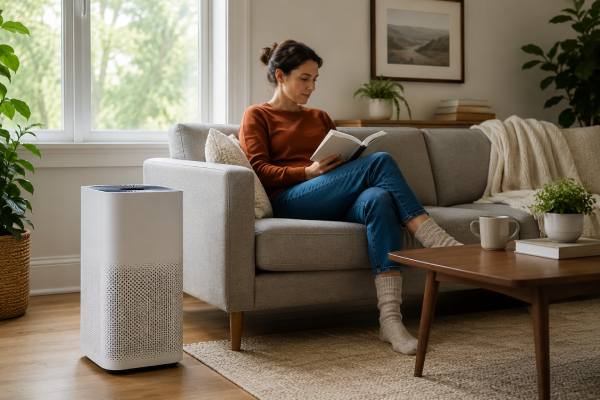
Put the unit where you spend the most time or where the risk is highest. For allergies, that is often the bedroom. For infection control, it may be the room where people gather, work, or isolate when sick. Keep the purifier where airflow is not blocked by curtains, furniture, or the side of a bed. Corners can work, but only if the intake and outlet remain open. If the machine sits behind a chair or under a table, performance drops.
Run time matters more than many people realize. Air purifiers are not best used like candles or essential oil diffusers. Turning one on for an hour here and there usually does little. During pollen season, smoke events, or periods of illness in the home, long daily run times make more sense. Many households get the best results by running the purifier continuously, then adjusting speed by time of day. Higher speed when the room is empty can clean the air faster; a quieter medium or sleep mode can maintain filtration overnight.
Use windows strategically. If outdoor air is clean, ventilation and filtration work well together. If outdoor pollen, smoke, or pollution is high, open windows can cancel out some of the purifier’s benefit. That tradeoff is one reason it helps to understand when ventilating matters more than surface-focused cleaning and when tighter control of incoming air makes more sense.
Humidity also influences comfort and particle behavior. Very dry air can irritate the nose and throat, while overly damp air encourages dust mites and mold. A purifier does not control humidity, so if dryness or dampness is part of the problem, address that separately. Many homes do best with moderate indoor humidity rather than extremes, especially during winter heating season. This is where practical guidance on healthy indoor humidity levels can complement filtration.
Maintenance is straightforward but not optional. Replace filters on schedule or sooner if the home is smoky, dusty, or has pets. Wash or vacuum prefilters if the manufacturer allows it. A clogged filter reduces airflow, and reduced airflow means less clean air delivered to the room. Also remember that sensor-based “filter life” estimates are not always perfect. If the purifier becomes louder, smells dusty, or seems weaker, inspect it.
Finally, keep expectations realistic. A well-used purifier should make the air in a room cleaner, not perfect. Think fewer particles, lower exposure, and easier breathing, not total control over every indoor problem. That mindset leads to better choices and less disappointment.
References
- Guide to Air Cleaners in the Home 2026 (Guideline)
- Taking Steps for Cleaner Air for Respiratory Virus Prevention 2025 (Guideline)
- Cleaning indoor air—what works for respiratory health: An updated literature review and recommendations 2024 (Review)
- A systematic review and meta-analysis of field studies of portable air cleaners: Performance, user behavior, and by-product emissions 2024 (Systematic Review and Meta-Analysis)
- Effectiveness of Air Filters in Allergic Rhinitis: A Systematic Review and Meta-Analysis 2024 (Systematic Review and Meta-Analysis)
Disclaimer
This article is for educational purposes only and is not medical advice, diagnosis, or treatment. Air purifiers can support cleaner indoor air, but they do not replace care from a qualified clinician, especially for asthma, severe allergies, immune problems, or suspected mold-related illness. Seek medical advice for breathing trouble, worsening allergy symptoms, high-risk viral exposure, or persistent indoor air concerns affecting health.
If this article was helpful, please share it on Facebook, X, or your preferred platform to help more people make sense of cleaner indoor air.