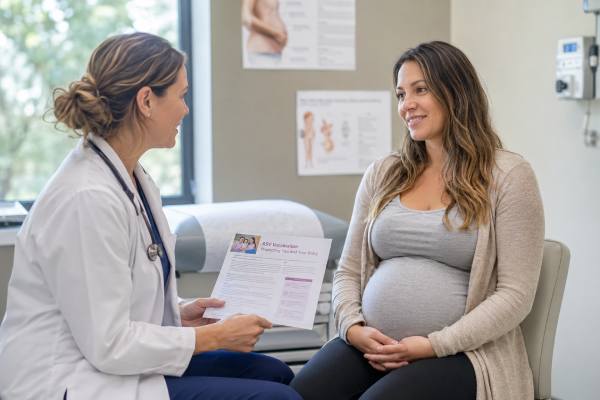
For many parents, RSV does not feel urgent until they hear about a baby struggling to breathe. Yet RSV is one of the most common reasons infants are hospitalized during respiratory virus season, especially in the first few months of life, when lungs and airways are still small and vulnerable. That is why the RSV vaccine in pregnancy has become such an important option. It is designed not mainly to protect the pregnant patient from severe RSV, but to pass protective antibodies to the baby before birth.
That simple idea raises practical questions. When in pregnancy is it given? How well does it work? Is it safe? And what happens if someone misses the timing window or was vaccinated in a previous pregnancy? This article walks through what the maternal RSV vaccine does, when it is recommended, how it compares with infant antibody protection, and what details matter most when you are making a real-world decision during pregnancy care.
Quick Facts
- The maternal RSV vaccine helps lower a baby’s risk of severe RSV illness during the first months after birth, when hospitalization risk is highest.
- Protection is passed through the placenta, so timing matters and the vaccine is used late in pregnancy rather than earlier on.
- In most of the United States, it is given seasonally during weeks 32 through 36 of pregnancy, usually from September through January.
- Most babies do not need both maternal vaccination and an infant RSV antibody, but a baby may need the antibody if the vaccine was not given in the current pregnancy.
- The most practical step is to ask about RSV vaccination once you reach the early part of week 32, especially if your due date falls near RSV season.
Table of Contents
- Why RSV Matters So Early
- How the Vaccine Protects Babies
- When It Is Given
- How Well It Works
- Safety, Side Effects, and Cautions
- Vaccine or Infant Antibody
Why RSV Matters So Early
RSV, short for respiratory syncytial virus, is extremely common. For many adults and older children, it looks like an ordinary cold. In young infants, especially during the first RSV season, it can be very different. Their airways are narrow, they have less respiratory reserve, and they cannot clear mucus as effectively as older children. When RSV reaches the lower airways, a baby can develop bronchiolitis, feeding difficulties, dehydration, labored breathing, or low oxygen levels quickly. That is why RSV causes a large share of winter hospital visits in infants, including babies who were born full-term and were healthy at birth.
The first months of life are the key reason maternal vaccination makes sense. A newborn cannot build vaccine-based protection against RSV in the same way older children and adults do, and there is no routine RSV vaccine series for infants. The window of greatest vulnerability comes before most babies can rely on their own maturing immune defenses. Pregnancy vaccination works by using the parent’s immune system to make antibodies and then passing those antibodies to the baby before delivery.
This late-pregnancy strategy fits the biology of newborn risk. RSV season in many places peaks in the cooler months, and the youngest infants often have the highest rate of severe disease. That is one reason the maternal RSV vaccine is not framed as a general pregnancy wellness extra. It is a targeted tool for preventing severe infant disease during a known period of vulnerability.
It also helps to separate RSV from other familiar respiratory viruses. Parents sometimes assume RSV is basically the same as flu or a mild version of a cold. It is not. Flu can be dangerous in infancy, and so can COVID, but RSV has a distinctive pattern of causing heavy lower-airway illness in babies, especially under 6 months. The maternal RSV vaccine is specifically designed around that problem: reducing serious infant lower respiratory tract disease during the period when passive antibodies can make the biggest difference.
This focus on infant benefit is what makes the conversation different from many adult vaccines. The person receiving the shot is pregnant, but the main goal is the baby’s first season of protection. That is also why timing, seasonality, and coordination with newborn care matter so much more than they might for a year-round adult vaccine.
If you are already thinking about other respiratory virus protection in pregnancy, it can help to place RSV beside flu and COVID as part of a broader seasonal plan rather than as a separate last-minute decision. For some families, this sits naturally alongside questions about flu, COVID, and RSV vaccine timing during prenatal care.
How the Vaccine Protects Babies
The RSV vaccine used in pregnancy protects babies through passive immunity. That means the pregnant person receives the vaccine, develops antibodies, and then transfers those antibodies across the placenta to the baby before birth. The baby is not being vaccinated directly. Instead, the baby is born with a supply of protective maternal antibodies already in circulation.
This is an established concept in pregnancy vaccination. The same broad principle helps explain why maternal immunization is used for other infant-protective strategies. What makes RSV different is the timing and the short, high-risk period it is designed to cover. The goal is not lifelong immunity. It is strong early protection during the first RSV season, especially the first few months of life, when severe disease is most likely.
The process is not instant. After vaccination, it takes time for the body to generate antibodies and for those antibodies to cross the placenta in meaningful amounts. That is one reason the vaccine is not given at the very end of pregnancy, and why someone who is already past the recommended late-pregnancy window is usually guided toward infant antibody protection instead. In practical terms, the maternal vaccine works best when there is enough time before birth for transfer to happen.
Another useful point is that the vaccine does not sterilize the world around the baby. It does not guarantee a baby will never catch RSV. The benefit is in lowering the risk of severe lower respiratory disease, hospitalization, and the most serious infant outcomes if exposure happens. That distinction matters because vaccine conversations can become confusing when people expect absolute prevention. With RSV in pregnancy, the better question is not “Will this stop all RSV?” but “Will this make serious RSV less likely during the baby’s most vulnerable months?” That is where the benefit is strongest.
In the United States, the vaccine approved and recommended for use during pregnancy is Pfizer’s Abrysvo. Other RSV vaccines used in older adults are not recommended for pregnant patients. That product-specific detail matters because people sometimes hear “RSV vaccine” and assume all RSV vaccines are interchangeable. They are not. Pregnancy use depends on the exact product, approval, and guidance.
This is also a good example of why the language of “boosting” immunity can be unhelpful. The maternal RSV vaccine is not about turning the whole immune system up. It is about creating targeted antibodies against RSV and passing them to the baby at the right time. That is a more precise, more useful way to think about what the vaccine is doing.
For parents, the key takeaway is simple: the protection begins before birth, not after. That is what gives a newborn an advantage from day one of RSV season, especially before routine exposures from siblings, childcare, family gatherings, or winter respiratory waves begin.
When It Is Given
The timing of the RSV vaccine in pregnancy is one of the most important parts of the whole strategy. In the United States, the maternal RSV vaccine is recommended during weeks 32 through 36 of pregnancy, more precisely from 32 weeks 0 days through 36 weeks 6 days. In most of the continental United States, it is given seasonally from September through January rather than year-round.
That narrow window often surprises people. Why not earlier, so there is more time? Why not later, so it is closer to delivery? The late-pregnancy timing is meant to balance two goals. First, there needs to be enough time for the pregnant person to make antibodies and transfer them across the placenta. Second, the vaccine is kept within the approved gestational window to avoid use earlier in pregnancy, where potential safety questions around preterm birth led regulators to adopt a more cautious schedule. In other words, timing is not a minor logistical detail. It is built into how the vaccine is meant to be used.
There is also a seasonal reason. In most of the country, RSV circulation is highest in fall and winter. Giving the vaccine between September and January helps align a baby’s early months of passive protection with the period when RSV risk is highest. A baby born one or two months after maternal vaccination can enter peak RSV season with antibodies already on board. By contrast, vaccinating someone in late winter or spring in a region with typical RSV seasonality may give the baby little useful protection by the time RSV returns months later.
This is why local context matters. In some places, including Alaska, tropical climates, and a few other regions where RSV circulation is less predictable, the recommended timing may differ. That means patients should follow local clinical guidance rather than assuming every U.S. location uses the exact same seasonal calendar.
There are a few other timing details worth knowing:
- If someone is already more than 36 weeks 6 days pregnant, the maternal RSV vaccine is generally not used, because there may not be enough time before birth for the baby to benefit fully.
- If someone has a mild illness such as a cold, vaccination can usually still happen.
- If someone has a moderate or severe acute illness, clinicians often wait until recovery before vaccinating.
It is also possible to receive the RSV vaccine at the same visit as other recommended vaccines in pregnancy. That can matter during busy prenatal care, especially when flu, COVID, and Tdap timing overlap. For families trying to simplify appointments, it helps to understand broader vaccine coadministration expectations rather than assuming every shot needs its own separate day.
The practical lesson is not to leave this conversation for the end of pregnancy. If your due date falls near RSV season, it is worth bringing up at the start of week 32 so timing stays on your side rather than becoming a last-minute scramble.
How Well It Works
The maternal RSV vaccine is designed to reduce serious RSV disease in infants, and that is where the evidence is most meaningful. In the phase 3 trial that supported approval, the vaccine reduced severe RSV-related lower respiratory illness in infants by about 82 percent within the first 3 months after birth and by about 69 percent within 6 months. It also lowered RSV-related hospitalizations and healthcare visits during those early months.
Those numbers deserve careful interpretation. They do not mean every vaccinated pregnancy prevents an infection, and they do not mean the baby is protected forever. What they do show is that babies born to vaccinated mothers were much less likely to develop the most serious forms of RSV disease during the period when infants are most fragile. That is the main public health value of the vaccine.
The pattern of protection also fits what we know about maternal antibodies. Benefit is strongest early, then wanes over time. That is normal. Maternal antibodies are meant to bridge a baby through a vulnerable early window, not replace the child’s own long-term immune development. In plain terms, the vaccine gives the baby a head start, not permanent RSV immunity.
Another helpful way to think about effectiveness is in comparison with the question parents are often really asking: “Will this keep my baby out of the hospital?” No preventive tool can remove all risk, but lowering the chance of severe lower respiratory illness and RSV hospitalization is a meaningful clinical benefit. For a family trying to reduce the odds of an emergency evaluation, oxygen support, or a hospital stay in a very young infant, that is not a small outcome.
At the same time, it is worth being realistic about what the vaccine does not do. It does not replace routine newborn care, safe sleep, hand hygiene, smoke avoidance, or common-sense exposure decisions during heavy respiratory virus season. It also does not make every cough or congestion episode an RSV issue. A vaccinated baby can still get colds, and parents still need to know how to recognize red flags such as poor feeding, dehydration, or increased work of breathing.
For some parents, the decision becomes easier when they frame the vaccine as one layer of protection rather than an all-or-nothing choice. That is often the best way to approach infant respiratory prevention more broadly. The goal is not perfection. It is risk reduction during a period when babies have very little reserve.
If you are also thinking about day-to-day steps after delivery, this topic can sit naturally beside practical questions about reducing illness exposure and what matters most during respiratory virus season. The vaccine is not the whole plan, but it can be a very strong early part of it.
Safety, Side Effects, and Cautions
Safety is understandably the question that carries the most emotional weight in pregnancy. The good news is that the maternal RSV vaccine was studied before approval, and safety monitoring has continued after rollout. The current picture is reassuring enough that health authorities recommend it within the approved gestational window, but it is also nuanced enough that a thoughtful explanation matters.
In clinical trials, common side effects for pregnant patients included pain at the injection site, headache, muscle pain, and nausea. These are the kinds of short-term reactions many people recognize from other vaccines. They are usually mild to moderate and resolve quickly. Severe allergic reactions are rare, but as with any vaccine, they are a reason clinicians screen for history of anaphylaxis to a vaccine component.
The more complicated part of the safety conversation involves pregnancy-specific outcomes. During trials that included vaccination earlier in pregnancy, there was an imbalance in preterm births and a non-statistically significant increase in hypertensive disorders of pregnancy, including conditions such as preeclampsia. These findings did not prove the vaccine caused those outcomes, but they were taken seriously. That is a major reason the approved and recommended pregnancy window is restricted to 32 through 36 weeks. The late-pregnancy schedule is a risk-management choice, not an arbitrary rule.
Post-licensure safety monitoring has so far been broadly consistent with the trial picture. Early surveillance has not shown a clear increase in preterm birth when the vaccine is given during the recommended 32-to-36-week window, but monitoring continues, especially for hypertensive disorders and rare adverse events. That ongoing follow-up is exactly what should happen with a newer maternal vaccine. Continued monitoring is a sign of caution and transparency, not a sign that the vaccine is failing.
It is also important to distinguish routine side effects from warning signs. A sore arm, headache, or brief nausea after vaccination is expected. Symptoms such as severe allergic reaction, persistent breathing difficulty, or signs of serious pregnancy complications need urgent medical attention. For parents who like to know what counts as normal after a shot versus what should prompt a call, it may help to review the difference between expected vaccine reactions and red flags.
None of this means the choice is identical for every patient. People with complex pregnancies, recent hypertensive issues, or other obstetric concerns may want a more individualized conversation. That is appropriate. But for most eligible pregnant patients in the recommended window, the reason the vaccine is offered is that the expected benefit for infant RSV prevention outweighs the known and potential risks based on the evidence available now.
The most balanced conclusion is this: the maternal RSV vaccine is not risk-free in the abstract, because no medical intervention is. But within the approved timing window, the safety profile is considered acceptable enough that it is recommended as a standard option for protecting infants during the first months of life.
Vaccine or Infant Antibody
One of the most practical questions parents ask is whether they should choose the RSV vaccine in pregnancy or the long-acting RSV antibody for the baby after birth. In many cases, the answer is not “both.” Current guidance is built around the idea that most babies need protection through one route or the other, not both routinely.
If a pregnant patient receives the RSV vaccine in the current pregnancy during the recommended window, most babies will not also need an RSV antibody after birth. The maternal vaccine is expected to provide passive protection through the first RSV season, especially the first months. That keeps newborn care simpler and avoids duplicate prevention for most infants.
If the vaccine was not given in the current pregnancy, the infant can instead receive a long-acting RSV antibody. This is especially important if the parent was already past the gestational timing window, delivered before the vaccine could be given, declined vaccination during pregnancy, or was vaccinated in a previous pregnancy rather than the current one. At present, repeat maternal RSV vaccination in a later pregnancy is not routinely recommended if someone already received it in an earlier pregnancy. In that situation, the current baby should be protected after birth with an RSV antibody.
This distinction between current and prior pregnancy matters more than many people realize. The vaccine is designed to protect the baby of the pregnancy in which it is given. A past pregnancy does not automatically provide the next newborn with the same benefit. That is why infant antibody protection becomes the fallback strategy when there was no maternal vaccination during the current pregnancy.
For parents, the comparison often comes down to timing and logistics:
- Maternal vaccine protects before birth through transferred antibodies.
- Infant antibody protects after birth through a directly given preventive product.
- Most babies do not need both.
- The best choice is often whichever route most reliably gets protection in place before RSV season.
This is also why late pregnancy visits matter. A missed maternal vaccination window does not mean the baby has no options. It usually means the plan shifts. Families who are sorting through that decision may find it helpful to understand more about how infant RSV antibodies differ from vaccination.
The larger point is reassuring: protection does not depend on a single perfect moment. There are two prevention paths. The maternal vaccine is a powerful option when timing works, and infant antibody protection helps cover babies when it does not. Good prenatal and newborn care is often about making sure one of those paths is lined up before RSV season arrives.
References
- RSV Vaccine Guidance for Pregnant Women 2024 (Guideline)
- Immunizations to Protect Infants 2025 (Guideline)
- Respiratory Syncytial Virus (RSV) Vaccine Safety 2025 (Safety Guidance)
- Bivalent Prefusion F Vaccine in Pregnancy to Prevent RSV Illness in Infants 2023 (Phase 3 Trial)
- Respiratory syncytial virus vaccination during pregnancy for improving infant outcomes 2024 (Systematic Review)
Disclaimer
This article is for educational purposes only and is not medical advice. Vaccine recommendations can vary based on gestational age, local RSV seasonality, medical history, and a baby’s birth timing. Pregnancy care decisions should be made with an obstetric clinician or other qualified healthcare professional who can apply current guidance to your situation. Seek urgent care right away for severe allergic symptoms after vaccination or for signs of serious illness in a newborn, including poor feeding, dehydration, blue lips, pauses in breathing, or increasing work of breathing.
If this article helped you, please share it on Facebook, X, or any other platform you prefer.