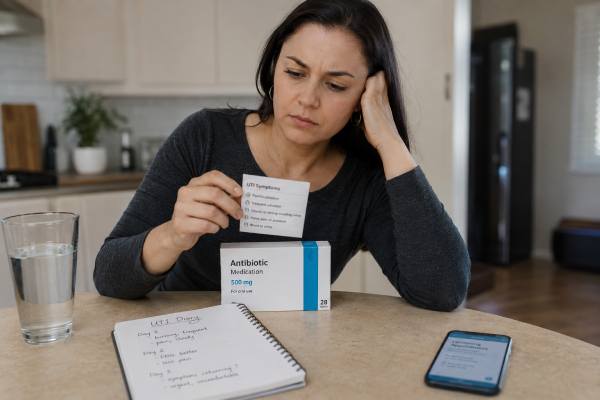
UTI symptoms that come back after antibiotics are frustrating because they feel like a problem that should already be solved. Burning returns. Urgency picks up again. The bladder pressure that had started to fade suddenly feels familiar. Sometimes the symptoms never fully went away. Other times they disappear for days or weeks, then come back sharply.
The next step is not simply “try another antibiotic.” The useful question is why the symptoms returned. A true bladder infection can persist if the bacteria resisted the antibiotic, the course was too short for the situation, the infection had already moved beyond the bladder, or the medicine did not reach the right bacteria. But UTI-like symptoms also come from yeast, vaginal irritation, sexually transmitted infections, pelvic floor tightness, bladder pain syndrome, stones, and inflammation after the infection is gone.
This guide explains what returning symptoms usually mean, when to seek urgent care, what tests clarify the cause, and how treatment changes when a UTI comes back after antibiotics.
Table of Contents
- What Returning Symptoms Mean After UTI Antibiotics
- Why UTI Symptoms Come Back After Antibiotics
- When to Get Medical Care Quickly
- Tests That Help Find the Real Cause
- How Treatment Changes the Second Time
- When It Feels Like a UTI but Is Not One
- How to Reduce the Chance of Another UTI
- What to Do Now If Symptoms Are Back
What Returning Symptoms Mean After UTI Antibiotics
Symptoms after antibiotics fall into a few different patterns, and the pattern gives clues about what is happening.
If symptoms improved within the first day or two, then came back soon after finishing the medicine, the infection might not have been fully cleared. This is more concerning when the same burning, urgency, cloudy urine, or lower belly pressure returns within a week or two. Clinicians often think about relapse when the same bacteria were likely suppressed but not eliminated.
If symptoms went away completely and a new episode appears weeks or months later, that is often a new infection rather than the old one coming back. This is common in people prone to UTIs, especially when episodes follow sex, spermicide use, menopause-related vaginal dryness, incomplete bladder emptying, or repeated antibiotic exposure.
If symptoms never improved at all during antibiotics, the first diagnosis deserves a second look. The bacteria might have been resistant, but the problem also might not be a bacterial bladder infection. Burning with urination can come from urethral irritation, yeast, bacterial vaginosis, herpes, chlamydia, gonorrhea, pelvic floor spasm, or bladder inflammation without infection.
A small amount of irritation can also linger briefly after a treated infection. The bladder lining has been inflamed, and it does not always feel normal the moment the last pill is swallowed. Mild urgency or tenderness that steadily improves is different from symptoms that clearly worsen, return after being gone, or come with fever, flank pain, vomiting, or visible blood.
The safest practical rule is this: if symptoms come back after antibiotics, do not guess and do not use leftover pills. A repeat evaluation, especially a urine culture, gives much better information than treating blindly again.
Why UTI Symptoms Come Back After Antibiotics
A UTI after antibiotics usually comes down to one of six problems: resistant bacteria, the wrong drug for the infection site, incomplete treatment, a new trigger, an underlying urinary issue, or a non-UTI condition that was never going to respond to antibiotics.
The bacteria resisted the antibiotic
Antibiotic resistance means the bacteria causing the infection are not reliably killed by the medicine used. This is one reason symptoms improve only slightly, fail to improve, or return quickly. Resistance is more likely after recent antibiotic use, repeated UTIs, recent travel, prior resistant cultures, catheter use, nursing home exposure, or recent hospitalization.
This is where culture results matter. A urine culture identifies the bacteria and shows which antibiotics are expected to work. Without that information, a second antibiotic choice is still partly a guess.
The antibiotic was reasonable for the bladder but not for the kidneys
A simple bladder infection and a kidney infection are not treated the same way. Some antibiotics work well in urine but do not reach kidney tissue well enough for a kidney infection. If symptoms include fever, chills, nausea, vomiting, back or side pain, or feeling seriously ill, the infection may be above the bladder. That situation needs prompt medical care and a different treatment plan.
This distinction matters because bladder symptoms can appear first, then systemic symptoms follow. A person might start antibiotics for cystitis, feel no better, and later develop flank pain or fever. Those are not “normal lingering symptoms.” They are warning signs.
The course did not fit the situation
Short antibiotic courses are often appropriate for uncomplicated bladder infections. They are not appropriate for every urinary infection. Pregnancy, male sex, catheter-associated infection, kidney infection, diabetes with complications, immune suppression, urinary tract abnormalities, stones, urinary retention, or recent urologic procedures all change the risk picture.
The issue is not simply “stronger antibiotics.” It is matching the drug, dose, and duration to the person and the infection. A three-day course that works for one person might be inadequate for another person with a higher-risk infection.
A new infection started after the first one cleared
A new UTI can start soon after treatment, especially when the original trigger is still present. Sex is a common trigger because bacteria near the urethra can be pushed toward the bladder. Spermicides and diaphragms increase risk in some people. Low estrogen after menopause changes the vaginal and urinary environment in ways that make recurrent infection more likely.
New infections can feel identical to the old one. That is why symptoms alone cannot reliably separate relapse from reinfection. Culture results, timing, and prior bacteria help.
The bladder is not emptying well
Urine that sits in the bladder gives bacteria more opportunity to grow. Incomplete emptying can happen with pelvic organ prolapse, enlarged prostate, constipation, certain medications, nerve problems, urethral narrowing, or pelvic floor muscles that do not relax well.
Clues include a weak stream, straining to urinate, stopping and starting, needing to pee again minutes after finishing, or feeling that the bladder never fully empties. Repeated infections in this setting often require more than repeated antibiotics. The emptying problem has to be addressed.
The original symptoms were not caused by a UTI
This is one of the most common reasons antibiotics “do not work.” Burning can come from irritated vulvar skin, vaginal infection, urethral inflammation, soap or lubricant reactions, low estrogen, pelvic floor tenderness, or bladder pain syndrome. Antibiotics can also trigger yeast symptoms, creating new burning and irritation after the UTI treatment.
When urine tests are negative or symptoms keep returning despite treatment, it is worth reading about UTI symptoms with a negative test and asking for a broader evaluation instead of repeating antibiotics again and again.
When to Get Medical Care Quickly
Some symptoms after UTI antibiotics need same-day care because they raise concern for kidney infection, worsening infection, obstruction, or another urgent problem.
Seek urgent care promptly if any of these are present:
- Fever, chills, shaking, or feeling suddenly very ill
- Back or side pain near the ribs, especially with nausea or fever
- Vomiting or inability to keep fluids or medicine down
- Pregnancy with UTI symptoms
- Confusion, faintness, severe weakness, or rapid worsening
- Blood clots in urine or heavy visible blood
- Inability to urinate or severe lower belly pain with a full-bladder feeling
- Symptoms in a man, child, older frail adult, or person with immune suppression
- A urinary catheter, kidney stone history, kidney disease, transplant history, or recent urinary procedure
Fever plus urinary symptoms should not be treated like simple cystitis. Side pain, fever, and vomiting are classic reasons to consider kidney involvement. A bladder infection is uncomfortable; a kidney infection can become serious. A clear comparison of bladder and kidney infection signs helps explain why those symptoms change the level of urgency.
People often hesitate because they already took antibiotics and assume they should wait longer. Waiting is risky when symptoms are moving upward rather than fading. If symptoms are severe, systemic, or worsening, the useful question is not whether the first antibiotic “should have worked.” The useful question is whether the infection needs a different diagnosis, culture-guided therapy, imaging, or urgent treatment.
Tests That Help Find the Real Cause
Testing is most useful when symptoms come back, treatment fails, or the situation is not a straightforward first bladder infection. The goal is to avoid two common mistakes: treating a resistant infection with the wrong drug, and treating non-UTI symptoms with unnecessary antibiotics.
Urinalysis gives quick clues
A urinalysis looks for signs such as white blood cells, nitrites, blood, and sometimes protein or pH changes. White blood cells suggest inflammation. Nitrites suggest certain bacteria, especially many E. coli infections, but a negative nitrite result does not rule out UTI. Some bacteria do not make nitrites, and frequent urination can flush urine before nitrites build up.
A home dipstick can be useful as a clue, not a final answer. A positive result supports the possibility of infection. A negative result is helpful when symptoms are mild and the chance of UTI is already low, but it does not settle every case. If symptoms are back after antibiotics, an at-home UTI test strip should not replace a clinician-ordered test when treatment decisions are needed.
Urine culture shows the bacteria and antibiotic options
A culture is especially important when symptoms return soon after antibiotics, symptoms persist during treatment, infections are recurrent, or risk factors are present. The result usually includes the bacteria name and a susceptibility report. Susceptibility tells the clinician which antibiotics the bacteria are likely sensitive or resistant to.
A good sample matters. A contaminated sample can confuse the picture by growing skin or vaginal bacteria. Clean-catch instructions usually include washing hands, cleaning the area as directed, starting to urinate, then catching urine midstream. If repeated samples look contaminated, a clinician may use a catheterized sample to get cleaner information.
Culture timing also matters. A sample taken after antibiotics have already started may grow little or nothing, even if infection was present. When symptoms return after finishing antibiotics, getting the sample before starting a new antibiotic is often more useful.
Other tests depend on the symptoms
If vaginal discharge, odor, itching, pelvic pain, or pain with sex is present, vaginal swabs or STI testing may be more useful than another urine antibiotic. If flank pain or stones are suspected, imaging may be needed. If repeated UTIs occur with poor emptying, a post-void residual test checks how much urine remains after urination.
Cystoscopy and advanced imaging are not routine for every person with recurrent simple bladder infections. They are more relevant when there is persistent blood in urine, suspected stones, unusual bacteria, repeated relapse with the same organism, urinary obstruction symptoms, prior urinary tract surgery, or concern for another bladder condition.
How Treatment Changes the Second Time
The second treatment decision should be more targeted than the first. Once symptoms return, the chance of resistance, relapse, or a wrong diagnosis is higher, so repeating the same approach is often the weakest option.
For a likely persistent bacterial UTI, clinicians usually use culture results to choose an antibiotic that matches the organism. The best choice also accounts for allergies, kidney function, pregnancy status, side effects, recent antibiotic exposure, local resistance patterns, and whether the infection appears limited to the bladder.
Common UTI medicines are not interchangeable. Nitrofurantoin is often used for uncomplicated bladder infection but is not used for kidney infection. Fosfomycin is a single-dose option for some bladder infections but is not a fit for every organism or higher-risk infection. Trimethoprim-sulfamethoxazole works only when resistance risk is acceptable or susceptibility is known. Fluoroquinolones are effective for some more serious urinary infections but have important side effects and are usually avoided when safer narrow options work. A practical overview of UTI antibiotics explains why the “strongest” drug is not always the best drug.
Pain relief is separate from infection treatment. Phenazopyridine, the urinary pain reliever found in some OTC products, can reduce burning short term, but it does not kill bacteria. It also turns urine bright orange and can interfere with how urine color looks. It should not be used to hide worsening symptoms or delay care.
For recurrent UTIs, treatment sometimes shifts from episode-by-episode care to a prevention plan. Options include culture-confirmed self-start antibiotics for selected patients, a single antibiotic dose after sex when infections are clearly sex-related, non-antibiotic prevention such as methenamine hippurate for appropriate patients, and vaginal estrogen for peri- and postmenopausal women. These are individualized plans, not one-size-fits-all fixes.
What you should not do is restart leftover antibiotics. Leftover pills are usually the wrong amount, may not match the bacteria, and can make future cultures harder to interpret. They also increase side effects and resistance pressure without giving a reliable cure.
When It Feels Like a UTI but Is Not One
A returning burning sensation does not automatically mean the UTI is back. Several conditions overlap with bladder infection, and some become more noticeable after antibiotics.
Yeast is a common example. Antibiotics can disrupt normal vaginal yeast balance. Yeast symptoms often include itching, vulvar redness, irritation, soreness, thick white discharge, or burning when urine touches inflamed skin. That burning can feel like it comes from the urethra, even when the bladder is not infected. A clear comparison of UTI and yeast infection symptoms is useful when itching or discharge appears after treatment.
STIs can also cause urinary burning, urgency, pelvic discomfort, or urethral discharge. Chlamydia, gonorrhea, trichomonas, herpes, and Mycoplasma genitalium do not reliably show up on a standard urine culture for UTI. Testing needs to match the suspected infection. This is especially important after a new partner, unprotected sex, partner symptoms, genital sores, bleeding after sex, or pelvic pain. UTI and STI symptoms overlap enough that guessing from symptoms alone leads to missed diagnoses.
Bladder pain syndrome, also called interstitial cystitis, causes bladder pressure, urgency, frequency, and pain that often worsens as the bladder fills and improves after urinating. Cultures are usually negative. Flares can follow sex, stress, certain foods or drinks, or a recent true UTI. Antibiotics do not treat this condition unless an actual infection is also present.
Pelvic floor dysfunction can mimic UTI because tight or tender pelvic muscles irritate the urethra and bladder. Clues include burning after urination, pelvic aching, pain with sex, constipation, difficulty starting the urine stream, or feeling unable to fully relax while peeing. Repeated antibiotics do not fix muscle-related urinary symptoms.
Skin and product irritation also matter. Scented soaps, wipes, pads, bubble bath, spermicides, lubricants, condoms, laundry products, and tight damp clothing can inflame vulvar tissue or the urethral opening. The result is burning, stinging, and rawness without a bacterial bladder infection.
The practical takeaway: if cultures are negative, symptoms are atypical, or antibiotics repeatedly fail, broaden the search. More antibiotics are not safer than a better diagnosis.
How to Reduce the Chance of Another UTI
Prevention works best when it matches the pattern. A person who gets UTIs after sex needs a different plan than someone with low estrogen, incomplete emptying, stones, or repeated resistant bacteria.
Start by tracking timing. Write down when symptoms start, recent sex, menstrual cycle timing, new products, constipation, diarrhea, travel, dehydration, and antibiotic use. A pattern over three episodes is more useful than memory during a painful flare.
Hydration helps most when low fluid intake is part of the pattern. The goal is steady urine flow, not forcing extreme amounts of water. Pale yellow urine during the day is a reasonable sign for many people. People with heart failure, advanced kidney disease, or fluid restrictions should follow their clinician’s fluid advice instead.
Urination habits matter. Do not routinely hold urine for long stretches. After sex, urinating soon afterward is low-risk and reasonable, though it is not a guaranteed shield. Avoid spermicides if UTIs follow sex, because spermicide can disrupt protective vaginal bacteria and increase UTI risk. A focused guide to post-sex UTI prevention covers the practical steps and limits.
For peri- and postmenopausal women, local estrogen is one of the most important prevention options to discuss. Low estrogen can thin and dry the vaginal and urethral tissues and change the bacteria that normally help protect the area. Vaginal estrogen is not the same as systemic hormone therapy; it is applied locally as a cream, tablet, insert, or ring. A clinician can explain whether vaginal estrogen for recurrent UTIs fits your medical history.
Cranberry products have mixed but supportive evidence for prevention in some groups, especially women with recurrent UTIs. They are not a treatment for an active infection. Product quality varies, and juice adds sugar for some people, so capsules with standardized proanthocyanidin content are often easier to use consistently.
D-mannose is less convincing than many older online claims suggest. Recent higher-quality research did not show clear prevention benefit for women with recurrent UTIs in primary care. It is also not a substitute for evaluation when symptoms return after antibiotics.
Methenamine hippurate is a non-antibiotic prescription prevention option for selected people with recurrent UTIs. It works as a urinary antiseptic under the right conditions and is used to reduce antibiotic exposure. It is not for everyone, especially people with certain kidney or liver issues, and it must be reviewed with a clinician.
If you meet the usual definition of recurrent UTIs—two or more in six months or three or more in a year—ask for a prevention plan rather than treating each episode as a surprise. At least one episode should be culture-confirmed, because prevention decisions are much stronger when the diagnosis is certain.
What to Do Now If Symptoms Are Back
When UTI symptoms return after antibiotics, use a simple decision path.
First, check for urgent signs. Fever, chills, flank pain, vomiting, pregnancy, inability to urinate, severe weakness, or rapidly worsening symptoms need prompt medical care.
Second, contact the clinician who treated the UTI or another qualified healthcare professional. Explain the timeline clearly: when symptoms started, which antibiotic you took, the dose if you know it, how many days you took it, whether symptoms improved, when they returned, and whether you had a urine culture.
Third, ask whether a repeat urinalysis and urine culture should be done before another antibiotic. This is especially important if symptoms came back within two weeks, never fully cleared, or you have had multiple UTIs.
Fourth, avoid leftover antibiotics and avoid taking someone else’s medicine. Also avoid using urinary pain relievers for several days while hoping the problem disappears. Short-term symptom relief is fine when appropriate, but worsening symptoms need evaluation.
Fifth, think beyond the bladder if the picture does not fit. New vaginal itching, odor, sores, discharge, pelvic pain, or partner risk should shift the conversation toward vaginal testing or STI testing. Repeated negative cultures should shift the conversation toward irritation, pelvic floor dysfunction, bladder pain syndrome, stones, or another cause.
Finally, make a prevention plan after the acute symptoms are addressed. The best time to prevent the next episode is not during the worst burning. It is after the current problem is clear, the culture results are available, and the trigger pattern is easier to see.
Returning symptoms are not a personal failure, and they do not mean antibiotics are useless. They mean the first answer was incomplete. The right next step is to identify whether this is persistent infection, a new infection, a higher-risk urinary problem, or a different condition that only feels like a UTI.
References
- Updates to Recurrent Uncomplicated Urinary Tract Infections in Women: AUA/CUA/SUFU Guideline (2025) 2026 (Guideline)
- IDSA 2025 Guideline Update on Complicated Urinary Tract Infections 2025 (Guideline)
- EAU Guidelines on Urological Infections – THE GUIDELINE 2026 (Guideline)
- Alternative to prophylactic antibiotics for the treatment of recurrent urinary tract infections in women: multicentre, open label, randomised, non-inferiority trial 2022 (RCT)
- Cranberries for preventing urinary tract infections 2023 (Systematic Review)
- d-Mannose for Prevention of Recurrent Urinary Tract Infection Among Women: A Randomized Clinical Trial 2024 (RCT)
Disclaimer
This article is for education about UTI symptoms that return after antibiotics. It cannot diagnose the cause of burning, urgency, pelvic pain, fever, or blood in urine. Contact a qualified healthcare professional for personal testing and treatment, especially if symptoms return soon after antibiotics, you are pregnant, you have kidney pain or fever, or you have repeated infections.