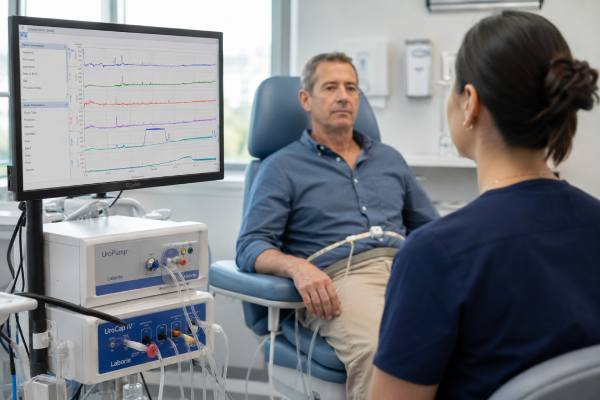
Urodynamic testing looks at how the bladder, urethra, urinary sphincter, and pelvic floor work while urine is stored and released. It is not a single test. It is a group of bladder function tests that measure urine flow, bladder pressure, bladder capacity, leakage, emptying, and the coordination between bladder muscle contraction and outlet relaxation.
Doctors use urodynamic testing when symptoms do not clearly explain what is going wrong. Urgency, leaks, weak stream, trouble starting, frequent urination, nighttime urination, and incomplete emptying all describe what a person feels. Urodynamic results show what the bladder and outlet are actually doing during filling and urination. That difference matters because two people with similar symptoms can need very different treatment.
A person with a slow stream might have a blockage, weak bladder muscle, tight pelvic floor, or a mix of problems. A person with urine leaks might have stress leakage from poor urethral support, urge leakage from bladder overactivity, overflow leakage from retention, or leakage caused by poor sphincter control. Urodynamic testing helps sort these patterns before medication, injections, surgery, catheter plans, or more advanced treatment.
Table of Contents
- What Urodynamic Testing Measures
- When the Test Is Used
- Types of Urodynamic Tests
- What Happens During the Test
- How to Prepare
- How Results Are Interpreted
- Limits, Risks, and Side Effects
- How Results Guide Treatment
What Urodynamic Testing Measures
Urodynamic testing measures the job of the lower urinary tract: storing urine at low pressure, sensing bladder filling, holding urine without leaking, relaxing the outlet, and emptying with an effective bladder contraction. A healthy bladder stores urine quietly, sends warning signals at reasonable volumes, stays relaxed until the right time, then contracts while the sphincter and pelvic floor open.
The test is useful because bladder symptoms do not always identify the cause. Urgency often points toward overactive bladder, but urgency also occurs with infection, bladder pain conditions, incomplete emptying, stones, prostate enlargement, pelvic floor dysfunction, or nerve-related bladder problems. Urodynamic testing adds measurements to that symptom story.
The main measurements include:
- Urine flow rate: how quickly urine comes out, often measured in milliliters per second.
- Voided volume: how much urine is passed during the test.
- Post-void residual: how much urine remains in the bladder after urination.
- Bladder capacity: how much the bladder holds before strong urgency or leakage.
- Bladder pressure: whether pressure stays low during filling or rises too much.
- Detrusor activity: whether the bladder muscle contracts when it should stay relaxed.
- Outlet behavior: whether the urethra, sphincter, and pelvic floor relax during voiding.
- Leak point information: whether leakage happens with coughing, straining, bladder contractions, or high pressure.
- Sensation during filling: when the person first feels filling, normal desire, strong desire, pain, or urgency.
The “detrusor” is the bladder muscle. During storage, it should stay relaxed. During urination, it should contract strongly enough to empty the bladder. Urodynamic testing separates bladder muscle pressure from abdominal pressure, which matters because coughing, laughing, straining, and position changes raise pressure in the belly without necessarily meaning the bladder muscle is contracting.
A common reason for testing is to distinguish storage problems from emptying problems. Storage problems include urgency, frequent urination, bladder spasms, and leakage before reaching the toilet. Emptying problems include weak stream, hesitancy, straining, stop-start flow, dribbling, and a feeling that the bladder is not empty. Some people have both, which is why a simple symptom label often falls short.
When the Test Is Used
Doctors usually order urodynamic testing when the result is likely to change the treatment plan. It is not needed for every person with urinary symptoms. A history, exam, urinalysis, bladder diary, and post-void residual check answer many straightforward cases.
Urodynamic testing is most useful when symptoms are mixed, severe, unusual, or not improving with basic treatment. It also becomes more important before irreversible or invasive treatments, such as incontinence surgery, prostate procedures, bladder Botox, neuromodulation, or long-term catheter decisions.
Common reasons for testing include:
- Urgency and leaks that have not improved with first-line treatment
- Mixed leakage, where both urge leaks and stress leaks seem possible
- Leakage after previous pelvic, prostate, or incontinence surgery
- Trouble emptying the bladder or a high post-void residual
- Weak stream with uncertainty about blockage versus weak bladder muscle
- Neurologic conditions such as spinal cord injury, multiple sclerosis, Parkinson’s disease, stroke, spina bifida, or diabetes-related nerve damage
- Symptoms that do not match office test findings
- Planning before surgery when the diagnosis is unclear
- Repeated urinary retention or catheter dependence
- Suspicion of unsafe high bladder pressure that could affect the kidneys
A bladder diary is often done before urodynamic testing because it shows real-life patterns that a clinic test might not capture. A diary records fluid intake, bathroom trips, leaks, urgency episodes, and nighttime urination. A well-kept bladder diary helps the clinician compare daily symptoms with test findings.
The test is often discussed when someone has symptoms of overactive bladder but does not respond as expected to behavior changes or medication. In that situation, urodynamics might show detrusor overactivity, poor bladder capacity, incomplete emptying, obstruction, or no clear abnormality during the test.
Testing also helps when retention is part of the picture. A person with urinary retention needs a different plan depending on whether the bladder muscle is weak, the outlet is blocked, the sphincter is not relaxing, or medications are reducing bladder contraction.
Not every symptom needs urodynamics before treatment. Straightforward stress leakage with a clear cough leak, no voiding trouble, normal urinalysis, and normal bladder emptying often starts with pelvic floor therapy or other conservative care. Straightforward urgency often starts with fluid changes, bladder training, constipation treatment, pelvic floor work, and medication before invasive testing.
Types of Urodynamic Tests
A urodynamic appointment often combines several tests. Some are noninvasive, meaning no catheter is placed. Others use small catheters to measure pressure inside the bladder and abdomen. The exact setup depends on the symptoms, medical history, and the question the clinician needs answered.
| Test | What it measures | Why it matters |
|---|---|---|
| Uroflowmetry | Speed, pattern, and amount of urine flow | Shows whether flow is strong, weak, intermittent, prolonged, or too low to interpret well |
| Post-void residual | Urine left in the bladder after voiding | Identifies incomplete emptying, which changes treatment choices |
| Cystometry | Bladder pressure, capacity, sensation, and contractions during filling | Shows whether the bladder stores urine at safe pressure and whether spasms occur |
| Pressure-flow study | Bladder pressure and urine flow during urination | Helps distinguish blockage from weak bladder contraction |
| Leak point testing | Pressure or activity associated with leakage | Clarifies stress leakage, urge leakage, or leakage from high bladder pressure |
| Electromyography | Pelvic floor or sphincter muscle activity | Shows whether muscles relax properly during voiding |
| Video urodynamics | Pressure measurements plus X-ray or imaging views | Shows bladder shape, reflux, obstruction level, and coordination in complex cases |
Uroflowmetry and residual urine
Uroflowmetry is usually the first step. The person urinates into a special toilet or funnel connected to a machine. The machine records the flow curve. A strong, smooth curve suggests good emptying mechanics. A flat, weak, or stop-start curve suggests obstruction, weak bladder contraction, pelvic floor tightening, low urine volume, or anxiety during the test.
The flow result is easiest to interpret when the bladder contains enough urine. A tiny voided amount does not say much. That is why many clinics ask patients to arrive with a comfortably full bladder.
After the flow test, the clinic checks post-void residual. This is done with ultrasound over the lower abdomen or with a catheter. A low residual suggests the bladder empties well. A high residual points toward incomplete emptying, but it does not prove the cause by itself.
Cystometry and pressure-flow testing
Cystometry measures what happens while the bladder fills. A small catheter is placed into the bladder, and another small pressure sensor is placed in the rectum or vagina to measure abdominal pressure. The bladder is slowly filled with sterile fluid. The person reports first sensation, normal desire, strong desire, urgency, pain, or leakage.
The clinician watches pressure lines on a computer. A stable bladder pressure line during filling is reassuring. A sudden bladder muscle contraction during filling suggests detrusor overactivity, especially when it matches urgency or leakage.
A pressure-flow study happens when the person urinates with the pressure catheter in place. This part is often the key to separating outlet obstruction from weak detrusor contraction. Low flow with high bladder pressure suggests the bladder is pushing against resistance. Low flow with low pressure suggests the bladder muscle is not generating enough force.
Specialized testing for complex cases
Electromyography uses sticky skin patches or fine sensors to record pelvic floor or sphincter activity. It is helpful when the outlet seems to tighten instead of relax during urination. This pattern occurs with dysfunctional voiding, some neurologic conditions, and some pelvic floor disorders.
Video urodynamics combines pressure testing with imaging. It is used more often for neurologic bladder problems, prior pelvic surgery, suspected reflux of urine toward the kidneys, structural concerns, or complex obstruction. The images show whether the bladder neck opens, whether the urethra narrows, whether the bladder wall changes shape, and whether urine travels backward toward the kidneys.
Ambulatory urodynamics is less common. It records bladder pressure during normal activity while the bladder fills naturally. It is sometimes used when standard testing does not reproduce the symptoms that happen at home.
What Happens During the Test
A typical urodynamic study takes about 30 to 90 minutes, depending on the type of testing and how quickly symptoms are reproduced. The appointment feels more awkward than painful for most people. The clinic team talks through each step, because the quality of the test depends on cooperation and clear symptom reporting.
The first step is usually a private urine flow test. You urinate into the testing equipment, then the staff checks how much urine remains in your bladder. This first void gives a baseline before catheters are placed.
Next, the clinician or nurse cleans the urethral opening and places a small catheter into the bladder. Local anesthetic gel is often used. Another small catheter or pressure sensor is placed in the rectum or vagina. These lines measure bladder pressure and abdominal pressure at the same time.
During filling, sterile fluid goes into the bladder at a controlled rate. You will be asked to say when you first feel filling, when you would normally look for a bathroom, when the urge becomes strong, and whether you feel pain or burning. The staff might ask you to cough, bear down, change position, run water, or stand if those actions trigger leakage in real life.
If leakage happens, the team notes what caused it. Leakage with coughing and no bladder contraction points toward stress incontinence. Leakage with a bladder contraction and urgency points toward urge incontinence. Some people have both, which is called mixed incontinence. A separate guide to stress leakage with coughing or sneezing helps explain why pressure from movement differs from bladder-driven urgency.
The final part is voiding with the catheter in place. This feels unnatural, but it provides important information. The clinician needs to see whether the bladder muscle contracts, whether the outlet relaxes, how urine flow responds, and how much urine remains afterward.
You can usually leave shortly after the test. Mild burning with urination, pink-tinged urine, or bladder irritation for a day is common. Drinking fluids after the appointment helps dilute the urine and reduce stinging, unless your clinician has told you to restrict fluids.
How to Prepare
Good preparation improves the chance that the test answers the right question. The clinic should give instructions specific to your situation, especially if you use catheters, take bladder medication, have frequent infections, are pregnant, or have a neurologic condition.
Bring a current medication list. Bladder relaxants, overactive bladder medications, diuretics, sedatives, antihistamines, decongestants, muscle relaxants, and prostate medicines can affect test results. Do not stop prescription medication unless the clinic tells you to. Some tests are designed to show how the bladder behaves on your usual medicines; others are designed to show baseline function without them.
Arrive with a comfortably full bladder unless your instructions say otherwise. This helps with the first urine flow test. “Comfortably full” means you need to urinate but are not in severe pain or at risk of leaking before check-in. If you cannot hold urine reliably, tell the clinic ahead of time.
Useful preparation steps include:
- Complete any requested bladder diary before the appointment.
- Ask whether to stop bladder medications and when to restart them.
- Tell the clinic about UTI symptoms, fever, new burning, or cloudy urine.
- Bring catheter supplies if you use intermittent catheterization.
- Wear clothing that is easy to remove from the waist down.
- Ask whether you need antibiotics if you have a high-risk medical condition.
- Tell the staff about latex, iodine, contrast, adhesive, or medication allergies.
- Mention pregnancy or possible pregnancy before X-ray-based video testing.
Urine infection changes the plan. Testing is often postponed when there are clear UTI symptoms because catheter testing can worsen discomfort and make results harder to interpret. People with recurrent infections should tell the clinic about recent cultures and antibiotics. A broader review of recurrent UTI testing and prevention is useful when infections keep overlapping with bladder symptoms.
Anxiety also affects the test. Some people cannot urinate on command in a clinic, especially with a catheter in place. Tell the staff if you need privacy, a different position, warm water sounds, more time, or a pause. A test that reflects your normal symptoms is more valuable than one rushed through embarrassment.
How Results Are Interpreted
Urodynamic results are interpreted as patterns, not as one number. The clinician compares symptoms, diary entries, urine flow, residual urine, bladder pressure, sensation, leakage, pelvic floor activity, and the physical exam. A result that looks abnormal on paper matters most when it matches the person’s symptoms and treatment decision.
One key result is detrusor overactivity. This means the bladder muscle contracts during filling when it should stay relaxed. If the contraction causes sudden urgency or leakage, it supports a diagnosis of urge incontinence. Not everyone with urgency shows detrusor overactivity during the test, because the bladder does not always misbehave on schedule.
Another major result is poor bladder compliance. Compliance describes how well the bladder expands while pressure stays low. A low-compliance bladder becomes stiff, so pressure rises during filling. This is especially important in people with neurologic bladder problems because sustained high bladder pressure can threaten the upper urinary tract.
A pressure-flow result can show bladder outlet obstruction. In men, this is often related to prostate enlargement, urethral narrowing, or bladder neck obstruction. In women, obstruction can come from pelvic organ prolapse, prior sling surgery, urethral stricture, nonrelaxing pelvic floor, or functional obstruction. A person with weak stream from BPH urinary symptoms does not automatically have obstruction severe enough to explain the problem; pressure-flow testing clarifies that distinction.
The opposite pattern is detrusor underactivity, meaning the bladder muscle contracts weakly or briefly. This can lead to slow emptying, straining, high residual urine, recurrent infections, or retention. Treatment focuses less on forcing the bladder to contract and more on safe emptying, medication review, outlet reduction when appropriate, and catheter strategies when needed.
Testing can also show urodynamic stress incontinence. This means leakage occurs when abdominal pressure rises, such as with coughing or straining, without a bladder contraction causing it. This result matters before stress incontinence surgery because surgery targets outlet support, not bladder spasms.
Some results point toward pelvic floor coordination problems. If the pelvic floor or sphincter stays active during voiding, urine flow can be weak even when there is no fixed blockage. This pattern often leads toward pelvic floor physical therapy rather than surgery. People with urgency, pain, and tight pelvic floor findings often need a broader look at pelvic floor therapy for bladder issues.
A normal test does not mean symptoms are imaginary. It means the specific abnormal pattern was not captured or the symptom is driven by something not measured well during that session. Bladder pain, irritation from foods, anxiety-related frequency, intermittent obstruction, infection, medication effects, and bowel pressure from constipation can produce real symptoms with limited urodynamic findings.
Limits, Risks, and Side Effects
Urodynamic testing gives useful physiologic information, but it does not diagnose every urinary problem. It shows bladder and outlet behavior during a controlled clinic test. Real life includes different fluid intake, caffeine, alcohol, constipation, stress, exercise, sleep, sexual activity, and bathroom access. Those factors can change symptoms.
The test also relies on reproducing the problem. If you leak mostly while running, lifting at work, or rushing to the bathroom with a full bladder, the clinic setup might not recreate that exact trigger. If urgency happens only after coffee or at night, a daytime study using sterile fluid might look less dramatic than your usual symptoms.
Urodynamics is not the same as cystoscopy. Urodynamics measures function. Cystoscopy looks inside the urethra and bladder with a small camera. A clinician might recommend cystoscopy when blood in the urine, recurrent infections, bladder stones, strictures, tumors, mesh erosion, or structural problems are suspected.
Common side effects after urodynamic testing include:
- Burning during urination for 24 to 48 hours
- Mild pelvic or urethral soreness
- A small amount of blood in the urine
- Temporary urgency or frequency
- Difficulty urinating immediately after the test
- Urinary tract infection
Call the clinic promptly for fever, chills, worsening pelvic pain, inability to urinate, heavy bleeding, or burning that gets worse instead of better. People who use catheters, have recurrent UTIs, have a history of urinary retention, or have neurologic bladder disease should ask ahead of time what symptoms require urgent care.
The most common mistake is expecting the test to produce a single simple answer. A better expectation is this: urodynamic testing narrows the likely cause, identifies unsafe pressure or emptying problems, and helps match treatment to the bladder pattern. It is a decision tool, not a stand-alone verdict.
How Results Guide Treatment
The best result is one that changes the plan in a useful way. Urodynamic testing often helps prevent the wrong treatment: bladder relaxants in someone who is already retaining urine, surgery for leakage that is mainly urge-driven, or prostate treatment when the real issue is a weak bladder contraction.
For detrusor overactivity, treatment usually focuses on calming bladder contractions and improving urgency control. Options include fluid timing, reducing bladder irritants, bladder training, pelvic floor strategies, medications, Botox injections, tibial nerve stimulation, or sacral neuromodulation. A structured bladder training plan is often part of early care, especially when bladder capacity and emptying are safe.
For stress incontinence, treatment targets urethral support and sphincter function. Pelvic floor muscle training, pessaries, urethral bulking, sling procedures, or other surgery are considered based on severity, anatomy, prior surgeries, and test findings. If urodynamics shows strong urgency contractions as well, treatment might need to address urge incontinence before or alongside stress leakage. A focused guide to urge incontinence treatment explains why those leaks need a different strategy.
For bladder outlet obstruction, treatment depends on the cause. Prostate-related obstruction, urethral stricture, bladder neck obstruction, pelvic organ prolapse, sling obstruction, and nonrelaxing pelvic floor do not have the same fix. Pressure-flow testing helps avoid a one-size-fits-all approach.
For detrusor underactivity, the plan centers on safe bladder emptying. Timed voiding, double voiding, medication review, treating constipation, reducing outlet resistance when appropriate, and intermittent catheterization are common discussions. The goal is to reduce residual urine, protect the urinary tract, and lower the risk of retention-related complications.
For neurologic bladder conditions, urodynamic testing often guides risk management. The clinician looks closely at storage pressure, bladder compliance, reflux risk, sphincter coordination, and emptying. The plan might include anticholinergic or beta-3 medication, Botox, catheterization, imaging follow-up, kidney monitoring, or surgery in severe cases.
Before leaving the follow-up visit, ask the clinician to translate the report into plain language:
- Did my bladder store urine at safe pressure?
- Did my bladder muscle contract too early?
- Did I leak from coughing, urgency, or both?
- Did my bladder empty completely?
- Was my urine flow low because of blockage, weak bladder muscle, or pelvic floor tightening?
- Does this result change my treatment options?
- Which treatments should I avoid based on these findings?
- What is the next step if symptoms continue?
Urodynamic testing is most valuable when the results are tied to a specific decision. A good report should not only list measurements. It should explain what pattern was found, how well it matches the symptoms, and what treatment choices make sense next.
References
- Urodynamic Testing and Interpretation 2023 (Review)
- URODYNAMIC STUDIES (PRESSURE-FLOW TESTS ON YOUR BLADDER) 2025 (Patient Information)
- Urodynamics tests for the diagnosis and management of male bladder outlet obstruction: long-term follow-up of the UPSTREAM non-inferiority RCT 2025 (RCT)
- EAU Guidelines on Non-neurogenic Female LUTS 2024 (Guideline)
- The AUA/SUFU guideline on the diagnosis and treatment of idiopathic overactive bladder 2024 (Guideline)
- The AUA/SUFU Guideline on Adult Neurogenic Lower Urinary Tract Dysfunction: Diagnosis and Evaluation 2021 (Guideline)
Disclaimer
This article is for general education about urodynamic testing and bladder function. It cannot determine whether you need testing or explain your personal results without your medical history, exam, urine tests, medications, and symptom pattern. Discuss urinary retention, blood in the urine, fever, severe pain, recurrent infections, neurologic disease, or planned bladder or prostate procedures with a qualified clinician.